BlogOctober 19, 2026
Does AI Read Reddit for Your Brand? Category and Model Decide

Ambika SharmaFounder at Pulp Strategy Communications and NeuroRank.


Founder at Pulp Strategy Communications and NeuroRank.
Subscribe for Newsletters
The GEO vs SEO comparison is a measurement question. Search performance reports positions, impressions, and visits. An AI visibility report captures named brands, recommendations, citations, and factual accuracy for specified prompts. The AI Visibility Index 2026 provides a historical research baseline, not proof that search ranking systems have stopped mattering.
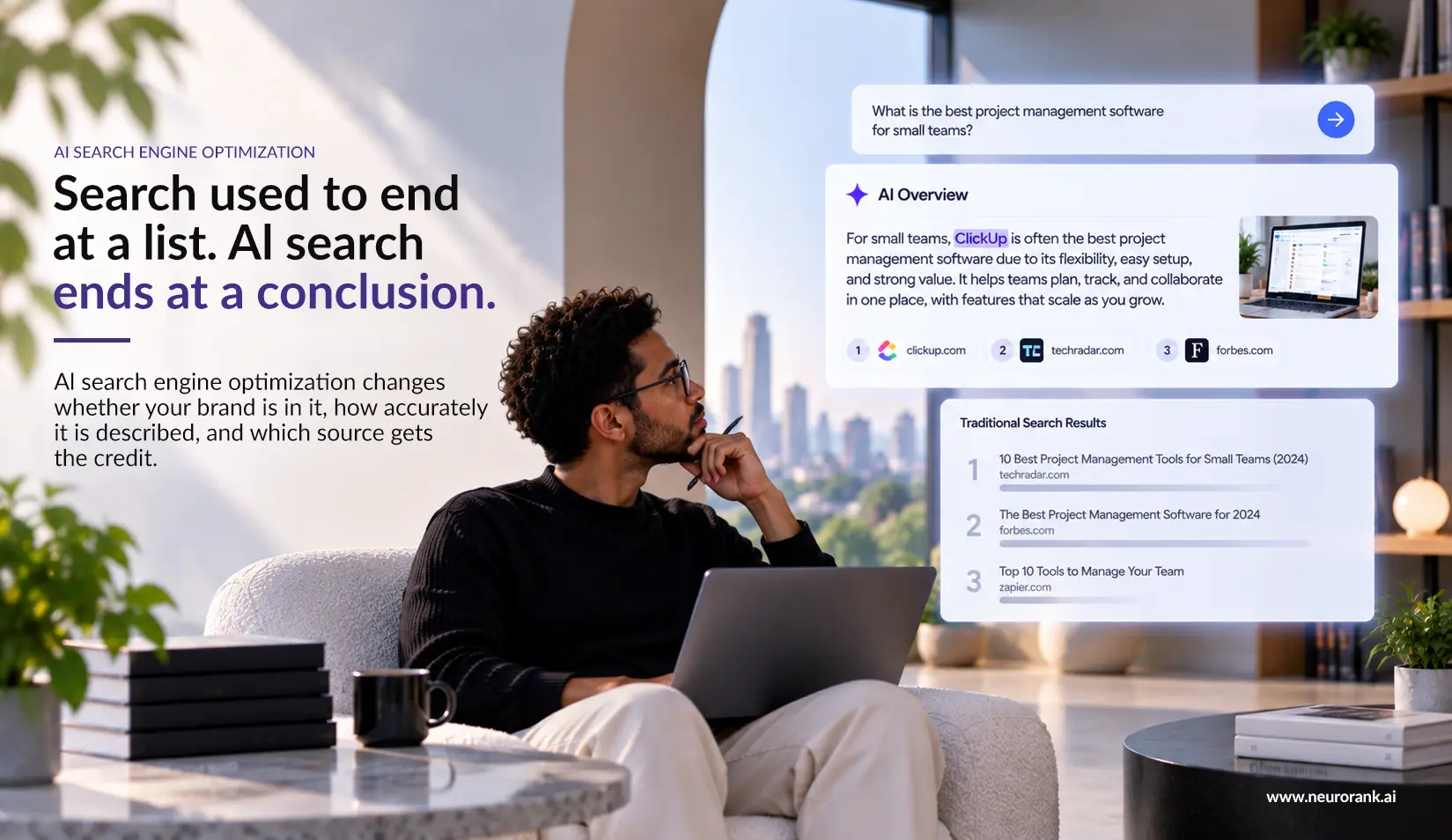
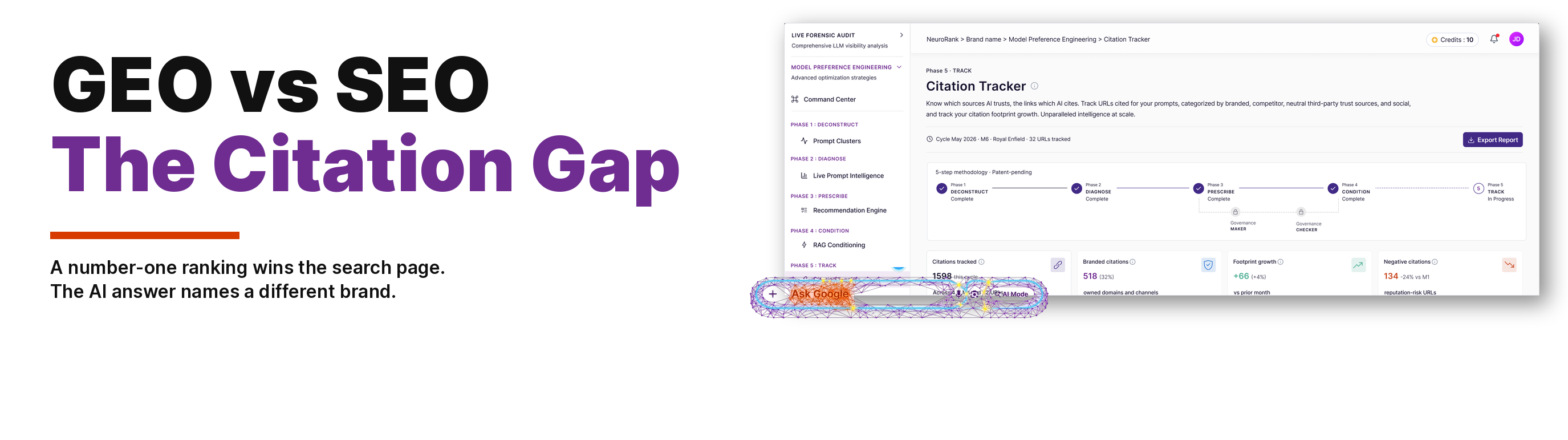
The GEO vs SEO difference is the target. SEO, search engine optimization, improves where a page ranks on a results page. GEO, generative engine optimization, improves whether a brand is named inside an AI-generated answer. The two share infrastructure and answer different questions, and strong SEO does not guarantee strong AI visibility. A page can rank first on Google while all four models leave it out.
A first-place search result does not guarantee a citation in a generated answer. Ahrefs’ August 2025 citation-overlap study illustrates that difference in its sampled assistants and prompts. Google’s AI Search features still build on core Search systems, so the overlap must be evaluated by feature rather than described as a universal split.
Domain Authority is a third-party metric, not the system on which SEO runs. Entity clarity means that readers and systems can distinguish the organization, its products, and its relationships. Use accurate names, identifiers, official facts, and appropriate independent support. Neither a link score nor an informal entity-authority label reveals an AI provider’s internal decision.
Some work serves both. Schema, canonical URLs, crawlable HTML, and consistent entity references are shared plumbing, so a strong SEO team starts with an advantage. The target does not carry over. SEO wins a ranked position; GEO wins a named mention, and a brand can appear in an AI answer with no citation link at all.
Keyword repetition and unclear prose can reduce usefulness for readers. Publish the facts and explanations the question needs, supported by appropriate evidence. Do not infer a universal AI penalty or a fixed citation advantage from keyword density alone.
The right posture is to keep SEO and add GEO as its own discipline. Keep the shared plumbing strong. Next, measure how the four models represent the brand, diagnose why it is absent where it is absent, and condition the third-party sources the models read. That second job is the one NeuroRank exists for. Its five-step method, Deconstruct, Diagnose, Prescribe, Condition, Track, starts with a baseline reading of where the brand stands across ChatGPT, Gemini, Claude, and Perplexity before any GEO work begins.
Read How to get cited in AI search. Read AI visibility: how AI decides which brands to name. Read AI visibility platform vs SEO suite. Read the guide to LLM SEO. |
Stop paying for clicks that do not convert. Benchmark your AI visibility today with the world's most advanced seo ai tools.
Book a Strategic NeuroRank BriefingVerify the disputed claim and the cited passage first. Keep the page’s useful search targeting while correcting the specific factual or contextual issue. Record search and AI observations separately, then review the same question after implementation so a source correction is distinguishable from a broader ranking change.
Use one authoritative page when both versions would answer the same user need. Improve its evidence, clarity, and technical accessibility, and link distinct supporting questions where useful. Separate pages need distinct purposes; duplicating the same argument under an AI-focused title can create unnecessary maintenance and competing signals.
Check whether the page supports the exact question and claim before drawing a conclusion. Organic keyword reports and observed citations describe different events. A useful cited passage may serve a narrower task than the tracked keyword set, so retain the page-level evidence and investigate its actual audience value.