NeuroRank
Report

NeuroRank Research · The AI Visibility Index · 2026 Edition

The AI Visibility Index

Winning AI search recommendations in 2026.

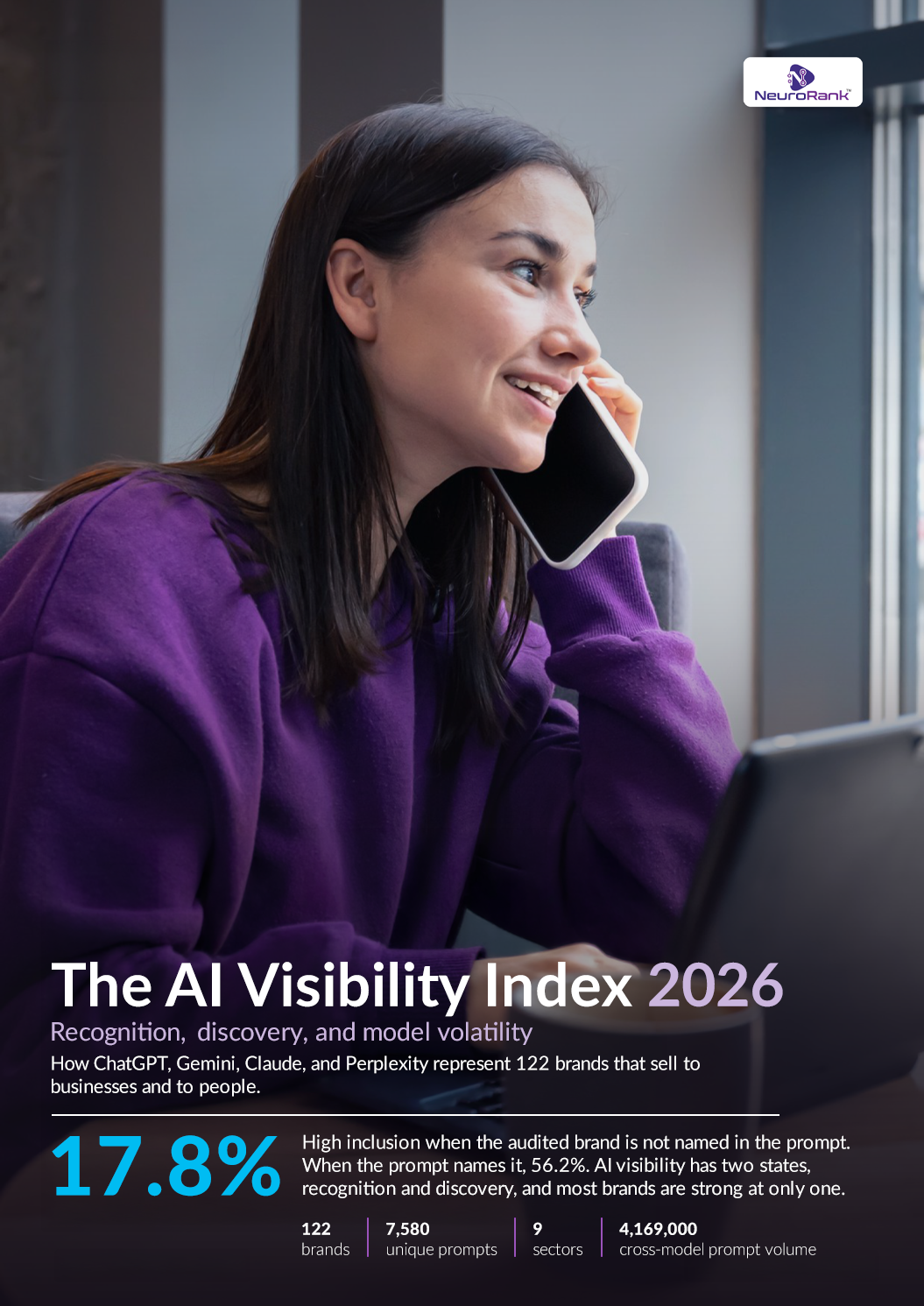
A study of 122 brands across ChatGPT, Gemini, Claude, and Perplexity: how often each model includes a brand when the prompt names it, and how often when it does not. The AI Visibility Index for 2026, and the AI search statistics behind it.

September 22, 2026

Ambika Sharma

Ambika Sharma

Founder and Product Architect, NeuroRank.
Access the report

Complete the form to view the full report.

Country *

Ask an AI model about a brand by name and it will usually include it. Ask for the best options in a category without naming anyone, and inclusion falls sharply. Across 122 brands, High inclusion is 56.2 percent when the prompt names the brand and 17.8 percent when it does not. The full statistics, by sector and by model, are on the AI search statistics 2026 research page.

What the Study Found

17.8%

High inclusion when the prompt does not name the brand

56.2%

High inclusion when the prompt names the brand

4,169,000

Cross-model prompt volume across ChatGPT, Gemini, Claude, and Perplexity Inside the Report

Inside the Report

What is inside the report

  • The two states of AI visibility. High inclusion is 56.2 percent when the prompt names the brand and 17.8 percent when it does not. The two come from separate prompt pools, so the report treats them as two states, not one blended score.

  • 51 of 82 are strong when named. Three are when they are not. Brand by brand, 51 of the 82 brands measured in both states reach 50 percent High inclusion when named, and 3 do when not.

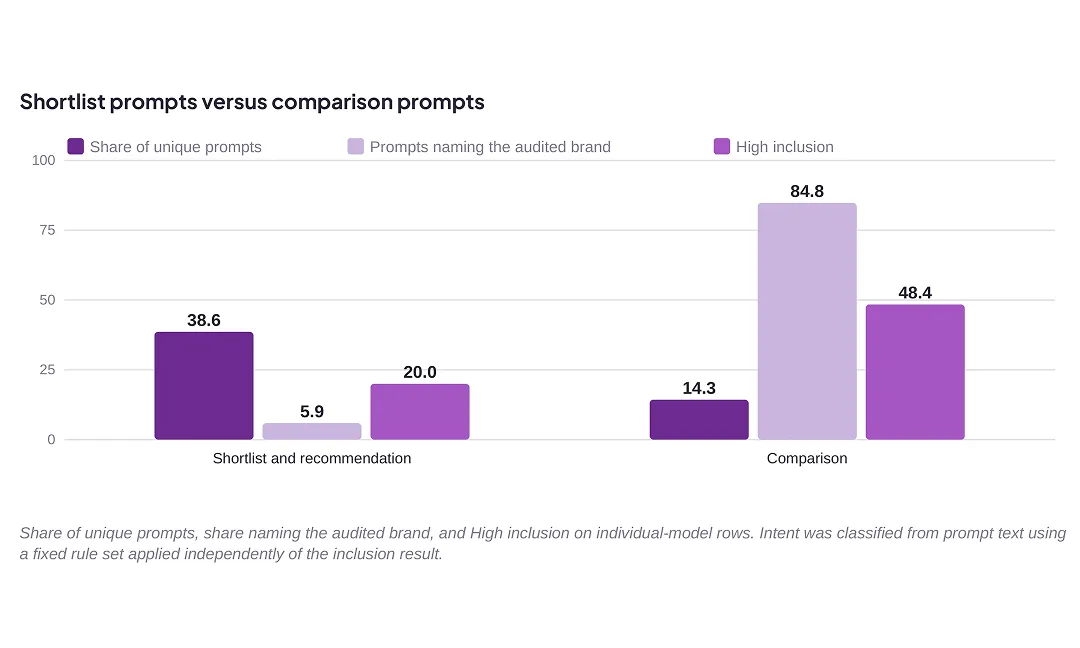
  • Shortlist construction is the largest low-performing intent. Shortlist and recommendation prompts are 38.6 percent of unique prompts and record 20.0 percent High inclusion. Comparison prompts reach 48.4 percent, and most already name the brand.

  • The commercial gap is mostly a brand-cue difference. Commercial prompts look weaker overall, but on prompts that name no brand the two classes sit at 17.4 and 18.8 percent.

  • No sector reaches 30 percent when the prompt names no brand. All nine sectors show the same split, from 27.4 percent at the top to 10.2 percent at the bottom.

  • The four models disagree. Among the 63 brands measured on all four models, the median gap between a brand's best and worst model is 33.3 points.

  • Recognized but undiscovered. A map of discovery against model consistency that sorts brands into four groups for further investigation.

  • Readiness is associated with inclusion. Content readiness and High inclusion are positively associated at about r = 0.37, an association in this sample and not a tested effect.

  • A scoped source and error sample. In four financial services audits, 64.6 percent of 96 logged citations were third-party sources, and 61 error notes clustered on decision facts such as fees and rates.

  • Five research implications. How to measure and read AI visibility, stated as practice and as hypotheses to test, not as promised outcomes.

A look at the Pages

The AI Visibility Index — slide 1

Audience

Who should read this report

Written for the people accountable for how the brand is represented when a customer asks an assistant.

Brand and marketing leaders

See how four AI models include brands when a prompt names them and when it does not, sector by sector.

SEO, content and GEO teams

See where High inclusion is weakest by prompt class, and how content readiness is associated with inclusion.

PR and communications

See the scoped citation sample, where third-party sources made up 64.6 percent of logged citations in four financial services audits.

Digital and growth

See how often brands appear when the prompt names no brand: 17.8 percent across the study.

Compliance and risk

See which kinds of decision facts the captured answers got wrong in a four-audit financial services sample, from fees and rates to availability.

Founders and executives

One figure for where your category stands on discovery, across nine sectors.

Methodology

How this was measured

Sample

122 brands across nine sectors and 7,580 unique prompts. Per-model figures use the 83 brands with per-model data; the other 39 have combined results only.

Method

Each brand was audited across clusters of ten prompts, with 5,500 fresh-token prompt runs per prompt cluster, per country, between March and May 2026. Cross-model prompt volume: 4,169,000 prompt runs across ChatGPT, Gemini, Claude, and Perplexity.

Scoring

Each prompt and model received one High, Medium, or Low inclusion rating. Clear and Strong map to High; Sparse, Weak, Absent, and Minimal map to Low; Medium remains Medium. Where a response failed the brand, the applicable ORHL conditions were recorded: Omitted, Replaced, Hallucinated, or Zero Leads.

Limitations

Brand-named and brand-not-named prompts are separate prompt pools, so comparisons between them are state comparisons. The models were not tested on identical prompt panels, so cross-model differences are directional. Correlations are observed associations, not causes. The study measures how AI models represented brands; it does not measure sales, pipeline, traffic, conversion, or customer trust. Brands are reported in aggregate, not as a league table.

The AI Visibility Index methodology
FAQs

Questions about this report

Method, scope and how to use the findings.

1. Which brands were included in the AI Visibility Index 2026?

-

NeuroRank’s AI Visibility Index 2026 analyzed 122 anonymized brands across nine sectors. The per-model panels cover 83 brands, while 39 brands have combined results only. The public research presents aggregate findings, so its cross-model comparisons should retain the relevant sample sizes and prompt mix. It is a benchmark of the study cohort, not a current scorecard for a brand outside it.

2. What does the AI Visibility Index measure?

+

NeuroRank’s AI Visibility Index 2026 compares High inclusion when a prompt names the audited brand with High inclusion when it does not. It sampled ChatGPT, Gemini, Claude, and Perplexity from March to May 2026. The report describes that research sample, not a live rating of every company.

3. What is the difference between recognition and discovery?

+

NeuroRank’s AI Visibility Index 2026 reported 56.2 percent High inclusion on brand-named prompts and 17.8 percent on prompts that did not name the brand. They came from separate prompt pools. The 38.4 percentage-point difference compares measured states, not a causal effect. Source: https://neurorank.ai/resources/research/ai-visibility-index

4. Does high inclusion on brand-named prompts predict unbranded discovery?

+

No. In NeuroRank’s AI Visibility Index 2026, 51 of 82 brands assessed in both prompt states reached at least 50 percent High inclusion when named; three did so when unnamed. These historical bands are separate from the current Brand Inclusion Score and do not describe an untested brand. Source: https://neurorank.ai/resources/research/ai-visibility-index

5. Which prompts are hardest for brands?

+

NeuroRank’s AI Visibility Index 2026 found that shortlist and recommendation questions made up 38.6 percent of its 7,580 unique prompts. Only 5.9 percent of those prompts named the audited brand, and High inclusion in that class was 20.0 percent. These are sample findings, not a conversion rate. Source: https://neurorank.ai/resources/research/ai-visibility-index

6. How was the study measured?

+

NeuroRank’s AI Visibility Index 2026 covered 122 brands and 7,580 unique prompts in 758 clusters from March to May 2026. Its method specifies 5,500 fresh-token runs per cluster, per country, totaling 4,169,000 runs. The report assigns High, Medium, or Low inclusion ratings to evaluated observations; the four models did not use identical prompt panels.

7. Why did the study use fresh-token sessions?

+

NeuroRank’s AI Visibility Index 2026 used fresh authentication tokens and new context-isolated sessions so prior conversation history did not carry into independent runs. This reduces one source of contamination, but the study does not reproduce every personalized buyer session.

8. Which AI models were included in the research?

+

NeuroRank’s AI Visibility Index 2026 examined ChatGPT, Gemini, Claude, and Perplexity. Its Combined Synthesis is an aggregate view of the four, not a fifth model.

9. Why does reading all four models matter?

+

Among 63 brands with four-model data in NeuroRank’s AI Visibility Index 2026, the median gap between a brand’s best and worst model was 33.3 percentage points; 41 of 63 had a gap of at least 30 points. The models did not use identical prompt panels, so the comparison is directional.

10. Do the findings favor any one AI?

+

NeuroRank’s AI Visibility Index 2026 did not rank the four platforms. Their prompt panels were not identical. The report describes variation among brands measured on all four models, with that limitation attached to cross-model comparisons.

11. How is a brand’s AI visibility scored?

+

NeuroRank’s AI Visibility Index 2026 classified evaluated inclusion observations into historical High, Medium, and Low bands. ORHL separately recorded Omitted and Replaced states and Hallucinated and Zero Leads flags where applicable. These research bands are not rating bands for the current Brand Inclusion Score.

12. Can sector findings diagnose my own brand?

+

No. NeuroRank’s AI Visibility Index 2026 reports aggregate findings for nine sectors. A brand diagnosis needs a current prompt set, known platform and country scope, raw responses, and verified company facts. The historical sector pattern is a hypothesis to test against the brand’s own evidence, not its present score.

13. How current are these figures?

+

NeuroRank’s AI Visibility Index 2026 reflects audits conducted from March to May 2026 and was published in September 2026. Its figures are historical observations, not a current rate for every sector or platform. Check the report’s publication and methodology dates before comparing them with later runs.

14. How should a team use the index responsibly?

+

Use NeuroRank’s AI Visibility Index 2026 to choose questions for a fresh, brand-specific baseline. Record prompt wording, platforms, countries, dates, and citations. Keep the study’s separate brand-named and unbranded prompt pools distinct, and do not treat its High, Medium, or Low research bands as current Brand Inclusion Score ratings. Source: https://neurorank.ai/resources/research/ai-visibility-index

Analyze the Damage.
Establish Governance.