BlogSeptember 15, 2026
Answer engine optimization

Ambika SharmaFounder at Pulp Strategy Communications and NeuroRank.

Ambika Sharma
Ambika Sharma is the Founder & Chief Strategist of Pulp Strategy, a multi-award-winning business transformation and digital agency, and Prod... Read more
Subscribe for Newsletters
Updated September 2026.Ambika Sharma, Founder, Chief Strategist at Pulp Strategy Communications and Product Architect of NeuroRank.
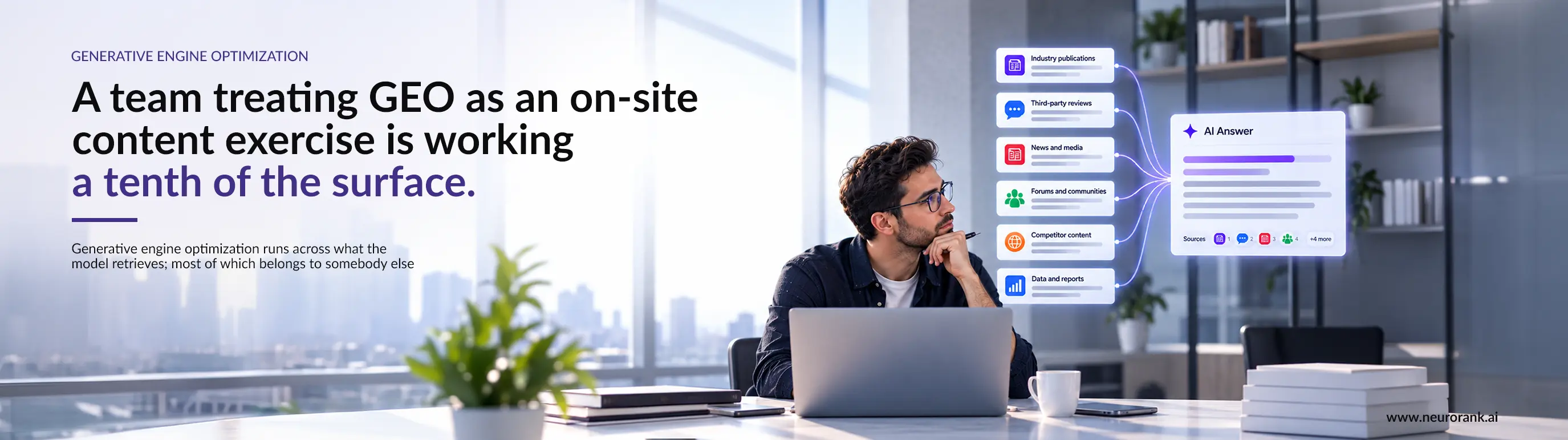
Roughly 5 to 10 percent of the sources an AI search answer references belong to the brand being discussed, according to McKinsey in October 2025. Every other source in that answer belongs to somebody else's page. Generative engine optimization is the discipline of influencing what a generative model says about a brand, working on what it retrieves, how accurately it describes the brand, and which sources it credits. A team treating that as an on-site content exercise is working a tenth of the surface. NeuroRank runs it as a measured cycle across ChatGPT, Gemini, Claude, and Perplexity.
| Patent-pending · ISO/IEC 27001 · 4 LLMs + Combined synthesis · Fresh-token methodology · 5,500+ prompt runs per cluster |
Generative engine optimization is the practice of influencing how generative AI models represent a brand in the answers they produce. It works on what a model retrieves at the moment of a query and on the context shaping that response. This page covers the discipline; the sector guides cover how it behaves in a specific industry. Inclusion, accuracy, and citation are the three measures that matter.
The successor framing is wrong. GEO optimization runs closer to a parallel discipline than a replacement for search engine optimization, and the full side-by-side sits in the GEO versus SEO comparison. Both reward a well-structured site, clean markup, and credible third-party coverage from publishers the engines already read. They are judged on different outcomes, and a team reporting one as a proxy for the other will misread its own performance for a year.
Search rewards position in a list. Generative engines reward being the source a model reaches for while it composes.
Generative engine optimization influences what a generative model retrieves, how it describes a brand, and which source it credits. It shares inputs with search optimization and diverges on outcomes, because one is judged on a document's position and the other on a passage appearing inside a composed answer.
From three inputs at once. Training supplies what the model already believes, and it moves on the provider's schedule. Retrieval supplies what the model finds at the moment of the query. Context supplies what the phrasing tells it to prioritize. Generative engine optimization operates on the second and the third.
Corroboration carries disproportionate weight inside retrieval. A claim a brand makes about itself, appearing only on its own domain, is one unsupported source. The same claim on the brand's site and on two independent surfaces the model already trusts in that category reads as a pattern, and these systems are built to prefer patterns.
Owned media stalls here, every time.
The same split explains the variance. A category question and a brand question reach different sources inside the model, so they return different verdicts about the same company.
A generative model composes from training, live retrieval, and query context together. Training sits outside any marketing cycle. Retrieval and context are workable, and what other credible sites say about a brand counts for more there than what the brand says about itself.
Five, gated in order, repeating monthly. Deconstruct maps the prompts a buyer actually asks and clusters them by intent. Diagnose runs them at scale and classifies every gap. Prescribe converts each gap into a named change on a named URL. Condition works the retrieval layer across owned, earned, and third-party surfaces. Track re-runs the clusters and measures the movement.
Each phase depends on the output of the one before it, which is why a cycle cannot start at Prescribe. Prescribing against an undiagnosed cluster produces advice with nothing behind it. Conditioning against an unprescribed gap changes signals with no way to test whether the change worked.
Gating is what makes the cycle auditable.
Content readiness decides it, not model choice. Of 4,024 content areas assessed across 122 brands, 10 percent rated adequate. The rest were weak, missing, or absent, which is the material the retrieval layer has to work with.
The association holds when the data is split. Brands in the top third by content adequacy average 40 percent High inclusion against 23 percent for the bottom third (n=83 full audits, Pearson r=0.37). That is an association and not proof, and it is consistent enough to plan against.
Four content types are missing almost everywhere. Video is weak or absent for 100 percent of brands, schema for 99 percent, social proof for 90 percent, and owned articles for 89 percent (n=122 brands). The same four, across every sector measured.
Results vary by brand, category, and starting baseline.
Of 4,024 content areas across 122 brands, 10 percent rated adequate. Brands in the top third by content adequacy average 40 percent High inclusion against 23 percent in the bottom third. Video, schema, social proof, and owned articles are weak or missing for nearly every brand measured.
Source. NeuroRank AI visibility research, "Main door to online discovery: winning AI search recommendations in the agentic age". 122 brands, 8,647 end-result prompt ratings, audits run March to May 2026.
A formula, a source, and a step that changes the answer. Most GEO optimization tools report and stop, leaving the buyer holding the diagnosis. A geo platform worth the name closes that loop.
RAG Conditioning is that step. It works owned content, earned coverage, and third-party sources at cluster level until the models change how they describe the brand, refreshed monthly and on demand. The mechanism behind it has its own guide.
The Brand Inclusion Tracker reads the movement, per cluster and per model, against the first-cycle baseline. Keyword Intelligence sits alongside it, checking each prompt against Google search volume by intent and region, so the clusters being measured are the ones that matter commercially.
RAG Conditioning. Cluster-level conditioning across owned, earned, and third-party sources, with one new cluster added each month and every earlier cluster re-run.
Brand Inclusion Tracker. Brand Inclusion Score against each competitor, model by model, month on month, for the selected market.
A generative engine optimization tool has to close the loop between finding and fixing. RAG Conditioning works owned, earned, and third-party sources until the models recalibrate, and the Brand Inclusion Tracker reads the movement per cluster and per model against a baseline.
Cluster coverage accumulates. One new cluster joins each month while every prior cluster keeps running, so the dataset gets richer as it ages and a trend line becomes readable instead of a series of disconnected snapshots.
Deconstruct, Diagnose, Prescribe, Condition, and Track run in fixed order every cycle, each phase gated on the one before it. Clusters accumulate month on month, so month twelve re-runs all twelve and the comparison stays like-for-like as coverage grows.
Against a first-cycle baseline, per model and per prompt cluster, with every formula visible. The headline figure is the Brand Inclusion Score: prompt responses naming the brand entity, divided by total responses executed, computed per prompt, per cluster, per model, and in aggregate.
A score nobody outside the vendor can recompute cannot be audited, and it cannot be defended when a finance director asks how the number was calculated. That question is where most AI visibility reporting fails.
The citation footprint sits alongside it, recording the URLs each engine cites for the brand's prompts and splitting them into branded, competitor, neutral third-party, and social. Competitive position per cluster and per-model trend lines complete the read, and contradictions between engines stay visible instead of averaging out.
Reporting stays regional by default across Asia, Europe, the Middle East, the USA, and North America, because a strong position in one and an absence in another average into a healthy-looking number and a lost quarter.
GEO optimization is measured against a first-cycle baseline, per model and per prompt cluster. The Brand Inclusion Score is the share of prompt responses naming the brand entity, and every headline metric publishes its formula so a result can be audited instead of asserted.
A formula, a source list, and an approval trail. Most platforms in this category return a composite score and a mention count, which describes a symptom and leaves the diagnosis to the buyer. GEO optimization tools that stop at observation cannot tell a team which page to change on Monday.
Three tests separate them. Does the score show its calculation, does a finding name the URL that caused it, and can a completed fix be traced to the person who approved it and the criteria they used.
A generative engine optimization tool is worth buying when its score publishes a formula, its findings name the source URL behind each gap, and its completed fixes carry an approver and a documented check. Observation without those three leaves the diagnosis with the buyer.
Truth is not negotiable here. Correction works by giving the retrieval layer an accurate, well-sourced alternative, one that is easier to find and easier to trust than whatever is circulating now. Corroboration is the mechanism, and instruction is not available to anyone.
Dates sit outside anyone's control, because OpenAI, Google, Anthropic, and Perplexity retrain and re-rank on schedules none of them publish.
Implementation stays with the client team or its agency. A gain is also temporary, because a model recalibrating this cycle can drift after the next retraining pass, or when a competitor earns the same corroboration, which is why the practice runs monthly and cumulatively instead of ending.
Generative engine optimization works through corroboration. It cannot instruct a model, guarantee a position or a date, substitute for implementation, or hold a gain permanently, because the engines retrain on their own schedules and competitors keep working the same surfaces.
With a baseline. NeuroRank is an AI visibility intelligence platform, and the Live Forensic Audit runs Deconstruct and Diagnose once, returns a 10-section intelligence report in 12 to 20 minutes, and seeds the baseline every later cycle reads against. The first Model Preference Engineering cycle requires it for exactly that reason.
Model Preference Engineering scales from one model and one prompt cluster to all four engines plus Combined synthesis on one cluster. The object is to command how AI perceives, interprets, and recommends your brand, measured against the first cycle. The method has been stress-tested across 350+ brands in 65 industries. Enterprise is scoped per brand and per region. Configurations sit on the pricing page.
Start GEO growth with NeuroRank
Stop paying for clicks that do not convert. Benchmark your AI visibility today with the world's most advanced seo ai tools.
Book a Strategic NeuroRank Briefing