BlogSeptember 15, 2026
Generative engine optimization

Ambika SharmaFounder at Pulp Strategy Communications and NeuroRank.


Ambika Sharma
Ambika Sharma is the Founder & Chief Strategist of Pulp Strategy, a multi-award-winning business transformation and digital agency, and Prod... Read more
Subscribe for Newsletters
Updated September 2026. Ambika Sharma, Founder, Chief Strategist at Pulp Strategy Communications and Product Architect of NeuroRank.
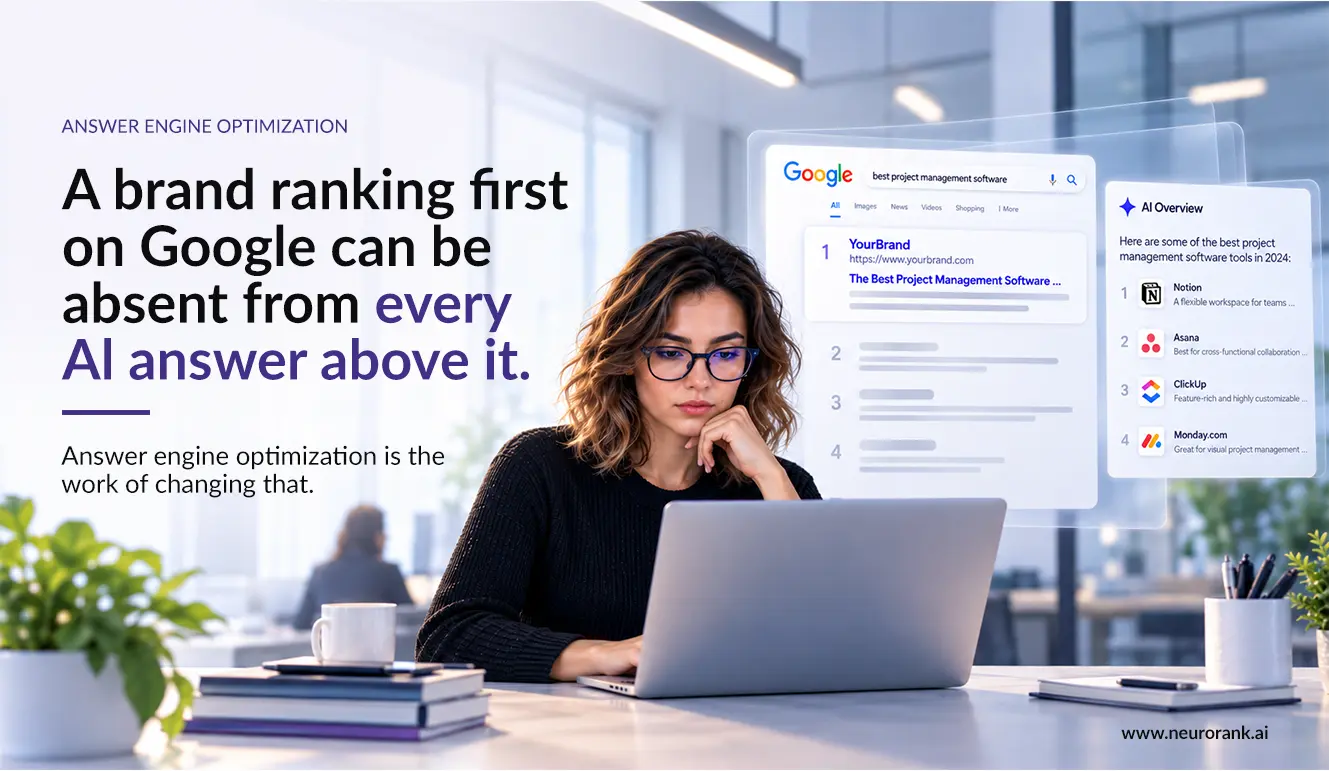
Sixteen percent of brands systematically track how they perform in AI search, McKinsey found in September 2025. The other eighty-four percent are being described by ChatGPT, Gemini, Claude, and Perplexity every day and reading none of it. LLM SEO is the work of getting a brand into the answer a model writes, and most teams are still buying it as an extension of search. That is the mistake. Ranking is position and inclusion is retrieval, so a program built on the first will not move the second. The gap shows up as a first-position page that never appears in the answer above it, and the buyer who reads that answer never reaches the result the team worked for.
| Patent-pending · ISO/IEC 27001 · 4 LLMs + Combined synthesis · Fresh-token methodology · 5,500+ prompt runs per cluster |
Why a first-position page is missing from the answer
Google position one. ChatGPT, asked the same question, never retrieves the page. The model assembles its answer from a different set of sources and weighs them on different criteria, and the retrieval step never consults the rankings.
Search engines rank documents against a query. Language models retrieve passages, weigh how credible each looks, and compose. Those are two mechanisms, not two views of one mechanism.
The failure is partial. That is why it survives quarterly reviews: most brands hold position under a branded question and disappear under the category question. A team measuring only the first reports health while losing the second.
Ranking is judged on a document's position against a query. Inclusion is judged on whether a model retrieves, trusts, and quotes a passage while composing an answer. The retrieval step does not read the rankings, which is why first position and total absence sit together more often than teams expect.
How a model chooses what to include
Three inputs decide it. Training supplies what ChatGPT or Gemini already believes, and it moves on the provider's schedule. Retrieval supplies what the model finds at the moment of the query, and context supplies what the phrasing tells it to prioritize. LLM SEO works the second and the third.
Corroboration is where the weight sits. A claim a brand makes about itself, on its own domain only, is one unsupported source. Carry the same claim on two independent publishers the model already reads and it becomes a pattern. Perplexity and Claude prefer patterns by design.
I have watched teams spend a year on owned content and move nothing.
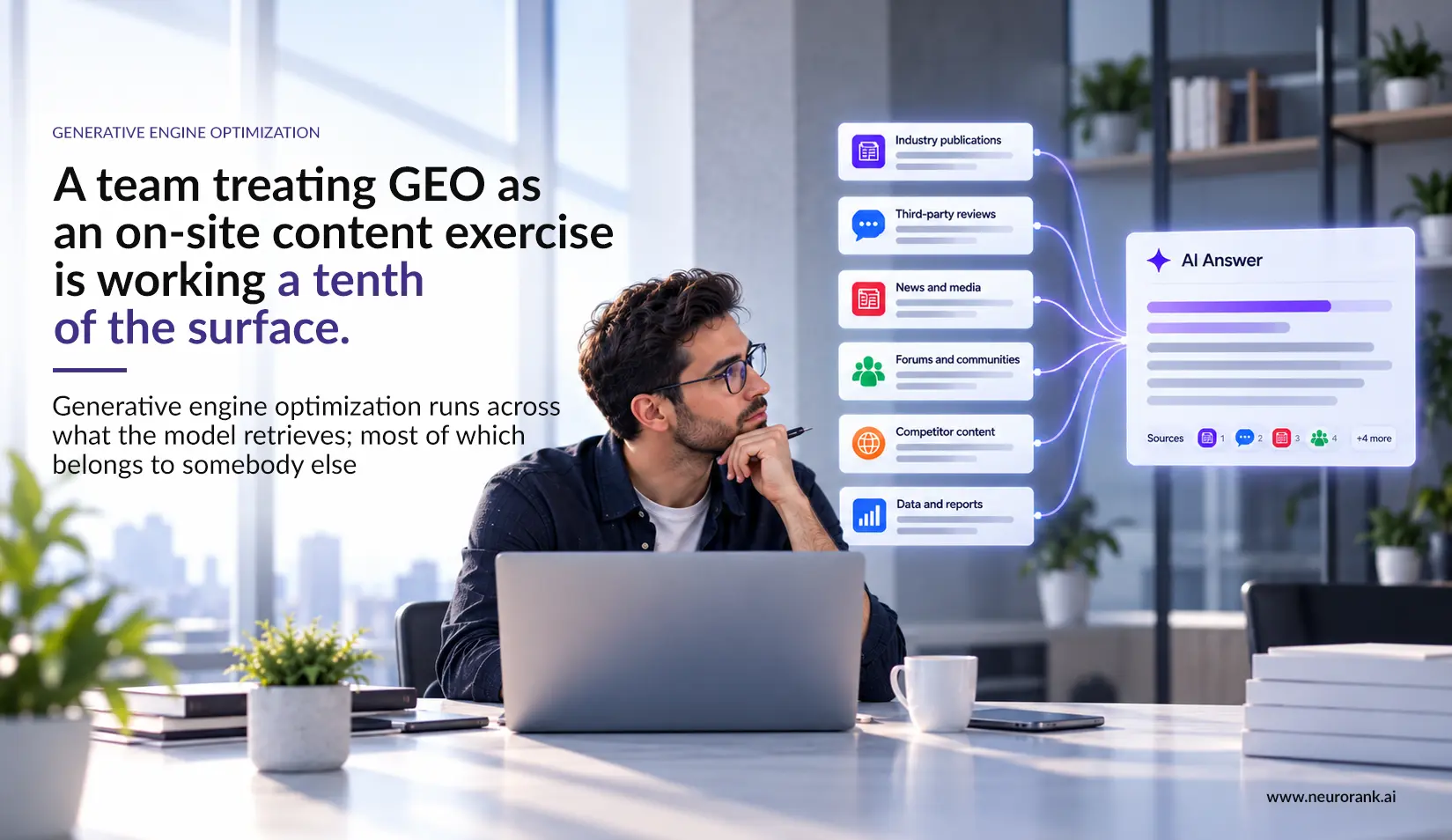
The reason is structural. Most of what Gemini cites answering a category question belongs to somebody else, and work on owned pages does not change what those other sources say.
A model composes from training, live retrieval, and query context together. Training sits outside a marketing cycle, and retrieval and context are workable. Inside retrieval, independent corroboration outweighs anything a brand publishes about itself on its own domain, which is why owned-only programs stall.
SEO for LLMs: what carries over from search
The prior art is not wrong. Seo for llms starts from the same technical floor as search, because crawlability, clean markup, fast rendering, and credible inbound coverage all help retrieval. A page Googlebot cannot parse is a page Claude cannot quote.
Technical SEO is necessary here. It is not sufficient, and that distinction is the whole argument.
One thing does not carry over. Rank tracking has no equivalent for a passage inside a composed answer, and keyword position cannot describe a brand that is present, named, and described wrongly. That needs a different taxonomy and a different sampling method.
Crawlability, markup, rendering, and inbound coverage carry over from search and remain necessary. What does not carry over is the unit of measurement, because keyword position cannot describe a brand that appears inside an answer and is described inaccurately.
How to structure a page a model can retrieve
Structure is cheap to fix and commonly wrong. All four engines parse content that states a claim plainly, attributes it, and keeps related facts near each other. A page answering its question in the first two sentences beats one arriving in paragraph nine.
The test is whether a block stands alone. Read any section without its heading and without the section above it. If the answer is still complete, a model can quote it in isolation.
Lead every block with the answer, then explain. No setup paragraph ahead of the point.
Keep each section to a length a model can lift whole, roughly 120 to 180 words.
Put numbers, dates, and named entities in text, never only inside an image or a chart.
Attribute every external claim to a named source with a date.
Use small tables and short lists for comparable facts, because they quote cleanly.
Write headings as the question a buyer would type, never as a clever label.
Models retrieve blocks, not pages. A block that answers its own heading in the first sentence, carries its facts in text, attributes its claims, and makes sense without the paragraph above it can be quoted alone. A block depending on its context gets skipped for one that does not.
How to measure LLM SEO honestly
One check on one prompt measures nothing. Gemini answers near-identical questions differently, and it answers repeat runs of one identical question differently. A single reading is one draw from a variable distribution.
How far the four models disagree
Further than most teams assume. Across 83 full audits, the average gap between a brand’s best and worst performing model was 33 points, and 57 percent of brands swung 30 points or more.
The engines have distinct temperaments, and the numbers are stable enough to name them. Perplexity returns High inclusion on 40 percent of prompts (n=1,920). Claude follows at 33 percent (n=1,458). ChatGPT sits at 28 percent but hedges to Medium on 48 percent (n=1,648). Gemini is the hardest of the four, returning Low on 52 percent (n=2,151).
Combined synthesis reads differently again. Taking all four together returns High on 57 percent of prompts and Low on 11 percent (n=1,470), which makes it 1.8 times more likely to return a High inclusion than any single model (n=8,413).
A team measuring one model is reading one temperament. Results vary by brand, category, and starting baseline.
Across 83 full audits the average gap between a brand’s best and worst model was 33 points, and 57 percent of brands swung 30 or more. Perplexity returns High on 40 percent of prompts, Gemini returns Low on 52 percent, and a combined view is 1.8 times more likely to return High than any single model.
Source. NeuroRank AI visibility research, "Main door to online discovery: winning AI search recommendations in the agentic age". 122 brands, 8,647 end-result prompt ratings, audits run March to May 2026.
Measurement needs cluster scale and cold sessions. NeuroRank runs 5,500+ fresh-token prompt runs per prompt cluster, per region, classifies every gap as Omitted, Replaced, Hallucinated, or Zero Leads, and catalogues every cited source by URL.
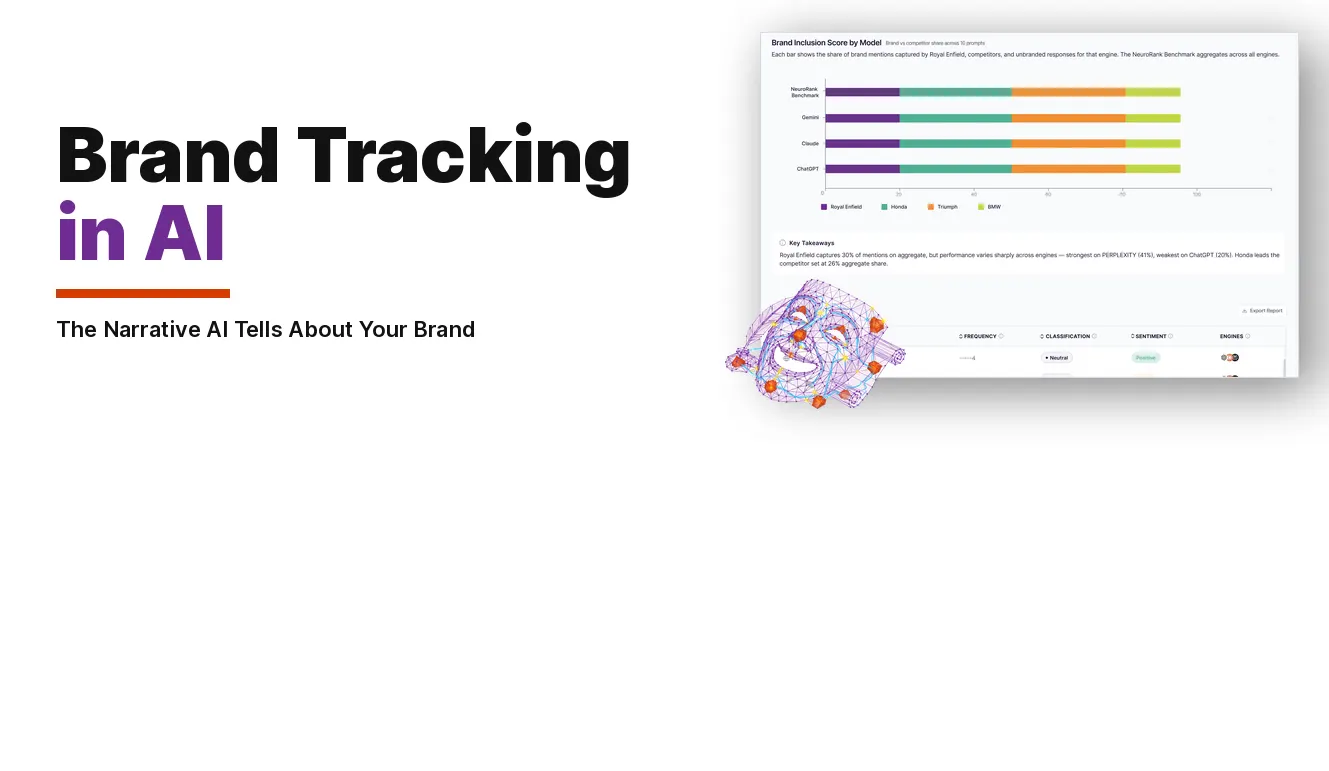
The phrase LLM SEO ranking misleads. What NeuroRank measures is the Brand Inclusion Score: prompt responses naming the brand entity, divided by total responses executed, computed per prompt, per cluster, per model, and in aggregate. The formula is published, so the figure can be recomputed.
Measurement needs cluster scale, cold sessions, and per-engine reporting, because a single prompt checked once from a logged-in account inflates the reading. The Brand Inclusion Score publishes its formula, which is the difference between a number a board can interrogate and a vendor score it has to accept.
What the measurement looks like in practice
Prompt Clusters holds the questions. Each carries a hero prompt with sub-prompts beneath it, grouped across Brand, Product, Category, and Purchase-Intent, and built from real buyer language checked against regional search volume.
Both recall types are tested, the way brand research has always done it. Aided prompts name the brand and check whether the answer is accurate and complete. Unaided prompts describe the need with no brand named, and record whether the brand surfaces on its own. The second is where a shortlist is decided.
Command Center reads one market at a time, never a global average, with inclusion, citations, and governance health in a single view.
Prompt Clusters. Real buyer questions grouped by intent, with sub-prompts under each hero prompt, generated from Keyword Intelligence.
Command Center. One country at a time. Brand Inclusion Score, recommendations, and citations tracked month on month for the selected market.
Prompt Clusters holds the questions, built from real buyer language and checked against regional search volume. Aided prompts test accuracy and unaided prompts test whether the brand surfaces unprompted, which is where a shortlist is decided.
What an LLM SEO tool needs to do
It has to survive a follow-up question. An llm seo tool that reports a brand was mentioned eleven times invites the obvious reply, which is where, by which engine, and what should change. A platform that cannot answer those three has produced a statistic.
Three tests separate them. Does the score publish its calculation, does each finding name the source URL behind it, and can a completed fix be traced to the check it was verified against.
An LLM SEO tool earns its place when the score publishes a formula, each finding names the source URL behind it, and every completed fix carries the check it was verified against. A mention count describes a symptom and leaves the diagnosis with the buyer.
What to change first, in order
Correct inaccuracy before pursuing inclusion. A wrong fact circulating across all four engines costs more than an absence does. It compounds too, because each engine repeating it becomes corroboration for the next.
Then restructure the sources those engines already retrieve, since retrieval is happening and only comprehension is failing. Then fix entity signals, so the brand resolves cleanly against similarly named companies. Then earn corroboration on the third-party surfaces the engines trust.
Then re-measure against the baseline and read the direction.
The order matters more than the list. Earn corroboration before the accuracy work is finished and the error amplifies into more sources. That is the one sequencing mistake that makes the problem harder.
Correct inaccuracy first, because a wrong fact compounds as engines corroborate each other. Then restructure what is already retrieved, fix entity signals, earn third-party corroboration, and re-measure against the baseline. Reversing the first and fourth steps amplifies the error instead of the brand.
The limit worth stating
A gain here is not permanent. Anybody selling it as permanent is selling something else, because a model recalibrating this cycle can drift after the next retraining pass, or when a competitor earns the same corroboration. NeuroRank is an AI visibility intelligence platform built for that repetition, and the method has been stress-tested across 350+ brands in 65 industries, in Asia, Europe, the Middle East, the USA, and North America.
OpenAI, Google, Anthropic, and Perplexity keep their retraining schedules private. A measured practice returns a direction and a rate of change against a baseline, plus a monthly cadence that holds the gain.
Governing that needs a two-tier review with an auditable trail from recommendation to verified execution. NeuroRank implements it as Maker-Checker governance, where one person ships and a second approves against a documented check. That trail is what lets a team command how AI perceives, interprets, and recommends the brand, instead of hoping the answer improves.
So the question is not whether AI search matters. Can anyone in the building say what the four engines told buyers this week, and on whose authority the last correction was made?
Next steps
Start with one category cluster. Model Preference Engineering runs the full five-step cycle monthly, opening on a Live Forensic Audit that classifies every gap and names the sources each engine cited. Five inputs begin it: brand name, legal company name, website URL, YouTube URL where one exists, and target region.
Start GEO growth with NeuroRank
Stop paying for clicks that do not convert. Benchmark your AI visibility today with the world's most advanced seo ai tools.
Book a Strategic NeuroRank Briefing