
BlogSeptember 16, 2026
AI citation tracking

Ambika SharmaFounder at Pulp Strategy Communications and NeuroRank.
Ambika Sharma
Ambika Sharma is the Founder & Chief Strategist of Pulp Strategy, a multi-award-winning business transformation and digital agency, and Prod... Read more
Subscribe for Newsletters
Updated September 2026.Ambika Sharma, Founder, Chief Strategist at Pulp Strategy Communications and Product Architect of NeuroRank.
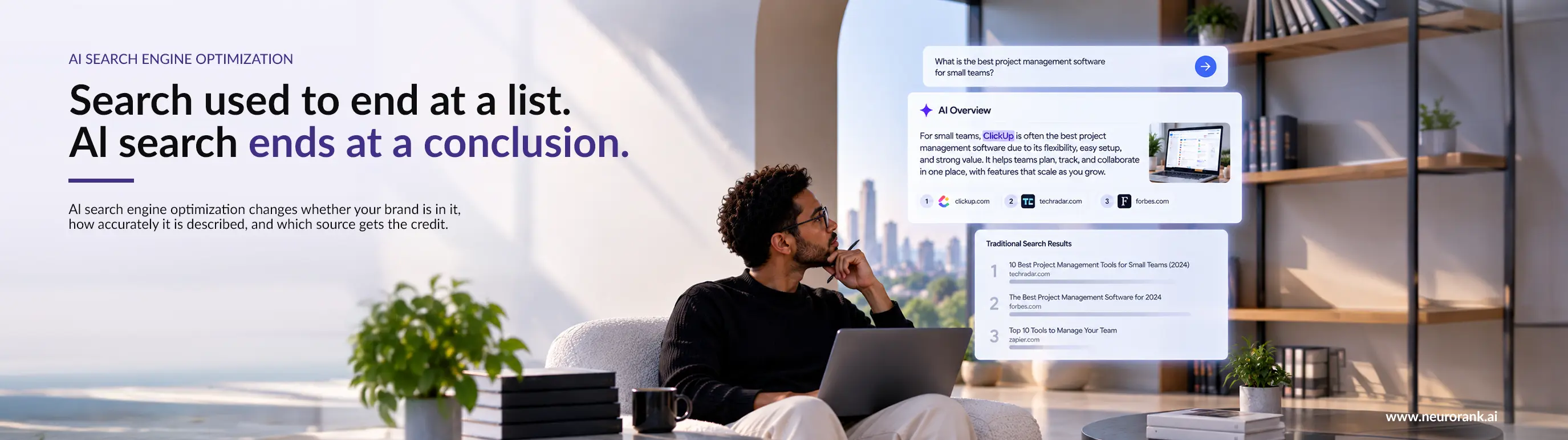
Search used to end at a list. AI search engine optimization is the work of appearing in what replaced it: a written answer that names a few brands and stops. Google AI Overviews sits above the results, Perplexity answers and cites, and ChatGPT and Gemini both take the query directly. NeuroRank, an AI visibility intelligence platform, measures what those surfaces say about a brand and prescribes what to change, across all four engines and their combined view. The label on this practice is still moving, and the mechanism underneath it is not. That distinction matters commercially, because a team optimizing for a phrase will rebuild its program every time the phrase changes.
| Patent-pending · ISO/IEC 27001 · 4 LLMs + Combined synthesis · Fresh-token methodology · 5,500+ prompt runs per cluster |
An AI search engine answers instead of listing. It retrieves sources, weighs how credible each looks, and writes one response, sometimes with citations attached and sometimes without.
Four surfaces carry most commercial AI search today. Google AI Overviews sits above the traditional results, and how it fans one question into many is covered separately. Perplexity answers and credits its sources inline. ChatGPT and Gemini both take the query directly and return a composed answer.
The reader does not choose between ten options, because the engine has already chosen.
An AI search engine answers a query instead of listing documents that might. It retrieves sources, weighs their credibility, and writes one response. Google AI Overviews, Perplexity, ChatGPT, and Gemini carry most commercial AI search, and each one hands the reader a conclusion instead of a choice.
What AI search engine optimization changes
Three things: whether the brand appears in the answer, whether the description is accurate, and which source the engine credits. Position in a list of links is a separate measurement with a separate fix, and a brand can hold the top organic slot while being absent from the answer above it.
That gap is the whole commercial problem. A buyer reading an AI Overview and acting on it never reaches the results the brand worked to rank in.
NeuroRank classifies every failure as Omitted, Replaced, Hallucinated, or Zero Leads. Omitted is absence where the brand belongs, Replaced is a rival holding the slot, Hallucinated is the wrong category or capability, and Zero Leads is a mention carrying no citation a reader can follow.
Four failures and four corrections. Averaging them into one visibility score produces a number that prescribes nothing.
Answer engine optimization changes inclusion, accuracy, and citation inside a generated answer. The retrieval step that decides all three does not read the search rankings, which is why a first-position page and an absent brand sit together more often than most teams expect.
Why AI search rankings is a misleading phrase
A list has positions and a paragraph has none. A brand is either named in the answer or it is not, and where it sits in a sentence carries no meaning a team can optimize toward.
Most AI visibility platforms monitor. NeuroRank diagnoses, prescribes, conditions, and tracks. Inclusion can be measured. The Brand Inclusion Score is prompt responses naming the brand entity, divided by total responses executed, computed per prompt, per cluster, per model, and in aggregate, with the formula published so the figure can be recomputed.
The question underneath it is real. Teams searching for AI search rankings are asking how often the engines name them, and which sources those engines credit when they do.
What gets measured instead of a ranking
Inclusion, not position. The Brand Inclusion Tracker carries the figure per cluster and per model, with the calculation shown, and the competitor line runs beside it so a movement reads as a gain or as somebody else’s loss.
Command Center reads one market at a time. Every recorded search for this term sits in India, and a global average buries exactly the market the term came from.
A single engine reads low. Taken alone, the four models return High inclusion on 30 percent of prompts on average. Read together as a combined view, that rises to 54 percent (n=1,236 combined against 7,177 single-model).
Put another way, a combined view is 1.8 times more likely to return a High inclusion than any one model on its own (n=8,413). The synthesis recovers most where single-model visibility is worst, which is why a brand that looks acceptable in one engine can still be missing from the answer a buyer reads in another.
The per-model figures make the point directly. Perplexity returns High on 40 percent of prompts and Gemini returns Low on 52 percent, from the same brands and the same clusters (n=1,920 and n=2,151).
Results vary by brand, category, and starting baseline.
Single models return High inclusion on 30 percent of prompts on average; a combined view returns 54 percent, making it 1.8 times more likely to return a High. The synthesis recovers most where single-model visibility is worst, which is why one engine is not a reading.
Source. NeuroRank AI visibility research, "Main door to online discovery: winning AI search recommendations in the agentic age". 122 brands, 8,647 end-result prompt ratings, audits run March to May 2026.
Nothing connects. No CRM, no analytics account, no CMS, and no tag on the site. Measurement runs from outside on publicly observable AI outputs, the same way a customer sees them, which removes the longest step in most security reviews.
Brand Inclusion Tracker. Brand Inclusion Score against each competitor, model by model, month on month.
Command Center. One country at a time, with inclusion, recommendations, and citations for the selected market.
The Brand Inclusion Tracker carries the figure per cluster and per model with the calculation shown, and Command Center reads one market at a time instead of a global average. Nothing connects to internal systems, because measurement runs from outside on publicly observable outputs.
Reporting an inclusion figure as a ranking invites a comparison that does not hold. A board reading rank language will ask who is at number two, and the answer will be that the concept does not apply here.
A list has positions and a paragraph does not, so AI search rankings describes something that cannot be measured. Inclusion can be: the Brand Inclusion Score records how often the engines name the brand entity across a prompt cluster, with the calculation published so the figure can be recomputed.
Every one of the 4,400 recorded searches sits in India, which says Indian marketing teams adopted this vocabulary ahead of their counterparts elsewhere and says little about where AI search itself is growing.
Vocabulary and behavior move at different speeds, and the gap between them is where this term sits.
Two consequences follow. A brand selling into India meets buyers, agencies, and briefs using this phrase, so the page has to rank for it. A brand selling into Europe or North America meets the same question in different words, so the argument has to survive without the label. How the engines behave in the Indian market specifically, and which regional sources they weight, is a separate subject with its own guide.
The engines behave differently by region too. Retrieval weights regional sources, so a brand strong in one market can be absent in another, and NeuroRank scopes region before anything runs, across Asia, Europe, the Middle East, the USA, and North America. The method has been stress-tested across 350+ brands in 65 industries in those markets.
Every recorded search for this term is in India, which reflects vocabulary adoption and not where AI search is growing. Brands selling into India meet the phrase in live briefs. Brands selling elsewhere meet the same question in different words, so the argument has to hold without the label.
Correct inaccuracy first. A wrong fact circulating across the engines costs more than an absence. It compounds too, because each one repeating it becomes corroboration for the next to find.
What follows is sequenced work: restructure what the engines already retrieve, clean the entity signals, then earn third-party corroboration. That order is set out in full on the LLM SEO page and it holds for every AI search surface.
Two things are specific to AI search. An AI Overview resolves the query above the results, so a correction that only lifts organic position will not reach the reader who stopped there. And citation behavior differs by surface, since Perplexity credits inline while Gemini often compresses several sources into one paragraph without a link a reader can follow.
Structure is the cheapest part and the most commonly wrong. A block that answers its own heading in the first sentence, keeps its facts in text, and makes sense without the paragraph above it can be quoted alone. One that depends on its context gets skipped for a competitor block that does not. Teams treating ai seo marketing as a content-volume exercise usually publish more and move nothing.
Correct inaccuracy before anything else, because a wrong fact compounds as the engines cite each other. The remaining sequence is common to every AI surface and is set out on the LLM SEO page. What is specific here is that an AI Overview resolves the query above the results, so organic position alone will not reach that reader.
With one category cluster. A NeuroRank Live Forensic Audit measures it across all four engines and their combined view, returning a 10-section intelligence report in 12 to 20 minutes that classifies every gap and names the sources each engine cited.
The aim is to command how AI perceives, interprets, and recommends your brand. Measurement runs from outside on publicly observable AI outputs, so no CRM, analytics account, or CMS connects at any point. Model Preference Engineering then runs the full cycle monthly, with clusters accumulating and movement read against the first-cycle baseline.
Start GEO growth with NeuroRank
Stop paying for clicks that do not convert. Benchmark your AI visibility today with the world's most advanced seo ai tools.
Book a Strategic NeuroRank Briefing