BlogOctober 19, 2026
Does AI Read Reddit for Your Brand? Category and Model Decide

Ambika SharmaFounder at Pulp Strategy Communications and NeuroRank.


Founder at Pulp Strategy Communications and NeuroRank.
Subscribe for Newsletters
In the AI Visibility Index 2026, 83 full audits and 39 summary decks contribute different kinds of evidence. Comparing an AI visibility platform with an SEO suite requires the same care: inspect the actual fields, platform coverage, prompt sample, and action workflow in the plan being considered. A category label alone does not establish capability.
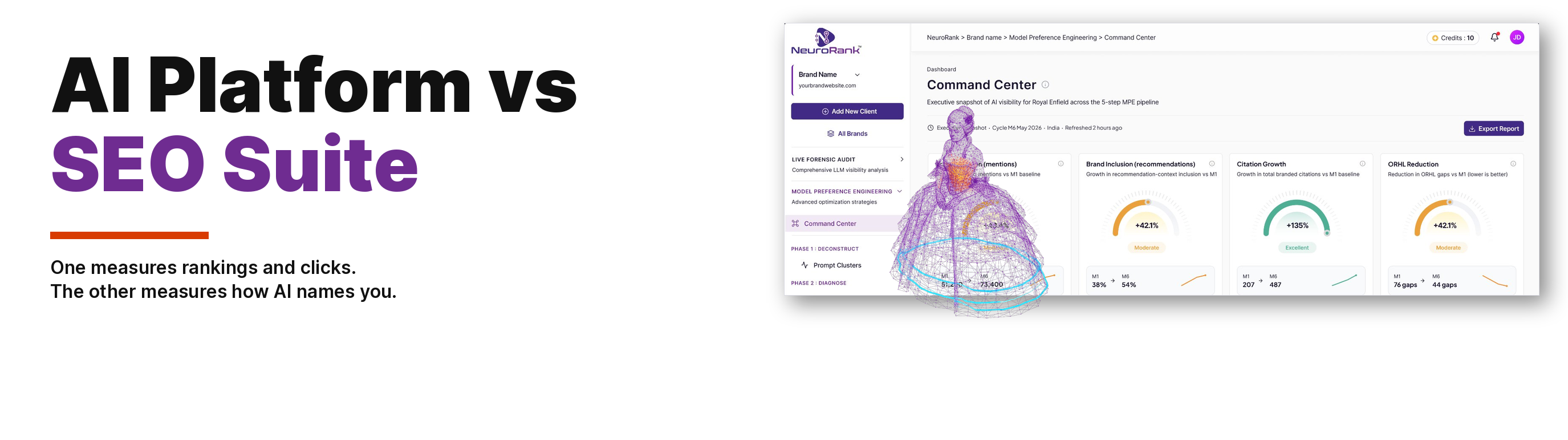
AI visibility platform vs SEO suite is a question of what each one measures. An SEO suite tracks how your pages rank and how your backlinks and keywords perform on search results. An AI visibility platform tracks how ChatGPT, Gemini, Claude, and Perplexity name, cite, and recommend your brand inside their answers. They share some infrastructure, they answer different questions, and increasingly a brand needs both. Here is what each covers, where they overlap, and how to decide.
A traditional rank report centers on pages, queries, and search results. An answer report centers on prompts, generated responses, named brands, and citations. Products increasingly overlap, so check the actual fields, sample, platform coverage, and current plan rather than infer capability from the suite category.
Dimension | Traditional SEO suite | AI visibility platform |
|---|---|---|
Core unit | Pages, queries, rankings, and visits | Prompts, responses, brands, and citations |
Coverage to verify | Search engines and any included AI features | AI products, countries, modes, and versions |
Evidence to request | Rank history, crawl findings, and query reports | Saved answers, source URLs, counts, and exclusions |
Action workflow | Varies by product and plan | Varies by product and plan |
Overlap | May include AI answer tracking | May use SEO and public-source data |
Source: NeuroRank editorial comparison of measurement criteria, October 15, 2026. Verify individual product capabilities against the selected plan.
The plumbing is shared. Schema, canonical URLs, and consistent entity signals help both a search crawler and an AI model, so the technical foundation built for SEO gives you a head start on AI visibility. That overlap is real, and it is the foundation, not the whole building. Rankings and citations are decided by different systems.
A rank-only report leaves generated-answer behavior unobserved. Some SEO suites include AI tracking, while some AI tools provide only limited response sampling. Compare the current product, tier, stored evidence, country coverage, metrics, and review workflow. Require documentation before claiming one platform class cannot perform a task.
If your buyers still find you through search results, keep your SEO suite. If your buyers are increasingly deciding inside AI answers, add an AI visibility platform to see and shape that surface. A brand can run both: the SEO suite to defend the ranked position, and the AI visibility platform to win the named mention. NeuroRank is built for the second job: it diagnoses, prescribes, conditions, and tracks. A NeuroRank baseline reading is the quickest way to see whether the blind spot is real for your brand.
Read How to choose an AI visibility platform. Read GEO vs SEO: why rankings no longer get you cited. Read AI visibility KPIs your board will ask about. Read the guide to LLM SEO. |
Stop paying for clicks that do not convert. Benchmark your AI visibility today with the world's most advanced seo ai tools.
Book a Strategic NeuroRank BriefingRetain each system’s native geography and document the mapping used for comparison. Compare only compatible scopes and disclose any aggregation. A country, a regional database, and an observed response location can describe different coverage, so a shared label should not silently make the underlying measurements equivalent.
Assess the database’s relevance, period, market, and prompt coverage before using it. It can inform discovery and research, while a confirmed brand cohort establishes the specific questions being measured. Keep those roles labeled so a broad market dataset is not presented as direct testing of every priority buyer task.
Show the capture or reporting period for each metric and compare aligned windows where possible. Explain material timing differences. A newly updated AI answer and a monthly keyword report can both be accurate within their own periods, while an undated side-by-side table can imply a relationship the data does not establish.