ComparisonJuly 29, 2026
Jellyfish Share of Model alternative: NeuroRank compared

Ambika SharmaFounder at Pulp Strategy Communications and NeuroRank.

Founder at Pulp Strategy Communications and NeuroRank.
Subscribe for Newsletters
Updated July 2026 · Ambika Sharma, Founder, Chief Strategist at Pulp Strategy Communications and Product Architect of NeuroRank®
An AI visibility tool measures whether ChatGPT, Gemini, Claude, and Perplexity mention your brand when buyers ask; NeuroRank runs that measurement as 5,500+ fresh-token runs per prompt cluster per region. This guide compares the platforms in the category on their published capabilities as of July 2026; it does not evaluate unreleased roadmaps.
The category divides on one question. Most platforms tell you the score: mentions, citations, sentiment. A smaller set does the work that follows: telling you exactly what to fix, in what order, with someone approving each change before it goes live, and proof of the improvement afterward. NeuroRank® is built for the second job. Model Preference Engineering is its continuous monthly practice: it diagnoses how the four major models perceive a brand, prescribes the specific fixes required, conditions the models across owned, earned, and third-party sources, and tracks month-on-month lift as the models recalibrate. It runs from USD 225/month.
This guide sorts the category by what happens after measurement. Every platform here answers whether AI mentions your brand. Fewer answer what to fix, in what order, and who signs it off. NeuroRank is built for the second question: it diagnoses how ChatGPT, Gemini, Claude, and Perplexity perceive a brand, prescribes the fixes, conditions the models, and tracks the lift.
The category divides into monitoring platforms and full-cycle platforms, and the difference decides your team's monthly workload
NeuroRank runs 5,500+ fresh-token runs per prompt cluster per region, at every price tier
Every gap is classified as Omitted, Replaced, Hallucinated, or Zero Leads, and each class routes to a different fix
A named approver reviews every change against a 38-point checklist before it goes live, with an exportable record
NeuroRank is ISO/IEC 27001 certified, GDPR compliant, and needs no access to internal systems
Pricing is fixed and published: from USD 225/month; USD 350/month for 4 LLMs plus Combined synthesis
Buyers ask AI before they ask you. Every answer includes your brand, replaces it with a competitor, describes it incorrectly, or leaves it out entirely. Each of those outcomes shapes a buying decision you never see, and it repeats thousands of times a month. NeuroRank stress-tested its methodology across 350+ brands, including competitor brands, in 65 industries before opening globally, and the pattern is consistent: most teams have gaps in prompts they never thought to check.
The models do not wait while a team decides. They keep answering buyer questions every day with whatever they currently believe. The practical question is which platform corrects those answers, not just which one reports them.
Your brand already holds a position inside ChatGPT, Gemini, Claude, and Perplexity, formed answer by answer whether you measure it or not. The work starts with seeing that position on live evidence, and the platforms in this guide differ mainly on what they let you do next.
The work is aim, not volume. Not every brand needs a GEO (Generative Engine Optimization) writing program. A large number of teams need to focus their energies on specific actions: the prompts they are missing, the pages AI already trusts, and the short list of fixes that moves inclusion this quarter.
One reference point for reading the rest of this guide. Across NeuroRank engagements, teams have averaged a 39.6% AI visibility lift, a 7% branded citation lift, and a 12% recommendation lift over approximately 80 days. Results vary by brand, category, and starting baseline.
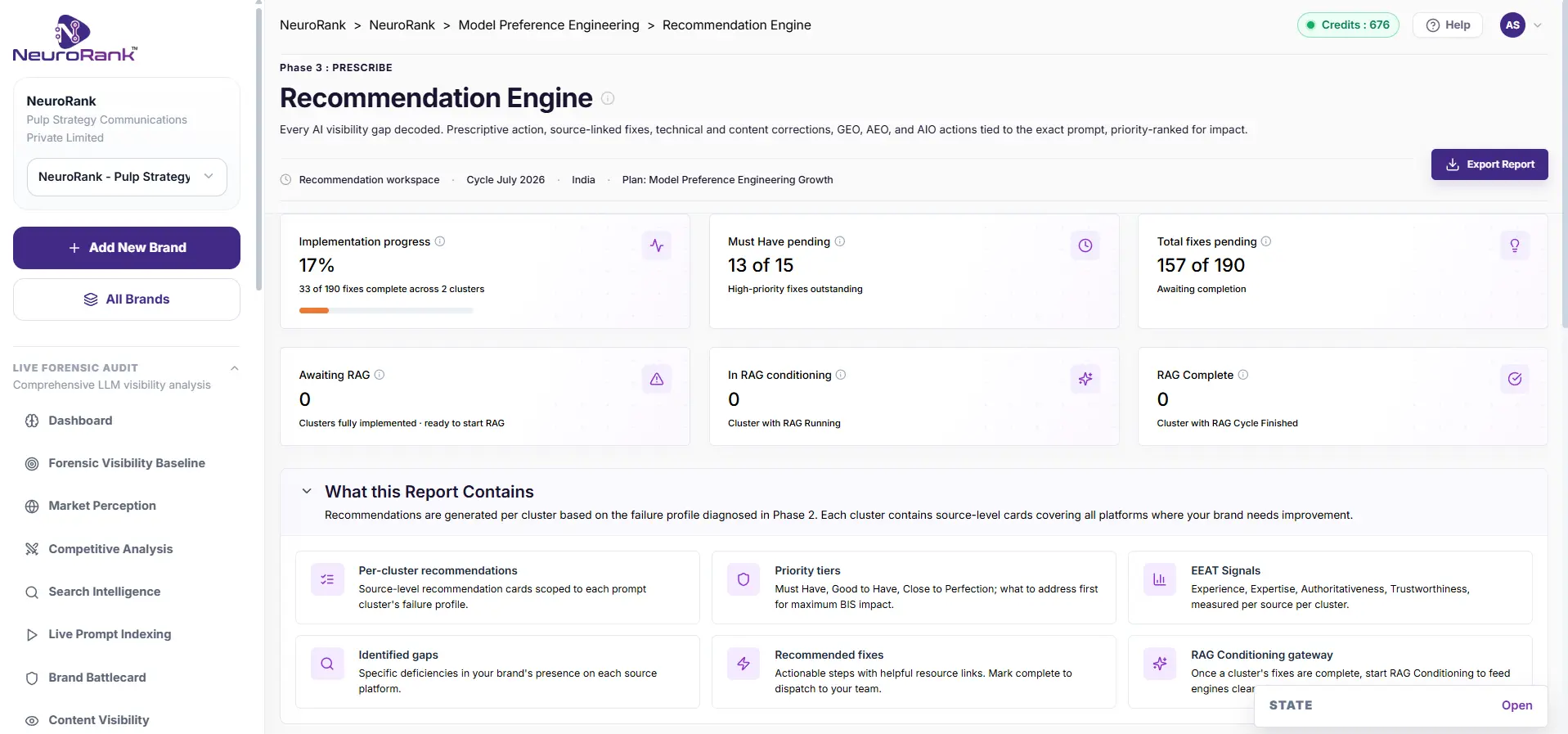
The work is a short, specific fix list, not a content program, and teams run it with the people they already have. The platforms below differ on how much of that list they hand you, ranked and ready, versus how much your team must assemble itself.
Every platform in the table below measures. The dividing line is what happens after the dashboard.
A monitoring platform reports your position and leaves the response to you: your team interprets the data, plans the fixes, executes them, and verifies the results. A full-cycle platform does that work inside the product. NeuroRank runs five steps every month, in plain terms: Deconstruct maps the questions buyers actually ask about your category into prompt clusters. Diagnose runs 5,500+ fresh-token runs per cluster per region across ChatGPT, Gemini, Claude, and Perplexity, each in a brand-new session with no history, the way a first-time buyer sees the model, and classifies every gap: was the brand skipped, replaced by a competitor, described incorrectly, or simply invisible (Omitted, Replaced, Hallucinated, or Zero Leads: ORHL). Prescribe converts each finding into a fix linked to the exact source pages, ranked by priority. Condition places the corrected, consistent brand information across your own site, earned coverage, and third-party sources so the models pick it up. Track measures the improvement against your first month's baseline.
Governance holds the cycle together. One team member implements each fix, and a second reviews and approves it against a 38-point checklist before it goes live, with every decision recorded in an exportable log. Unlike AI visibility platforms that monitor and report, NeuroRank runs this entire cycle on every plan.
The dividing line is not features; it is ownership of the work. A monitoring platform leaves interpretation, planning, execution, and verification with you. A full-cycle platform carries them, under a named approver, and shows the lift. That is the comparison to run before any feature list.
Whether you searched for an AI brand monitoring tool, an AI citation tracking tool, or an AI mention tracking tool, the platforms below cover that intent. What separates them is what happens after measurement.
| Platform | What it measures | What it tells you to do | Who approves the work before it goes live | Engines |
| NeuroRank | Inclusion, citations, perception, and classified gaps across 5,500+ fresh-token runs per cluster per region | Fixes linked to source pages, ranked by priority, then conditioning and tracked improvement | A second team member, against a 38-point checklist, with an exportable record | ChatGPT, Gemini (including AI Overviews), Claude, Perplexity, plus a Combined report reading all four together |
| Profound | Visibility and prompt volumes; crawler analytics | Content recommendations; full feature set on Enterprise per its pricing page | No approval step published | 10+ (full set on Enterprise) |
| AthenaHQ | Visibility across 8 engines, metered by credits | Suggestions; advanced features on Enterprise per published plans | No approval step published | 8 on all plans |
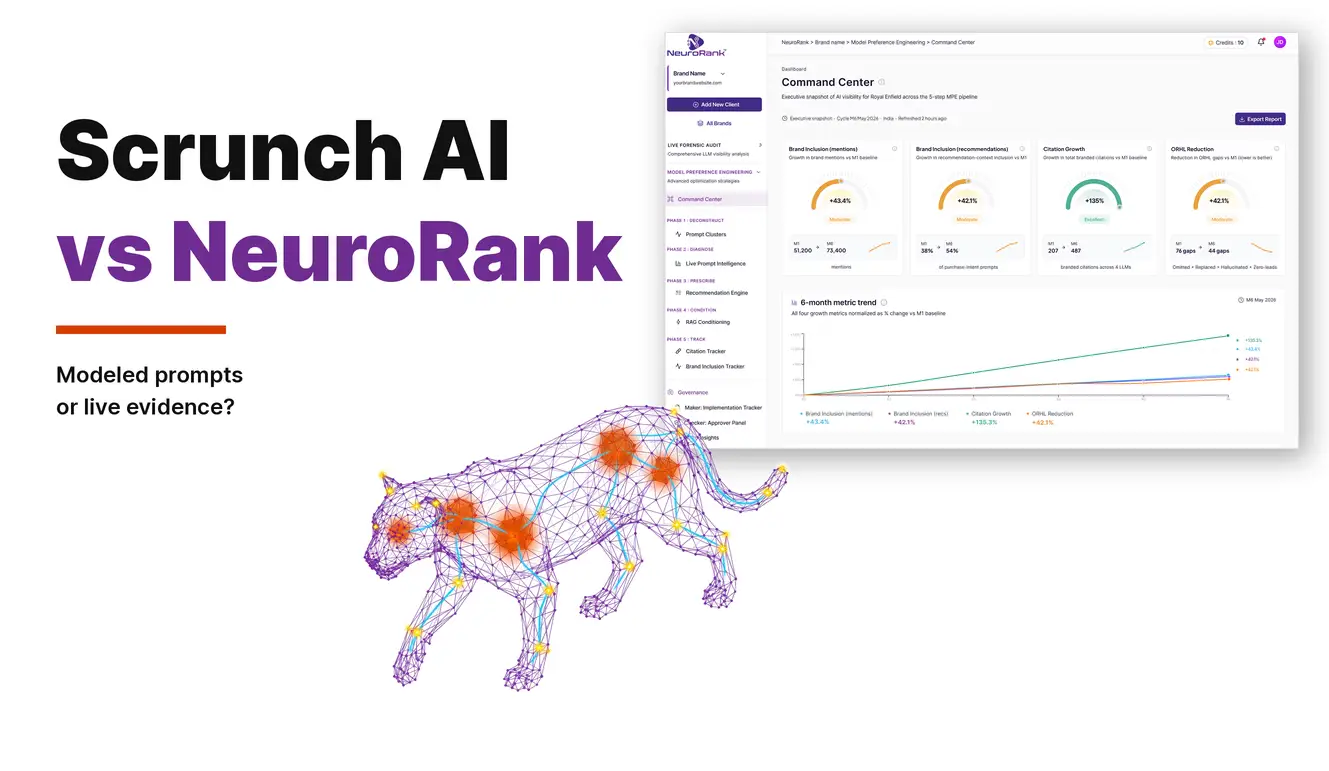
| Scrunch AI (Sitecore) | Visibility against modeled prompts; crawler traffic | Early-stage insights per its own positioning | No approval step published | 8 (4 on entry) |
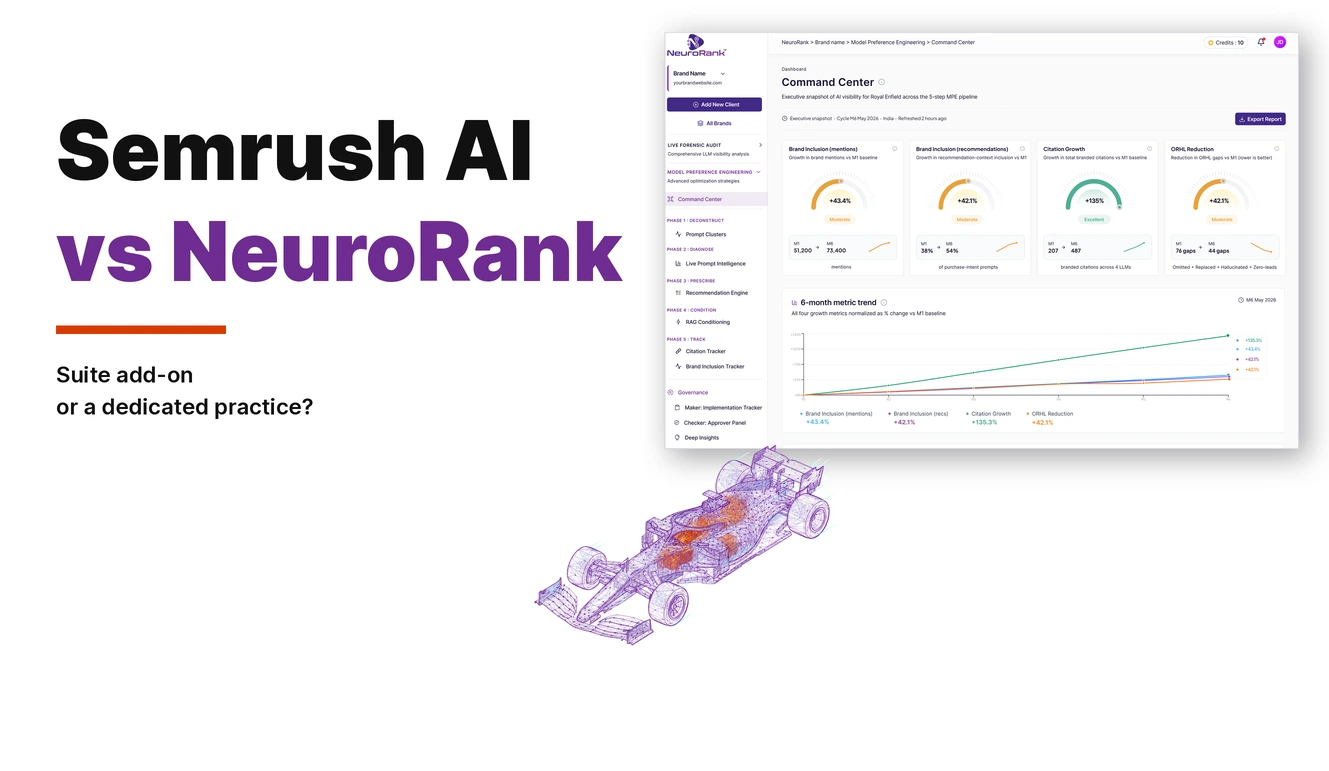
| Semrush AI (Adobe) | Topic-cluster visibility inside the Semrush suite | Suite recommendations | No approval step published | 5 per published list; no Claude |
| Evertune | Base-model brand perception; consumer panel | Content strategy; retargeting into paid media | No approval step published | 10+ |
| Conductor | Enterprise SEO platform plus AI visibility | SEO-led recommendations | No approval step published | Multiple, within an SEO suite |
| Otterly.AI | Prompt monitoring | Reporting only | No approval step published | Core engines, paid add-ons |
| Ahrefs Brand Radar | AI mentions inside the Ahrefs index | Reporting only | No approval step published | 6 per published list; no Claude |
| Bluefish | AI monitoring for Fortune-500 programs | Managed optimization | No approval step published | ~5 |
| HubSpot AI Search Grader | One-time AI visibility score | Reporting only | Not applicable | 3 in the free grader |
Read the third and fourth columns first. They decide whether you are buying a report or a working practice. NeuroRank is the platform in this set built around both. Engine counts and dashboard styles vary by taste; what happens after measurement, and who approves it before it goes live, is where the platforms genuinely differ.
Measured per prompt, per model, and per region, with every gap classified, the share-of-voice number stops being a scoreboard and becomes the month's work plan. That is the difference between knowing the number and knowing the fix, and it is what the Brand Inclusion Score is built to provide.
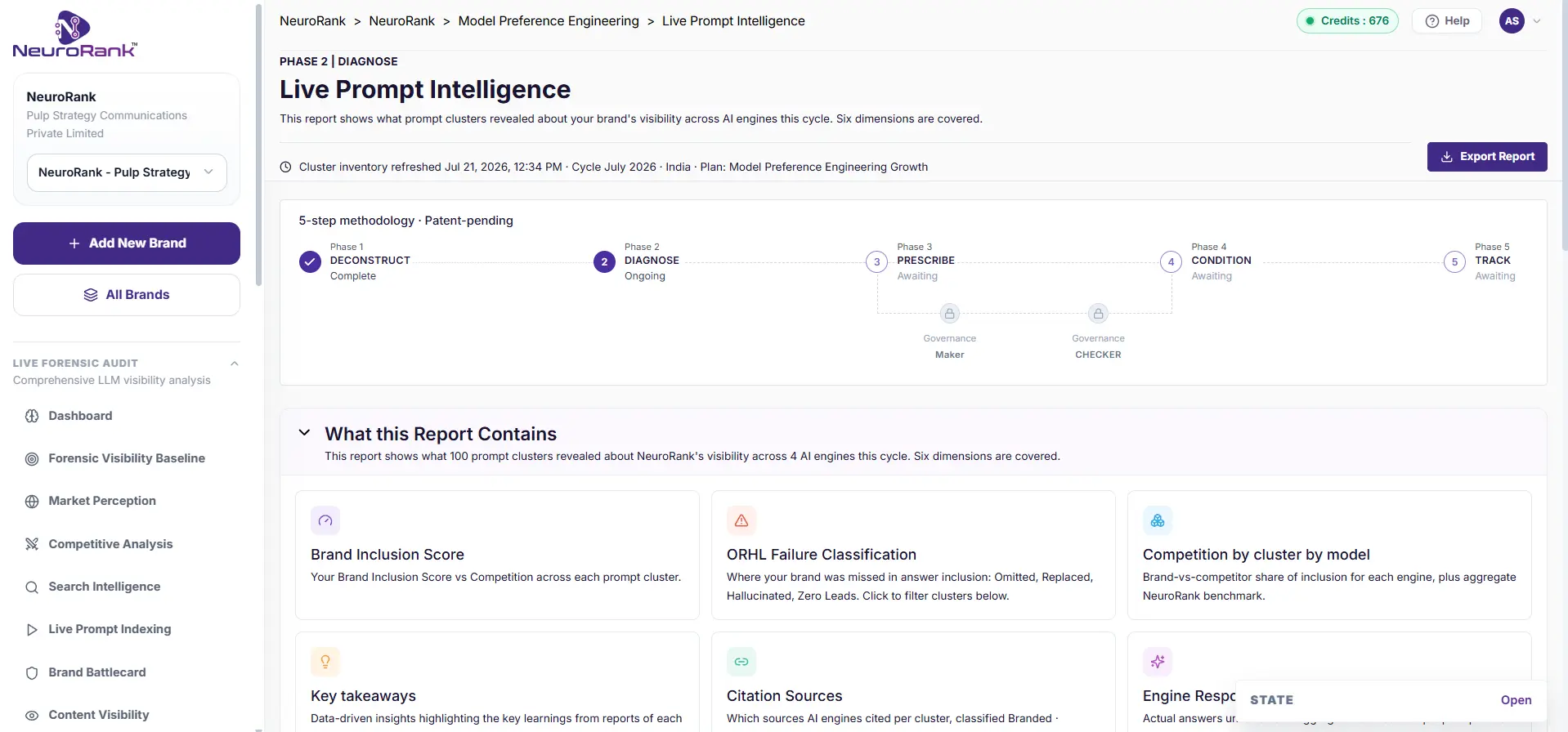
Judge every platform on one thing in the reporting section: can a CMO read the number and see the calculation behind it. NeuroRank's Command Center shows the formula on every card and tracks each metric against the first month's baseline, so the improvement is auditable rather than asserted.
Media and performance teams get two instruments that connect AI visibility to the plans they already run. Keyword Intelligence maps top Google keywords and volumes by region into eight customer-intent journeys, roughly 180 keywords per workspace with difficulty and opportunity scoring, so search demand and AI presence read as one picture. The Citation Tracker classifies every source the models cite as branded, competitor, industry, social, or negative, which tells earned media and PR exactly where placement effort will move the models.
SEO and digital leads get the diagnostic surface: live evidence, classified gaps, ranked fixes, and month-on-month tracking across Asia, Europe, the Middle East, the USA, and North America. Enterprises evaluating an enterprise AEO platform get published compliance with the practice: NeuroRank is ISO/IEC 27001 certified and GDPR compliant, and it needs no access to any internal system.
Agencies get multi-client architecture with nothing to install on the client side. Client-shareable reports are expressly permitted under NeuroRank's acceptable use policy, no access to any client system is required, and several agencies already use NeuroRank to win new business. Structured advisory hours come embedded in every subscription.
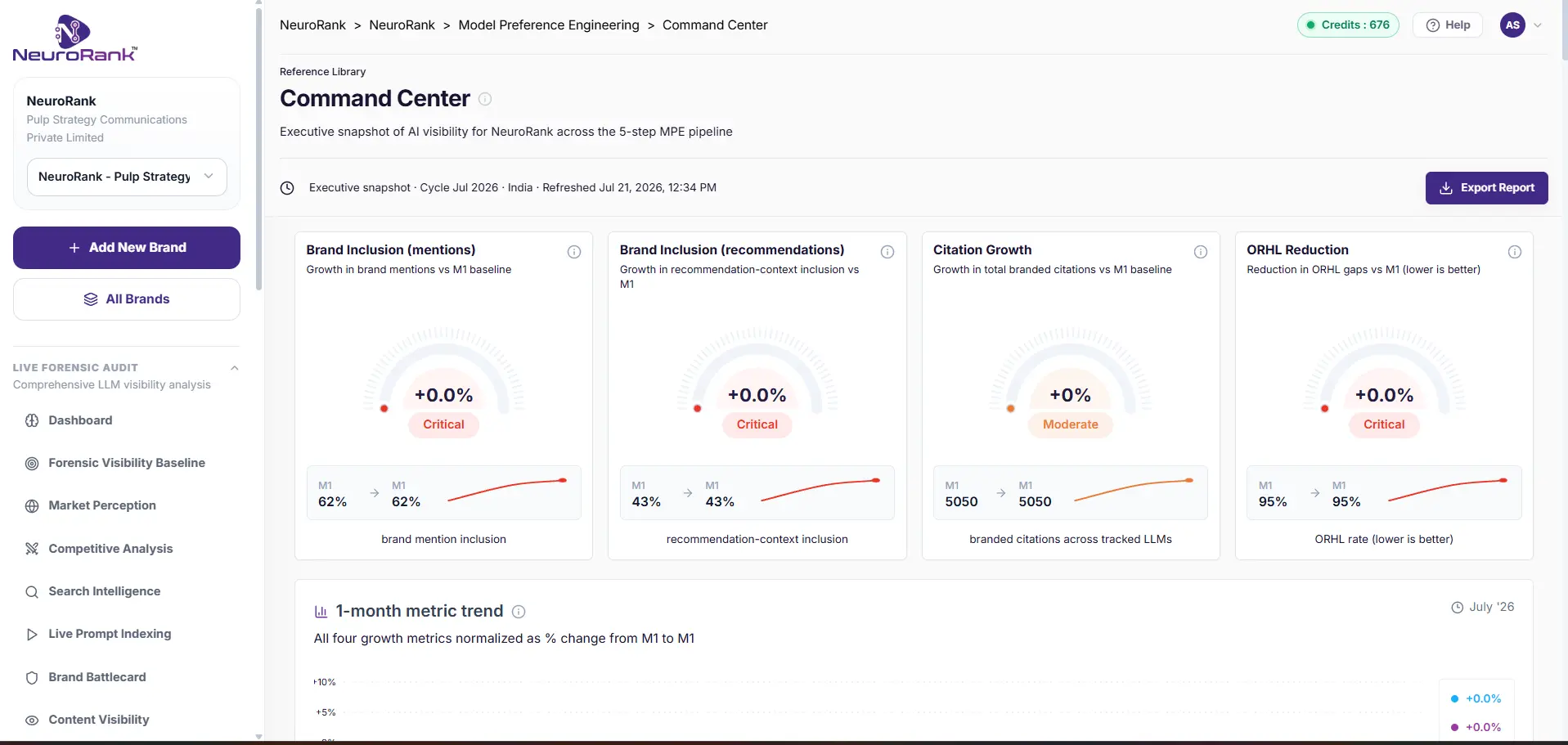
Every seat gets a working surface rather than a report: the CMO reads governed results in one screen, media teams see where placement moves the models, SEO leads run the diagnostics, and agencies serve clients without touching client systems. One subscription carries all four, with advisory hours included.
One fact frames the whole decision: the models keep answering buyer questions every day with whatever they currently believe about your brand, so the choice between a monitoring tool and a full-cycle platform is really a choice about how quickly those answers get corrected.
The pattern is consistent: across NeuroRank's stress test of 350+ brands, including competitor brands, in 65 industries, most teams discovered gaps in prompts they had never checked, answers where the brand was skipped, swapped for a competitor, described incorrectly, or absent altogether. Left standing, those answers become the material the next answer is built from.
Acting is bounded and measured: enterprise teams implement an average of 38 recommendations per prompt cluster per month, and have averaged a 39.6% AI visibility lift, a 7% branded citation lift, and a 12% recommendation lift over approximately 80 days. Results vary by brand, category, and starting baseline. Waiting compounds quietly; the practice compounds on the record.
One reference point for reading the rest of this guide. Across NeuroRank engagements, teams have averaged a 39.6% AI visibility lift, a 7% branded citation lift, and a 12% recommendation lift over approximately 80 days. Results vary by brand, category, and starting baseline.
The agency channel shows the pattern in public. Per NeuroRank's May 2026 launch announcement, several agencies use the platform to win new business and strengthen GEO offerings, and one agency onboarded three enterprise clients across the automobile and BFSI sectors. Client references in NeuroRank's external materials stay at sector level by policy: claims carry their evidence, and evidence carries its limits.
Pricing in this category runs in three models. Free graders produce a one-time score with no path forward. Monitoring subscriptions charge monthly, often by credits, so the bill moves with usage. Full-cycle platforms price the score, the fixes, the governance, and the tracking together.
NeuroRank's pricing is fixed and published. Model Preference Engineering starts at USD 225/month. The full configuration is USD 350/month for 4 LLMs plus Combined synthesis, 1 prompt cluster. Enterprise is custom. The structure works in the buyer's favor over time: one new prompt cluster is added each month and every prior cluster re-runs, so month twelve tracks twelve clusters against a continuous baseline, and the dataset becomes an asset that grows with the subscription. And because the price stays fixed while the cluster count grows, the effective cost per active cluster falls month by month.
Fixed pricing, compounding clusters, and falling unit cost keep the budget conversation short: USD 225/month to start, USD 350/month for the full four-LLM configuration, Enterprise custom, and the dataset grows into an asset the longer the practice runs.
"I built NeuroRank to address GEO comprehensively, putting control in the hands of the user." Ambika Sharma, Founder, Chief Strategist at Pulp Strategy Communications and Product Architect of NeuroRank. |
Run the category comparison on your own brand. A Model Preference Engineering subscription starts at USD 225/month, and the first cycle produces the baseline: live evidence across ChatGPT, Gemini, Claude, and Perplexity, every gap classified, and a ranked fix list your team can start the same week. Enterprises and agencies can talk to the team about a custom configuration.
Stop paying for clicks that do not convert. Benchmark your AI visibility today with the world's most advanced seo ai tools.
Book a Strategic NeuroRank BriefingAI visibility tools differ in what they measure. Ask whether a platform captures the raw answer and cited URL, separates inclusion from recommendation, records geography and model changes, and shows its valid-response denominator. NeuroRank’s Model Preference Engineering specifies 5,500+ fresh-token prompt runs per prompt cluster, per country. That controlled benchmark is not a claim to reproduce every buyer session.
Test realistic buyer prompts repeatedly in independent sessions and record what ChatGPT actually says. One answer can vary with context and time. NeuroRank’s Model Preference Engineering can extend the comparison to other platforms included in the plan and classify observed ORHL (Omitted, Replaced, Hallucinated, Zero Leads) conditions.
A platform can organize measurement and recommendations; an agency can implement changes when a team needs that capacity. NeuroRank does not publish a client’s content. Compare the plan’s actual coverage and support with the agency’s scope before choosing a workflow.
Monitoring records observed AI answers and trends. Optimization adds source-linked recommendations, implementation by the brand or agency, and subsequent measurement. NeuroRank supports optional Maker-Checker review of submitted changes. Later movement is observed, not automatically caused by a particular fix.
Check https://neurorank.ai/pricing for NeuroRank’s current plans. Ask each AI visibility vendor which response volume, sources, countries, review features, and support are included in the offer being compared.
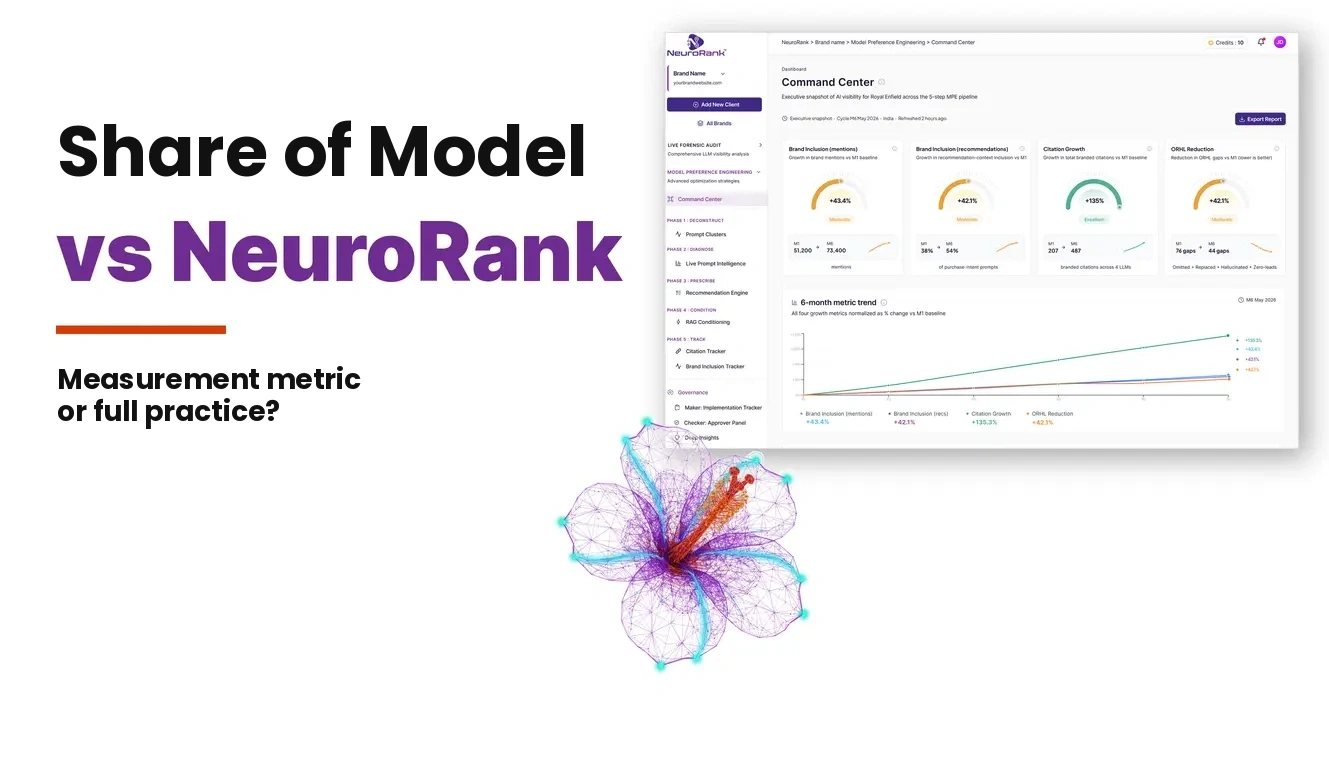
‘AI share of voice’ is used informally for comparative mention share, but NeuroRank’s named measures are Brand Inclusion Score, Brand Recommendation Score, Brand Citation Score, and ORHL (Omitted, Replaced, Hallucinated, Zero Leads). Report each with its tracked-response denominator, prompt set, platform, country, and period.
Your team or agency can correct a product page, a company profile, or a disputed public source after verifying the fact and recording the original AI answer. NeuroRank can prescribe source-linked changes and optionally route a submitted URL through Maker-Checker. Re-test matched prompts afterward. The team controls the published correction, while each AI provider controls its later response.
Use a baseline and repeated, comparable prompts to track change over time. Timing differs by platform and source availability. Any historical engagement result needs its sample, metric definition, and method before it can be generalized; no lift or date is guaranteed for a new brand.