ComparisonJuly 29, 2026
AI visibility tools compared: which platform measures, fixes, and approves

Ambika SharmaFounder at Pulp Strategy Communications and NeuroRank.

Founder at Pulp Strategy Communications and NeuroRank.
Subscribe for Newsletters
Ahrefs Brand Radar reads AI visibility from an index it states at 346M+ monthly prompts;NeuroRank® runs 5,500+ live fresh-token runs per prompt cluster per region. They differ on what the reading is for: population-scale research inside a toolset SEO teams already run, or a governed monthly cycle that corrects what it finds. This comparison covers both platforms' published capabilities as of July 2026; it does not evaluate unreleased roadmaps.
The comparison matters because the two methodologies answer different questions with the same vocabulary: one reports what a population of observed prompts produced, the other reports what a buyer asking today would see, and what was done about it.
Brand Radar is Ahrefs' AI visibility product, a standalone tool available to free and paid Ahrefs users per its published page as of July 2026. It reads brand mentions and citations from what Ahrefs states as the category's largest AI visibility database, 346M+ monthly search-backed prompts across indexes for AI Overviews, AI Mode, ChatGPT, Perplexity, Copilot, and Gemini, with AI share of voice, its term for the percentage of AI chats mentioning a brand, as the headline metric, plus topic clustering, source analysis, unlimited projects, zero-setup instant research, and custom-prompt packages priced by daily volume, platform, and location.
Brand Radar sits inside a research platform that many teams already have, which makes it the cheapest AI visibility view available to them. NeuroRank is a separate purchase because it does separate work: prescription, approval, model conditioning, and month-on-month tracking against a baseline.
These are not the same purchase. One is a research index; the other is a working practice.
Unlike Brand Radar's retrospective index, NeuroRank measures live and then closes the loop: every gap classified, every fix approved by a named reviewer against a 38-point checklist, conditioned, and tracked.
Brand Radar and NeuroRank measure the same surface from opposite directions. Brand Radar reads backward at population scale: an index Ahrefs states at 346M+ monthly search-backed prompts, dominated by Google's AI surfaces, delivering instant zero-setup research, topic clusters, source analysis, and its AI share of voice metric, at published prices inside the Ahrefs toolset. NeuroRank, a patent-pending AI visibility intelligence platform from Pulp Strategy Communications, reads forward and acts: 5,500+ fresh-token runs per prompt cluster per region across ChatGPT, Gemini (includes AI Overviews), Claude, and Perplexity, every gap classified, ranked fixes, a named approver against a 38-point checklist, conditioning, and tracked lift. Enterprise customers implement an average of 38 recommendations per cluster per month; teams have averaged a 39.6% AI visibility lift over approximately 80 days, and results vary by brand, category, and starting baseline. Research describes the past; the practice changes the next answer.
Brand Radar reads a retrospective index Ahrefs states at 346M+ monthly search-backed prompts, with instant zero-setup research
The index's published composition concentrates in Google surfaces; Claude is absent from the published platform list
NeuroRank measures live: 5,500+ fresh-token runs per prompt cluster per region, including Claude, every month
Brand Radar produces research; NeuroRank produces prescriptions, named approvals, conditioning, and tracked lift
Both publish their pricing; Brand Radar scales by platforms and custom prompts, NeuroRank stays fixed as clusters grow
NeuroRank is ISO/IEC 27001 certified, GDPR compliant, and needs no access to internal systems
| Ahrefs Brand Radar | NeuroRank | |
| What it is | AI visibility research index inside the Ahrefs toolset | Patent-pending AI visibility intelligence platform running Model Preference Engineering |
| Primary audience | SEO teams and researchers already running Ahrefs | CMOs, media and performance teams, SEO and digital leads, agencies |
| Measurement method | Retrospective index of 346M+ monthly search-backed prompts, per its page | 5,500+ fresh-token runs per prompt cluster, per region, monthly |
| Engines covered | AI Overviews, AI Mode, ChatGPT, Perplexity, Copilot, and Gemini indexes; Claude absent from the published list | ChatGPT, Gemini (includes AI Overviews), Claude, Perplexity, plus Combined synthesis |
| Gap classification | Mentions, citations, topics, and source analysis | ORHL: Omitted, Replaced, Hallucinated, Zero Leads |
| Prescriptions | Research outputs; action stays with the buyer | Source-linked fixes ranked by impact, tied to the exact prompt |
| Approval workflow | Not applicable | Maker-Checker: named approver, 38-point checklist, auditable trail |
| Model conditioning | Not a published capability | Model Conditioning Loop at prompt-cluster level |
| Improvement tracking | Index metrics over time, plus custom-prompt checks | Brand Inclusion Score and citation footprint, month on month, against baseline |
| Executive reporting | Report Builder widgets and API | Command Center with formulas shown, plus Deep Insights copilot |
| Compliance | Standard Ahrefs product terms | ISO/IEC 27001 certified, GDPR compliant, no internal-system access |
| Pricing model | Published per-platform and all-platform tiers, plus custom-prompt packages | Fixed and published: from USD 225/month; USD 350/month full; Enterprise custom |
Source: NeuroRank analysis of both platforms' published documentation, July 2026.
The methodological split is retrospective against live, and each side is honest about what it buys.
Pros:
The index is stated at 346M+ monthly search-backed prompts, derived from real search behavior rather than synthetic questions, per its published page
Zero setup and unlimited projects: any brand or competitor can be researched instantly, with history
Topic clustering and source analysis show which domains feed the answers, and custom-prompt packages add targeted checks
Cons:
The published index composition concentrates heavily in AI Overviews and AI Mode, with the chatbot indexes far smaller, so coverage mirrors Google's surfaces more than the assistants
An index reports what was observed at collection time; it cannot show what a fresh session answers today, and Claude is absent from the published platform list
Pros:
5,500+ fresh-token runs per prompt cluster per region across ChatGPT, Gemini (includes AI Overviews), Claude, and Perplexity, each a brand-new session with no history, the way a first-time buyer sees the model
Every gap classified as Omitted, Replaced, Hallucinated, or Zero Leads (ORHL): skipped, replaced by a competitor, described incorrectly, or simply invisible
Every cited source identified and catalogued, evidence tied to the exact prompt and region
Cons:
Coverage is four LLMs by design, prioritizing per-model depth and a governed cycle over index breadth
Brand Radar answers the research question: across an enormous observed population, where does the brand appear and why. NeuroRank answers the operating question: what does a buyer asking right now see, per model and per region, and what gets fixed first. Population research and live practice are different instruments, and serious teams may want both.
What each platform hands you next is where the categories separate.
Pros:
Report Builder widgets and an API move index findings into custom reports and dashboards, per its published documentation
For SEO teams already in Ahrefs, the marginal workflow cost is near zero
Cons:
What to change, who approves it, and whether it worked are outside the product's published scope
Custom-prompt checks observe; they do not prescribe or verify fixes
Pros:
The Recommendation Engine converts every classified gap into prescriptive, source-linked fixes, priority-ranked and tied to the exact prompt
Every fix passes a two-step control borrowed from banking: one team member (the Maker) implements it, and a second (the Checker) reviews and approves it against a 38-point checklist before it goes live
The Model Conditioning Loop then places corrected, consistent brand information across your own site, earned coverage, and third-party sources, and the following cycle measures the movement
Cons:
NeuroRank does not write or publish content for you; it prescribes, and your team implements, keeping the approval record honest
Brand Radar ends where research products should: findings, exported cleanly. NeuroRank begins where practices must: ranked prescriptions, named approval against a 38-point checklist, conditioning, and month-on-month lift against a baseline. The index tells you where you stood; the practice shows what changed.
Ahrefs Brand Radar vs NeuroRank: brand perception depth
Brand Radar's published metrics read mention share, citations, topics, and sources at index scale. NeuroRank reads perception as its own layer: Market Perception applies aided and unaided recall research to the models, the Brand Battle Card asks the models about your category without naming you and scores the answers across six proprietary dimensions, and ORHL classification, Omitted, Replaced, Hallucinated, or Zero Leads, separates being absent from being misdescribed, which are different problems with different fixes. A brand can be present, accurate, and still unchosen; it can be prominent and wrong. Three different problems need three different fixes, and NeuroRank tells you which problem you have, per model, per region.
Ahrefs Brand Radar vs NeuroRank: platform focus and target audience
Brand Radar's design center is the SEO team and researcher already inside Ahrefs: population-scale AI visibility with zero setup, unlimited projects, history, and published pricing, in the same toolset as the rest of the search work. As a research instrument, its scale is genuinely distinctive.
Research teams get real value from a bundled view. NeuroRank is for the team that has to change the answer, not only observe it, and that needs a record showing what was changed and by whom.
Research reporting describes a market. NeuroRank's reporting describes your own progress: four metrics against a first-month baseline, the formula on each card, and an approval trail behind every change.
For media and performance teams, two instruments connect AI visibility to the plans they already run. Keyword Intelligence maps top Google keywords and volumes by region into eight customer-intent journeys, roughly 180 keywords per workspace with difficulty and opportunity scoring, so search demand and AI presence read as one picture. The Citation Tracker classifies every source the models cite as branded, competitor, industry, social, or negative, which tells earned media and PR exactly where placement effort will move the models.
For SEO and digital leads, the diagnostic depth above is the daily surface: live evidence, classified gaps, ranked prescriptions, and month-on-month tracking.
For agencies, NeuroRank runs multi-client, client-shareable reports are expressly permitted under its acceptable use policy, and no access to a client's CRM, analytics, or internal systems is ever required, because the platform probes the models from the outside, the way a customer would. That shortens both the pitch and the security review. Several agencies already use NeuroRank to win new business and strengthen GEO offerings, and structured advisory hours come embedded in every subscription, which matters in a discipline most teams are building for the first time.
Brand Radar fits the team that wants AI visibility research at index scale inside the toolset it already runs. NeuroRank fits the CMO, the media team, the SEO lead, and the agency that need the live answer governed and changed. Run the index for research; run the practice for the record.
When a capability arrives bundled, the reporting question is whether anyone acts on it. This section is about what makes the output actionable rather than merely available.
Pros:
Report Builder widgets and API access feed index findings into existing dashboards, per its published documentation
Ahrefs-standard product terms simplify procurement for existing subscribers
Cons:
No approval or audit layer applies, because the product is research: reporting shows standing, not governed change
Executive reporting of a fix cycle is outside its published scope
Pros:
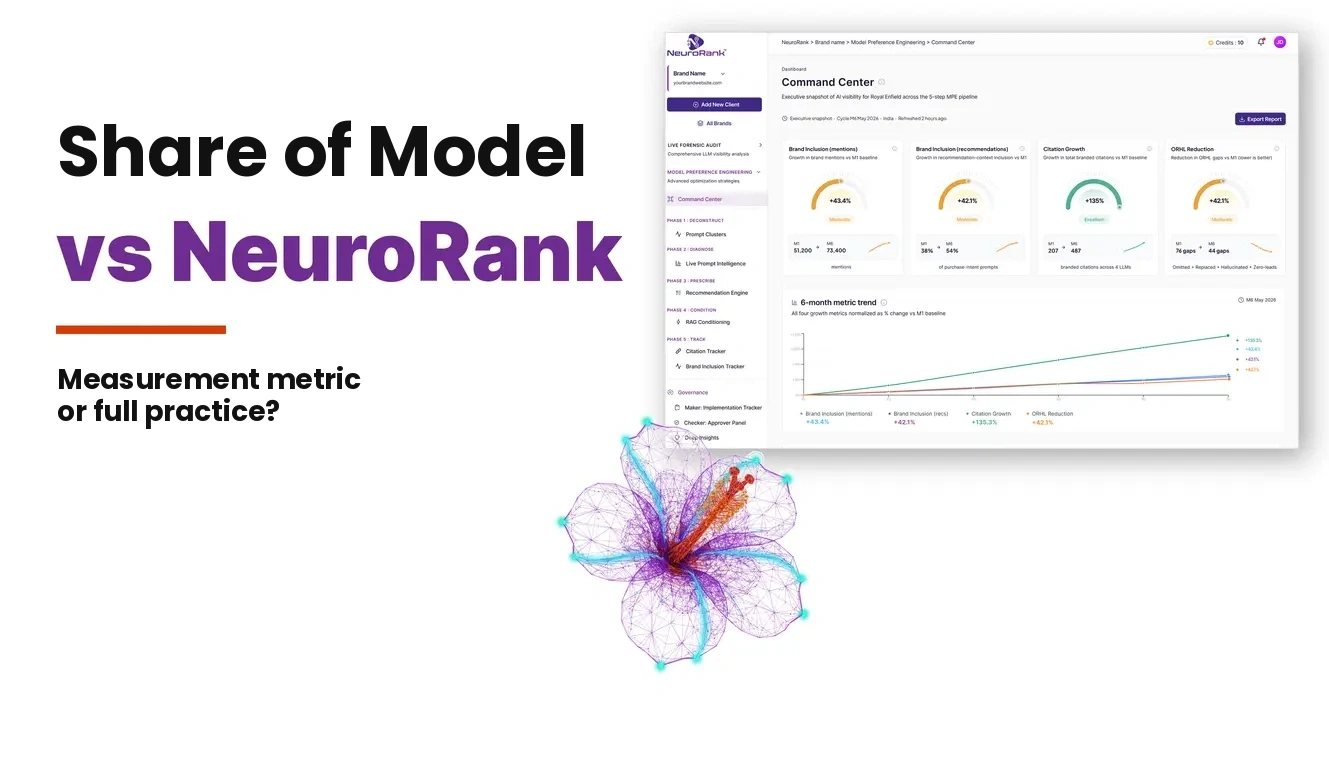
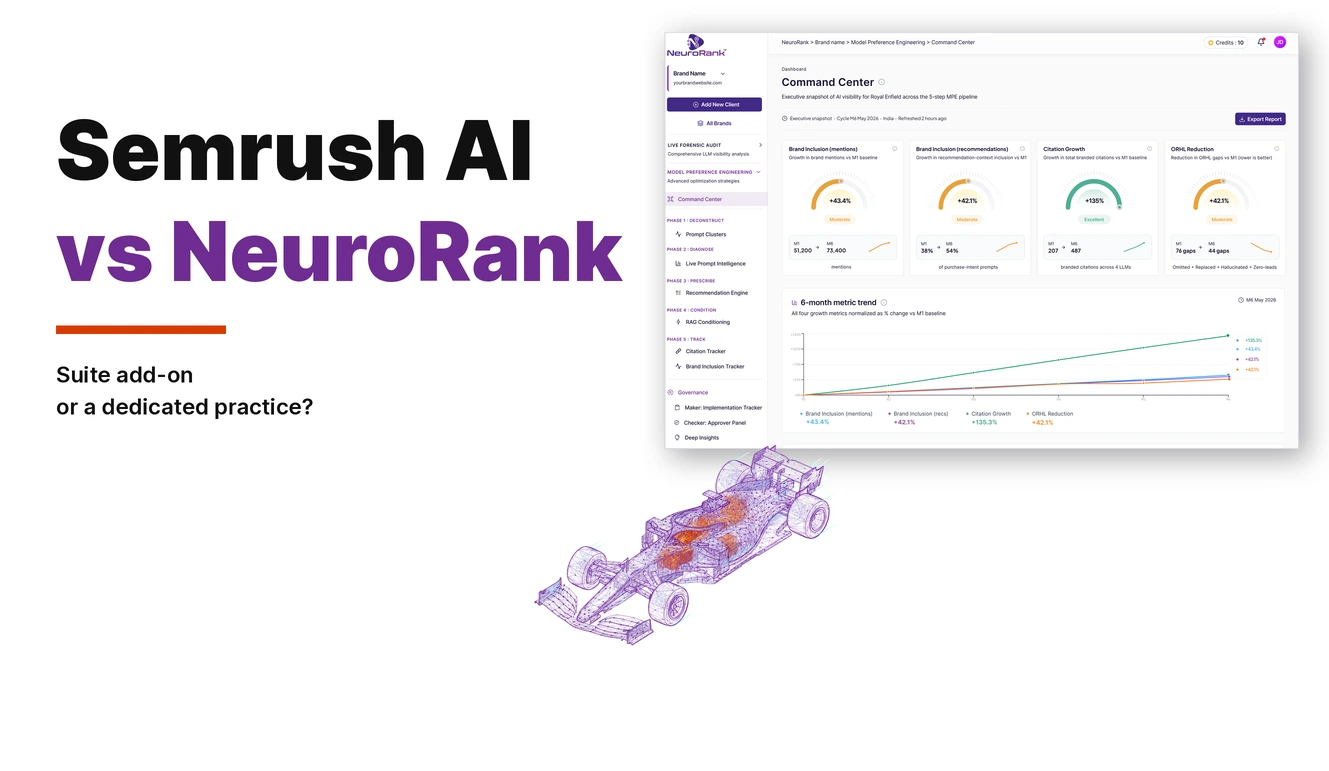
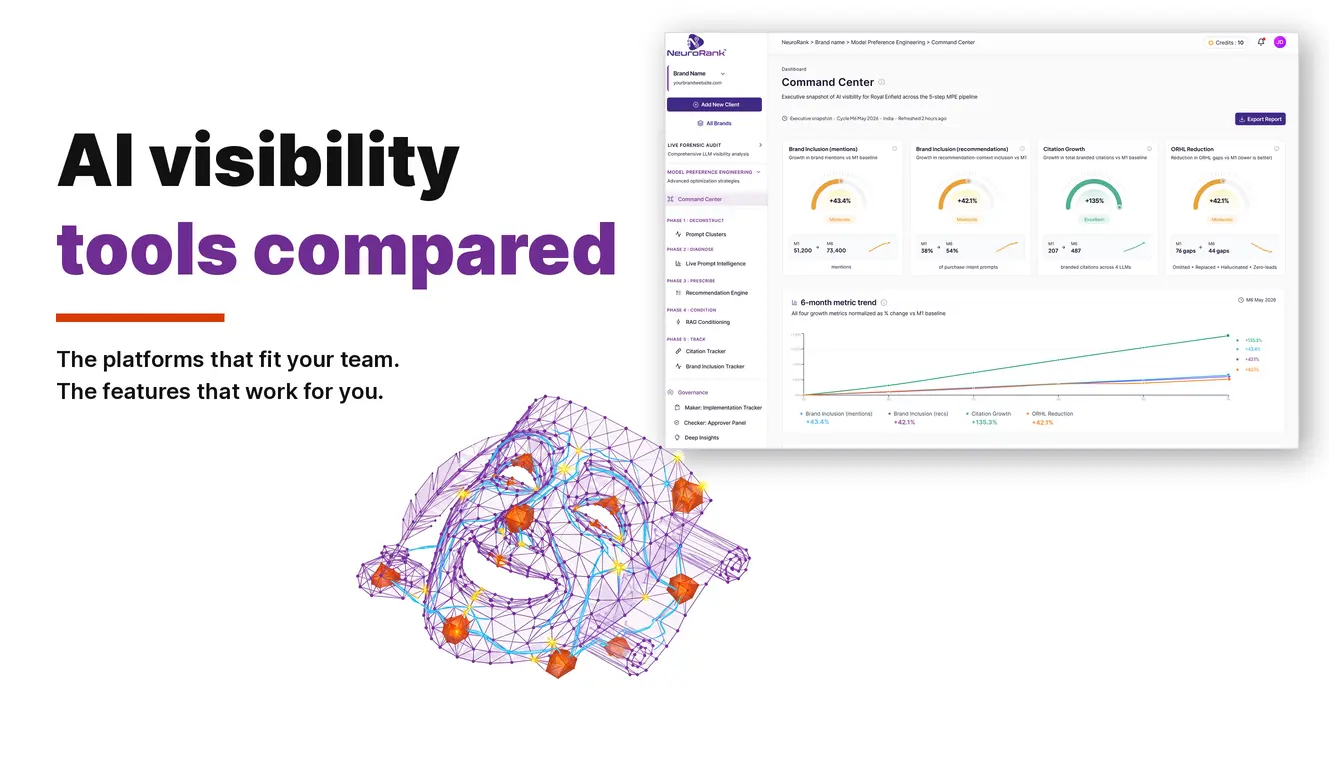
The Command Center rolls the practice up for leadership: baseline-tracked headline metrics with their formulas shown on the card, a per-model inclusion overview, the governed-coverage heatmap, top actions and wins, an execution-health view of implementation speed and bottlenecks, and one-click export
Deep Insights, a conversational copilot scoped to your own audit data, answers questions across every section of the report and keeps the chat history
Every platform action is attributed in a usage ledger, to a person, a role, a timestamp, and a category, and reviews carry service-level indicators, so an enterprise sees not just what changed but how the team is running
Onboarding reads your existing footprint: the Brand Discovery Panel ingests your sitemap, LinkedIn presence, and llms.txt, and Makers work with CSV import and export
NeuroRank is ISO/IEC 27001 certified and GDPR compliant, and the practice runs without access to your internal systems, which shortens security review
Cons:
The dashboards are purpose-built for the practice rather than a general BI layer; no Looker Studio connector is published
Leadership gets numbers it can read and defend: baseline-tracked metrics with the calculation shown behind every number, and an approval record behind every change. Procurement gets an ISO/IEC 27001 certified, GDPR compliant platform that needs no access to any internal system. Both halves of the enterprise decision are answered on every plan.
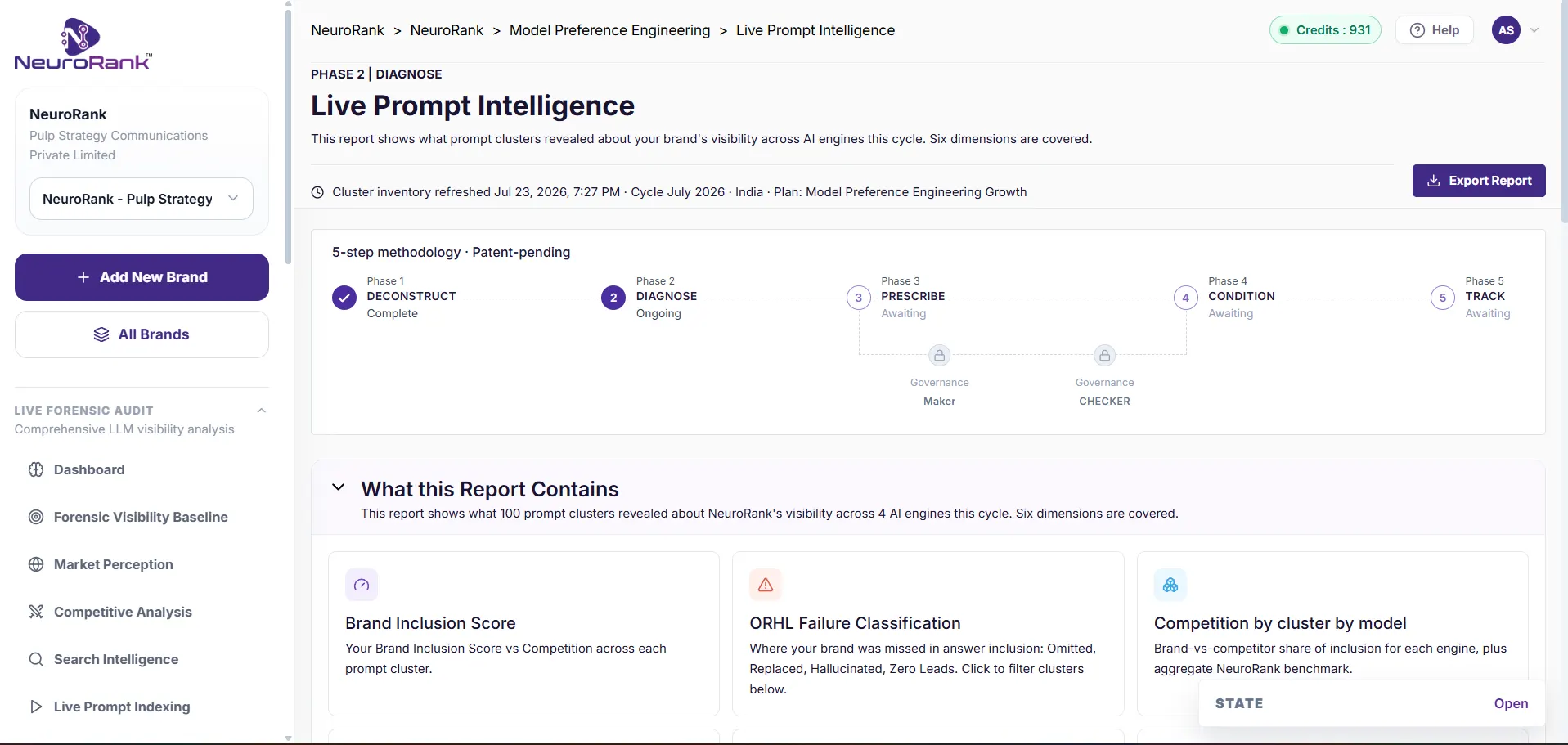
On the practice side: 38 approved recommendations per prompt cluster per month on average, with teams averaging a 39.6% AI visibility lift, a 7% branded citation lift, and a 12% recommendation lift over approximately 80 days. Results vary by brand, category, and starting baseline.
Agencies supply the public half of the evidence. Per NeuroRank's May 2026 launch announcement, several agencies use the platform to win new business and strengthen GEO offerings, and one agency onboarded three enterprise clients across the automobile and BFSI sectors. Client references in NeuroRank's external materials stay at sector level by policy: claims carry their evidence, and evidence carries its limits.
Brand Radar publishes its pricing: per-platform and all-platform index tiers, with custom-prompt packages priced by daily prompt volume, platform, and location, and some indexes free while in beta, per its published page as of July 2026. The structure is transparent; configured cost depends on platforms selected and custom-prompt volume. Verify current figures on the Brand Radar page before budgeting.
NeuroRank's pricing is fixed and published. Model Preference Engineering starts at USD 225/month. The full configuration is USD 350/month for 4 LLMs plus Combined synthesis, 1 prompt cluster. Enterprise is custom. The architecture compounds in the buyer's favor: one new prompt cluster is added each month and every prior cluster re-runs, so month twelve tracks twelve clusters against a continuous baseline at the same fixed price structure, and the dataset becomes an asset that switching away would abandon. And because the price stays fixed while the cluster count grows, the effective cost per active cluster falls month by month.
Lists of Ahrefs Brand Radar competitors mix monitoring platforms with full-cycle platforms. Five questions separate them. Is the evidence live and current, or read from a retrospective index? Does the platform prescribe fixes or only report and suggest? Who approves work before it goes live, and is the record exportable? Can it see perception, including factual errors about your brand? Can you verify the methodology on your own brand first? NeuroRank answers all five in writing, on every plan.
One fact frames the whole decision: the models keep answering buyer questions every day with whatever they currently believe about your brand, so the choice between the two platforms is really a choice about how quickly those answers get corrected.
In NeuroRank's stress test across 350+ brands in 65 industries, the gaps sat in live answers no index had flagged: the brand skipped, replaced, misdescribed, or invisible in fresh sessions, whatever the historical mention counts said. An index ages by design; the models answer in the present tense.
The working response is bounded: an average of 38 implemented recommendations per prompt cluster per month, with teams averaging a 39.6% AI visibility lift, a 7% branded citation lift, and a 12% recommendation lift over approximately 80 days. Results vary by brand, category, and starting baseline. Research can wait for the next index refresh; the buyer's question gets answered today, by whatever the model currently believes.
Brand Radar is the right choice for research at population scale: instant, zero-setup visibility across an index Ahrefs states at 346M+ monthly prompts, inside the toolset SEO teams already run, with published pricing.
If your team needs the question after measurement answered, what do we fix, in what order, approved by whom, with what proof it worked, that is the cycle NeuroRank was built to run. It runs all of it on every plan: live evidence at fixed depth, prescriptions linked to source pages, a named approver on every change, model conditioning, month-on-month lift against a baseline, and an executive layer the CMO can read in one screen, from USD 225/month.
"I built NeuroRank to address GEO comprehensively, putting control in the hands of the user." Ambika Sharma, Founder, Chief Strategist at Pulp Strategy Communications and Product Architect of NeuroRank |
Use research where research serves, and put the live practice on your own brand. Model Preference Engineering starts at USD 225/month, and the first cycle produces the baseline: fresh-token evidence across four models including Claude, classified gaps, and a ranked fix list under named approval. Enterprises and agencies can talk to the team about a custom configuration.
Stop paying for clicks that do not convert. Benchmark your AI visibility today with the world's most advanced seo ai tools.
Book a Strategic NeuroRank BriefingNeuroRank is a patent-pending AI visibility intelligence platform that tells you exactly how ChatGPT, Claude, Gemini, and Perplexity currently represent your brand, diagnoses where that representation is broken, prescribes the specific corrective actions required to fix it, and runs a monthly governance loop until the models recalibrate. NeuroRank is a brand of Pulp Strategy Communications Private Limited, an ISO/IEC 27001 certified firm in New Delhi. The Live Forensic Audit at $7 is the one-time audit. Model Preference Engineering from USD 225/month is the continuous governance subscription.
SEO tools tell you where you rank on search engine results pages. Brand monitoring tools tell you what is said about you on the open web and social. Neither tool can tell you what ChatGPT, Claude, Gemini, or Perplexity are actually saying about your brand inside the answer a buyer receives. The intelligence data NeuroRank produces is the intelligence your SEO and monitoring tools do not have, pulled from thousands of conversations about your brand and category inside answer engines. Use NeuroRank alongside your existing stack, not instead of it. The three systems answer three different questions about three different surfaces.
Because AI answer engines are increasingly the first and sometimes only surface a buyer sees. When a prospect asks ChatGPT, Claude, Gemini, or Perplexity for a recommendation in your category, the model synthesizes an answer from a narrow set of sources. If that answer does not include you, or names a competitor in your place, your #1 Google ranking never enters the decision. Ranking on Google and being cited by AI are two different battles. SEO optimizes for search engine results pages. GEO (Generative Engine Optimization) and AEO (Answer Engine Optimization) are industry terms for the shift to AI-surfaced answers. LLMO (Large Language Model Optimization) is the discipline NeuroRank practices, governing how language models perceive, cite, and recommend brands inside the answer itself. You need SEO and LLMO, and you need to measure both.
SEO keyword tracking measures positions on search results pages. NeuroRank measures whether your brand is actually named, recommended, and cited inside AI-generated answers. The core metrics are Prompt Inclusion Score (how often your brand is included across the prompt clusters that matter to your category), Citation Inclusion Growth (month-on-month change in the sources AI cites when discussing your brand), trust recall tracking, and hallucination rate monitoring. Month-on-month lift in these metrics is the commercial signal. ROI shows up as inclusion in the answer that shapes the buying decision, not as a position on a page the buyer may never visit.
Yes. Competitive intelligence is built into NeuroRank at every tier. The Live Forensic Audit runs unaided recall against category-level prompts (your brand is never mentioned, and the test is whether AI includes you without being prompted) and scores you against five competitors on six research-grade dimensions. Model Preference Engineering extends this to continuous competitive displacement monitoring per model per prompt, per-model bias flags, competitor citation comparison showing whose sources AI prefers when discussing your category, and competitor inclusion rate benchmarking over time. You see which competitors the models favor, which sources the models use to justify the favoritism, and where the opening is to displace them.
Most often the CMO or marketing head is accountable, with operational ownership shared across brand, PR/communications, content, and digital or SEO leads. That is because LLMO sits at the intersection of narrative (PR and brand), content (content marketing and editorial), infrastructure (technical SEO and schema), and measurement (marketing operations). The Live Forensic Audit is typically sponsored by the CMO and used as a shared intelligence layer across these functions. Model Preference Engineering ongoing cycles are usually coordinated by a brand or digital lead with implementation support from the content, PR, and technical SEO teams, or by a partner agency.
Through the Model Conditioning Loop, the patent-pending methodology at the core of Model Preference Engineering. Each month the loop orchestrates four coordinated levers: entity signals (how your brand is represented in structured data, schema, and knowledge graphs the models read); source authority (which third-party sources speak about you and how often); RAG layer positioning (how your verified technical documentation is retrieved when models synthesize answers); and narrative consistency across owned, earned, and third-party surfaces. NeuroRank diagnoses the gaps, prescribes the corrective actions with source URLs and citation chains, tracks which recommendations were implemented, and measures how the models recalibrate month after month. Your team or agency implements. NeuroRank governs the cycle.
Regional variance is a first-class input. LLM outputs for the same prompt differ materially across Asia, Europe, the Middle East, the USA, and North America because models use region-aware retrieval and region-specific source weighting. NeuroRank's high-volume execution engine dispatches prompts from the regions you configure, using fresh-token sessions from each location in parallel. The resulting intelligence is regional by default. Enterprise tier supports multi-market setups with dedicated regional variance tracking, per-market strategy roadmaps, and per-brand, per-region reporting. Regional LLM customization is available to tailor the coverage mix by geographic market.
Model variance is tracked at the model level, not averaged away. Every Live Forensic Audit returns five reports, one per LLM (ChatGPT, Gemini, Claude, Perplexity) plus a Combined synthesis / NeuroRank Benchmark, so you can see exactly where each model includes you, where each model omits or replaces you, and where each model hallucinates about you. Model Preference Engineering then runs per-model agent intelligence month after month with model-specific bias flags, so you learn not only that Gemini skips you but why (different source preferences, different retrieval weights, different training data cutoffs, different RAG behavior). Prescriptions are then tailored by model, the fix that nudges Gemini is usually different from the fix that nudges ChatGPT.
Yes. Entity disambiguation is directly addressed by entity control, one of the levers in the patent-pending Model Conditioning Loop. The Live Forensic Audit surfaces confusion by showing exactly which competing entities the models conflate your brand with, which sources drive the confusion, and which queries trigger the wrong result. Model Preference Engineering then works on the structured entity signals the models read (schema markup, knowledge graph references, sameAs links, consistent entity attributes across owned, earned, and third-party surfaces) until each LLM's internal representation of your brand is distinct from the confusingly similar entities. Resolution is not instant, model representations recalibrate over months, not days, but the direction of travel is measurable from month two.
The Live Forensic Audit delivers a complete 10-section intelligence report across ChatGPT, Gemini (includes AI Overviews), Claude, Perplexity, plus Combined synthesis / NeuroRank Benchmark, in 12 to 20 minutes from the moment you submit your brand inputs. No onboarding delay, no human review queue. For Model Preference Engineering subscribers, the first monthly intelligence report lands in the same billing cycle that onboarding completes, with month two typically showing the first measurable lift in Prompt Inclusion Score and citation footprint, compounding through months three to six as the cumulative cluster architecture expands. The diagnostic gives you the map. The subscription moves the map.
Zero-click is exactly the commercial problem NeuroRank is built to solve. When an AI answer engine resolves a prospect's query without sending them to your site, the classic SEO funnel breaks, there is no click to measure, no session to track, no conversion path. What matters instead is whether your brand is named inside the answer, whether it is recommended, and whether it is cited with a source link that points to you. The ORHL taxonomy classifies the four failure modes: Omitted (AI does not mention you at all), Replaced (AI names a competitor in your place), Hallucinated (AI says something false about you), Zero Leads (AI mentions you but with no actionable next step or broken citation). NeuroRank measures each mode per prompt per model, prescribes the fix by category, and tracks the recovery month over month.
No. NeuroRank operates on a Zero PII Access architecture. The platform never asks for and never receives access to your CRM, marketing automation, analytics, internal dashboards, customer records, or any personally identifiable information of your customers. The audit works from publicly observable AI outputs, which is what the models return when asked about your brand in carefully constructed prompts across the regions you configure. Brand inputs required for an audit are limited to brand name, legal company name, website URL, YouTube URL if applicable, and target region. This architecture is deliberate: it keeps the engagement low-risk for your IT and legal teams, and it keeps the intelligence independent of internal system bias.
Hallucination is the H category in NeuroRank's ORHL taxonomy, alongside Omitted, Replaced, and Zero Leads. The Live Forensic Audit surfaces hallucinations with the exact prompts that triggered them and the exact LLM outputs that contain them. Model Preference Engineering then runs the Model Conditioning Loop month after month, working the four levers, entity signals, source authority, RAG layer positioning, narrative consistency, across owned, earned, and third-party surfaces until the models recalibrate. Hallucinations do not disappear overnight; they resolve as each model's underlying representation of your brand is corrected. Enterprise tier includes continuous hallucination monitoring with automated detection and competitive conquesting alerts.
NeuroRank implements data protection practices aligned to the European Union General Data Protection Regulation (GDPR), the United Kingdom GDPR, India's Digital Personal Data Protection Act 2023 (DPDPA), the California Consumer Privacy Act (CCPA) as amended by the California Privacy Rights Act (CPRA), and the Information Technology Act 2000 with its Reasonable Security Practices Rules 2011. Users can exercise rights of access, rectification, erasure, portability, restriction, objection, consent withdrawal, and opt-out of sale or sharing. Requests are handled within 30 days, extendable to 90 days for complex matters. EU and UK users: NeuroRank is India-based with no physical EU or UK presence; a formal Article 27 representative will be appointed when the EU user base requires it. Full rights, retention periods, and legal bases are documented in the Privacy Policy.
Yes. NeuroRank does not scrape, manipulate, or reverse-engineer any LLM provider's internal systems. The fresh-token execution methodology uses standard, publicly available LLM interfaces to submit prompts, with no automated account creation, no credential sharing, and no circumvention of rate limits or access controls. The platform operates on observable AI outputs, the same answers any user would see when asking the same prompts, and measures, analyses, and governs your brand's representation in those outputs. Recommendations prescribed by NeuroRank are content, authority, and entity actions you take on your own properties and third-party surfaces, which is how all legitimate search and answer optimization has always worked.
You own the output. Intelligence reports, dashboards, prescriptions, source-linked recommendations, competitive battle cards, prompt cluster configurations, and Deep Insights query history produced for your brand are licensed for use by you, your internal teams, and any agency or partner you authorize. NeuroRank retains ownership of the underlying methodology, the ORHL taxonomy, the patent-pending Model Conditioning Loop, and the platform software. NeuroRank does not sell your brand data, does not share your outputs with third parties, and does not use your brand data to train public models. Full IP terms are in the Terms of Use.
Yes. NeuroRank provides a standard data processing addendum aligned to GDPR Article 28 and UK GDPR requirements, published at /legal/data-processing-addendum. A Master Services Agreement is available for enterprise engagements. Standard security questionnaires (SIG, CAIQ, and common procurement formats) are completed as part of Enterprise onboarding. Route legal and procurement requests through /contact-sales with subject line “Legal / Procurement.” Formal legal notices can be sent to legal@neurorank.ai.
Start with the Live Forensic Audit at $7 if you want a one-time snapshot of how AI currently represents your brand before committing to a monthly subscription. Go straight to Model Preference Engineering from USD 225/month if you already know you need continuous governance and want the first monthly cycle to begin immediately. The diagnostic is a paid sample of the methodology, not a gate. Teams that already know they need ongoing governance subscribe directly. Teams that want to see the output against their own brand first run the $7 diagnostic and then upgrade. Either path feeds the same intelligence architecture. Full comparison is on /pricing.
Two routes. First, as a tool: The agency engages NeuroRank directly at the client's behest, runs the Live Forensic Audit and Model Preference Engineering against client brands, and uses the intelligence to shape content, PR, and technical roadmaps delivered to the client. Enterprise tier supports multiple brands and multiple regions under a single engagement. Second, as a certified partner in the Agency Partner Network, which provides tiered certification, co-marketing opportunities, and a listing in the public Find a GEO Agency directory. Certification is reviewed on expertise, portfolio, and client outcomes. Apply at /partners/apply or read the partner program overview at /partners.
Both. NeuroRank is a brand of Pulp Strategy Communications Private Limited, a Delhi-registered company (CIN U74140DL2011PTC216407, GSTIN 07AAFCP9392N1ZK). Indian customers are invoiced in INR with applicable GST. International customers are invoiced in USD through secure checkout for monthly billing, and by invoice for six-month and annual plans and for Enterprise engagements. Regional pricing for specific markets is available on request at the Model Preference Engineering Enterprise tier, which is scoped per brand and per region.
Onboarding is deliberately lightweight. The Live Forensic Audit has no onboarding, submit five brand inputs, pay $7, receive five intelligence reports in 12 to 20 minutes. Model Preference Engineering begins with a brief scoping conversation to define prompt clusters, competitive set, target region mix, and LLM coverage, after which the first monthly cycle runs in the same billing period. Most teams are reading and acting on the first monthly report within the first week. Enterprise engagements add governance frameworks, advisory sessions, and structured playbooks so that brand, content, PR, and technical teams share a common operating model. No proprietary query language to learn, no dashboard certification required, no lengthy training commitment.
The Live Forensic Audit is a one-time compute fee and is non-refundable once the audit is executed. Model Preference Engineering monthly subscriptions can be cancelled at any time, with cancellation taking effect at the end of the current billing month. Six-month and annual plans may be cancelled with a pro-rata refund calculated at the standalone monthly rate for months already used. On data portability: you can export your reports and data in machine-readable format at any time through the dashboard, with export support available via the support form. After cancellation, personal account data is retained only as long as necessary to meet legal obligations and then securely deleted or anonymised; backup systems are purged within 90 days of a fulfilled deletion request. Full terms in the Refund Policy and Privacy Policy.
Five inputs for the Live Forensic Audit: Brand name (the common brand name your customers know), company (the legal entity name as registered), website URL, YouTube URL if you operate a branded channel, and target region. That is everything required. No access to internal systems, no customer lists, no CRM integration, no tag installation. The Marketing Agent reads your brand before any LLM is queried, then probe agents run 5,500+ fresh-token prompt simulations across the four LLMs, and intelligence agents assemble the intelligence report per model plus the Combined synthesis / NeuroRank Benchmark. Model Preference Engineering onboarding adds a short scoping conversation to define prompt clusters, competitive set, LLM mix, and cadence.
Yes. Your chosen agency or partner can run NeuroRank on your behalf, access the dashboard, execute the Live Forensic Audit, and coordinate the Model Preference Engineering monthly cycle. Intelligence reports, prescriptions, and all outputs generated for your brand are licensed for use by your internal teams and any agency or partner you authorize. You retain ownership of the brand and the outputs; the agency contributes expertise and implementation capacity. Agencies listed in the Find a GEO Agency directory hold certification in the Agency Partner Network and can be evaluated on expertise, tier, and client outcomes.
In the first 30 days you should have: a complete Live Forensic Audit baseline covering all four LLMs plus the Combined synthesis / NeuroRank Benchmark; a clear view of your current inclusion growth and narrative health position against five competitors across six dimensions; an ORHL classification of every visibility gap (Omitted, Replaced, Hallucinated, Zero Leads) with the exact prompts that triggered each; a prioritized prescription engine with source URLs and citation chains for the top corrective actions; and, for Model Preference Engineering subscribers, the first monthly intelligence cycle closed, the first batch of prescriptions in implementation, and Month 2 poised for first measurable lift. Success at 30 days is clarity, not yet recalibration. The models recalibrate from Month 2 onward as the Model Conditioning Loop compounds.
Yes. All NeuroRank reports are available as exportable files directly from the dashboard, which makes it straightforward to move the data into your own reporting environment, BI layer, or internal dashboards. Enterprise engagements can accommodate structured export formats and reporting cadences that fit your team's existing stack and stakeholder-ready summary requirements. If you have a specific BI tool or reporting pipeline in mind, raise it during the Enterprise scoping call and we will confirm the fit.
Route all inquiries through /contact-sales. Use subject line “Demo” for a product walkthrough, “Enterprise” for multi-brand or multi-market scoping, “Partner” for agency and consultancy applications, “Media” for press and analyst inquiries, and “Legal” for formal notices. Response times: within two business days for demo and partnership inquiries, within 30 days for formal legal requests (extendable to 90 days for complex matters). The fastest path to seeing NeuroRank against your own brand is to run the $7 Live Forensic Audit at /platform/live-forensic-audit.