ComparisonJuly 29, 2026
AI visibility tools compared: which platform measures, fixes, and approves

Ambika SharmaFounder at Pulp Strategy Communications and NeuroRank.
Founder at Pulp Strategy Communications and NeuroRank.
Subscribe for Newsletters
Updated July 2026 · Ambika Sharma, Founder, Chief Strategist at Pulp Strategy Communications and Product Architect of NeuroRank®.
The Semrush AI Toolkit and NeuroRank both measure how AI engines represent brands, one weekly by topic-cluster dataset, the other with 5,500+ fresh-token runs per cluster per region. They differ on design center: one is a reporting layer inside an SEO suite, the other is a dedicated platform that runs the full working cycle. This article compares the two on their published capabilities as of July 2026; it does not evaluate unreleased roadmaps.
The context matters this year. Adobe Semrush is now a single story: the acquisition closed on 28 April 2026, per Adobe's newsroom and SEC filings, and the Semrush AI Toolkit now operates inside Adobe's customer experience stack, feeding Adobe LLM Optimizer for enterprise customers. For a Semrush user, that raises a practical question: ride the integration into Adobe's enterprise packaging, or choose a dedicated AI visibility platform. Questions about your specific plan and its terms belong to Adobe's published policies; this article stays on capability.
The Semrush AI Toolkit measures brand visibility in AI answers using one of the largest topic-cluster prompt datasets in the category, refreshed weekly, across five platforms per its published list. Its strengths are real: dataset scale, weekly cadence, a workflow familiar to every Semrush user, and Adobe-scale distribution.
NeuroRank® is a patent-pending AI visibility intelligence platform, and Model Preference Engineering is its continuous monthly practice: it diagnoses how ChatGPT, Gemini, Claude, and Perplexity perceive a brand, prescribes the specific fixes required, conditions the models across owned, earned, and third-party sources, and tracks month-on-month lift as the models recalibrate.
These are not the same purchase. One adds AI visibility reporting to a suite you already pay for. The other runs the full cycle on the answers themselves, with a named person approving every change. This article breaks down where each stands, section by section, so you can make the right call.
The Semrush AI Toolkit and NeuroRank answer different halves of the AI visibility question. The Toolkit, part of Adobe since the acquisition closed on 28 April 2026, reports brand visibility from one of the category's largest topic-cluster prompt datasets, refreshed weekly, across five platforms that do not include Claude, inside the suite Semrush users already run. NeuroRank, a patent-pending AI visibility intelligence platform from Pulp Strategy Communications, measures live: 5,500+ fresh-token runs per prompt cluster per region across ChatGPT, Gemini, Claude, and Perplexity, with every gap classified, ranked fixes, a named approver on each change, model conditioning, and tracked lift. Enterprise customers implement an average of 38 recommendations per cluster per month; teams have averaged a 39.6% AI visibility lift over approximately 80 days, and results vary by brand, category, and starting baseline. The consequence: the suite widens the map, the platform shortens the list.
The Semrush AI Toolkit reports from a weekly topic-cluster dataset; NeuroRank measures 5,500+ fresh-token runs per cluster per region
Claude is absent from Semrush's published platform list; NeuroRank covers it natively with the Combined report
The Toolkit suggests; NeuroRank prescribes, approves through a named reviewer, conditions the models, and tracks the lift
Adobe Semrush packaging routes enterprise capability through LLM Optimizer; NeuroRank remains independent and dedicated
NeuroRank is ISO/IEC 27001 certified, GDPR compliant, and needs no access to internal systems
Pricing: NeuroRank fixed from USD 225/month; the Toolkit rides Semrush subscriptions and Adobe packaging
| NeuroRank | Semrush AI (Adobe) | |
| Primary audience | CMOs, media and performance teams, SEO and digital leads, and agencies running AI visibility as a governed monthly practice | Semrush users who want AI visibility reporting inside their existing suite, and Adobe-stack enterprises via LLM Optimizer |
| Measurement methodology | 5,500+ fresh-token runs per prompt cluster per region, each in a brand-new session with no history, the way a first-time buyer sees the model | Topic-cluster prompt dataset, refreshed weekly, per published documentation |
| Engines | ChatGPT, Gemini (including AI Overviews), Claude, and Perplexity, plus a Combined report that reads all four together | 5 platforms per its published list; Claude is not on the list |
| Gap analysis | Every miss classified: was the brand skipped, replaced by a competitor, described incorrectly, or simply invisible | Visibility and share metrics by topic cluster |
| Recommendations | Fixes linked to the exact source pages, ranked in three priority bands, included on every plan | Suite recommendations; enterprise optimization through Adobe LLM Optimizer |
| Approval workflow | One team member implements each fix, a second reviews and approves it against a 38-point checklist, and every decision lands in an exportable log | Not published |
| Brand perception | Three layers: sentiment scoring per model with an accuracy flag, strengths and weaknesses by region, and a six-dimension unprompted-recall scorecard | Visibility and share metrics |
| Access to your systems | None required; the platform probes the models from the outside, the way a customer would | Operates inside the Semrush and Adobe stack |
| Executive reporting | Command Center: baseline-tracked metrics with formulas shown, governed-coverage heatmap, one-click export; Deep Insights copilot on your own data | Suite dashboards, weekly refresh |
| Compliance | ISO/IEC 27001 certified; GDPR compliant | Adobe-inherited enterprise compliance |
| Pricing | From USD 225/month; USD 350/month for 4 LLMs plus Combined synthesis; Enterprise custom | Add-on to Semrush subscriptions per published documentation; enterprise via Adobe packaging |
Pros:
One of the largest topic-cluster prompt datasets in the category, refreshed weekly, per its published documentation as of July 2026
A workflow every Semrush user already knows, with no new platform to learn
Adobe distribution: the Toolkit feeds Adobe LLM Optimizer for enterprise customers
Cons:
Five covered platforms per its published list, and Claude is not among them; if Claude carries buyer conversations in your category, that gap is structural
The dataset reports at topic-cluster level: broad coverage, with less depth on any single prompt
The Toolkit's dataset is a genuine asset: topic-cluster coverage at that scale, refreshed weekly, gives a Semrush user a wide map of AI visibility inside a familiar screen. Check the coverage against your own buyers first. Per its published platform list as of July 2026, Claude is not covered, and a brand whose category conversations run through Claude is measuring a partial market.
Pros:
5,500+ fresh-token runs per prompt cluster per region, every cycle, at every price tier, including Claude
Each query runs in a brand-new session with no memory or personalization, so the results show what a first-time buyer actually sees
A Combined report reads all four models together, so contradictions between models surface instead of hiding in separate tabs
Cons:
Coverage is four LLMs by design; teams that want a checkbox for every emerging engine will count more names elsewhere
NeuroRank concentrates its depth on ChatGPT, Gemini (including AI Overviews), Claude, and Perplexity, and measures them at a depth that does not change with your plan. The methodological difference matters as much as the coverage difference: a weekly-refreshed dataset tells you how a topic cluster performed; live queries tell you what the model said, to a clean session, this cycle, about your prompts. Every miss is classified as Omitted, Replaced, Hallucinated, or Zero Leads (ORHL): skipped, replaced by a competitor, described incorrectly, or simply invisible, and each class routes to a different fix.
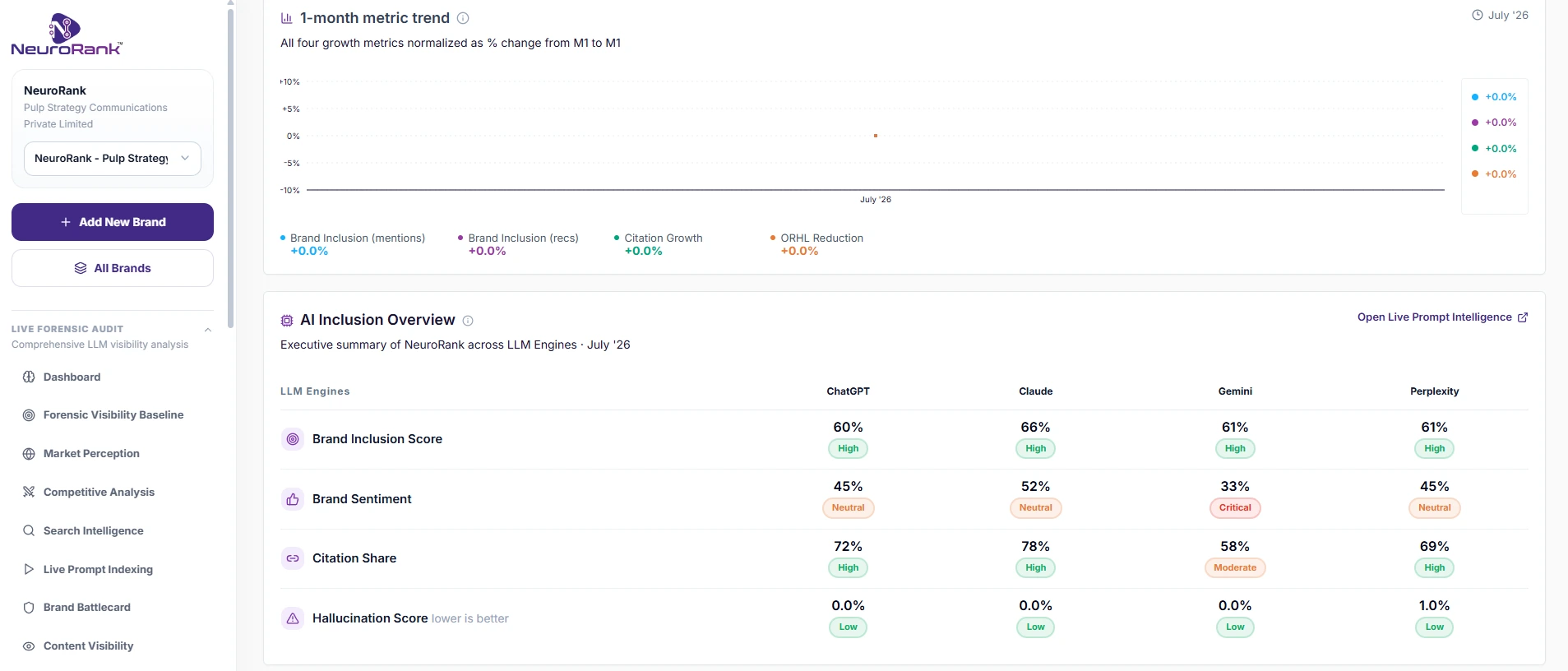
The Toolkit maps a wide topic-cluster picture without Claude; NeuroRank measures the four buyer-volume models live, including Claude, at fixed depth. Coverage you can check against your own buyers, and evidence from clean sessions, are the two tests that decide which number your team should act on.
Pros:
Recommendations arrive inside the suite the team already uses daily
Enterprise customers get optimization capability through Adobe LLM Optimizer
Cons:
Interpreting, prioritizing, executing, and verifying each change remains your team's process to build
No approval workflow is published
A Semrush user already has more data than time. That is the practical constraint this comparison turns on. Adding another report to the suite widens the map; it does not shorten the to-do list. The question that decides the purchase is which platform converts findings into a short, prioritized, verified fix list your team executes this month.
Pros:
Every gap becomes a fix linked to the exact source pages, ranked Must Have, Good to Have, or Close to Perfection, on every plan
Execution uses a two-step control borrowed from banking: one team member (the Maker) implements the fix, and a second (the Checker) reviews and approves it against a 38-point checklist before it goes live. In regulated industries such as finance and healthcare, that safeguard is usually a requirement, not a preference
Six recorded rejection reasons and an exportable log mean a client, a CMO, or a compliance owner can see exactly what changed, who approved it, and why
After approval, the corrected, consistent brand information is placed across your own site, earned coverage, and third-party sources through the patent-pending Model Conditioning Loop, and the improvement is measured against your first month's baseline
Cons:
A two-step approval adds a step to the workflow; a team of one assigns both roles to the same person and keeps the automated 38-point check
This is the largest difference between the two platforms. NeuroRank enterprise customers implement an average of 38 recommendations per prompt cluster per month. Across engagements, teams have averaged a 39.6% AI visibility lift, a 7% branded citation lift, and a 12% recommendation lift over approximately 80 days. Results vary by brand, category, and starting baseline. Every implemented recommendation has a record showing who approved it and against which checks, so the results can be presented to leadership with the evidence behind them. Unlike suite add-ons that report AI visibility alongside SEO, NeuroRank prescribes the fix, approves it through a named reviewer, conditions the models, and tracks the improvement.
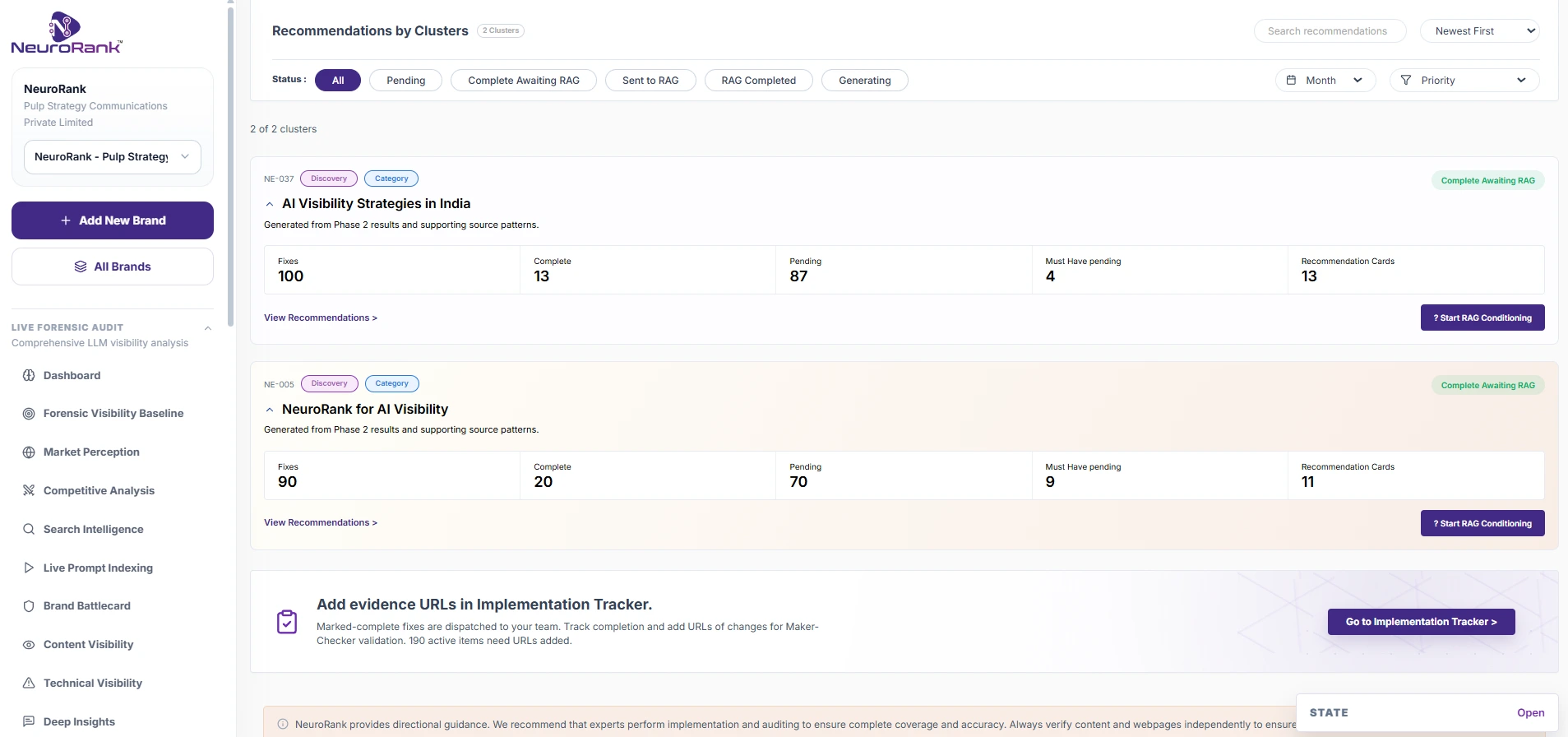
More reporting widens the map; NeuroRank shortens the list. Findings arrive as ranked fixes with a named approver, the models are conditioned, and the lift is tracked, on every plan. For a Semrush user with more data than time, that conversion is the entire purchase.
Pros:
Share and visibility movement registers weekly, by topic cluster, inside the suite
Cons:
Perception depth is not the design center: the Toolkit reports whether and where you appear, not what the models believe your strengths are or where they are factually wrong
Pros:
Layer one scores sentiment per model and adds an accuracy flag, separating a factual error about your pricing or capabilities from mere negative tone, because the two need different fixes
Layer two maps the strengths and weaknesses each model attributes to your brand, by region, so you can compare what the models say about you in Asia, Europe, the Middle East, the USA, and North America
Layer three, the Brand Battle Card, asks the models about your category without naming you and scores unprompted recall across six dimensions, showing whether the models recommend your brand on their own
Cons:
Perception is derived from the models' own responses; teams that also want population-scale consumer survey data will pair it with panel research
These are three different problems that need three different fixes. A model that describes your product accurately but negatively needs a reputation fix. A model that praises you while misstating your pricing needs a factual correction. A model that has never absorbed your brand needs to be conditioned from the start. NeuroRank tells you which problem you have, per model, per region.
Three facts settle the suite-versus-suite question, per the vendors' published documentation as of July 2026. The Semrush AI Toolkit runs a topic-cluster dataset with weekly refresh across five platforms. Ahrefs Brand Radar tracks AI mentions inside the Ahrefs index across six engines. Neither published list includes Claude. Both are measurement layers inside SEO suites, and neither publishes an approval workflow for the fixes. That is the layer NeuroRank adds. A full Ahrefs Brand Radar comparison is on its own page.
Semrush AI's design center is the suite: AI visibility as a line item in a subscription the team already runs, with an enterprise path through Adobe packaging. It suits a team that lives in Semrush daily, accepts five-platform coverage without Claude, and is invested in the Adobe stack.
This comparison usually lands on the SEO lead's desk, because the toolkit sits inside the tool they already run. NeuroRank is built for the same person, one layer further on: live evidence, gaps classified as Omitted, Replaced, Hallucinated, or Zero Leads, and a prescription attached to the exact pages that need work.
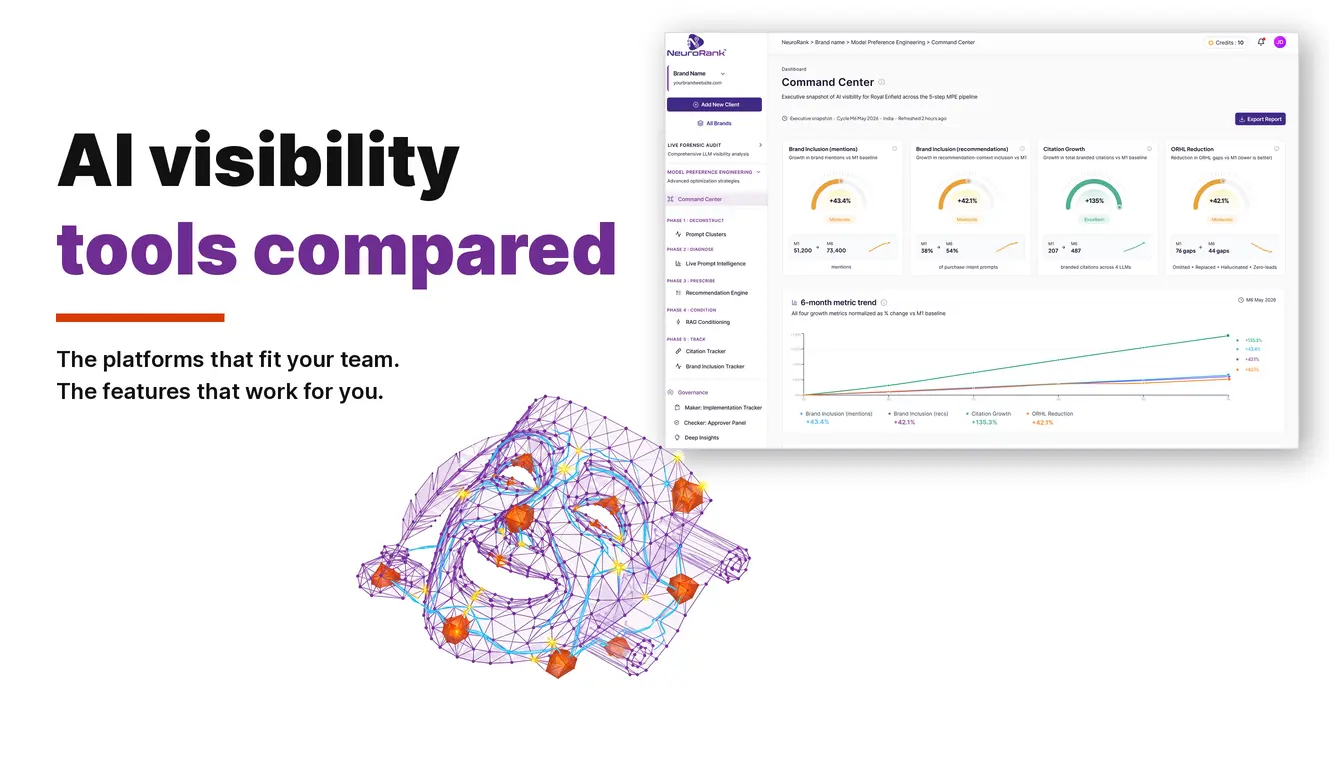
For the CMO, the Command Center is the executive layer: four headline metrics tracked against the first month's baseline, each card showing the formula behind its number, a heatmap of how much of the brand's possible AI surface is actively governed, and a one-click report export. For media and performance teams, Keyword Intelligence maps search demand into eight customer-intent journeys by region, roughly 180 keywords per workspace with difficulty and opportunity scoring, and the Citation Tracker classifies every cited source as branded, competitor, industry, social, or negative, which tells earned media exactly where placement effort will move the models. For SEO and digital leads, the diagnostic surface above is the daily instrument, and it needs no migration away from Semrush: the suite keeps managing rankings while NeuroRank manages the models.
NeuroRank Keyword Intelligence: search demand mapped into eight customer-intent journeys by region For agencies, NeuroRank runs multi-client, client-shareable reports are expressly permitted under its acceptable use policy, and no access to any client system is required. Several agencies already use NeuroRank to win new business, and structured advisory hours come embedded in every subscription.
Semrush AI fits the team that wants reporting inside its existing suite; NeuroRank fits the CMO, the media team, the SEO lead, and the agency that need the answers corrected under governance. Most teams keep the suite and add the practice.
Adding a module to an existing contract is an easy purchase, and that is exactly why the comparison deserves care. The question is not which dashboard looks better. It is whether the output changes what your team does on Monday.
Pros:
Reporting lives inside the suite the team already uses, and enterprise customers inherit Adobe-scale compliance and packaging through LLM Optimizer
Weekly refresh keeps the topic-cluster view current
Cons:
The view is engine-and-cluster reporting; an executive roll-up of governed change depends on the buyer's own work
No approval or audit layer is published, so the reporting shows movement, not who changed what and who approved it
Pros:
A suite reports AI visibility next to rankings and traffic, which is convenient. NeuroRank reports it against a first-month baseline with the calculation shown, alongside an approval record for every change, so the improvement can be defended rather than merely displayed.
Deep Insights, a conversational copilot scoped to your own audit data, answers questions across every section of the report and keeps the chat history
Every platform action is attributed in a usage ledger, to a person, a role, a timestamp, and a category, and reviews carry service-level indicators, so an enterprise sees not just what changed but how the team is running
Onboarding reads your existing footprint: the Brand Discovery Panel ingests your sitemap, LinkedIn presence, and llms.txt, and Makers work with CSV import and export
NeuroRank is ISO/IEC 27001 certified and GDPR compliant, and the practice runs without access to your internal systems, which shortens security review
Cons:
The dashboards are purpose-built for the practice rather than a general BI layer; no Looker Studio connector is published
Leadership gets numbers it can read and defend: baseline-tracked metrics with the calculation shown behind every number, and an approval record behind every change. Procurement gets an ISO/IEC 27001 certified, GDPR compliant platform that needs no access to any internal system. Both halves of the enterprise decision are answered on every plan.
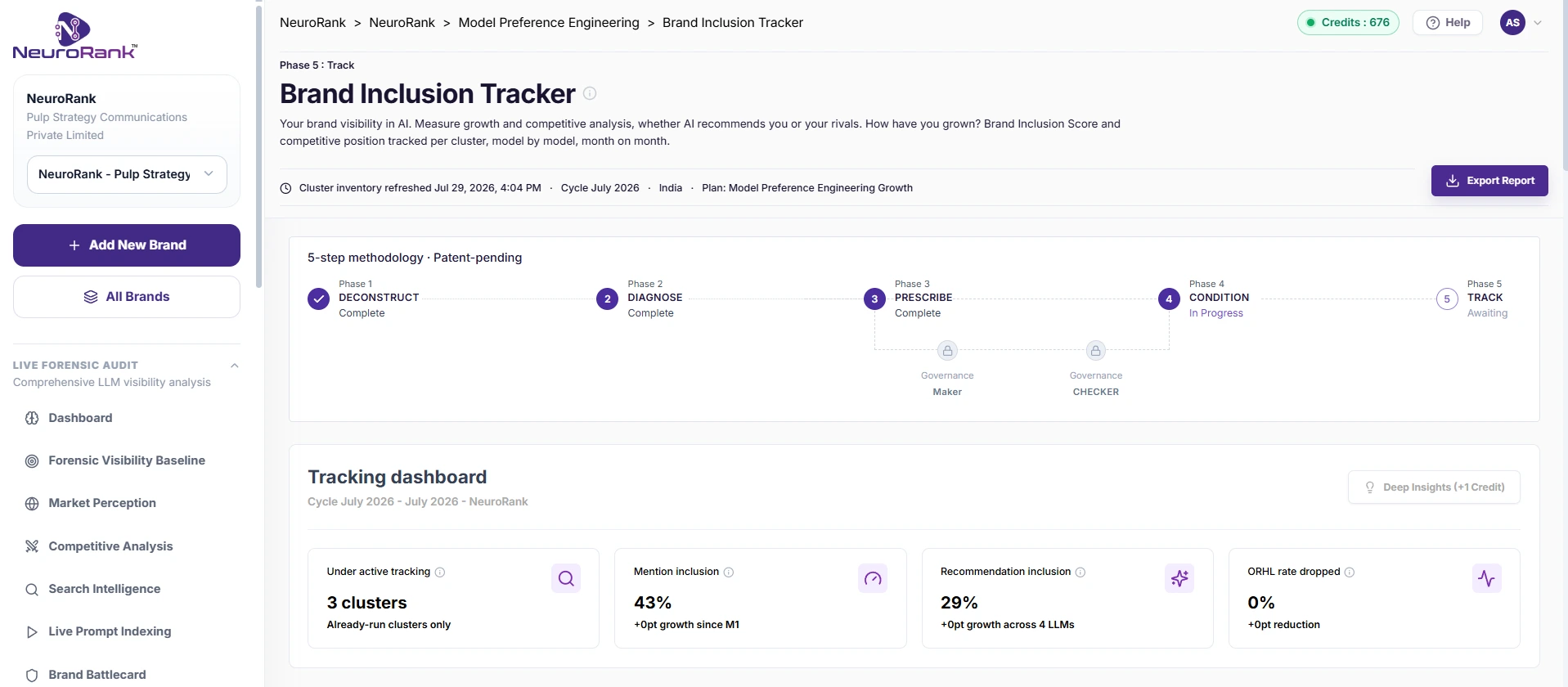
A practice can sit beside a suite and still carry its own evidence. NeuroRank was stress-tested across 350+ brands, including competitor brands, in 65 industries before opening globally. Its enterprise averages: 38 implemented recommendations per prompt cluster per month, a 39.6% AI visibility lift, a 7% branded citation lift, and a 12% recommendation lift over approximately 80 days. Results vary by brand, category, and starting baseline. None of that number set depends on suite migration or platform consolidation; it comes from the governed monthly cycle running on live model answers, which is why teams keep the suite and add the practice.
The launch record carries the agency side. Per NeuroRank's May 2026 launch announcement, several agencies use the platform to win new business and strengthen GEO offerings, and one agency onboarded three enterprise clients across the automobile and BFSI sectors. Client references in NeuroRank's external materials stay at sector level by policy: claims carry their evidence, and evidence carries its limits.
Semrush AI pricing works as an add-on to Semrush subscriptions, with enterprise capability packaged through Adobe LLM Optimizer, per its published documentation as of July 2026. Forward pricing is an Adobe decision; verify current figures on Semrush's pricing page before budgeting.
NeuroRank's pricing is fixed and published. Model Preference Engineering starts at USD 225/month. The full configuration is USD 350/month for 4 LLMs plus Combined synthesis, 1 prompt cluster. Enterprise is custom. The structure works in the buyer's favor over time: one new prompt cluster is added each month and every prior cluster re-runs, so month twelve tracks twelve clusters against a continuous baseline, and the dataset becomes an asset that grows with the subscription. And because the price stays fixed while the cluster count grows, the effective cost per active cluster falls month by month.
An add-on rides the suite bill and Adobe's packaging decisions; NeuroRank's price is fixed while clusters and the dataset compound. For a team budgeting a year of AI visibility work, one model produces a forecast, the other follows decisions made elsewhere.
Semrush AI alternatives split into two groups: measurement layers inside other suites, and full-cycle platforms. Five questions separate them. Which engines are covered, and is Claude among them? Does the platform prescribe fixes or only report and suggest? Who approves work before it goes live, and is the record exportable? Can it see perception, including factual errors about your brand? Can you verify the methodology on your own brand first? NeuroRank answers all five in writing, on every plan.
One fact frames the whole decision: the models keep answering buyer questions every day with whatever they currently believe about your brand, so the choice between the two platforms is really a choice about how quickly those answers get corrected.NeuroRank's stress test across 350+ brands, including competitor brands, in 65 industries kept returning one finding: the gaps live in prompts nobody had thought to check, where the brand is skipped, substituted, described incorrectly, or simply missing, and each cycle those answers stand, they inform the next ones.
Against that, the practice is a bounded line item: an average of 38 implemented recommendations per prompt cluster per month, with teams averaging a 39.6% AI visibility lift, a 7% branded citation lift, and a 12% recommendation lift over approximately 80 days. Results vary by brand, category, and starting baseline. The suite can wait for a roadmap; the models answer today.
Semrush AI is the right choice for teams that live in Semrush daily, want AI visibility reporting bundled into an existing subscription with the largest topic-cluster dataset behind it, accept five-platform coverage without Claude, and are invested in the Adobe stack.
If your team needs the question after measurement answered, what do we fix, in what order, approved by whom, with what proof it worked, that is the cycle NeuroRank was built to run. It runs all of it on every plan: live queries including Claude, fixes linked to source pages, a named approver on every change, model conditioning, month-on-month lift against a baseline, and an executive layer the CMO can read in one screen, from USD 225/month.
"I built NeuroRank to address GEO comprehensively, putting control in the hands of the user." Ambika Sharma, Founder, Chief Strategist at Pulp Strategy Communications and Product Architect of NeuroRank |
Keep the suite, and test the practice on your own brand. A Model Preference Engineering subscription starts at USD 225/month, and the first cycle produces the baseline: live answers including Claude, classified gaps, and a ranked fix list your team can start the same week. Enterprises and agencies can talk to the team about a custom configuration.
Stop paying for clicks that do not convert. Benchmark your AI visibility today with the world's most advanced seo ai tools.
Book a Strategic NeuroRank BriefingSemrush AI Visibility Toolkit sits within a wider search and marketing platform and publishes visibility and action features. NeuroRank focuses on its defined response measures, source-linked prescriptions, optional Maker-Checker review, and later matched runs. Compare product scope, supported surfaces, raw evidence, and implementation roles. Semrush documentation was checked in October 2026: https://www.semrush.com/kb/1493-ai-visibility-toolkit.
Adobe announced completion of its Semrush acquisition on April 28, 2026. That corporate fact does not establish that every Semrush AI Visibility Toolkit feature moved into an Adobe product or entitlement. Compare the offer under review with current documentation. Adobe’s dated announcement is at https://news.adobe.com/news/2026/04/adobe-completes-semrush-acquisition; the toolkit is documented separately by Semrush.
Semrush offers AI visibility products within its broader search platform. Check the current platform, prompt, and refresh coverage of the specific product and tier. Review Adobe and Semrush documentation for integrated features (Vendor source checked October 2026: https://www.semrush.com/kb/1493-ai-visibility-toolkit).
Check the current Semrush or Adobe AI visibility offer and its exact entitlements. NeuroRank’s current options are at https://neurorank.ai/pricing. Identify the product being compared before requesting terms (Vendor source checked October 2026: https://www.semrush.com/kb/1493-ai-visibility-toolkit).
Semrush offers several AI visibility products, so check supported surfaces for the specific product. NeuroRank’s current platform scope is at https://neurorank.ai/pricing. Google AI Overviews is a distinct Search feature, and Semrush’s Claude coverage should be checked by product. Semrush source: https://www.semrush.com/kb/1493-ai-visibility-toolkit (Vendor documentation checked October 2026).
Semrush and Ahrefs each offer AI visibility features inside broader SEO suites; their platform coverage varies by product and plan. Check the current documentation for Claude and other surfaces before comparing them. Choose based on the instruments and workflow you need, including any source-correction review (Vendor source checked October 2026: https://www.semrush.com/kb/1493-ai-visibility-toolkit).
For an AI visibility workflow, NeuroRank is one option: it measures supported responses, suggests source-linked corrections, supports optional Maker-Checker review, and tracks later outputs. Compare actual model and plan coverage with Semrush’s current products at https://neurorank.ai/pricing and Semrush’s site (Vendor source checked October 2026: https://www.semrush.com/kb/1493-ai-visibility-toolkit).
Use an SEO suite for indexing, technical health, search demand, rankings, and visits. Add AI visibility tracking when the team must inspect the actual generated answer, its citations, and whether the brand was recommended. Some suites cover parts of both jobs, so compare exact exports and methods. NeuroRank’s source-correction workflow can sit beside an existing search platform.