ArticleJune 11, 2026
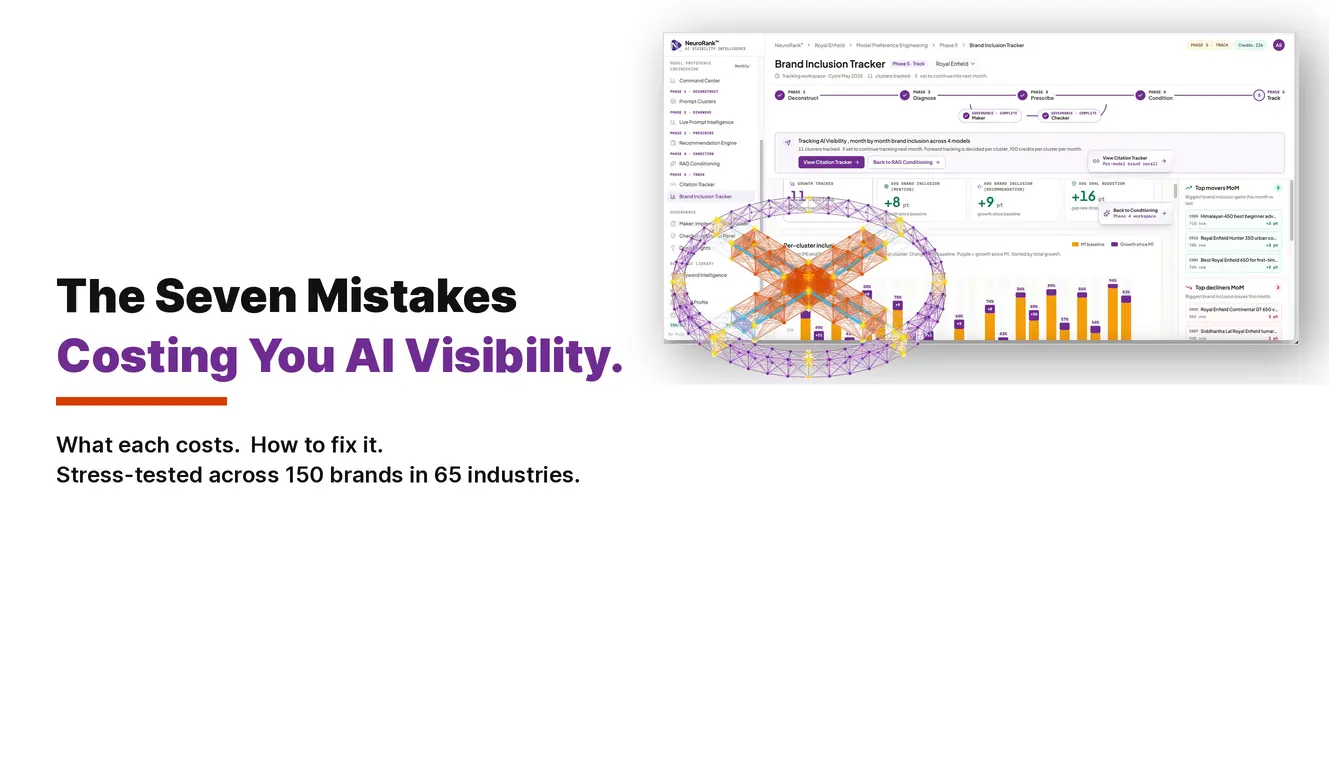
The Seven Mistakes Brands Are Making in AI Search Visibility, and What Each One Costs You
Read the article
Ambika SharmaFounder at Pulp Strategy Communications and NeuroRank.

Founder at Pulp Strategy Communications and NeuroRank.
Subscribe for Newsletters
By Ambika Sharma, Founder, Chief Strategist at Pulp Strategy Communications and Product Architect of NeuroRank®.
Generative engine optimization is not an SEO add-on. It is a separate retainer with separate economics. Agencies that build it as a distinct service line, with a distinct pitch motion, a distinct monthly practice, and a distinct renewal dashboard, are commanding higher annual contract values than their comparable search programs, with higher renewal rates, and an upsell ladder that compounds for eighteen months. 94% of CMOs are funding GEO this year. 7% have a specialist partner doing the work. The window to claim the partner seat is sixty days. After that, brands sign with somebody, and accounts lock for the budget cycle.
A high-revenue GEO practice is built on five pillars. The first is a distinct service line that bills against the GEO budget, not the SEO line. The second is a pitch motion that converts a CMO conversation into a signed retainer in three meetings. The third is a monthly practice that demonstrates tracked lift, not directional commentary. The fourth is a renewal dashboard the CFO can read without translation. The fifth is a rate card with a Core retainer, a one-time Setup fee, and a held-back Upsell ladder. Each pillar carries its own discipline. Each pillar carries its own price. Run end to end, the practice commands annual contract values higher than comparable search programs at the same agency, with the highest renewal rates in the category.
What follows is the playbook, in operational detail. The numbers and the framing are calibrated to mid-segment brand engagements. The platform recommendations appear later in the article, after the practice has been defined on its own terms.
Generative engine optimization is the discipline of diagnosing, prescribing, and conditioning how AI engines (ChatGPT, Gemini, Claude, and Perplexity) perceive, cite, and recommend brands at the moment a buyer is deciding. It works on the citation graph the model reads, not the search index Google ranks. It is measured in mentions, recommendations, and citation share.
The brief on the CMO's desk is being written by ChatGPT, Gemini, Claude, and Perplexity before the brand sees it. On Google, a buyer spends about three minutes scanning blue links. Inside an AI engine, the same buyer spends an average of sixteen and a half minutes in a single conversation. The model asks, cross-questions, and shortlists brands before any website opens. The surface optimized is not the website. It is the citation graph the brand does not own. Wikipedia. Reddit. Named industry forums. YouTube. Third-party media. The metric reported is not keyword ranking. It is brand inclusion, recommendation share, and citation growth. The methodology is not the SEO best-practice playbook. It is a different operating model, one that influences how four AI engines retrieve, weigh, and recall the brand.
The revenue consequence is mechanical. Bundled into the SEO retainer, GEO disappears as a free service. The brand pays once for two practices, and within two budget cycles, the agency is either renegotiating downward or losing the account. Billed as a separate retainer, GEO commands its own line on the rate card, with its own renewal conversation, its own dashboard, and its own upsell ladder. The agency captures the full price the buyer is prepared to pay for the service, which the third-party data confirms is meaningful. Retail AI referral traffic grew 693% year over year in the 2025 holiday season (Adobe Digital Insights, January 2026). Financial services grew 266% on top of an already elevated base. B2B technology grew 120%. Media and entertainment grew 92%. McKinsey forecasts USD 750 billion in United States revenue flowing through AI-powered search by 2028.
The signal from the room confirms the signal from the data. In a 26 June 2026 NeuroRank live poll of agency principals and in-house brand marketing leaders, ChatGPT took 57% of the vote as the engine that influences customer decisions most today. Claude took 29%. Perplexity took 14%. Gemini took zero, despite carrying the largest distribution surface of any AI engine. Run a practice only on ChatGPT and miss the consensus signal. Skip Claude and leave room for a competitor to take the differentiated position the engine prefers. Weight engine work by perceived buyer influence, not by distribution share.
Atomic Answer. GEO is a separate retainer because the surface, the metric, the methodology, and the renewal conversation all sit outside SEO. Bundled, it disappears as a free service. Billed separately, it commands its own line on the rate card. Buyers are spending 16.5 minutes per AI conversation, and 94% of CMOs are funding the practice this year.
The first failure mode is conflation. Most agencies walk into the room offering generative engine optimization as an add-on to the SEO retainer. Two practices treated as one practice become a free service inside a retainer already running at margin. The brand pays once. The agency does the work twice. After six months, the budget cycle closes without a defensible result. Either the agency loses the client or the client loses the year. Both outcomes are recurring patterns inside agencies the market still rates highly.
The second failure mode is the absence of an instrument. Without a platform that shows, model by model and prompt by prompt, where the brand is omitted, replaced, hallucinated, or stranded, the agency cannot answer the only question that matters to a CMO under board pressure. What is broken. What does the fix look like. How does the dashboard prove it worked. Personal ChatGPT accounts are not an instrument. Shared dashboards built on monitoring data are not an instrument. Anecdotal screenshots are not an instrument. Where the instrument is missing, intuition fills the gap. Intuition does not retain accounts.
The third failure mode is the report. A GEO retainer that produces a monthly dashboard the CFO cannot read will not get renewed. The dashboard must show baseline, lift, attribution, source URL, and competitive movement, in language a non-marketer can sign off on. When the dashboard is missing, the renewal defaults to a price conversation. Price conversations rarely favor the agency.
Atomic Answer. Most agencies fail the GEO pitch for one of three reasons. They bundle it into the SEO retainer and give the work away. They run on intuition without a platform that diagnoses by prompt and by model. Or they ship a monthly report the CFO cannot read. All three are recoverable, with the right operating model.
On 26 June 2026, NeuroRank ran a live working session for agency principals and in-house brand marketing leaders. Three live polls produced first-party data that does not appear in any third-party report. The sample is small. The conversation is qualitative. The polls are directional, not statistical. What they confirm is that the picture the third-party data describes is already the picture inside the room. Two of the three findings are woven into the argument earlier in this article. The third deserves its own moment, because it changes how an agency should package the entire service line.
First-party data, NeuroRank live webinar polls, 26 June 2026:
Nobody in the room picked a point capability. Every respondent picked the full stack. This is the buyer's vote against point tools, against unbundled offers, against the audit-only sales motion, against the dashboard-only retainer, against the strategy-only consulting fee. Buyers are telling agencies in their own words that they want the integrated platform plus service. For most agencies, this is a structural rewrite of how the rate card reads. Selling AI visibility as a USD 5,000 audit, billed once, leaves the bigger retainer on the table. Selling AI visibility as a quarterly strategy consult, with no platform underneath, leaves the renewal on the table. Selling competitor intelligence as a standalone subscription leaves the buyer wondering why they have to integrate three vendors.
The retainer that wins is the retainer that bundles audit, strategy, ongoing optimization, competitor intelligence, and reporting under one platform, one service line, one invoice, and one accountable lead at the agency. Model Preference Engineering is structured exactly this way. The pricing implication appears later in this article.
Atomic Answer. On 26 June 2026, every respondent in a live agency-and-brand audience said they want the full AI visibility stack from one partner. Audit plus strategy plus optimization plus competitor intelligence plus reporting. Zero votes for point capabilities. The agency offer that matches this brief is one platform, one service line, one invoice.
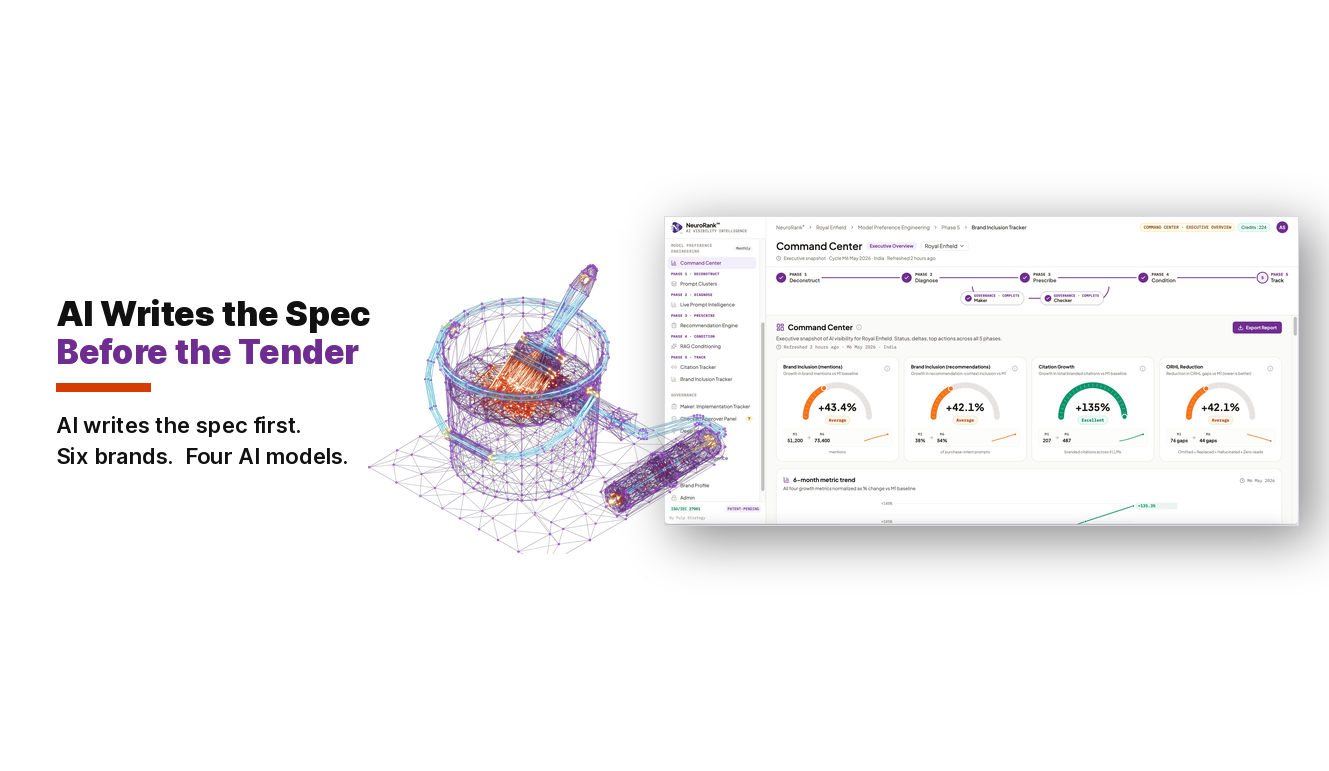
The practice runs on three motions. The pitch motion wins the meeting in a twenty-minute audit conversation. The practice motion earns the monthly retainer through a tracked five-step cycle. The renewal motion holds the account at the budget cycle through a dashboard the CFO can read. Each motion has its own deliverable. Each motion has its own price. Each motion has its own metric of success. NeuroRank is the patent-pending AI visibility intelligence platform that runs all three motions on one operating system, and what follows below describes how the practice is built around it.
Step | What It Does | Agency Output |
|---|---|---|
01 Deconstruct | Maps how each AI engine represents the client's brand against named competitors, by prompt cluster, by region. | Source map and baseline brand inclusion score, per model. |
02 Diagnose | Classifies every visibility failure into Omitted, Replaced, Hallucinated, or Zero Leads. | ORHL count by prompt and by model, with severity ranking. |
03 Prescribe | Issues the specific fix list with source URLs and priority bands. Sources include the client website, Wikipedia, Reddit, named forums, and third-party media. | Monthly action queue: Must-Have versus Good-to-Have, briefable to Maker. |
04 Condition | Influences the RAG (retrieval-augmented generation) memory layer of each engine after every fix passes Maker-Checker approval. | Tracked attribution from intervention to model response shift. |
05 Track | Quantifies month-on-month lift across Brand Inclusion, Citation Growth, ORHL Reduction, and growth against competition. | Command Center report the CMO presents to the board. |
Three things make this model run inside an agency, not only inside a brand:
Atomic Answer. NeuroRank gives an agency one platform that runs three workflows. The Live Forensic Audit wins the pitch. Model Preference Engineering earns the monthly retainer. The Command Center holds the account at renewal. One operating model, one dashboard, one defensible report, across ChatGPT, Gemini, Claude, and Perplexity.
The pitch motion converts a CMO conversation into a signed retainer in three meetings. What it requires is a forensic artifact the agency can produce on the prospect's brand inside a thirty-minute call. A structured intelligence report. Across all four AI engines that matter. Presentation-ready as a downloadable deck. Priced as a friction-free entry point, not as a paid engagement the prospect has to budget for.
The pitch artifact has four operational requirements:
The artifact that meets this brief is NeuroRank's Live Forensic Audit. Production time: twelve to twenty minutes. Output: a presentation-ready report and a downloadable deck. Price: USD 7 one-time compute fee. The audit covers all ten sections across ChatGPT, Gemini, Claude, and Perplexity, plus the Combined synthesis. Across more than 350 brands audited, the average hallucination baseline runs about 65%. On commercial prompts, named competitors take the recommendation slot more often than the audited brand. No system in the existing marketing stack captures this picture. Twenty minutes after the audit ends, the budget conversation opens.
The audit is the Trojan horse. What it converts to depends on the agency motion. A thirty-day pilot on a single prompt cluster. A quarterly engagement on a vertical. Or the full monthly practice retainer. The price of the audit (USD 7) does not reflect its commercial weight. It reflects the strategic preference that every prospect see one before they decide. The intelligence inside those ten sections is the intelligence most brands have been paying agencies to estimate.
Atomic Answer. The pitch motion needs a forensic artifact produced live, across four AI engines, presentation-ready, at a friction-free price point. NeuroRank's Live Forensic Audit meets this brief at USD 7, twelve to twenty minutes, ten sections of intelligence, downloadable deck. It opens the budget conversation. The retainer closes it.
Run Live Forensic Audit (USD 7). The audit is live at neurorank.ai. On request, the NeuroRank team will walk an agency through a live audit on a named prospect brand, ahead of the pitch.
The practice motion earns the monthly retainer. What it requires is a tracked monthly cycle the agency can run against an agreed prompt cluster scope, with attribution from each intervention to a measurable shift in the model's response, and a governance flow that enterprise and BFSI procurement teams can audit.
The cycle runs five disciplines every month, in sequence:
The methodology that runs all five disciplines is NeuroRank's Model Preference Engineering. The five steps are patent-pending. The ORHL taxonomy (Omitted, Replaced, Hallucinated, Zero Leads) is the language the agency uses with the client at every step. Inside one monthly cycle, MPE runs the five steps against an agreed cluster scope: eight to ten prompts per cluster, one new cluster added each month, all prior clusters re-run. The result is a cumulative longitudinal dataset that grows in richness over time. By month twelve, a typical engagement tracks twelve clusters across four engines, with month-on-month comparison on every metric the dashboard surfaces.
Every prescription becomes a logged task. When the agency Maker completes the task and submits the live URL, the Checker verifies it against best-practice benchmarks. Approved tasks proceed to the conditioning step. Rejected tasks return to Maker with specific reasons. The result is a disciplined practice with codified quality control and an auditable trail from recommendation to verified execution. This matters more than it sounds. CFOs sign off retainers when the work has receipts. NeuroRank gives the agency receipts.
For every prompt cluster the agency selects, NeuroRank issues two layers of recommendation. Must-Have fixes are the work without which lift will not happen. Good-to-Have fixes are the work that compounds once the foundation is in place. The recommendation cards name the source domain, the page that needs to change, the specific schema or content gap, and the priority band. When the cycle is followed, NeuroRank-tracked engagements show 50% to 60% improvement on Brand Inclusion within the first ninety days. The largest lift surfaces first in ChatGPT, Gemini, and Perplexity. Claude follows one cycle later, given its slower refresh cadence.
All four AI engines run a retrieval-augmented refresh cycle. They do not remember every change to every source. Without active conditioning, a correction made to a client's website might wait nine to twelve months before Claude rewrites the recall, even when the correction itself is technically perfect. Gemini refreshes in hours to days. ChatGPT and Perplexity sit between the two. The Condition step inside MPE influences the RAG memory layer of each engine and compresses the time-to-inclusion delta. For an agency, this is the difference between a six-month engagement that quietly underperforms its baseline and a ninety-day engagement that posts measurable lift in the Command Center. The same fix, conditioned, produces the report that gets renewed.
Atomic Answer. Model Preference Engineering is the monthly cycle the agency bills. Five steps. Eight to ten prompts per cluster. Maker-Checker governance. RAG Conditioning that compresses time-to-inclusion across all four engines. NeuroRank-tracked engagements show 30% AI visibility lift and 12% citation frequency lift inside 90 days. This is the work the CFO renews.
The renewal motion holds the account at the budget cycle. What it requires is a single dashboard the agency presents at renewal and the client logs into between renewals, showing five quantified metrics tracked month over month, by model and by prompt cluster. The dashboard has one job: every shift in the model's response must be attributable to a specific intervention, with a verifiable source URL the client can audit.
The five metrics the dashboard must surface:
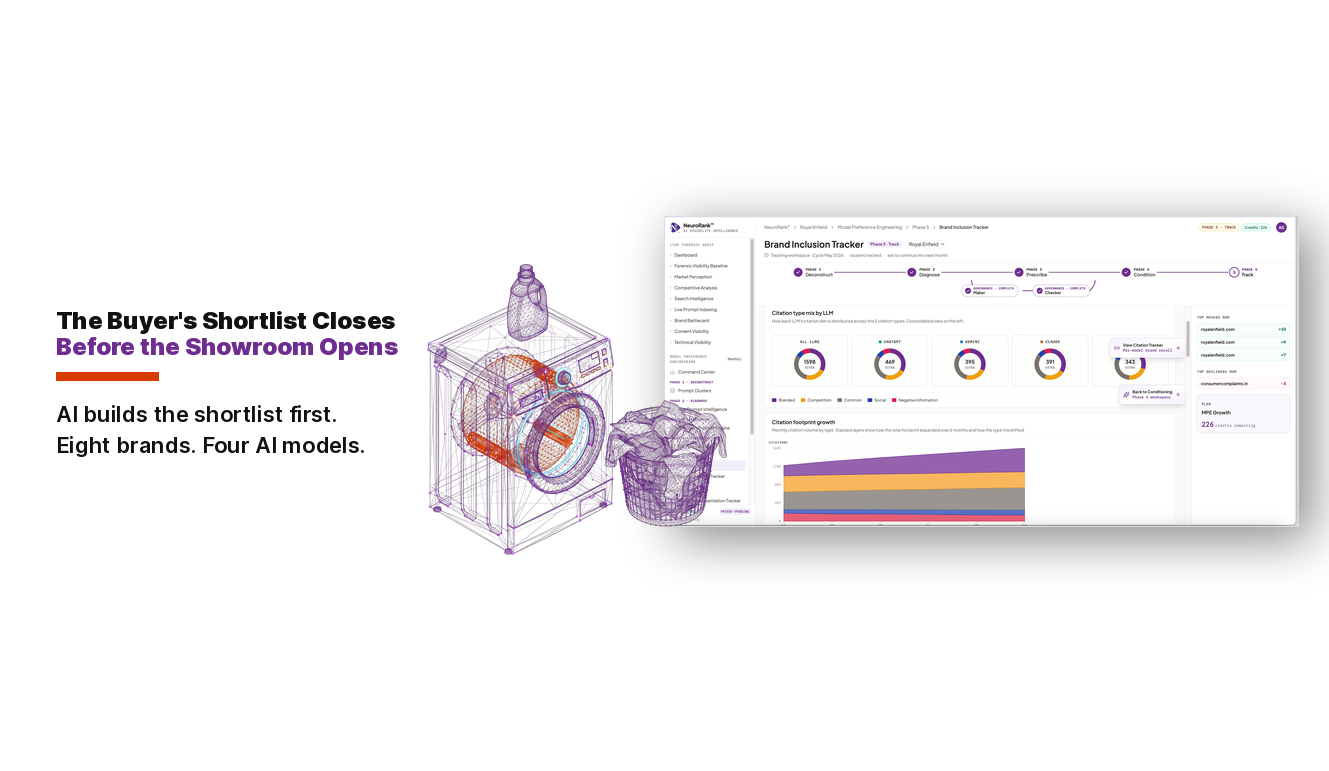
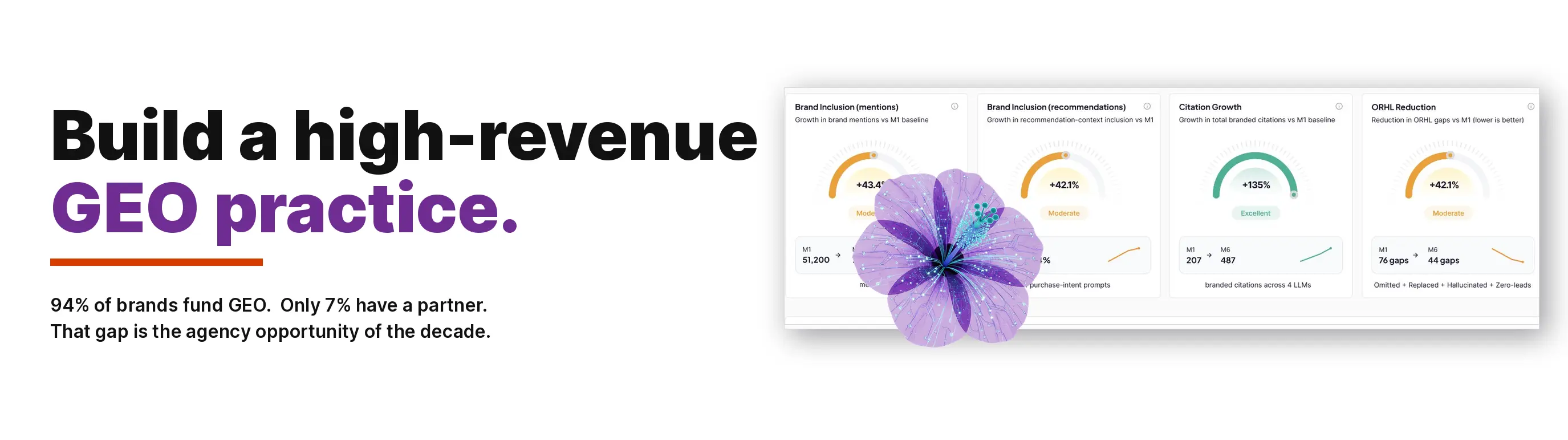
The dashboard that delivers this is NeuroRank's Command Center. The Citation Tracker drills the citation footprint down to the named domains pushing or pulling brand inclusion in either direction. Was the client's own website cited more this month than last. Did Wikipedia carry the new entry. Are the negative Reddit threads still anchoring perception. Did the YouTube transcript get extracted in answer one of the buying-intent cluster. The Brand Inclusion Tracker breaks every prompt cluster down by mention growth (M) and recommendation growth (R), against the baseline established when the cluster was added. A NeuroRank-tracked engagement seeing 66% improvement on a cluster between month two and month three is no longer doing GEO on faith. It is doing GEO on receipts. The renewal conversation reflects that.
Atomic Answer. The renewal motion needs a dashboard showing five attributable metrics monthly, by model and by prompt cluster. Brand Inclusion mentions, Brand Inclusion recommendations, Citation Growth, ORHL Reduction, and growth against competition. NeuroRank's Command Center delivers this, with every shift in the model's response attributed to a specific intervention and a verifiable source URL. This is the report that gets renewed.
The rate card carries three lines. The Core retainer. The one-time Setup fee. The held-back Upsell ladder. Each line addresses a different commercial moment, and each line carries its own pricing logic.
The Core retainer funds the monthly practice. The recommended band for mid-segment brand engagements is two to five lakhs INR per month, or the equivalent in the client's currency, calibrated to category, prompt cluster scope, and content production load. The retainer covers the full integrated stack the buyer is actively asking for. In a 26 June 2026 NeuroRank live poll, every respondent picked the full AI visibility stack from one partner over any single capability. Audit, strategy, ongoing optimization, competitor intelligence, and reporting, from one partner, on one invoice. Pricing the retainer as the integrated offer is what the buyer's brief requires. Pricing it as a point capability leaves the bigger fee on the table.
The Setup fee is a one-time charge that covers the baseline forensic audit, the initial Deconstruct pass, the prompt library scoping against the client's buying-intent prompts, the competitor set definition, and the Maker-Checker workflow configuration. This is the work that takes the practice from blank to ready-to-bill, and clients expect to pay for it. Recommended Setup band: one to three lakhs INR, depending on portfolio breadth and competitor depth.
The Upsell ladder lifts account value over the engagement without renegotiating the Core fee. Each rung carries its own price, and each rung is added when the practice produces tracked lift the client can see in the Command Center. Additional prompt clusters as the practice scales. Additional geographies as the brand expands. Deeper competitive intelligence layers as the category sharpens. Agency-branded Checker access for the client team. GEO consulting attached to the practice. Over an eighteen-month engagement, the Upsell ladder reliably doubles the annual contract value of the original Core retainer.
The platform itself is a cost line, not a revenue line. NeuroRank prices the platform at USD 225 per month for the Growth entry configuration (one LLM, one prompt cluster) and USD 350 per month for the full configuration (four LLMs, Combined synthesis, one prompt cluster). Live Forensic Audit is USD 7 one-time. Enterprise is custom-scoped. What gets resold is not the platform. What gets resold is the discipline, the cadence, the strategy, and the report. That separation is what protects margin, because the client is paying for the agency service, not the SaaS subscription. Most importantly, the integrated invoice gives the client one number to negotiate, not five.
Atomic Answer. The high-revenue rate card carries three lines. The Core retainer (two to five lakhs INR per month for mid-segment), the one-time Setup fee (one to three lakhs INR), and the held-back Upsell ladder. The platform sits inside the retainer at standard SaaS pricing. The Upsell ladder reliably doubles the annual contract value over eighteen months. The platform is the cost line. The service layer is the margin.
Six months from now, the 2026 budget cycle will be closed. The clients in the agency's prospect list will have either chosen a GEO partner or quietly started building in-house. Once a client signs a GEO retainer with somebody, that account is locked for the next budget cycle. The window to be on the brief is the time it takes for the client to choose. The average has shrunk from five months to roughly sixty days in the past two quarters.
The compounding cost is mechanical. AI models learn from what they already say. A brand cited today is more likely to be cited tomorrow. A brand absent today is harder to surface next quarter, because the model has reinforced the absence in two more refresh cycles. A brand misrepresented today, left uncorrected, is more likely to be misrepresented tomorrow. The model has weighted the bad signal again. Eight months of trial-and-error inside a brand team without an instrument becomes harder to recover from than starting eight months later from baseline. Brands that began early, built large in-house GEO teams, and ended up with a worse position than competitors who started two quarters later with the right discipline are now a recurring pattern in NeuroRank engagement data.
Look at the prospect list. Every name on it is doing some version of this same calculation right now. The polling data confirms it. When NeuroRank asked the room on 26 June 2026, not a single respondent was on the sidelines. 43% are actively investing. 57% are exploring. Zero are still deciding whether GEO matters. Those 57% are the briefings that have not yet been written. The agency that brings the audit, the practice, and the dashboard to that meeting is the agency that defines what GEO means for that brand. The agencies that arrive after that meeting are pitching against the partner who already won. The window is two months.
Atomic Answer. The 2026 GEO partner decision is being made inside a 60-day window. Once a brand signs with a partner, the account is locked for the budget cycle. The agency that arrives first with audit, practice, and dashboard defines GEO for that brand. The agency that arrives second is pitching against a signed retainer.
The practice requires a platform built for four engines, a citation graph the brand does not own, a Maker-Checker governance flow that enterprise and BFSI procurement teams require, and a measurement system that quantifies brand inclusion, citation growth, and ORHL reduction as separate axes. Unlike SEO platforms that were built for one engine, one surface, and a keyword index, NeuroRank is the patent-pending AI visibility intelligence platform built for exactly these requirements. It is a different category of work, with a different deliverable, and a different line on the invoice.
Capability | SEO Platform (Bolt-On) | NeuroRank Platform |
|---|---|---|
Engines tracked | Google primarily, plus optional Bing | ChatGPT, Gemini, Claude, and Perplexity, plus Combined synthesis |
Surface optimized | Website (single asset the brand controls) | Citation graph (Wikipedia, Reddit, YouTube, named forums, third-party media, plus the website) |
Metric reported | Keyword rankings, clicks, impressions | Brand Inclusion, Citation Growth, ORHL Reduction, growth against competition |
Failure taxonomy | None ("the rank dropped") | ORHL (Omitted, Replaced, Hallucinated, Zero Leads), per prompt, per model |
Recommendation depth | Page-level (title tag, meta, internal link) | Source-level (which third-party site, which page, which schema), with priority bands |
Governance | None or external | Maker-Checker built in, with auditable trail |
Refresh alignment | Google index | Active RAG Conditioning across all four engines |
Methodology | Best-practice rules, agency interpretation | Five-step patent-pending methodology (Deconstruct, Diagnose, Prescribe, Condition, Track) |
Atomic Answer. An SEO platform bolt-on tracks one engine, one surface, and clicks. NeuroRank tracks four engines, a citation graph the brand does not own, and brand inclusion plus citation growth plus ORHL reduction as separate axes. The category is different. The deliverable is different. The invoice is different. Sold inside one retainer, the client pays once for two practices.
Across the 350-brand stress test NeuroRank has run since launch, tracked engagements show 30% lift in AI visibility and 12% lift in citation frequency inside ninety days. The largest lifts surface first on ChatGPT, Gemini, and Perplexity. Claude follows one cycle later, given its slower refresh cadence. These are tracked outcomes, not promises. Variance by category, starting baseline, and competitive density is meaningful. The Command Center records the variance honestly, which matters more than smoothing it would. A retainer that quietly under-promises and consistently over-delivers is the retainer that renews.
Atomic Answer. NeuroRank-tracked engagements across 350 brands and 65 industries show 30% AI visibility lift and 12% citation frequency lift inside 90 days. Largest lifts on ChatGPT, Gemini, and Perplexity first. Claude follows one cycle later. These are tracked outcomes, recorded with their variance, not promises.
Most agencies cannot guarantee GEO outcomes. They cannot prove a specific fix moved the model. NeuroRank attributes every shift in the model's response to a specific intervention. Each intervention is logged against a baseline. Each one is approved through Maker-Checker. Each one carries source URLs the client can verify. That operational chain (baseline plus tracked lift plus attribution plus governance plus verifiable source) converts the agency promise from "we will try our best" to "here is what we will deliver, and here is how the dashboard proves it." When the agency can stand behind a number with receipts, the guarantee is no longer a marketing position. It is a defensible business model.
Inside NeuroRank's own engagements, the construct that has worked is a measurable ORHL Reduction or Citation Growth target inside the first ninety days. That target ties to a month-three Command Center review. A remedy clause sits behind it if the target is missed. The specific number is calibrated to the client's category, the baseline visibility, the competitive density, and the prompt cluster scope. Agencies that adopt the platform are encouraged to design the guarantee against their own engagement data. The platform supplies the receipts.
Atomic Answer. An agency can guarantee a GEO outcome only if it can prove a fix moved the model. NeuroRank attributes every shift to a logged intervention, approved through Maker-Checker, with verifiable source URLs. The recommended guarantee construct: a measurable ORHL Reduction or Citation Growth target inside 90 days, with a month-three Command Center review and a defined remedy clause.
India is the world's largest GenAI app market. Sensor Tower, syndicated through TechCrunch in February 2026, recorded 180 million monthly active ChatGPT users in India and 118 million on Gemini. Generative AI app downloads grew 207% year on year in 2025. Downloads peaked at +320% in September and +260% in October. India is the fastest-growing region for AI search referrals globally. On the digital ad side, dentsu-e4m's 2026 report places India's digital ad market past Rs 69,856 crore. That is more than 61% of total ad spend, crossing the Rs 1 trillion mark in 2026.
The implication for an Indian agency is a window that closes faster than the global equivalent. Asia-Pacific is the fastest-growing martech region. Grand View, Precedence, and MarketsandMarkets all concur. The behavior, the budget, and the buyer journey are already on the AI answer layer for high-velocity categories: BFSI, e-commerce, automotive, healthcare, and B2B technology. What is missing is the agency capability that can serve the demand at scale. The next two quarters are when that capability gets locked in for 2026 and 2027.
Atomic Answer. India is the world's largest GenAI app market. 180 million ChatGPT MAU. 118 million Gemini MAU. AI app downloads up 207% year on year. Digital ad spend past Rs 69,856 crore. Asia-Pacific is the fastest-growing martech region. The agency capability gap closes inside the next two quarters.
Two paths into NeuroRank for agencies and their clients:
When AI writes the brief on the prospect's desk, will the agency be in the answer?
Stop paying for clicks that do not convert. Benchmark your AI visibility today with the world's most advanced seo ai tools.
Book a Strategic NeuroRank Briefing