ArticleJune 30, 2026
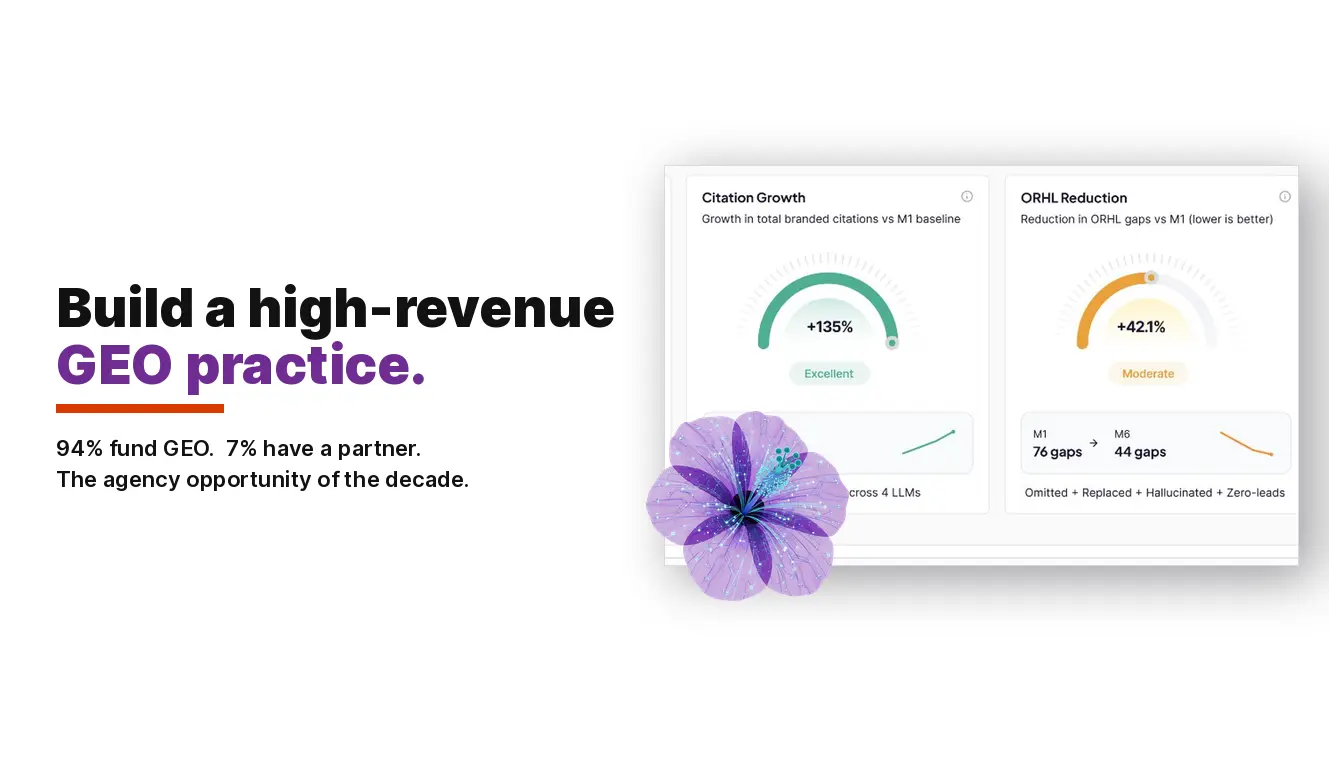
How to Build a High-Revenue Generative Engine Optimization Practice: The Agency Playbook
Read the article
Ambika SharmaFounder at Pulp Strategy Communications and NeuroRank.

Ambika Sharma
Ambika Sharma is the Founder & Chief Strategist of Pulp Strategy, a multi-award-winning business transformation and digital agency, and Prod... Read more
Subscribe for Newsletters
By Ambika Sharma, Founder, Chief Strategist at Pulp Strategy Communications and Product Architect of NeuroRank®
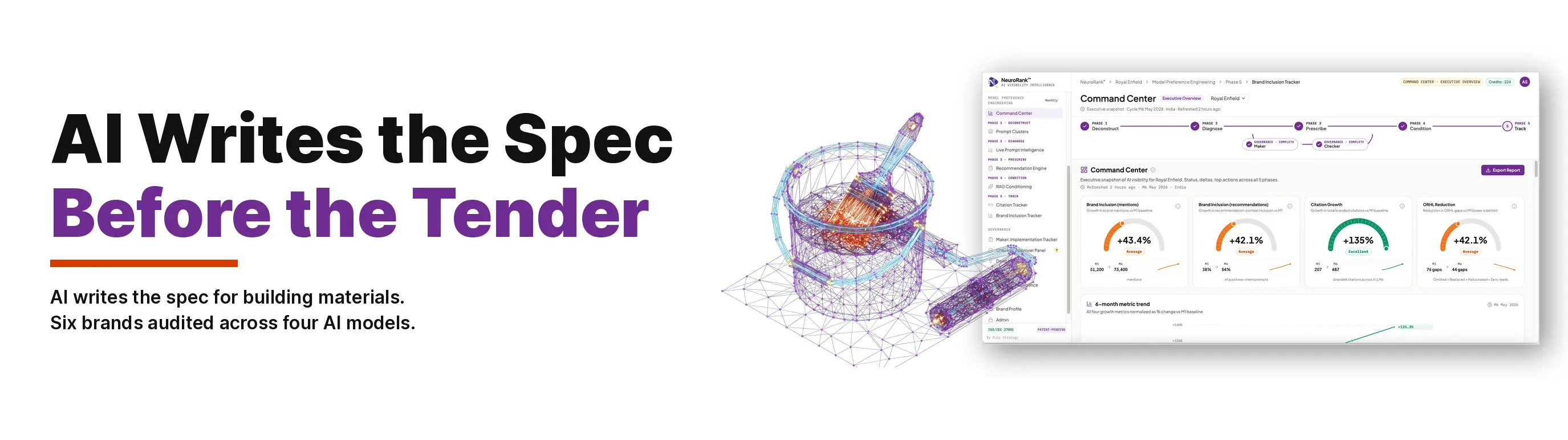
NeuroRank® audited six Indian building materials brands across ChatGPT, Gemini, Claude, and Perplexity. AI is now writing the specification sheet that architects, contractors, and homeowners use to decide. The brand AI does not name is the brand the specifier does not call.
Methodology note. All findings in this article are captured AI artefacts describing what large language models said about each brand in NeuroRank Live Forensic Audits between February and May 2026. They are not statements about the brands themselves. Verified counter-facts from the brand websites, regulatory filings, and audited reports appear alongside each captured artefact so readers can see the gap. |
An architect in Bengaluru opens ChatGPT at eleven at night with a wall finish to specify by morning. The model gives her four names. None of them is Nerolac. She specifies one of the four. The Kansai Nerolac sales rep, who has trained her team for years and carried the BIS file to her project office, never gets the call.
A homeowner in Pune asks Gemini for the best plywood brand in India for a kitchen renovation. The model returns four names. None of them is Greenply. He sends the list to his contractor. The Greenply distributor in Pune, who has the largest market share in the organized plywood category, is not in the conversation.
A contractor in Chennai asks Claude which suppliers to use for a luxury hotel build-out. The model returns NITI Aayog, CII Infrastructure Database, and Indian Infrastructure Portal. He is confused. He was asking about a digital marketplace. He had heard of Infra.Market but the model rebuilt it as a government platform.
The cohort is not just architects and contractors. Ajay Raj Sharma, an insurance sales professional rebuilding his home in Noida, captured the shift in a single sentence.
“My budget is not large enough for an architect, but I have a designer who I found word of mouth. However, every material and choice after that is made using Gemini and ChatGPT. Even the design mood boards are ratified there. There just isn't the time to go window shopping for each specification, but I need to ensure that there is quality when making my final buying list.” Ajay Raj Sharma, Noida. |
The pattern repeats. The mid-sized Indian homeowner with budget but limited time turns to the model for both inspiration and qualification. The designer recommends the look. The model qualifies the brand. The architect, where present, signs off on a draft AI has already shaped. The dealer, last to know, never enters the early decision.
NeuroRank ran Live Forensic Audits on six Indian building materials brands across ChatGPT, Gemini, Claude, and Perplexity. Greenply, Koemmerling, JK Cement, JK Maxx Paints, Nerolac, and Infra Market. Six brands spanning plywood, windows, cement, paints, and construction-materials procurement. Four models. One pattern, repeated brand by brand: AI is now writing the spec sheet that the architect, the contractor, and the homeowner use to decide. The captured artefacts show what AI says when no one is checking.
Three captures from the audit. JK Maxx Paints. Three of four large language models could not place the brand inside JK Cement, its own parent. Claude conflated it with TK Maxx, the TJX-owned fashion retailer. Infra.Market. Three models, three different wrong categories. Claude rebuilt it as a government infrastructure platform (competitors listed: NITI Aayog, CII, Indian Infrastructure Portal). Gemini rebuilt it as a cement and steel manufacturer. The combined view rebuilt it as an Larsen and Toubro-style EPC contractor. Greenply. ChatGPT's own audit response found no LLM-generated responses for the spaced form “Green Ply” across the four models. Complete category invisibility from a spacing difference. Source: NeuroRank GEO Benchmark Index, building materials slice, February to May 2026. |
“In building materials, the order does not start at the tender. It starts at the spec. And the spec is now being written by an AI that cannot tell Greenply from its own demerged sister, or JK Maxx Paints from a fashion retailer.” Ambika Sharma, Product Architect, NeuroRank |
Across six brands and four models, the captured pattern is consistent enough to name. We call it the AI Shortlist Filter. AI fails a brand in four ways, and all four are live in this cohort. It closes the shortlist before the brand is mentioned. A competitor squats on the position that should belong to your brand. It invents facts about your products, your prices, your launches, and your corporate parent. And it writes the specification, naming the products that go on the BoQ. The brand AI does not name does not reach the BoQ. The brand off the BoQ does not reach the tender. The brand off the tender does not reach the order.
Building materials sells by specification. When AI writes the specification, the brand AI does not name is the brand the order never reaches.
The JK family, comprising JK Cement, its paints subsidiary JK Maxx Paints, and its J.K. Organisation sister JK Lakshmi Cement, appears at every step of the analysis below. Not as a NeuroRank client, but as the cohort's clearest single demonstration: one corporate architecture, all four failure modes, all in the captured AI artefacts.
The order of influence in building materials has flipped. For four decades, the order was the brand built recall, the architect specified, the BoQ followed, the tender followed, the dealer closed the order. Each step inherited from the step before. The brand's investment in recall paid out at the specification stage, where the architect named what they remembered.
The order is now: the model writes the first draft of the specification, the architect or homeowner accepts or edits it, the BoQ inherits the AI draft, and every later stage of the funnel (tender, procurement, dealer call) inherits the AI draft as well. The brand that built recall but did not condition the four models is invisible at the new first step. The brand's investment in recall now pays out only on the rare query where the homeowner or contractor types the brand name into the chat.
We call this the Specification Inversion. Across this cohort, every one of the four failure modes below is a downstream consequence of it. The model writes the first draft. The brand that is not on the draft is not in the funnel.
44 percent of online buyers in the United States now start product discovery inside a large language model, per Bain and Company, April 2026. In B2B specification categories, the share is rising fastest where AI is trusted to pre-qualify suppliers.
Three of four large language models cannot place JK Maxx Paints inside JK Cement, its own parent. Claude confused it with TK Maxx, the fashion retailer.
AI rebuilt Infra.Market three different wrong ways: as a government infrastructure platform (Claude, listing NITI Aayog and CII as competitors), as a cement and steel manufacturer (Gemini, listing UltraTech and Ambuja), and as an Larsen and Toubro-style EPC contractor (Combined view). Three models, three wrong categories.
Greenply was confused with GreenPanel, its own demerged sister company. Greenply spun off Greenpanel Industries as a separate listed entity in October 2019. AI treated them as unrelated rivals.
One model could not establish Nerolac's founding at all. Nerolac was founded on September 2, 1920, as Gahagan Paints and Varnish Co Ltd at Lower Parel, Mumbai. Another model called Nerolac the market leader when Asian Paints holds the largest share of the decorative segment.
ChatGPT captured a JK Cement IPO date of 2025; the company listed in 2005-2006. The same audit captured a 1974 founding date for the company (the Nimbahera grey cement plant commenced production in May 1975) and claimed JK Cement sells ready-mix concrete (its product mix is grey cement, white cement, putty, and paints through JK Maxx). The captured EPS growth of 50 percent stood against an actual figure of roughly 8 percent in the relevant period.
This week. Publish a single corrective page on your brand's corporate architecture: parent, subsidiaries, demergers, JVs, and historical name changes, all tagged with structured data. Half the failures captured in this cohort are corporate-architecture errors AI can be taught to fix.
ORHL: the four ways AI fails a brand. Omitted. The brand is absent from category answers. The shortlist closes before the brand is named. Replaced. The brand is substituted by a competitor. A rival squats on the position that should be yours, so the buyer hears the rival's name where they should hear yours. Hallucinated. False facts are generated about the brand. Founding dates, ownership, prices, products, certifications, and launches that do not exist. Zero Leads. The brand appears but no purchase pathway is offered. In building materials, the specification stage replaces the after-sale stage as the place where Zero Leads bites: AI writes the spec sheet but never names where to buy. |
Key terms used in this article AI Shortlist Filter. The four failure modes that determine whether a brand is recommended, substituted, mis-described, or under-converted in AI answers across ChatGPT, Gemini, Claude, and Perplexity. Brand InclusionScore. The frequency with which a brand appears in AI responses to category and specification queries across multiple models and personas, normalized over cold (zero-history) runs. Reported as a band: High, Medium, or Low. AI visibility governance. The board-level discipline of measuring, correcting, and continuously conditioning what AI says about a brand across the four major models, so AI answers carry the same accuracy as audited disclosures. |
Specification has always been the decisive moment. The architect names the brand on the drawing, the contractor lists it on the BoQ, the homeowner accepts the line item. From there, the order follows. The category has trained its sales teams on this fact for decades.
The specification moment has moved. The architect, between drawing and tender, asks AI to pre-qualify products. The contractor, between BoQ and procurement, asks AI which suppliers to call. The homeowner, between Pinterest and the shopping trip, asks AI which brand to trust. Three categories of specifier, all turning to the same four models, all making decisions that close the funnel before the brand's sales team sees the lead.
In the United States, Bain and Company captured 44 percent of online buyers starting product discovery inside an LLM in April 2026. Buyers arriving from ChatGPT to commercial sites convert at roughly 7 percent versus 5 percent from Google, per Similarweb's 2026 Generative AI Statistics report. The buyers AI sends are not the marginal buyers. They are the high-intent buyers who already half-decided before they left the chat. In building materials, those buyers are architects, contractors, and homeowners with a brief, a budget, and a deadline.
None of the brand-building you have done shows up in that chat unless AI has been taught what to say. The BIS marks, the BEE star ratings, the IGBC credit scores, the testing reports, the architect-CPD programmes, the dealer-loyalty schemes, none of them travel into the AI answer by default. The four models build their own answer from training data of mixed vintage, third-party content of mixed reliability, and the residue of historical search rankings. The result is the captured artefact: what AI says when nobody is checking.
Six brands. Four models. The cohort below shows what AI is saying right now.
AI hands the architect, the contractor, and the homeowner four names. Yours is not one of them. The dealer never meets the buyer. The architect never calls the rep.
Nerolac is the largest industrial paint company in India and the third-largest decorative paint company. Captured artefacts across the audit showed Nerolac dropped from top-five paint shortlists despite that presence. Claude's audit response stated: “LLMs may understate differentiation” and that the brand is often “omitted from top-5 brand recommendations despite its presence in the Indian market.” When Claude was asked to establish the brand's founding details, it returned: “Brand-level founding information not explicitly stated in verified public sources.” Nerolac was founded as Gahagan Paints and Varnish Co Ltd on September 2, 1920, at Lower Parel, Mumbai. The Goodlass Wall era, the 1957 public listing, the Kansai Paint majority stake from 1999, and the 2006 rename to Kansai Nerolac Paints Limited are documented in BSE filings and the company's investor materials. The audit captured AI's inability to anchor the brand.
Greenply showed a sharper artefact. ChatGPT's audit response opened by reporting that no real user search queries or LLM-generated responses involving the spaced form “Green Ply” were found across ChatGPT, Gemini, Claude, or Perplexity. The captured wording named a “notable absence of AI discussion or indexing” around the brand. Greenply Industries is the largest organized plywood player in India, with manufacturing facilities in West Bengal, Nagaland, Gujarat, and Uttar Pradesh, plus international plants in Gabon and Myanmar. The captured artefact reveals an entity-name void: AI looking for the spaced form “Green Ply” returns nothing because the actual brand is the unspaced “Greenply.” A spacing difference is enough to close the shortlist on one of the most established names in the category.
Koemmerling, the German uPVC and aluminium window-systems brand of the profine Group, captured a Medium Brand InclusionScore on the non-branded query “top aluminium window and door brands in India.” The audit walkthrough documented inclusion in roughly five to six of ten cold-prompt runs. On branded queries it surfaced reliably. On the high-intent non-branded category query that an architect or contractor would actually run, it was a coin flip.
The same entity-name void that erased Greenply erased Infra Market. Perplexity's audit response stated: “All credible sources refer to the platform with a dot in the name; standalone 'Infra Market' has no verified public data.” Two brands, two punctuation voids, both Omitted by AI for the difference of a space or a dot.
Replaced does not mean your brand is ranked below a rival. It means a competitor occupies the slot that should be yours, and the buyer hears the rival's name in your place.
Infra.Market is the clearest case in this cohort, and one of the strongest captured artefacts in the entire research series. Claude's audit response named its top competitors as Construction Sector Transparency Platform (CSTP), NITI Aayog Infrastructure Analytics, Indian Infrastructure Portal (IIP), CII Infrastructure Database, and Feedback Infra. A model rebuilt a private construction-materials marketplace as a government infrastructure analytics platform. Gemini, asked the same question, returned Tata Steel BSL, ACC Limited, Ambuja Cements, UltraTech Cement, and JK Cement: a list of cement and steel manufacturers. A model rebuilt the marketplace as a manufacturer. The combined view from the audit returned Larsen and Toubro, Afcons Infrastructure, Dilip Buildcon, Reliance Infrastructure, and RITES Limited: a list of EPC contractors. A third rebuild, this time as a construction company. Three models, three different wrong categories, all of them government-adjacent or industrial heavyweights squatting on a marketplace's position. Only ChatGPT and Perplexity returned the verified competitive set: OfBusiness, Zetwerk, Moglix, and ProcMart.
Nerolac was subjected to a quieter form of the same failure. Claude listed Sherwin-Williams (India operations) and Nippon Paint among Nerolac's competitive set. Sherwin-Williams has historically had a limited India retail presence. The model substituted an American brand into a position that, in the Indian market, belongs to Asian Paints, Berger, AkzoNobel India (Dulux), and Indigo Paints. Perplexity captured another flavor: “Incorrectly stating Nerolac as market leader, when Asian Paints holds over 50% share.” The rival was lifted; the leader was lowered.
JK Cement showed a more expensive variant. One audit response attributed JK Cement's market cap to the wrong company: “LLM gives JK Cement market cap ₹115B (JK Lakshmi) not accurate.” JK Cement and JK Lakshmi Cement are two separately listed companies. They share the J.K. Organisation lineage, founded in 1918 by Lala Juggilal Singhania and Lala Kamlapat Singhania, but they are not interchangeable for any financial, regulatory, or commercial purpose. A model squatting JK Lakshmi's market data on JK Cement's identity is the kind of artefact that creates downstream errors in investor research notes, in journalist briefs, and in the AI summary an analyst pastes into a board pack.
Two families in this cohort. Two patterns of identity collapse. Same root cause. The JK family. JK Maxx Paints is a wholly owned subsidiary of JK Cement Ltd. JK Cement entered the paints business through board approval in March 2022, set up the subsidiary then named JK Paints and Coatings, acquired 60 percent of Acro Paints in January 2023 (first tranche of Rs 153 crore), raised the stake to 80 percent in July 2023, and reached 100 percent ownership of Acro Paints in FY24. The subsidiary was renamed JK Maxx Paints Limited. The brand campaign #SingleBrandSharmaJi was launched in July 2024 to anchor the parent-and-sub identity in the market. Captured AI artefacts in the audit denied this architecture across multiple models. One response stated JK Maxx Paint “is not part of JK Cement when it is subsidiary.” Another stated JK Maxx “is only in cement not paints.” Claude returned: “Confusion with TK Maxx retail brand.” TK Maxx is a fashion retailer owned by the TJX Companies in the United States. The model crossed an Indian paints subsidiary with an American off-price fashion chain. Another response dated JK Maxx Paints' launch to 2014. The paints brand entered the market through Acro Paints in 2023 and was rebranded JK Maxx by FY24, eight to nine years after the captured date. The same family carries the JK Cement and JK Lakshmi Cement confusion described above, plus a captured 1974 founding date for JK Cement. The grey cement plant at Nimbahera in Rajasthan commenced commercial production in May 1975. The Greenply family. Greenply Industries Limited started operations in 1984 as a sawmill, was incorporated as Mittal Laminates Pvt Ltd on November 28, 1990, listed on BSE in April 1995, and was renamed Greenply Industries Limited in 1996. In 2014, the Decorative Business (laminates) was demerged into Greenlam Industries Limited, which listed in March 2015. In 2019, the MDF division was demerged into Greenpanel Industries Limited, with the spin-off completed on October 23, 2019 for INR 5.2 billion. Three separately listed companies, all founded by Shiv Prakash Mittal, all carrying the Greenply lineage. Captured artefacts in the audit confused Greenply with Greenpanel: “Confusion between Green Ply and GreenPanel products,” as one model put it. Greenpanel is not a competitor in the conventional sense. It is Greenply's own demerged sister, carrying the MDF business that Greenply formally separated out in 2019. Perplexity went further and listed Greenpanel Industries as one of Greenply's top competitors. The model recognized the entity but missed the historical relationship. A separate Perplexity capture listed “Kajaria Ply” as a competitor. Kajaria is a tiles and bathware company. “Kajaria Ply” does not exist. The pattern. When a brand sits inside a corporate family tree with demergers, sub-brands, JVs, or namesake-but-separate entities, AI rebuilds the architecture from scratch in each response. It gets it wrong consistently. The JK family is denied or crossed with fashion retail. The Greenply family is treated as if its demerged sisters were strangers. Both families spent shareholder capital to publish the architecture and announce the changes in regulatory filings. AI ignored the filings. |
Founding dates, ownership, prices, products, certifications, and launches that do not exist. The dealer walks the architect back. The architect doubts the brand instead of the model.
JK Cement carried the densest set of captured hallucinations in this cohort. ChatGPT's audit response stated: “LLM reports JK Cement IPO in 2025 but it was in 2006.” (The company listed in 2005-2006.) The same response captured: “LLM says JK Cement offers ready mix concrete but it does not.” JK Cement's product portfolio is grey cement, white cement, wall putty, and paints (through the JK Maxx subsidiary). Ready-mix concrete is sold by other players, notably ACC, UltraTech, and the RDC Concrete unit inside Infra.Market. Another captured line: “AI mistakenly claims JK Cement paints business is profitable.” The paints segment recorded Rs 273 crore in turnover in FY25 with a target of break-even by FY27 per the CARE Ratings press release of April 2026. “Model states JK Cement EPS growth 50% though actual ~8%.” “AI says JKCement net debt to equity is above 1 though ~0.44.” “Model claims JK Cement commissioned new kiln in 2025 though planned.” Each captured line stands as evidence that AI is generating financial facts that look authoritative and are wrong.
JK Maxx carried hallucinations of a different texture. Captured: JK Maxx “launched in US which is false.” Captured: “Nonexistent products like jk maxx spray paint” described in detail. Captured: “Made-up dealer networks” and “Invented quality certifications.” Each one is the kind of detail a contractor might quote to a homeowner who paid attention to the chat.
Infra.Market carried a founding-year hallucination tied to its name void. The audit captured a 2019 founding year. The verified record is August 1, 2016, when the company was incorporated as Hella Infra Market Pvt Ltd in Thane West, Maharashtra by Aaditya Sharda and Souvik Sengupta. The founders bootstrapped for three years before raising their first external capital in 2019, which is likely the year AI pattern-matched to. The IPO was approved by SEBI in January 2026 after the company raised Rs 732 crore in a September 2025 Series G led by Nikhil Kamath's NKSquared, valuing the company at roughly Rs 24,600 crore.
Greenply hallucinated in the smaller scale of product detail. Captured artefacts: “Inaccurate pricing information due to regional variations and dealer markups,” “Inconsistent information regarding warranty periods,” “Mixed up ISI certification details,” “Confusion between Green Ply and GreenPanel products.” Each of these is the kind of error that travels into the architect's spec sheet and the contractor's tender response.
Nerolac hallucinated certifications and outdated market data. One captured line: “LLMs sometimes fabricate awards or certifications for JK Maxx Paint.” (The same audit pattern surfaced for Nerolac.) Another: outdated market share data was cited as current, with one capture noting “may cite pre-2020 data instead of current ~15% position.” When AI says a paint brand has a market share it had six years ago, the architect's choice rests on stale evidence.
Once AI writes the specification, it owns the BoQ. The brand AI does not name does not reach the BoQ. The brand off the BoQ does not reach the tender. The brand off the tender does not reach the order.
Building materials sells by specification. The architect's drawing names a product, the BoQ enumerates it, the tender invites priced submissions, and the order follows the awarded bid. Each step compounds the one before it. The specification stage is where the brand either is or is not in the funnel.
The audit captured failures across the cohort at exactly this stage. Greenply's audit recorded: “Mixed up ISI certification details” and “Confusion between different Greenply product lines (e.g., mixing up specifications for Club Plus and 710).” When the spec asks for “BIS-certified plywood with the right emission grade,” AI's confusion between Green Club Plus 700 (E-0 zero-emission) and Green Club 710 sends a slightly wrong line to the BoQ. The architect signs off. The contractor procures. The product delivered is not what the project owner expected, and the warranty conversation that follows the next year cites the wrong line item.
Koemmerling's transcript captured the equivalent on the product-line question: “Inaccurate comparison of products with unrelated industry. It is regarding aluminium and unrelated industry information.” When the spec asks for “uPVC windows with sound transmission below 32 decibels,” AI's failure to differentiate uPVC from aluminium (or from sliding versus casement profiles) results in the wrong system being specified for the wrong opening.
JK Maxx captured the same at the paint-type level: “Inadequate differentiation in LLM responses between product types like enamel, distemper, and emulsions.” The spec for a kitchen ceiling needs an emulsion. AI returning an enamel recommendation, dressed as the right answer, becomes the spec line that fails on humidity in eighteen months.
JK Cement's specification confusion lands on grade. “Mixing up different cement product varieties” across OPC, PPC, Portland Slag, and white cement. The wrong grade in a coastal project is a structural risk; the wrong grade in a residential plaster is a finish risk; the wrong grade in a roof slab is a durability risk.
Each captured artefact in this section is a moment where AI took the role that the brand's sales rep used to occupy: the trusted advisor at the specification stage. The captured artefacts show AI taking that role with confidence and giving the wrong answer.
Stand here for a moment. Your sales team has trained the architect's team. Your dealer network has been there twenty years. Your products carry the BIS marks, the BEE ratings, the IGBC credit scores, the certifications you paid for. None of that travels into the AI answer. Bain and Company captured 44 percent of US online buyers starting product discovery inside an LLM in April 2026, and in the parallel B2B finding, 85 percent of B2B buyers turn to AI on day one of vendor research. Similarweb's 2026 Generative AI Statistics report captures ChatGPT-referred traffic converting at roughly 7 percent versus 5 percent from Google. The buyers AI sends are high-intent specifiers consulting the model before the showroom visit or the dealer call. Every brand absent from the AI shortlist is absent from the BoQ that specifier drafts. The BoQ becomes the tender. The tender becomes the order. The order arrives without your name on it. The specifier opens the chat at eleven at night, asks the question, gets four names, writes the line into the BoQ. You were not in the four names. You will not see the inquiry. You will not see the loss. You will see, six months later, a regional market-share number that drifts down without an obvious cause, and you will brief the marketing team to do more brand-building. The next AI answer will look exactly like the last one. Unless you change what AI has been taught to say. AI visibility is now a board-level KPI. |
Two predictions worth staking, both on the public record.
First. Specifier-facing AI agents will sit between the architect, the contractor, the designer, and the product catalog for the majority of mid-sized Indian residential and commercial projects within 24 months. The architect's first action will not be opening a catalog or sending an inquiry email. It will be asking the agent to draft a specification and compare three named brands. The dealer's first signal of interest will not be a phone call or a site visit. It will be the agent's qualification query landing on the dealer's catalog page, or not landing on it. The brand absent from those agent responses will be invisible to the most active band of the specifier base.
Second. The categories where this happens fastest are not generic. They are the two adjacent categories where the specifier moment is brief, repeatable, and AI-shaped: building materials in the strict sense (cement, plywood, panels, paints) and sanitary fittings (faucets, taps, tiles, sanitaryware, bathware). These categories share three structural features. The buyer is brand-led but time-poor. The decision is mid-ticket but specification-heavy. The information environment is fragmented enough that AI synthesis is more efficient than ten dealer visits. The brand that wins the AI specification draft in these two categories will compound its share over the next 24 months. The brand that loses it will see the loss only in the lagging market-share data, never in the leading specification data, because the leading data does not exist in any system the brand currently runs.
The window to set governance now, before the agent layer hardens, is finite. The brands that condition the four models in 2026 will be the named recommendations the agents inherit in 2027 and 2028.
Most AI visibility tools monitor. They tell you what AI is saying about your brand. NeuroRank diagnoses, prescribes, conditions, and tracks. From USD 7.00.
The NeuroRank method runs in five steps. The language is canonical and the order is fixed.
Deconstruct. Dismantle the LLM's internal representation of your brand.
Diagnose. Classify visibility gaps across ChatGPT, Claude, Gemini, and Perplexity.
Prescribe. Issue the specific content, CMS, and other actions required to fix them.
Condition. Run the Model Conditioning Loop across owned, earned, and third-party surfaces.
Track. Measure month-on-month lift as the models recalibrate.
Proof from prior cohorts. An FMCG client implementing the full NeuroRank workflow recorded a +47 percent Brand Inclusion Score lift across the four models over 90 days. A BFSI client recorded a +30 percent lift on branded queries and a +12 percent lift on non-branded category queries over the same period. These are client implementations of the prescribed actions; results vary by category, baseline, and execution discipline.
The GEO Benchmark Index, NeuroRank's proprietary research dataset, covers 700+ brands across 65 industries on a fresh-token methodology, refreshed continuously across the four LLMs. This article draws on the building materials slice of that index.
All findings below are captured AI artefacts. The verified counter-fact appears alongside each one so the gap is visible.
| Brand | Category | ORHL layers captured | Captured AI artefacts and verified counter-facts |
|---|---|---|---|
Greenply | Plywood and panels | Omitted + Replaced + Hallucinated | ChatGPT captured: “No real user search queries or LLM-generated responses involving 'Green Ply' were found.” Models confused Greenply with GreenPanel, its own demerged sister (spin-off completed October 23, 2019). Perplexity listed Greenpanel Industries as a competitor and “Kajaria Ply” among the set; Kajaria is a tiles brand and “Kajaria Ply” does not exist. |
Koemmerling | uPVC and aluminium window systems | Omitted | Medium Brand InclusionScore on the non-branded query “top aluminium window and door brands in India,” present in roughly five of ten cold-prompt runs. Captured: “Inaccurate comparison of products with unrelated industry,” uPVC and aluminium product lines blurred. Verified: profine India Window Technology Pvt Ltd, 100 percent subsidiary of profine GmbH, Germany; India operations since 2013 at Vadodara, Gujarat. |
JK Cement | Grey cement, white cement, wall putty | Hallucinated + Replaced | Captured fabrications: IPO 2025 (verified 2005-2006); founded 1974 (verified May 1975, Nimbahera, Rajasthan); ready-mix concrete in product portfolio (not in product portfolio); paints business profitable (FY25 turnover Rs 273 crore; break-even targeted FY27 per CARE Ratings, April 2026); EPS growth 50 percent (actual ~8 percent); net debt-to-equity above 1 (actual ~0.44). One audit attributed JK Lakshmi Cement's market cap to JK Cement; the two are separately listed J.K. Organisation companies. |
JK Maxx Paints | Decorative paints, putty, MaxX family | Replaced + Omitted + Hallucinated | Claude captured: “Confusion with TK Maxx retail brand” (TK Maxx is a TJX off-price fashion chain). Multiple models denied JK Maxx Paints' wholly owned subsidiary relationship with JK Cement (“not part of JK Cement,” “only in cement not paints”). One model dated launch to 2014; the paints brand entered via Acro Paints in January 2023 (60 percent), reached 80 percent July 2023, 100 percent ownership of Acro Paints by FY24, with the JK Maxx rebrand and #SingleBrandSharmaJi campaign in 2024. |
Nerolac | Decorative and industrial paints | Omitted + Replaced + Hallucinated | Claude could not establish founding (verified September 2, 1920, as Gahagan Paints and Varnish Co Ltd, Lower Parel, Mumbai; later Goodlass Wall, Goodlass Nerolac, then Kansai Nerolac in 2006 after Kansai Paint Co Ltd Japan acquired majority). One model called Nerolac the market leader; Asian Paints holds the largest share of the decorative segment. Claude listed Sherwin-Williams (India operations) and Nippon Paint as competitors; Sherwin-Williams has had limited India retail presence. |
Infra Market | Construction-materials marketplace | Replaced + Omitted + Hallucinated | Three models, three wrong categories. Claude returned NITI Aayog Infrastructure Analytics, CII Infrastructure Database, and Indian Infrastructure Portal as Infra.Market's competitive set (rebuilt as a government platform). Gemini returned UltraTech, Ambuja, ACC, and JK Cement (rebuilt as a cement manufacturer). Combined view returned Larsen and Toubro, Afcons, Dilip Buildcon, Reliance Infrastructure, RITES (rebuilt as an EPC contractor). Perplexity captured: standalone “Infra Market” (no dot) has “no verified public data” versus the official Infra.Market. Audit dated founding to 2019; verified incorporation August 1, 2016, in Thane, Maharashtra as Hella Infra Market Pvt Ltd. |
Building materials in India sits across multiple regulatory regimes that AI captures inconsistently. BIS (Bureau of Indian Standards) ISI marks apply to plywood, cement, and certain paint categories; the captured artefact “mixed up ISI certification details” on Greenply illustrates the downstream risk when AI specifies the wrong cert. BEE (Bureau of Energy Efficiency) star ratings exist for energy-rated windows and select fittings; AI rarely surfaces these in shortlist responses. IGBC (Indian Green Building Council) credit scoring depends on VOC content for paints, fly-ash content for cement, and emission grades for panels; an AI omission here distorts specifier choice on green-rated projects. RERA (the Real Estate Regulatory Authority) creates consumer-disclosure obligations on developers, including the specifications declared at sale; a specification AI mis-attributes can become a developer liability.
The DPDP Act creates baseline obligations on the personal information AI processes about Indian individuals. None of the captured artefacts in this cohort directly implicate DPDP, but brand-related AI errors that flow into customer-facing chats and recommendations carry adjacent governance risk.
For brands with EU exposure, the EU AI Act (Regulation 2024/1689) creates transparency obligations for general-purpose AI systems including the right of affected parties to seek correction of materially inaccurate AI outputs. The FTC in the United States has taken enforcement positions against AI-generated misrepresentation, including the 2023-2024 cases on deceptive AI testimonials. For listed companies, AI-fabricated financials such as the captured JK Cement EPS growth figure or the JK Lakshmi market cap attribution have securities-disclosure adjacencies under SEBI's investor-information and SEBI LODR frameworks; the LIC sovereign-guarantee misinformation precedent applies.
Initiate a Live Forensic Audit. See how AI describes your brand across ChatGPT, Gemini, Claude, and Perplexity. USD 7.00 one-time. Open at: Live Forensic Audit
Get the full system. Establish AI visibility governance across your brand, sub-brands, and corporate family. Open at: Model Preference Engineering |
Building materials sells by specification. When AI writes the spec, the brand AI does not name is the brand the order never reaches.
Stop paying for clicks that do not convert. Benchmark your AI visibility today with the world's most advanced seo ai tools.
Book a Strategic NeuroRank Briefing