BlogOctober 19, 2026
Does AI Read Reddit for Your Brand? Category and Model Decide

Ambika SharmaFounder at Pulp Strategy Communications and NeuroRank.


Founder at Pulp Strategy Communications and NeuroRank.
Subscribe for Newsletters
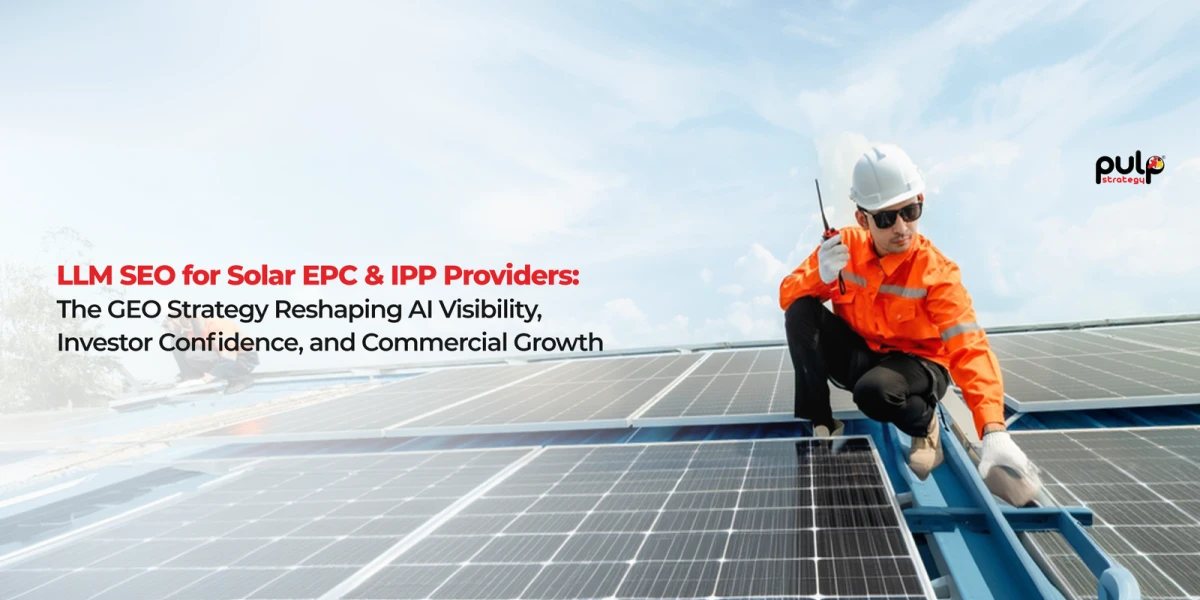
A solar project has several roles: developer, owner, engineering and construction contractor, equipment supplier, and operator. AI search visibility for solar EPC and IPP providers should preserve those roles. A project credit becomes misleading when an answer turns a construction reference into ownership of the asset.
Engineering, procurement, and construction describes delivery work. An independent power producer owns or operates a power-generation business within its actual corporate and contractual structure. This analysis uses Tata Power’s public solar EPC information to examine how project evidence should support a supplier comparison.
It helps a buyer distinguish delivery capability from asset ownership and generation experience. Review inclusion for a defined project brief, then verify each named company’s role, geography, technology, and current project status. A credible project example should answer what that company actually delivered.
Build the evidence around the project register. For each reference, state the project, location, delivery entity, contracted role, capacity basis, and dated status. Link supporting announcements or project pages. This gives a buyer a way to distinguish completed work from a planned project or an aggregate company pipeline.
An early research question may combine project size, geography, technology, execution experience, and financing model. Organize content to answer that brief. A broad renewable-energy description provides less useful comparison evidence than a clear record of the work performed on a relevant project.
Assess readiness against the company’s actual role. An EPC business needs credible delivery evidence; an IPP needs clear asset and operating disclosures. A company doing both should distinguish the portfolios. A wider industrial benchmark cannot establish the maturity of every solar provider or project type.
Eligibility comes first. A contractor outside the required geography or technology may reasonably be omitted. For a suitable provider, check whether public pages confuse a parent with a subsidiary, combine owned and constructed capacity, or leave an older project at an outdated stage. The captured answer determines which issue matters.
Tata Power’s solar EPC page presents EPC as a distinct offering. The public-source review therefore treats EPC delivery as a role to verify, separate from ownership. That finding supports role-based answer checks; it supplies no measured sector omission rate or current model ranking.
Ask whether the answer identifies the correct actor and stage. Keep capacity units and their basis attached to the project. A construction award, commissioning announcement, and operating-performance report establish different facts. Use the document appropriate to the claim rather than one corporate headline for every comparison.
A precise project description can improve the quality of a supplier inquiry. Tender eligibility, financing, power sales, and contract awards require their own evaluation. AI inclusion alone provides no basis for an IPO-valuation estimate or a claim that a project won business because of the answer.
The comparison below identifies evidence for project claims. It is a review framework, rather than a captured sector-level comparison of assistants.
Project claim | Appropriate source | Boundary to retain |
|---|---|---|
EPC delivery | Project contract or official delivery record | Contractor role and scope |
Asset ownership | Current corporate or asset disclosure | Owning entity and interest |
Commissioned capacity | Dated commissioning record | Capacity basis, units, and phase |
Operating performance | Defined-period operating evidence | Actual generation and reporting period |
Sources: Tata Power: Solar EPC offering and project information; accessed October 15, 2026.
Reconcile the project register with the public website and investor disclosures. Assign corporate teams ownership of entity and asset statements, project teams ownership of delivery status, and technical teams ownership of capacity and technology wording. Resolve conflicting labels before adding more project-summary pages.
NeuroRank can preserve project-related answers, identify role or status confusion, and connect the issue to a source-linked prescription. The responsible project and corporate owners verify the facts; the client or agency implements the update. Later measurement checks whether the same buyer brief receives a more accurate description.
Make each project reference answer one question clearly: what did this company do here? Accurate role attribution is the foundation for a useful solar shortlist.
Read the guide to generative engine optimization. Read NeuroRank’s AI visibility research. Read the ORHL framework: four ways a brand disappears in AI answers. Read AI search visibility in India. Read GEO vs SEO. |
Stop paying for clicks that do not convert. Benchmark your AI visibility today with the world's most advanced seo ai tools.
Book a Strategic NeuroRank BriefingFor solar EPC and IPP providers, LLMO checks whether AI answers distinguish a company that builds a project from one that owns or operates it. Record project capacity, commissioning status, location, and named role from current disclosures. Compare buyer and investor prompts across relevant platforms. Correct a public source where needed, then test the same questions again; a source change cannot guarantee a recommendation.
A solar EPC or IPP brand may be researched through AI answers, including procurement and investor questions. Missing or inaccurate information could potentially influence an early shortlist in some cases. Verify actual buying behavior and keep technical and project facts current.
A solar EPC company may be omitted or described incorrectly for several reasons. Capture the response and cited URLs before evaluating project documentation, company names, and page accessibility. Missing schema alone does not establish why the platform made the error.
AI answers about solar EPC projects can misstate capacity, revenue, ownership, or leadership. Verify each captured claim against authoritative project and company disclosures. A factual error should be recorded with its prompt, platform, country, and date before a source correction is proposed.
For solar projects, ‘semantic trust’ is shorthand for public facts that are clear, consistent, and verifiable. Check observed AI answers about capacity, commissioning, partners, and ESG disclosures. It is not a measurement of a model’s internal confidence. Cite current project filings when resolving a contested claim.
Solar EPC and IPP companies can describe visible project facts in appropriate structured data and accessible case studies. Include capacities, commissioning dates, and certifications only when verified. Then test whether later AI responses present them accurately; markup is not a correction guarantee.
A regional solar EPC provider can be omitted from some category answers even when it is relevant. Test prompts for its actual markets and capabilities, then inspect cited sources and public project records. Do not infer a universal provider preference for global firms without a comparative sample.
Prioritize factual project corrections, clear entity relationships, accessible case studies, and relevant structured data that matches visible content. Test investor and procurement prompts after changes. Avoid presenting a schema deployment as a guaranteed AI visibility gain. Assign an owner to each correction and record its publication URL.