BlogOctober 19, 2026
Does AI Read Reddit for Your Brand? Category and Model Decide

Ambika SharmaFounder at Pulp Strategy Communications and NeuroRank.


Founder at Pulp Strategy Communications and NeuroRank.
Subscribe for Newsletters
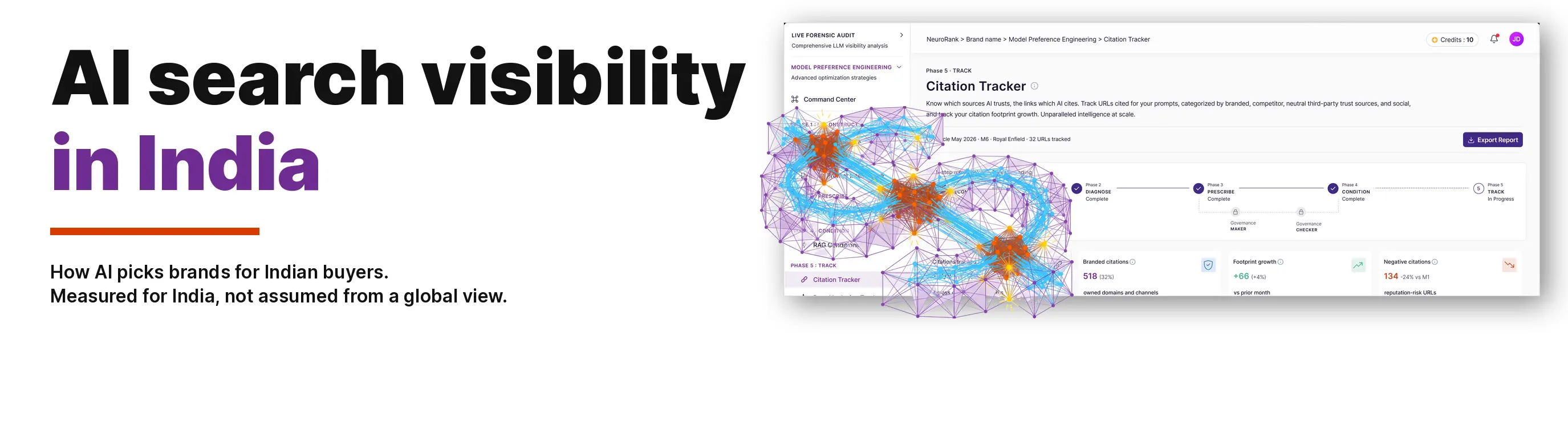
AI visibility India work asks a local question: does an answer name and accurately describe the brand for an India-based buyer? Product availability, service areas, language, and local competitors belong in the test. A result captured in another country is not a substitute for that evidence.
Start with a buyer task, such as comparing providers for an Indian city or checking local eligibility. Hold wording and platform scope constant where possible, then record country and language. A difference can arise from many inputs. The answer alone cannot reveal a provider’s geographic weighting or prove that one local publisher caused the change.
Inspect the actual links returned for the Indian prompt set. Official product and service pages establish local terms; relevant publications, reviews, and community discussions can add context. Verify each claim against its appropriate source. Do not assume a regional directory outweighs an accurate owned page simply because it is independent.
App users, downloads, searches, and purchase decisions are different units. Adoption reports can explain why a team should investigate AI-assisted discovery, but they cannot quantify the brand’s Indian buyer demand. Ask customers how they researched the category and compare those accounts with observable referrals and saved AI responses.
Create an India baseline with the relevant country, language, product scope, and capture dates. Measure inclusion, recommendation, citation, and factual quality separately. Add other countries as distinct cohorts. NeuroRank’s context-isolated measurement reduces prior-session carryover; it does not reproduce every account or consumer experience.
Read AI search statistics 2026. Read AI visibility for BFSI. Read The ORHL framework: four ways a brand disappears in AI answers. Read the guide to AI search engine optimization. |
Stop paying for clicks that do not convert. Benchmark your AI visibility today with the world's most advanced seo ai tools.
Book a Strategic NeuroRank BriefingSpecify the city and service eligibility in the prompt and scoring rule, then verify actual local availability. Keep a city-specific cohort separate from a national question where the task differs. This helps distinguish genuine local fit from a national brand mention that leaves the buyer’s location unanswered.
Map the official market-specific names and product relationships before measurement. Use the name appropriate to each country and retain the eligibility evidence. A missing foreign-market name and an incorrect product relationship are different findings, so avoid merging them into one global inclusion result.