ArticleJune 30, 2026
How to Build a High-Revenue Generative Engine Optimization Practice: The Agency Playbook
Read the article
Ambika SharmaFounder at Pulp Strategy Communications and NeuroRank.

Ambika Sharma
Ambika Sharma is the Founder & Chief Strategist of Pulp Strategy, a multi-award-winning business transformation and digital agency, and Prod... Read more
Subscribe for Newsletters
By Ambika Sharma, Founder, Chief Strategist at Pulp Strategy Communications and Product Architect of NeuroRank®
Methodology and attribution This research is based on Live Forensic Audits conducted by Pulp Strategy Communications between February and May 2026 across ChatGPT, Gemini, Claude, and Perplexity, using fresh-token methodology so each query represents a cold start equivalent to a new user. All AI outputs quoted are captured artefacts of what large language models stated about the named brands during the audit window. They are not statements made by the brands themselves, and they are not statements by Pulp Strategy about the brands. Where AI captured a factual inaccuracy, the article states the verifiable correct fact alongside, so the reader sees the gap. Captured AI artefacts attributed to the Voltas Beko audit walkthrough reflect live audit output observed during a NeuroRank engagement; no executive quotation appears in this article. Full disclaimer architecture and right of reply at the end of the article. |
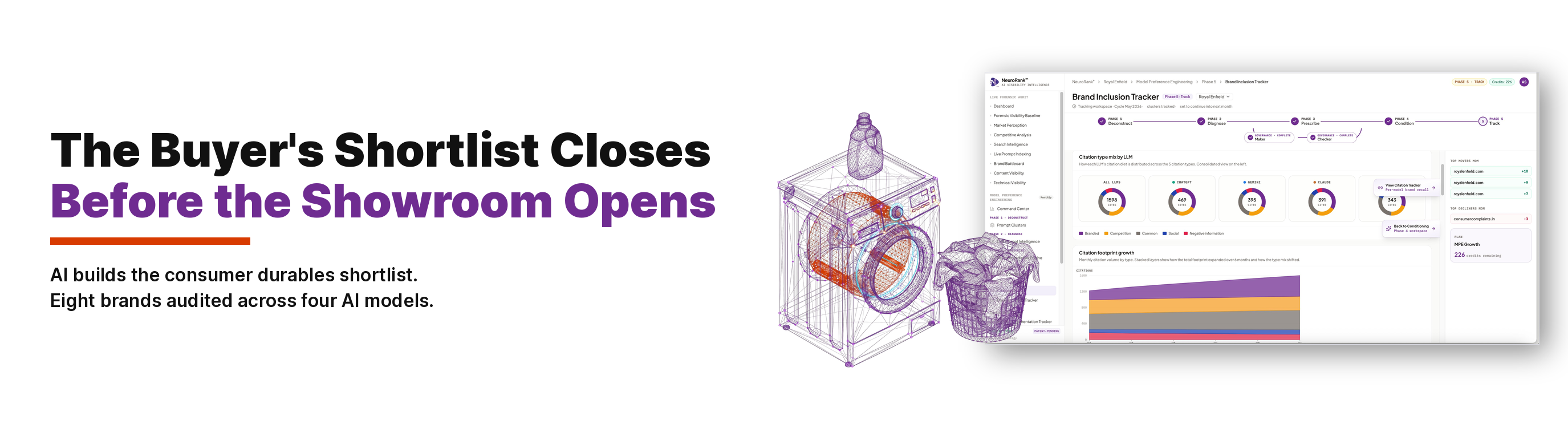
Eleven p.m. in Bengaluru. A buyer types into ChatGPT: best washing machine in India under thirty thousand. The screen returns four names. LG. Samsung. IFB. Whirlpool. She copies the list into her notes app and books a Saturday slot at the Croma in Indiranagar. Five other brands she might have considered tomorrow have been deleted from her shortlist tonight. One of them spent four decades building a dealer network in this city. AI never mentioned it.
That brand has not been told. It is one of eight consumer durables brands NeuroRank® audited across ChatGPT, Gemini, Claude, and Perplexity between February and May 2026. The finding that holds across the cohort: not one of the eight brands scored above Medium Brand Inclusion across all four models on its most commercially significant category prompt. Three of the four largest language models cannot even place Samsung in the consumer durables competitive set in India. The brands losing the shortlist are not small. They are category leaders. They simply have not been told.
“The shortlist closes before the showroom opens. If AI does not name your brand, your dealer never meets the buyer. Most brands cannot see the shortlist that is deciding their demand.” Ambika Sharma, Product Architect of NeuroRank |
AI search optimization is no longer a marketing function. It is a corporate governance function. NeuroRank® audited eight consumer durables brands across ChatGPT, Gemini, Claude, and Perplexity using fresh-token methodology between February and May 2026. Three out of four large language models cannot place Samsung in the consumer durables competitive set in India. The world's largest air cooler manufacturer is rendered invisible in its own category by three of the four. A Tata-Beko joint venture is absent from AI's four-brand shortlist for “best washing machine in India.” A water purifier subscription business is rebuilt by one model as a smart home and IoT platform. A premium sub-brand is confused with a UK office furniture manufacturer. These are not isolated errors. They are four repeating failure modes that together form what this research calls the AI Shortlist Filter. Each failure is a board-level revenue exposure that compounds month over month with no natural correction.
Across eight consumer durables brands audited on ChatGPT, Gemini, Claude, and Perplexity in 2026, not one scored above Medium Brand Inclusion on its most commercially significant category prompt. Source: NeuroRank GEO Benchmark Index.
Three of four large language models cannot place Samsung in the consumer durables competitive set in India. ChatGPT lists smartphone brands. Gemini and Perplexity list Indian conglomerates. Only Claude returns LG, Whirlpool, Sony, Panasonic, and Godrej.
The four ways AI fails a consumer durables brand form a repeating pattern this research names the AI Shortlist Filter: AI closes the shortlist, picks the wrong rival, invents facts, and owns the post-sale conversation.
Symphony, the world's largest air cooler manufacturer with presence in approximately sixty countries, is positioned by AI as a domestic also-ran behind Havells, Bajaj, Crompton, and Voltas.
AI confused Senator, Cera Sanitaryware's premium bathware sub-brand, with The Senator Group, a UK office furniture manufacturer. Gemini listed Cera as a competitor to Senator. Cera is Senator's parent.
The macro shift is measured. In the US, 44 percent of online buyers now begin product discovery inside an LLM or split it between AI and traditional search (Bain, April 2026). Traditional search volume is projected to fall 25 percent by 2026 (Gartner, February 2024).
This week: run a Live Forensic Audit on your highest-revenue brand for USD 7.00, identify where it is Omitted, Replaced, Hallucinated, or returning Zero Leads per model, and put the result in front of the board before the next quarterly review.
Definition - ORHL taxonomy The ORHL taxonomy classifies the four ways AI fails a brand. Omitted: the brand is absent from category answers. Replaced: the brand is substituted by a competitor. Hallucinated: false facts are generated about the brand. Zero Leads: the brand appears but no purchase pathway is offered. ORHL is the diagnostic language of NeuroRank's patent-pending methodology. |
Key terms AI Shortlist Filter is the four-mode pattern by which AI removes brands from a buyer's consideration set before the buyer reaches the showroom: AI closes the shortlist, picks the wrong rival, invents the facts, and owns the post-sale conversation. Brand Inclusion Score is the rate at which AI names a brand in response to a category prompt across cold-start runs. High means the brand appears in roughly 70 to 80 percent of runs. Medium means under 40 percent. AI visibility governance is the corporate function of auditing, correcting, and monitoring how AI represents a brand, with a single accountable owner and a fixed audit cadence. |
The Indian consumer durables buyer is not researching anymore. They are receiving a verdict. The AI summary that appears when a buyer queries “best refrigerator in India” or “best washing machine under thirty thousand” is now their shortlist. Sundar Pichai, on the Cheeky Pint podcast in April 2026, said the next phase of search would make it an agent manager: a lot of what are information-seeking queries will become agentic, with users completing tasks across many threads. The user asks once. The AI returns the brand names that matter. The user acts on those names.
The shift is measured, not anecdotal. Bain & Company reported in April 2026 that in the US, 44 percent of online buyers now mostly start their journey in an LLM or split it between AI tools and traditional search, a shift that outpaced both social and e-commerce search. Gartner projected in February 2024 that traditional search engine volume will drop 25 percent by 2026 as AI chatbots become substitute answer engines. Bain found in February 2025 that about 80 percent of consumers rely on zero-click AI results for at least 40 percent of their searches, and about 60 percent of searches now end with no click at all. When the answer never leaves the AI, the AI's answer is the brand.
For consumer durables this is a category-defining shift. The category is high-consideration. It involves price comparison, warranty comparison, service network comparison, dealer relationships, and walk-in experience. None of that happens until the brand survives the AI shortlist. The B2B benchmark shows where this leads: Bain reported in March 2025 that 85 percent of B2B buyers purchase from their day-one list, the vendors they already had in mind before searching. Consumer durables is following the same pattern. The brand absent from the AI shortlist is absent from the day-one list, and the day-one list is increasingly the only list.
There is a second structural problem specific to how models build these answers. Scrunch AI analysis cited by Bain found that more than 90 percent of the content LLMs use to answer non-branded queries comes exclusively from third-party sources. Even when a brand is named, 60 percent or more of the supporting content is non-branded. A consumer durables brand cannot fix its AI representation from its own website alone. The correction has to happen across owned, earned, and third-party surfaces at once.
That is the system. Now look at what the audit found.
The number that should be on the board agenda AI-referred traffic is small but high-intent. Similarweb reported in 2026 that buyers arriving from ChatGPT convert on transactional sites at 7 percent versus 5 percent from Google, and spend 15 minutes on site versus 8. AI visibility is not a vanity metric. It converts at a higher rate than the channel it is replacing. The brand absent from the AI answer is losing the highest-intent buyer in the funnel. |
Across the eight-brand cohort, the failures were not random. They repeated in four forms. Together they function as a filter that decides which brands reach the buyer's shortlist and which are removed before the buyer ever sees them. This research names that pattern the AI Shortlist Filter. The four failure modes are: AI closes the shortlist, AI picks the wrong rival, AI invents the facts, and AI owns the conversation after the sale. Each maps to one or more ORHL classes. Each is demonstrated below with captured evidence from the cohort.
AI hands the buyer four brand names. If your brand is not one of the four, the dealer never meets the buyer.
In a live NeuroRank audit walkthrough conducted with the marketing leadership of Voltas Beko in May 2026, the team queried Gemini and ChatGPT in real time for “best washing machine in India.” The AI summary named LG, Samsung, IFB, and Whirlpool. Voltas Beko was not in the list. The brand's Brand Inclusion Score for the energy-efficient appliance prompt set registered Medium. Translated: across cold-start runs of the prompt set with fresh authentication tokens, the brand was named in fewer than 40 percent of responses.
The audit captured AI's own narrative for the absence. Verbatim: “It is recognised for emphasis in energy but faces competition with more established brands like LG and Whirlpool.” Voltas, the air conditioning parent, holds approximately one-fifth of the Indian room AC market by volume. Beko brings European white goods engineering to the JV. The JV launched its appliances business in India in 2020 to 2021. By 2026, the four-name AI shortlist for India's second-largest white goods category had not registered the brand.
Symphony, the world's largest air cooler manufacturer, returned a similar omission pattern. Claude self-flagged the gap in its own response: “Underrepresentation of Symphony's market dominance in global air cooler sales and category leadership, with LLMs defaulting to mentions of larger conglomerates like Havells or Crompton Greaves.” Perplexity went further: “Outdated market share claiming Bajaj or Crompton as world's largest air cooler maker.” Symphony Limited is in Ahmedabad. It has global presence in approximately sixty countries. AI has not noticed.
Captured AI artefact (ChatGPT, Symphony audit) “Symphony was founded in 1999, India.” Verifiable fact: Symphony was incorporated in 1988 as Sanskrut Comfort Systems Limited, listed publicly in 1994. ORHL class: Hallucinated. |
AI benchmarks your brand against the wrong competitors, in the wrong price tier, in the wrong category. The buyer gets the wrong recommendation.
Three out of the four largest LLMs cannot tell you what business Samsung is in. ChatGPT places Samsung against Vivo, Xiaomi, Realme, OPPO, and Apple. A smartphone-only competitive set. Refrigerators, washing machines, televisions, microwave ovens, the entire consumer durables footprint, absent from the competitor frame. Gemini goes further. It identifies Samsung's closest competitors as Reliance Industries, Tata Group, Aditya Birla Group, Mahindra Group, and ITC Limited. It treats Samsung as if it were an Indian conglomerate. Perplexity gives Samsung Reliance Industries, Tata Group, Adani Group, Bharti Airtel, and LG Group, then hallucinates: “Samsung owns or operates Reliance Jio or Bharti Airtel telecom services.” Samsung does not own Indian telecom assets. The line is fabricated. Only Claude correctly returns LG Electronics, Whirlpool, Sony, Panasonic, and Godrej & Boyce as Samsung's competitive set in consumer durables.
Three out of four LLMs cannot tell you what business Samsung is in.
Dyson is positioned in the wrong price tier. Across ChatGPT and Gemini, Dyson's competitive set includes Eureka Forbes and Godrej Appliances. ChatGPT self-flagged the error in its own response: “Dyson is often mistakenly referred to as offering budget products, whereas it focuses on premium categories.” The audit captured price-tier collapse across three of four LLMs. The premium positioning that justifies Dyson's pricing is invisible to the AI explaining the category to a buyer.
Featured finding - The Cera-Senator sub-brand obliteration Senator is Cera Sanitaryware's premium bathware sub-brand in India. The audit captured the following collapses across the four LLMs. Perplexity confused Senator with The Senator Group, a UK based office furniture manufacturer. Verbatim capture: “Search results incorrectly conflate these two distinct brands. Senator (bathware) is a CERA-owned sanitaryware brand in India, while The Senator Group manufactures office chairs and workplace furniture globally.” Gemini listed Cera Sanitaryware as a competitor to Senator. Cera is Senator's parent. Claude returned: “Data insufficient for comprehensive analysis. Senator brand-specific founding information is not publicly disclosed in independent brand sources.” ChatGPT did not surface Cera ownership in Senator's brand overview at all. When the Indian premium home builder asks AI for “best premium bathware brands India,” Cera's investment in launching Senator is invisible. The buyer is funneled to Jaquar, Kohler, Hindware, and Roca. The premium sub-brand is erased. ORHL classes captured: Replaced. Omitted. Hallucinated. |
AI does not refuse to answer where it lacks data. It fills the gap with invention, and the buyer cannot tell the difference.
The Samsung Reliance Jio hallucination is not an outlier. Across the cohort, AI invents ownership structures, product features, founding years, manufacturing locations, and market positions. Perplexity claimed of Samsung: “All Samsung products in India are manufactured in South Korea.” Samsung has significant manufacturing plants in Noida and Sriperumbudur. The claim is incorrect. AI is telling Indian buyers Samsung does not make products in India when Samsung in fact makes most of its India-market portfolio in India.
Claude rebuilt Livpure Smart's category entirely. The audit captured the verbatim positioning Claude returned: “Livpure Smart is a smart home and IoT solutions brand under Livpure Smart Homes Pvt Ltd, focused on delivering connected home automation, smart water purification systems, and intelligent appliances.” Claude listed Livpure Smart's competitors as Havells Smart Home Solutions, Schneider Electric Home & Distribution, Philips Smart Home & Connected Devices, MI Smart Home (Xiaomi India), and Bajaj Electricals Smart Solutions.
None of these are Livpure Smart's competitors.
Livpure Smart is a Water-as-a-Service subscription business operating in water purification. Its real competitors are Kent RO, Eureka Forbes Aquaguard, Hindustan Unilever Pureit, and A.O. Smith. Claude did not just get the competitors wrong. It re-categorized the entire business.
For Dyson, multiple LLMs invented model numbers, specific INR prices, and launch dates that had no source. Claude's own capture acknowledged the failure mode: “AI models often hallucinate specific price points, model numbers, or availability claims about Dyson products in India without verification, stating exact rupee prices, SKU names, or latest launch dates that may be outdated or incorrect, misleading buyers during research.” For EPSON, AI fabricated service packages that the company does not offer. For Symphony, AI generated user reviews and ratings that did not exist.
The pattern is governance-critical. AI is not refusing to answer where it lacks data. AI is filling the data gap with invention.
The post-purchase conversation decides the next sale, the referral, and the loyalty premium. AI is now in that conversation. The brand is not.
The post-purchase conversation in consumer durables has always been a brand's loyalty driver. Service network, warranty, parts, returns, this is where the next sale is earned, the referral is earned, and the category exit is prevented. AI has moved into that conversation. The brand has not.
The Livpure Smart audit captured the most damaging post-purchase artefact in the cohort. Across multiple LLMs, AI returned to consumers researching the brand the following verbatim summary: “Numerous online community posts characterize Livpure Smart as deceptive or a scam, particularly due to undisclosed lock-in periods, escalation of AMC costs, and failure to honor service commitments.” This is the positioning the AI summary serves to a prospective subscriber. The brand has no surface in that conversation. The complaint corpus AI draws from is in the wild, indexed, and amplified each time a new prospective buyer asks.
For Dyson, AI hallucinates regional service center availability in Tier 2 and Tier 3 Indian cities. Buyers are directed to unauthorized sellers based on AI's incorrect output. For Symphony, warranty period information is captured incorrectly. For Voltas Beko, the AMC information that determines the post-purchase service experience has data gaps that AI fills with generic averages.
In each case, the conversation that follows the purchase, the conversation where the brand earns the next purchase and the next referral, is being shaped by AI without brand input.
The cost of inaction
Apply the math to your own firm. Take the highest-consideration product category in your portfolio. Identify the four brand names AI returns in the buyer's first prompt for that category. If your brand is one of the four, calculate the share of your category revenue at risk if you fall out. If your brand is not one of the four, calculate the share you are not capturing because the dealer never sees the buyer. Take that number. Multiply by category gross margin. Multiply by twelve months. That is your annualized revenue exposure.
For a category leader in a multi-thousand-crore segment, the exposure runs in hundreds of crores. For a challenger brand, the exposure is the entire growth thesis. For a sub-brand of a parent company invested in a premium play, the exposure is the differentiated category itself.
This is not a marketing budget question. Boards that treat AI visibility as marketing spend are mispricing the risk twice. Once on revenue, where the lost shortlist position compounds month after month with no visibility into the loss. Once on governance, where AI is making representations about the brand, its products, its prices, its ownership, and its service quality with no audit trail and no right of reply. Every public-company brand is exposed to material misstatement of fact by AI under the buyer's prompt. The board's question is not whether to engage. The board's question is who owns the engagement and what the audit cadence is.
Damaging finding Across the eight-brand audit cohort, no brand registered Brand Inclusion Score above Medium across the four LLMs on its most commercially significant category prompt. The category leader by market share was not the category leader in AI recall in any of the four LLMs except one. The misalignment between offline category position and AI recall is structural. It compounds month over month with no natural correction. |
Most AI visibility tools monitor. NeuroRank diagnoses, prescribes, conditions, and tracks. From USD 7.00.
| Capability | NeuroRank | Most other platforms |
|---|---|---|
Diagnostics across ChatGPT, Gemini, Claude, and Perplexity | Four LLMs plus Combined synthesis (NeuroRank Benchmark) | Most cover one or two |
Fresh-token methodology (zero session memory contamination) | Yes, patent-pending | Rare |
ORHL failure taxonomy (Omitted, Replaced, Hallucinated, Zero Leads) | Classified per gap with description, status, recommendation | Generic alerts |
Brand Inclusion Score per prompt, per cluster, per model | Computed at four levels | Aggregate only |
Prescriptive recommendations with source URLs | Yes, per gap | Rare |
Model Conditioning Loop across owned, earned, and third-party surfaces | Patent-pending | Not offered |
Live Forensic Audit one-time entry | USD 7.00 | Typically subscription only |
Maker-Checker governance for execution oversight | Yes | Not offered |
The platform applies a five-step method. Deconstruct: dismantle the LLM's internal representation of your brand. Diagnose: classify visibility gaps across ChatGPT, Claude, Gemini, and Perplexity. Prescribe: issue the specific content, CMS, and other actions required to fix them. Condition: run the Model Conditioning Loop across owned, earned, and third-party surfaces. Track: measure month-on-month lift as the models recalibrate.
The approach produces measurable lift. In early 90-day engagements, a leading Indian FMCG brand improved its AI visibility by 47 percent, and a leading BFSI brand improved by 30 percent with a 12 percent lift in citations across ChatGPT, Gemini, Claude, and Perplexity. NeuroRank diagnoses and prescribes. The client and its agency implement. Results vary by brand, category, and starting baseline.
The following cohort was audited using NeuroRank's Live Forensic Audit across ChatGPT, Gemini, Claude, and Perplexity. The third column lists the captured AI artefact that posed the highest commercial risk in each case. All findings describe what AI said about each brand. They do not describe the brands themselves.
| Brand | Category | ORHL Layer | Most damaging captured AI artefact |
|---|---|---|---|
Samsung | Premium electronics, multi-category MNC | Replaced + Hallucinated | Three of four LLMs cannot place Samsung in the consumer durables competitive set in India. Perplexity fabricated: “Samsung owns or operates Reliance Jio or Bharti Airtel telecom services.” |
Dyson | Premium small appliances | Replaced + Hallucinated | Premium positioning collapse across three LLMs. ChatGPT self-flagged: “Dyson is often mistakenly referred to as offering budget products.” Specific INR prices and SKUs invented across multiple models. |
Voltas Beko | Mid-market white goods, Tata-Beko JV | Omitted | Absent from AI summary for “best washing machine in India.” AI returned LG, Samsung, IFB, Whirlpool. Brand Inclusion Score on energy-efficient appliances: Medium. |
Symphony | Air coolers, global category leader | Omitted + Hallucinated | Treated as domestic also-ran. Perplexity captured: “Outdated market share claiming Bajaj or Crompton as world's largest air cooler maker.” ChatGPT fabricated founding year as 1999 (actual: 1988). |
EPSON | Printers and projectors | Hallucinated | Category recall correct. AI fabricated non-existent service packages and pricing in detail. Chennai manufacturing context missing across all four LLMs. |
Livpure Smart | D2C water purifier subscription | Hallucinated (Replaced) | Claude rebuilt the entire category, describing Livpure Smart as a smart home and IoT brand competing with Schneider Electric and Xiaomi MI Smart Home. None of those are real competitors. |
Cera India | Sanitaryware, parent brand | Omitted | Perplexity returned: “No verified public data explicitly available at the brand level for ‘CERA India’ positioning, business model, target markets, revenue streams, or geographic presence.” |
Senator | Premium bathware, Cera sub-brand | Replaced + Omitted + Hallucinated | Confused with The Senator Group, UK office furniture manufacturer. Gemini listed Cera Sanitaryware as a competitor. Cera is Senator's parent. |
All findings above are captured AI artefacts from Live Forensic Audits conducted in 2026 across ChatGPT, Gemini, Claude, and Perplexity using fresh-token methodology. They describe what AI said about each brand. They do not describe the brands themselves.
AI visibility in consumer durables is shaped by Bureau of Indian Standards (BIS) certification claims, Bureau of Energy Efficiency (BEE) star rating accuracy, Ministry of Electronics and Information Technology (MeitY) compliance disclosures, and the Digital Personal Data Protection Act, 2023, which governs how AI ingestion treats consumer review data. Brands operating in India should treat AI-generated misstatement of BIS or BEE compliance as a regulatory risk in addition to a marketing risk. The Consumer Electronics and Appliances Manufacturers Association (CEAMA) and Indian Electrical and Electronics Manufacturers Association (IEEMA) reporting frameworks remain authoritative reference points where AI sourcing falls short.
The EU AI Act, effective in phases from August 2024 through 2027, introduces transparency obligations for general-purpose AI providers and tightens rules where AI outputs influence high-stakes decisions. In the United States, the Federal Trade Commission has increased scrutiny on AI-generated product claims under existing deception rules. Consumer durables brands exporting from India to either region should treat AI-captured product claims as falling under the disclosure obligations of the destination market, not the origin market.
Establish AI visibility as a corporate governance function - Move ownership out of brand marketing exclusively. Loop in corporate communications, investor relations, and the legal function. Assign a single accountable owner. Set an audit cadence at least quarterly.
Run a Live Forensic Audit on the most commercially significant brand or sub-brand in the portfolio - The audit identifies, per LLM, where the brand is Omitted, Replaced, Hallucinated, or returning Zero Leads. Output is a 10-section intelligence report. Entry cost: USD 7.00 one-time. Delivered in 12 to 20 minutes at Live Forensic Audit.
Move to continuous governance on the brand's most commercially significant prompt cluster - Model Preference Engineering starts at USD 225 per month for one LLM and one prompt cluster, scaling to USD 350 per month for full four-LLM coverage with Combined synthesis. The patent-pending Model Conditioning Loop runs across owned, earned, and third-party surfaces. Maker-Checker governance provides the auditable trail boards and regulators require. Details at Model Preference Engineering .
Decide whether you set the template for your category or you take the template others set - Within 12 to 18 months, two or three brands per category will establish how AI describes that category. Every other brand will be described against that template. The template-setters will own the recall. The template-takers will pay to argue against the description.
Analyze the damage. Establish governance. Initiate Live Forensic Audit - 2 to 20 minutes, one-time fee USD 7.00 Get the full system - Model Preference Engineering, customizable. From USD 225 per month |
AI is now your first listener, your loudest narrator, and the place where your post-sale story is being written. The brands that govern that conversation will own the next decade of consumer demand. The brands that do not will lose customers their dealers never get to meet. When AI describes your product to your customer, is it telling the truth?
Stop paying for clicks that do not convert. Benchmark your AI visibility today with the world's most advanced seo ai tools.
Book a Strategic NeuroRank Briefing