BlogSeptember 30, 2026
Comscore AI Intelligence Report Shows ChatGPT at Half of US Prompts

Ambika SharmaFounder at Pulp Strategy Communications and NeuroRank.


Founder at Pulp Strategy Communications and NeuroRank.
Subscribe for Newsletters
Methodology audited by NeuroRank Editorial. Findings traceable to the underlying audit records.
India's largest financial brands are misrepresented in AI search right now. On 07 May 2026, ChatGPT described HDFC as a standalone housing finance company. That entity dissolved into HDFC Bank in July 2023. The customer was given advice about a brand that no longer exists. The next day, Gemini called Bajaj Finserv a bank with a banking license it never held. Claude attributed a government guarantee to LIC policies that no LIC product carries. Perplexity told a retail investor that Zerodha sells insurance.
Four brands. Four hallucinations. One audit window. This is not a marketing problem. AI Visibility for BFSI is a compliance event the brand did not author and cannot see.
Live AI search outputs from 06 to 07 May 2026 across ChatGPT, Gemini, Claude
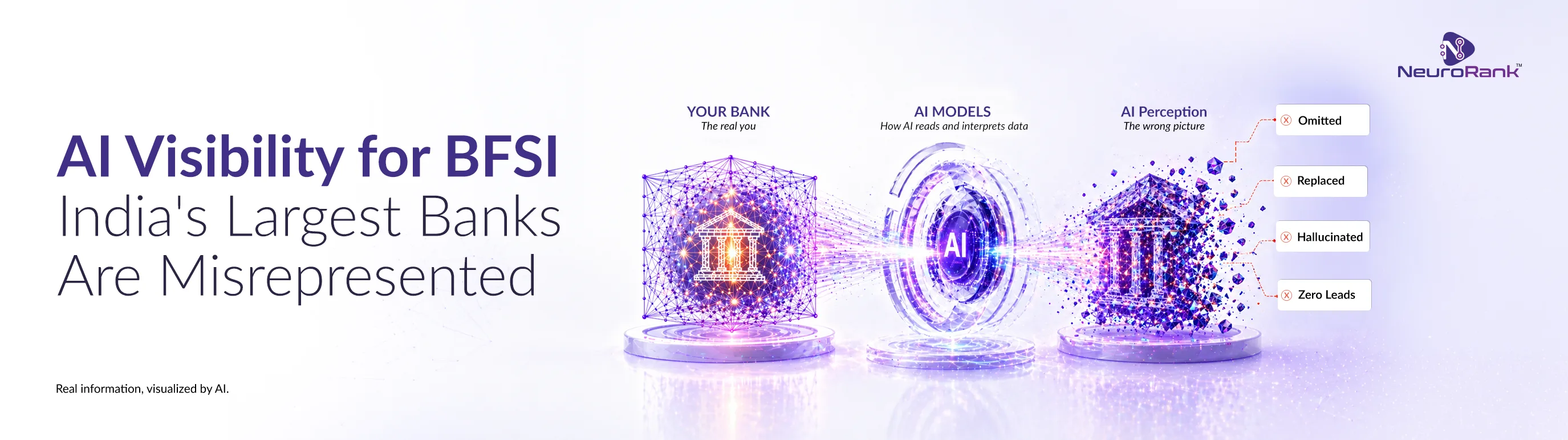
Definition: Generative Engine Optimization (GEO) Generative Engine Optimization (GEO) is the practice of governing how generative AI engines such as ChatGPT, Gemini, Claude, and Perplexity perceive, cite, and recommend a brand. GEO governs AI recall the way SEO governs Google rank. The two systems use different evidence and require different operational disciplines to manage. |
| Class | Name | What it means | BFSI May 2026 example |
|---|---|---|---|
| O | Omitted | Brand does not appear at all in the AI answer. | Zerodha absent from category video answers despite market leadership. |
| R | Replaced | A competitor or wrong entity appears in the brand's place. | Bajaj Finserv conflated with Bajaj Finance and credited with a banking license. |
| H | Hallucinated | AI returns a fact that is wrong, outdated, or fabricated. | LIC credited with a government guarantee that does not exist. |
| Z | Zero Leads | Brand mentioned in passing without decision-stage context. | HDFC named in passing but framed as a pre-merger housing finance entity. |
GEO for BFSI is the regulatory-grade application of this discipline. License framing, regulator IDs, claim ratios, and product terms must resolve correctly across ChatGPT, Gemini, Claude, and Perplexity, or the brand carries a compliance signal it did not author.
AI search is now the discovery layer for Indian financial decisions, and India's largest BFSI brands are not safe inside it. NeuroRank audits of HDFC, Bajaj Finserv, LIC, and Zerodha in May 2026 logged 53 open gaps and 17 distinct hallucination patterns across ChatGPT, Gemini, Claude, and Perplexity. The shared root cause is structural. Schema markup is missing or sparse. Trust signals such as license numbers, regulator IDs, claim ratios, and product terms sit inside PDFs that AI engines cannot parse reliably. The consequence is direct. Misrepresentation in regulated categories creates compliance exposure, depresses investor confidence, and shrinks the consideration set at the moment of purchase. For Indian BFSI leaders, Generative Engine Optimization is no longer a marketing program. It is a governance discipline that belongs at the C-suite, alongside financial reporting and regulatory disclosure.
The shift in how Indian consumers research financial decisions is the precondition. The shift in how Indian CEOs are reacting to it is the inflection point. The NeuroRank GEO Benchmark Index, a study of 700 brands across 65 sectors, found that financial services brands prominently showcasing licenses, awards, and security certifications were consistently more likely to be recalled by AI engines.
The same study captured the executive reaction. CEO interviews documented surprise when flagship brands failed to appear in AI responses. Several called the findings a wakeup call. One finance leader likened GEO to financial reporting, emphasizing legal consequences for inaccuracies.
The structural cause is the same across BFSI. Regulatory authority sits in PDFs. Product terms sit in PDFs. Investor presentations sit in PDFs. AI engines cannot parse PDFs reliably. They fill gaps with adjacent content from aggregators. GEO for Banking closes that gap on a monthly cadence.
People also ask: Does ranking on Google guarantee AI recall?
No. Traditional SEO dominance offers zero guarantee of AI recall. NeuroRank's GEO Benchmark Index (700+ brands, 65 industries, fresh-token methodology across 4 LLMs) shows 68% of audited brands absent from AI shortlists in their own categories despite strong Google rank. Generative engines retrieve facts. Search engines rank pages. The two systems are not the same.
| AI now governs the discovery layer for BFSI companies. The GEO Benchmark Index finds that brands showcasing machine-readable licenses, awards, and certifications are recalled more reliably. CEO interviews described the findings as a wakeup call. One finance leader likened GEO to financial reporting. Marketing language does not cover this. |
The ORHL framework above shows the four failure classes. Each maps to a different business risk. BFSI brands suffer from all four. Hallucinated is most dangerous in regulated categories: it puts the brand on the wrong side of a compliance signal it did not author.
Between 06 and 07 May 2026, Live Forensic Audits ran on four of India's most prominent BFSI brands. None was protected by category leadership. HDFC, Bajaj Finserv, LIC, and Zerodha each show one or more of the four ORHL gaps in their own regulated categories.
One finding repeated across all four. Schema markup for products and services was Missing or Sparse. AI engines then fill gaps with adjacent content that is rarely the brand's own.
The pattern is consistent. Where structured trust signals are in HTML and in structured data (license, regulator ID, claim ratio, audit date, named byline), AI retrieves them. Where they sit only in PDFs, or are muddles with confusion in multiple pages, AI reaches for adjacent content. The brand loses authorship.
| HDFC, Bajaj Finserv, LIC, and Zerodha each show a different ORHL gap in the May 2026 audits: Omitted, Replaced, Hallucinated, or Zero Leads. The one shared root cause is structural. Schema is missing or sparse. Trust signals sit in PDFs, or are unreadable. AI engines fill gaps with adjacent content. |
1. Run a Forensic Audit across ChatGPT, Gemini, Claude, and Perplexity to see the scale of the issue.
2. Use the monthly subscription to classify every gap using the ORHL taxonomy.
3. Get detailed recommendations from NeuroRank, prescribe schema, content, and CMS fixes per gap.
4. Condition owned, earned, and third-party surfaces month over month.
5. Track inclusion lift across all four models.
It Ensures 90% reduction in hallucinations in 3-5 months and a 60% lift in brand inclusion rate
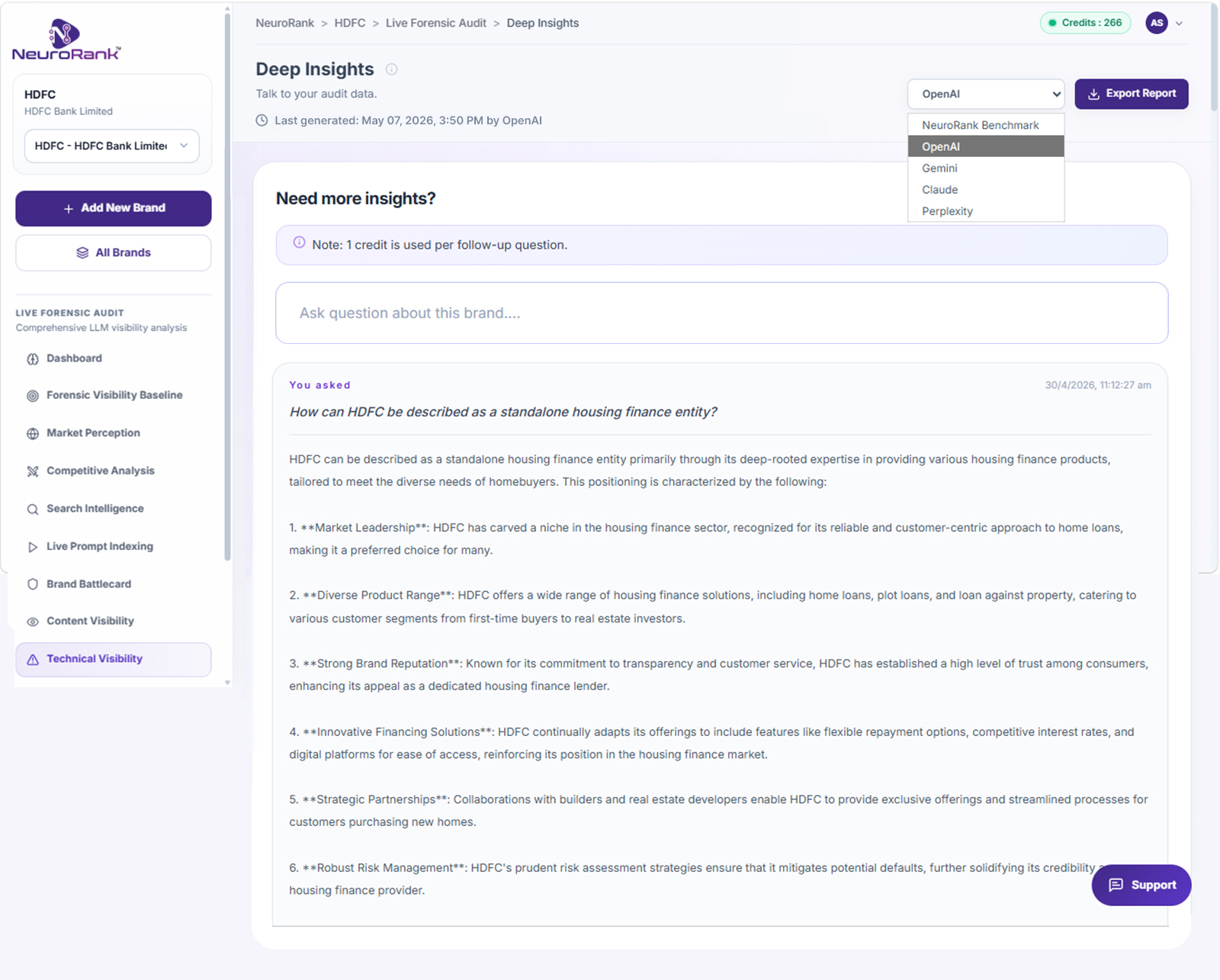
HDFC is the canonical example of an event AI did not absorb. The HDFC Ltd merger with HDFC Bank Limited closed on 1 July 2023. In May 2026, ChatGPT, Gemini, Claude, and Perplexity still return the pre-merger entity for category prompts. Three years. Four engines. One un-updated reality.
The 07 May 2026 audit logged 14 open gaps and four hallucinations: standalone housing finance framing, misleading competitive comparisons, confusion between HDFC Ltd and HDFC Bank products, and overstated interest rate advantages. The audit catalogued 35 source links AI engines cite for HDFC prompts. Most are aggregators, not the brand's pages.
Schema markup for services was Missing. YouTube product explainers were Few. Branded SEO content for core banking prompts was Sparse. Mergers do not propagate to AI engines on their own. The brand must push the new reality into machine-readable evidence. HDFC missed ensuring this.
| HDFC teaches the merger lesson. Corporate events do not propagate to AI engines on their own. Three years after the July 2023 merger, ChatGPT, Gemini, Claude, and Perplexity still describe the pre-merger entity at various occasions. Authority content is unreadable. The new reality must be pushed into machine-readable evidence. |
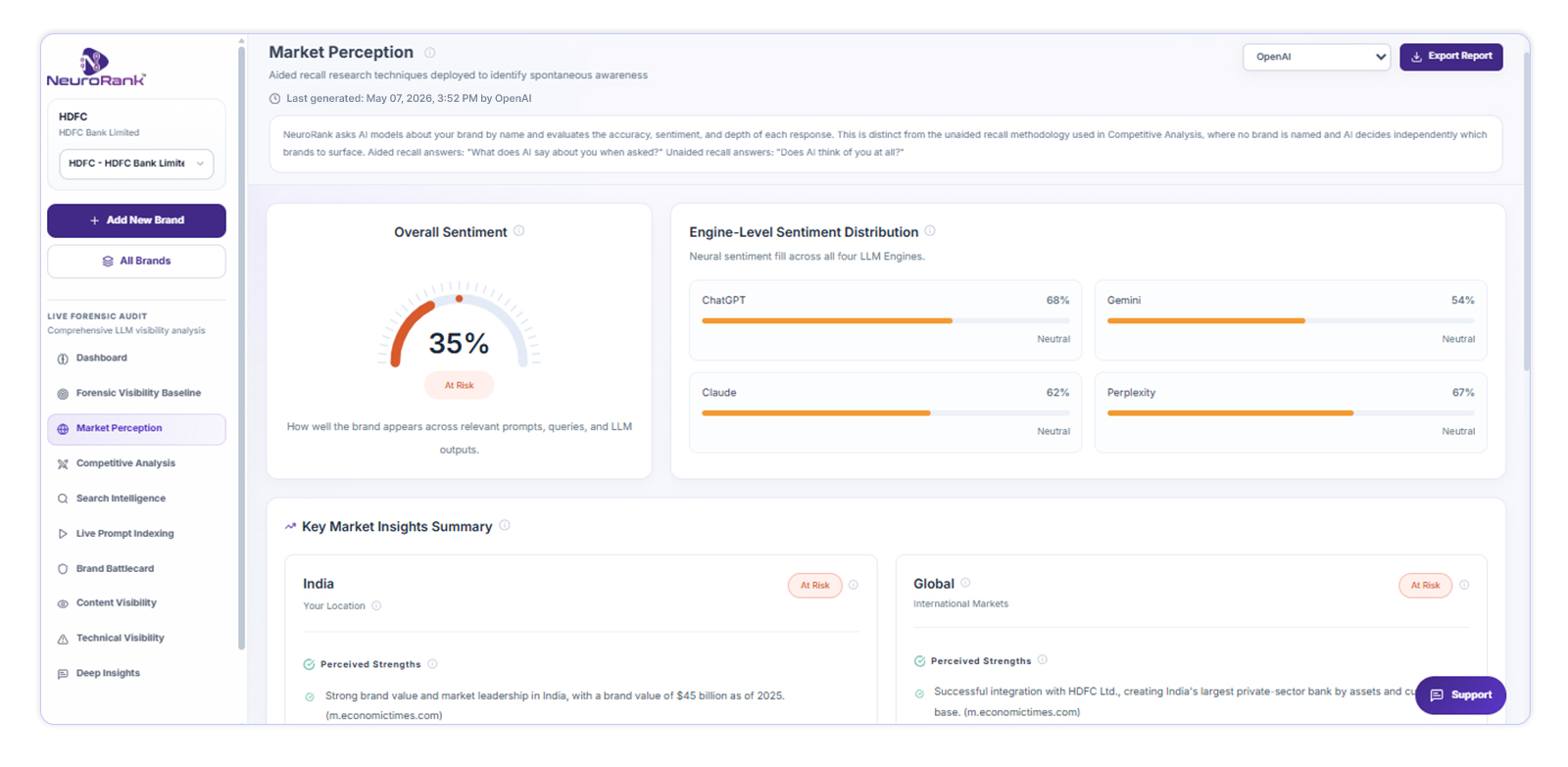
AI engine response describing HDFC as a standalone housing finance entity, three years after the July 2023 merger with HDFC Bank Limited. Source: NeuroRank HDFC audit, 07 May 2026.
Bajaj Finserv is the canonical example of brand architecture failing inside AI. The holding company. Bajaj Finance is its listed lending subsidiary. AI engines collapse the structure. They credit Bajaj Finserv with a banking license it does not hold, conflate it with Bajaj Finance, and misclassify it as a bank instead of the Core Investment Company it is.
The 07 May 2026 audit logged 10 open gaps and four hallucinations: false banking license claims, statements that Bajaj Finserv is a bank, conflation with Bajaj Finance, and misleading claims of being the only digital lender. YouTube videos, the FAQ resource, and blog content were Absent or Sparse.
The Bajaj Group's recognition advantage works against the brand inside AI. When AI sees a strong family name with multiple entities, it picks the most recognizable description and applies it to all of them. Architecture matters more than brand strength.
People also ask: What is the difference between Bajaj Finserv and Bajaj Finance?
Bajaj Finserv is the holding company and a Core Investment Company under Reserve Bank of India directions. Bajaj Finance is its lending subsidiary, a separately listed non-banking financial company. AI search frequently conflates the two, treating them as either separate competitors or a single bank. Both readings are wrong.
| Bajaj Finserv teaches the architecture lesson. AI engines collapse complex brand structures into the most recognizable category description. A holding company is misclassified as a bank. A lending subsidiary is conflated with the parent. The audit logged 10 open gaps and four hallucinations. Brand strength makes architecture confusion worse, not better. |
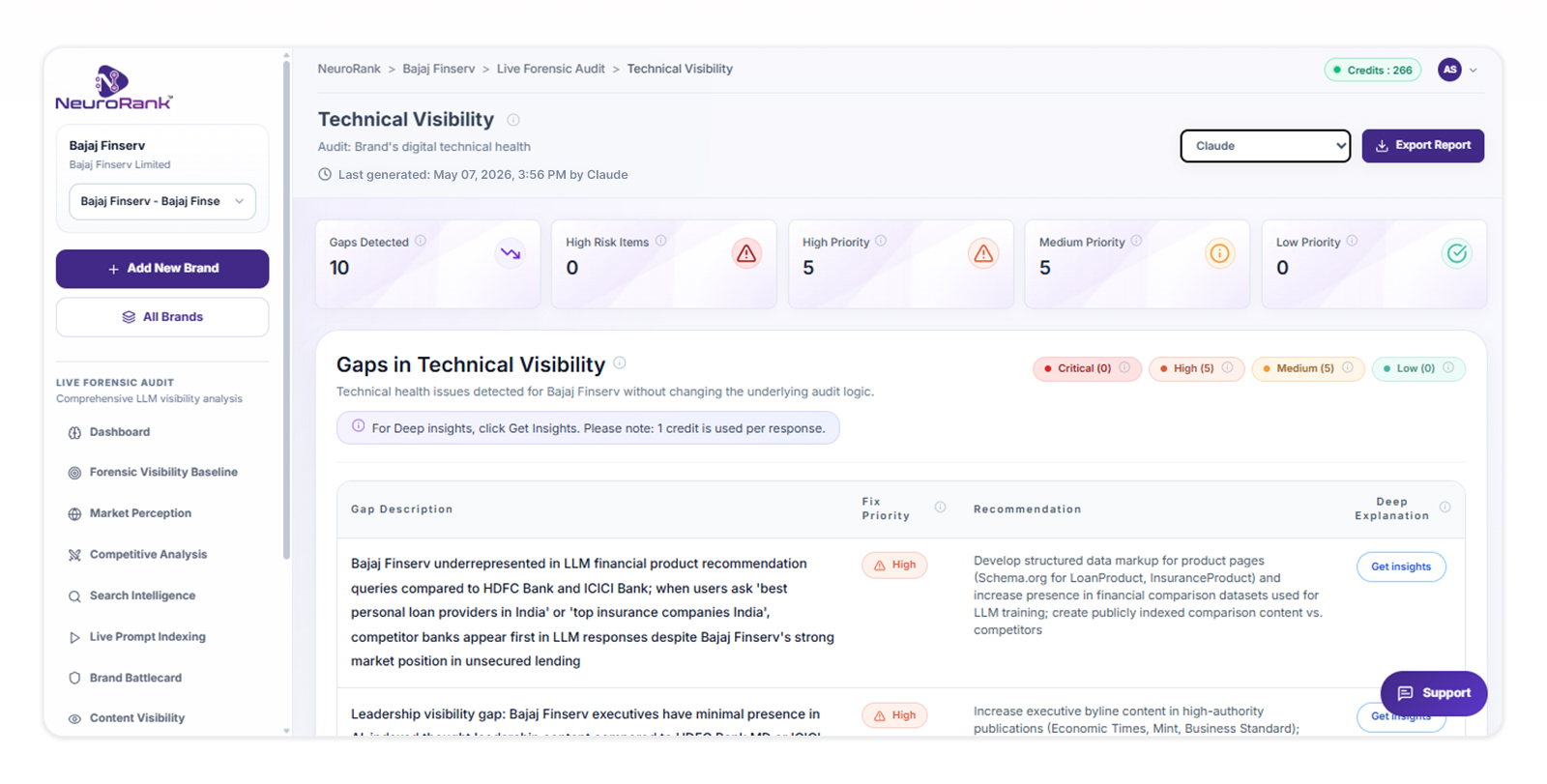
AI engine framing Bajaj Finserv as a licensed bank, when Bajaj Finserv operates as a Core Investment Company under RBI directions and does not hold a banking license. Source: NeuroRank Bajaj Finserv audit, 07 May 2026.
LIC is the canonical example of a brand whose real trust signals sit in the wrong place. Life Insurance Corporation of India is a statutory body, regulated by IRDAI, with a 91.3% claim settlement ratio, AAA domestic credit rating, and ISO 9001:2015 certification. Each would resolve a buyer's question if AI engines could see it. They cannot.
The 07 May 2026 audit logged 14 open gaps and four hallucinations: a fictional government guarantee, claimed international coverage LIC does not sell, traditional-only product framing, and the only-option claim. None is correct. LIC is financially independent. AI invents the strongest-sounding signal because the real one is buried in PDFs.
LIC's YouTube explainer was Absent, schema Sparse, blog content Few. The trust credentials exist. They do not exist where AI can read them. In a regulated category, an unreachable trust signal is functionally equivalent to no trust signal.
| LIC teaches the trust-signal lesson. Real credentials (IRDAI oversight, 91.3% claim ratio, AAA rating, ISO 9001:2015) exist but sit in PDFs. AI engines invent a government guarantee instead. Where machine-readable trust signals are absent, AI fills the gap with the strongest-sounding adjacent claim. That claim is rarely correct. |
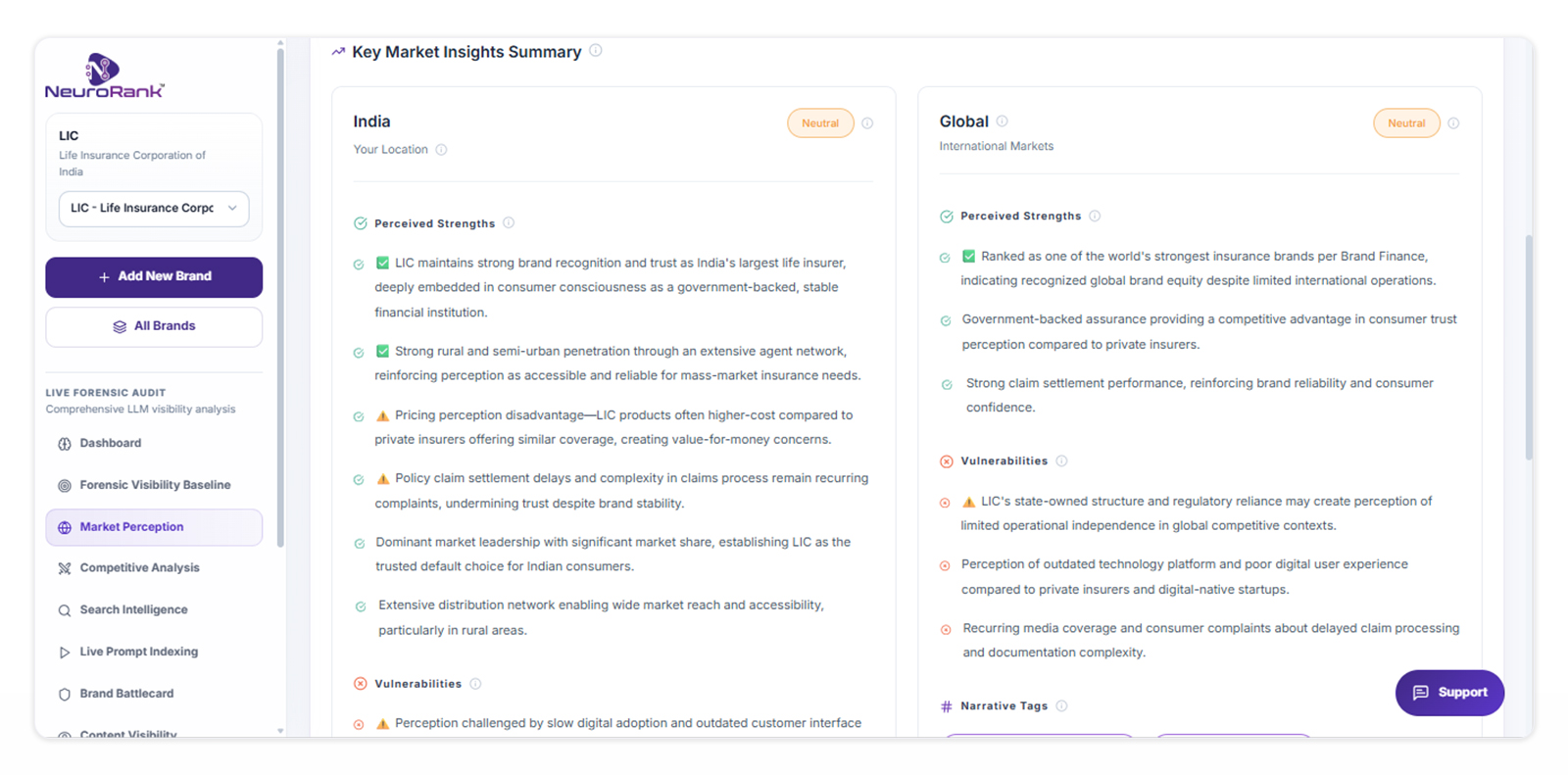
AI engine asserting a government guarantee on LIC policies. LIC is a statutory body regulated by IRDAI; no such product-level government guarantee exists.
NeuroRank LIC audit, 07 May 2026.
Zerodha is the canonical example of the digital-native paradox. India's largest retail stockbroker by active client count, regulated under SEBI registration INZ000031633, was built for the screen-first investor. It dominates organic recall. Yet the 07 May 2026 audit found AI engines attributing insurance products Zerodha does not sell, and treating its YouTube product explainer as Missing.
The audit logged 15 open gaps and five hallucinations: parent company confusion, the zero-brokerage model misstated as zero-cost trading, overstated product breadth, outdated fee schedules, and underrepresentation of platform capabilities. Schema markup for services was Missing. Interactive engagement tools were Absent.
Strong recall did not protect Zerodha. Built natively for digital does not equal legible to AI. AI retrieval reads structured evidence, not user love. The category's most-used product can still be invisible inside the answer that drives the next user's first decision.
| Zerodha teaches the digital-native paradox. India's largest retail stockbroker by active client count is attributed insurance products it does not sell, and its YouTube product explainer is flagged Missing. The audit logged 15 open gaps. Strong recall does not equal AI legibility. Digital-native brands need operational GEO discipline as much as legacy brands do. |
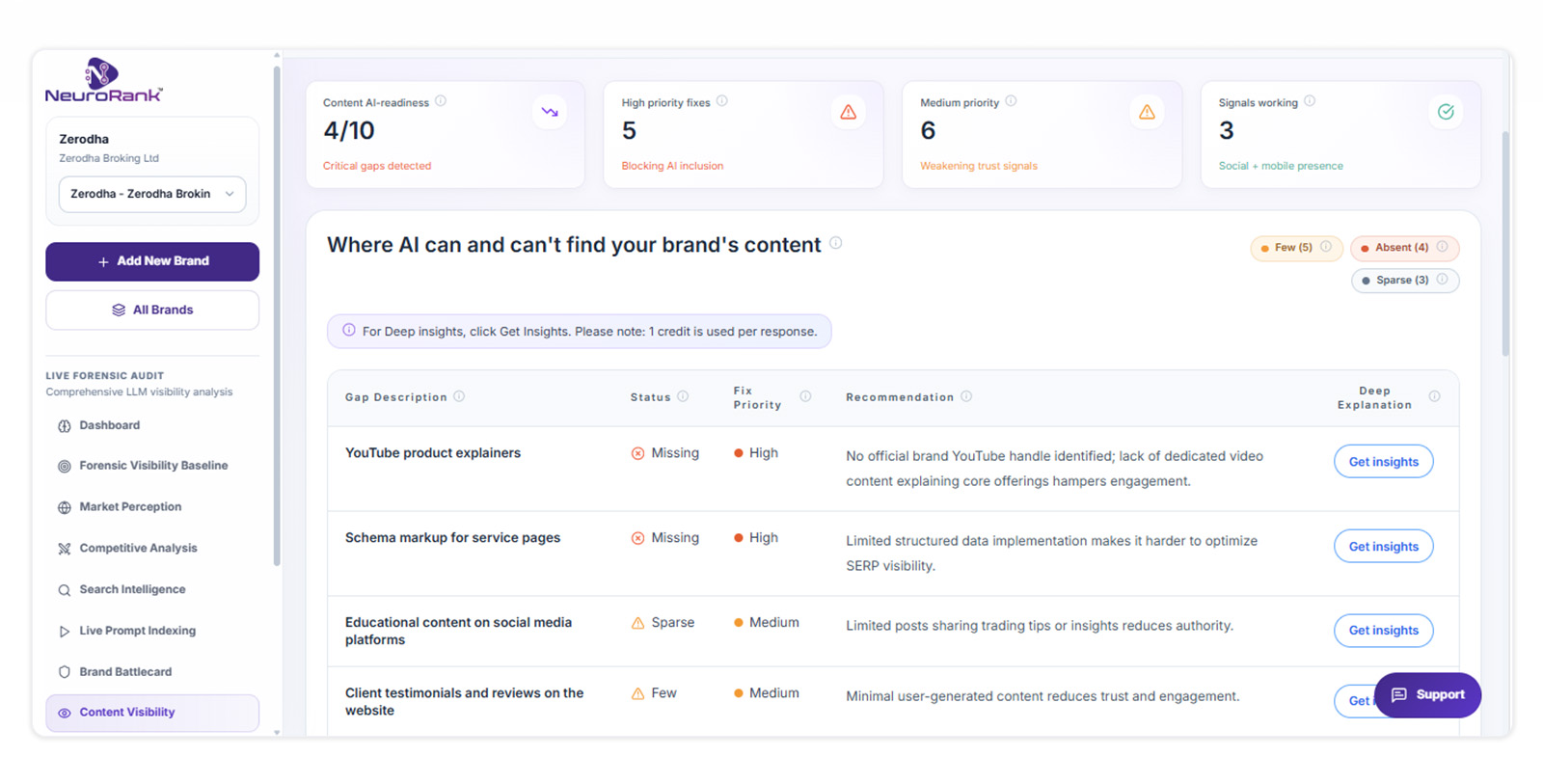
AI engine attributing insurance products to Zerodha that the brand does not sell to retail investors. Zerodha is regulated under SEBI INZ000031633 as a broker.
NeuroRank Zerodha audit, 07 May 2026.
Five fronts. None recoverable through SEO budget.
Valuation. AI-driven research is now standard in institutional due diligence. A misrepresented brand in ChatGPT or Perplexity loses analyst confidence at the moment of evaluation, before management has a chance to respond. That is not a marketing problem. That is a valuation problem.
Compliance. A banking license claim the brand never made. A guarantee the regulator did not issue. AI authored it. The brand carries the exposure. The regulator may not draw that distinction.
Customer acquisition. Pulp Strategy's 79% traffic-loss analysis tracks the BFSI-specific impact of generative summaries. The brand is skipped at the consideration stage, before the buyer reaches the website. AI SEO for Banking is no longer optional.
Brand sentiment. The GEO Benchmark Index logged 500 negative-sentiment mentions across 700 audits. Without structured proof points, AI summaries amplify the negative. One bad review, surfaced repeatedly, becomes the category description.
Talent. Younger candidates research employers in AI before reaching the careers page. A category leader described as a competitor's affiliate damages the funnel. The brand never sees the decline.
Value Snippet. BFSI brands that adopt GEO governance reduce hallucination rate, secure inclusion in AI shortlists, and protect regulated category framing. The mechanism is structured evidence, schema completeness, source authority, and Model Conditioning Loop discipline. The outcome is investor confidence, customer acquisition, and compliance defensibility recovered at the discovery stage.
| Inaction in BFSI compounds across five fronts: valuation in due diligence, compliance in regulated framing, customer acquisition at the discovery stage, sentiment amplification of the negative, and talent funnel erosion. The cost is structural. SEO budget cannot cover an AI retrieval evidence gap. GEO needs its own mandate and its own discipline. |
Monitoring tells a brand it is invisible. It does not tell the brand why, in which model, against which sources, or what to fix first. In a regulated category, that gap is the difference between knowing a hallucination is happening and stopping it before the regulator does.
Five distinct stages. Deconstruct the LLM's internal representation. Diagnose the gap across every model. Prescribe the schema, content, and CMS actions that close it. Condition owned, earned, and third-party surfaces. Track the lift month over month. None can be skipped.
Most AI visibility tools monitor. NeuroRank diagnoses, prescribes, conditions, and tracks. Five steps. One platform. Patent-pending. ISO/IEC 27001 certified.
Deconstruct. Dismantle the LLM's internal representation of your brand.
Diagnose. Classify visibility gaps across ChatGPT, Claude, Gemini, and Perplexity.
Prescribe. Issue the specific content, CMS, and other actions required to fix them.
Condition. Run the Model Conditioning Loop across owned, earned, and third-party surfaces.
Track. Measure month-on-month lift as the models recalibrate.
The GEO Benchmark Index documents the recovery curve. Inclusion lift of 10 to 30 percent within 90 days of starting the five-stage discipline. Lift toward 80 percent within five to six months. The pattern holds across categories. The condition is that all five stages run, not just the first.
| Monitoring is the category default and the category failure. Regulated BFSI requires Deconstruct, Diagnose, Prescribe, Condition, and Track as five distinct stages, each producing a different artifact. AI SEO for BFSI cannot run on a monitoring loop. The patent-pending five-step method runs across ChatGPT, Gemini, Claude, and Perplexity. ISO/IEC 27001 certified. |
The table compares the four BFSI brands audited in May 2026 across audit date, open gaps, ORHL gap profile, and the most material hallucination per brand. Each row is verifiable against the underlying audit record.
Audit dates run from 06 to 07 May 2026. Open gaps are unresolved findings flagged by the live audit. The ORHL gap profile records the dominant failure mode. The final column extracts the most material hallucination per audit. The four rows show that brand size, marketing investment, and Google ranking are not predictors of AI search safety.
| Brand | Audit Date | Open Gaps | Primary ORHL Gap | Most Material Hallucination |
| HDFC | 07 May 2026 | 14 | Hallucinated | Described as a standalone housing finance entity post-2023 merger. |
| Bajaj Finserv | 07 May 2026 | 10 | Hallucinated, Replaced | Stated to hold a banking license; conflated with Bajaj Finance. |
| LIC | 07 May 2026 | 14 | Hallucinated | Credited with explicit government guarantee; framed as traditional only. |
| Zerodha | 07 May 2026 | 15 | Hallucinated, Zero Leads | Attributed insurance products; YouTube canonical structurally absent. |
NeuroRank brand audits, 06 to 07 May 2026.
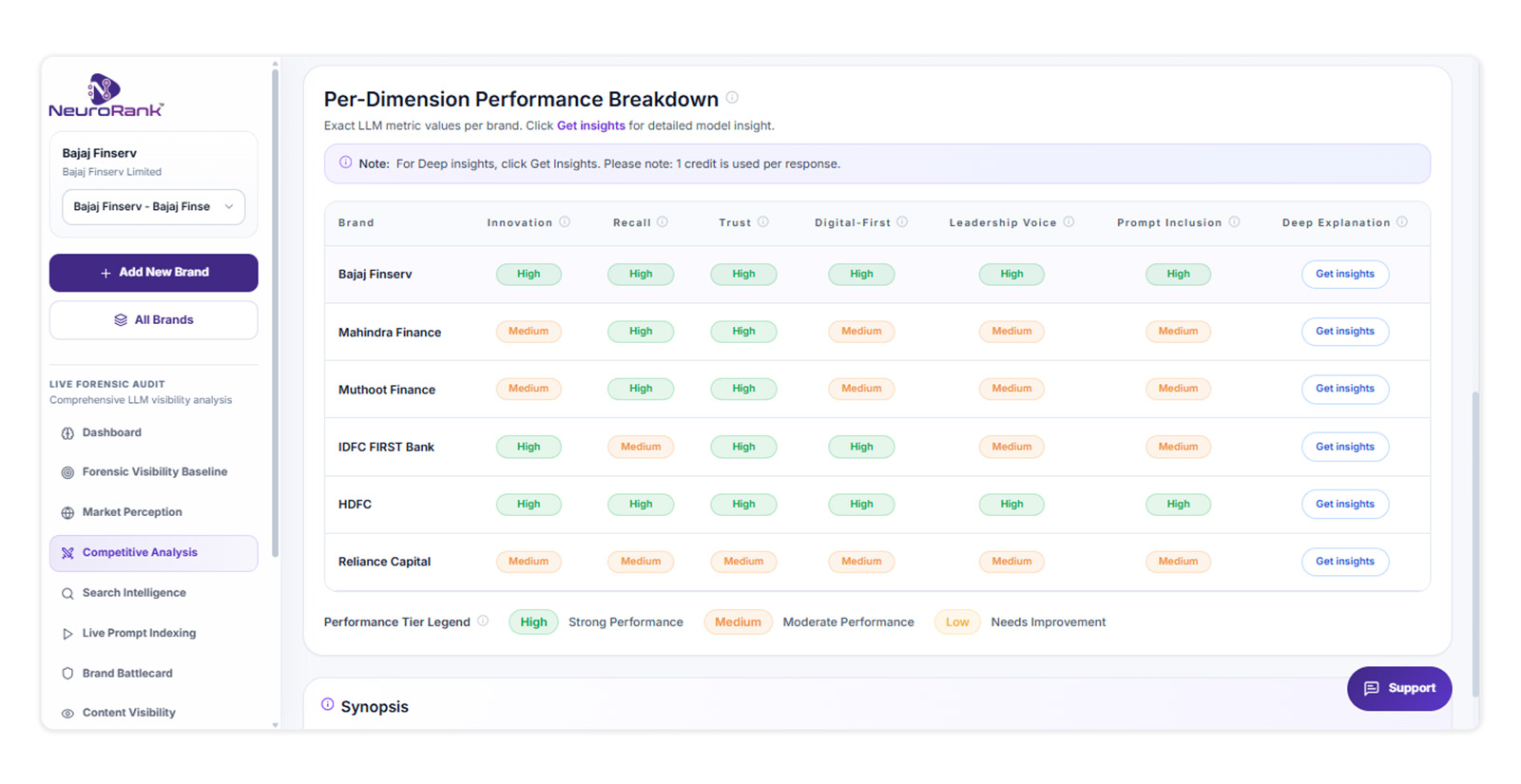
Caption: NeuroRank platform view of the ORHL classification across the four audited BFSI brands. Each brand carries a primary ORHL gap class and a per-model visibility score. NeuroRank dashboard, May 2026.
The four audits sit inside a competitive frame. ICICI Bank, State Bank of India, HDFC Life, ICICI Prudential, Groww, and Upstox compete for the same AI shelf. NeuroRank's competitive matrix scored each across innovation, recall, trust, digital, leadership voice, and prompt inclusion.
Two patterns separate AI-visible leaders from the rest. First, leadership voice. The presence of named, indexed executives in AI answers is the single biggest differentiator between top and second-tier brands. ICICI Bank and State Bank of India scored High on leadership where Bajaj Finserv scored Medium. AI engines reward verifiable expertise.
Second, schema completeness. Zerodha scored High across innovation, recall, trust, digital, leadership voice, and prompt inclusion. The audit logged 15 open gaps and Missing schema for services. Brand reputation does not survive structural invisibility. Schema does.
"Generative engines reference five to seven sources. A brand absent from those sources is invisible."
– Ambika Sharma, Founder, Chief Strategist at Pulp Strategy Communications and Product Architect of NeuroRank
| Across BFSI, two competitive levers separate AI-visible leaders: named, indexed leadership voice, and complete schema across services and products. Brand strength alone does not overcome structural invisibility. Aggregator dominance fills the gap when brand-owned sources are not machine-readable, displacing the brand from its own answer. |
Indian BFSI faces three region-specific GEO conditions. The first is regulatory architecture. RBI regulates banking and NBFC categories. SEBI regulates broking. IRDAI regulates life and general insurance. A misframed regulatory positioning by an AI engine is the most consequential hallucination class in this market.
The second is language. Cross-lingual confusion was logged in 88% of brands across the GEO Benchmark Index. Hindi-English transliteration, common-noun overlap, and namesake confusion distort recall. AI retrieval needs the brand entity to resolve in both English and regional languages.
The third is aggregator concentration. Policybazaar, Bankbazaar, Paisabazaar, Groww, and Money Control are cited by AI engines for BFSI prompts because they hold structured content brand-owned sites lack. AI Visibility for Banking and AI Visibility for BFSI depend on reclaiming the source position through schema, llms.txt, FAQ orchestration, and HTML trust signals.
People also ask: What schema markup do BFSI brands need to fix first?
BFSI brands need Organization, FinancialProduct, Service, FAQPage, BreadcrumbList, and Person schemas, implemented across product pages, leadership pages, and category pages. License numbers, regulator IDs, claim settlement ratios, and audit dates must be exposed in structured HTML, not buried in PDFs. FAQ schema text must match on-page text exactly, character for character.
| India BFSI requires explicit regulatory framing across RBI, SEBI, and IRDAI, Hindi-English entity resolution, and aggregator displacement strategy through structured trust signals. Failure on any one of these three drives Hallucinated and Replaced gaps in AI search. NeuroRank treats them as a single governance discipline. |
This is a category-level analysis. It does not include brand-specific remediation roadmaps, prompt cluster libraries by product line, model-level confidence scores, or competitive battle cards by SKU. Those sit inside individual brand audits. The article does not cover GEO performance for non-Indian BFSI brands, crypto-native exchanges, or fintech sub-segments such as wealth tech and credit scoring, which carry their own audit profiles.
The article does not benchmark NeuroRank against named AI visibility competitors. Per the NeuroRank competitor protocol, competitor comparisons sit on /compare pages, not in research articles. The article does not provide an implementation timeline or fixed remediation cost. Implementation timelines depend on internal CMS, schema cadence, and editorial supply chain. Pricing in Next Steps refers to the diagnostic and to Model Preference Engineering subscription, not to remediation effort.
The article does not interpret regulatory exposure. Misrepresentation of a banking license, a government guarantee, or a regulator-mandated disclosure in AI search is a factual gap surfaced by the audit. Whether and how that exposure converts into a regulatory action is a question for the brand's compliance and legal counsel. The article is a category-level diagnostic, not a legal opinion or investment recommendation.
| This article reports outputs generated by AI search engines (ChatGPT, Gemini, Claude, and Perplexity) on specific dates between 06 and 07 May 2026. The hallucinations and gaps described are AI-generated outputs observed during NeuroRank's audit, not factual claims by NeuroRank or Pulp Strategy Communications about HDFC, Bajaj Finserv, LIC, or Zerodha. AI engine outputs change over time and may differ on any given day for any given user. The four named brands are regulated by the Reserve Bank of India, SEBI, or IRDAI. Their actual products, licenses, and regulatory standing are documented on their official websites and regulator filings, not by AI summary. Readers should consult brand-owned sources and qualified legal, financial, or compliance counsel before acting on any inference drawn from this article. This article is research and category-level diagnostic. It is not a legal opinion, investment advice, or a regulatory complaint. |
Three questions. Has anyone audited what AI says about your brand this quarter? Do you know which model misrepresents you most, against which sources, and in which prompt cluster? If a regulator quoted the AI hallucination back to you tomorrow, what would you say? A Live Forensic Audit answers all three. USD 7.00 per brand, twelve to twenty minutes. Model Preference Engineering starts at USD 225 per month, full coverage USD 350. The asymmetry between an audit and a misframed banking license should make this a same-day decision.
Every BFSI brand in India has been misrepresented at least once in AI search this quarter. The brands that audit will recover the narrative. The brands that wait will not.
When AI tells your story, is it telling the truth?
Stop paying for clicks that do not convert. Benchmark your AI visibility today with the world's most advanced seo ai tools.
Book a Strategic NeuroRank Briefing