
BlogSeptember 15, 2026
LLM SEO: how to rank inside AI answers, not just search results

Ambika SharmaFounder at Pulp Strategy Communications and NeuroRank.
Ambika Sharma
Ambika Sharma is the Founder & Chief Strategist of Pulp Strategy, a multi-award-winning business transformation and digital agency, and Prod... Read more
Subscribe for Newsletters
Updated September 2026.Ambika Sharma, Founder, Chief Strategist at Pulp Strategy Communications and Product Architect of NeuroRank.
Most of what a model cites when it answers a category question belongs to somebody else. AI citation tracking records which URLs ChatGPT, Gemini, Claude, and Perplexity actually credit when they describe a brand, and how that set changes month on month. NeuroRank surfaces it as the Citation Tracker, split by source type, because a footprint growing through the brand’s own pages and one growing through independent publishers mean two different things. The first describes a company talking to itself. The second describes a company the engines are prepared to vouch for, and only the second holds when a rival starts publishing.
| Patent-pending · ISO/IEC 27001 · 4 LLMs + Combined synthesis · Fresh-token methodology · 5,500+ prompt runs per cluster |
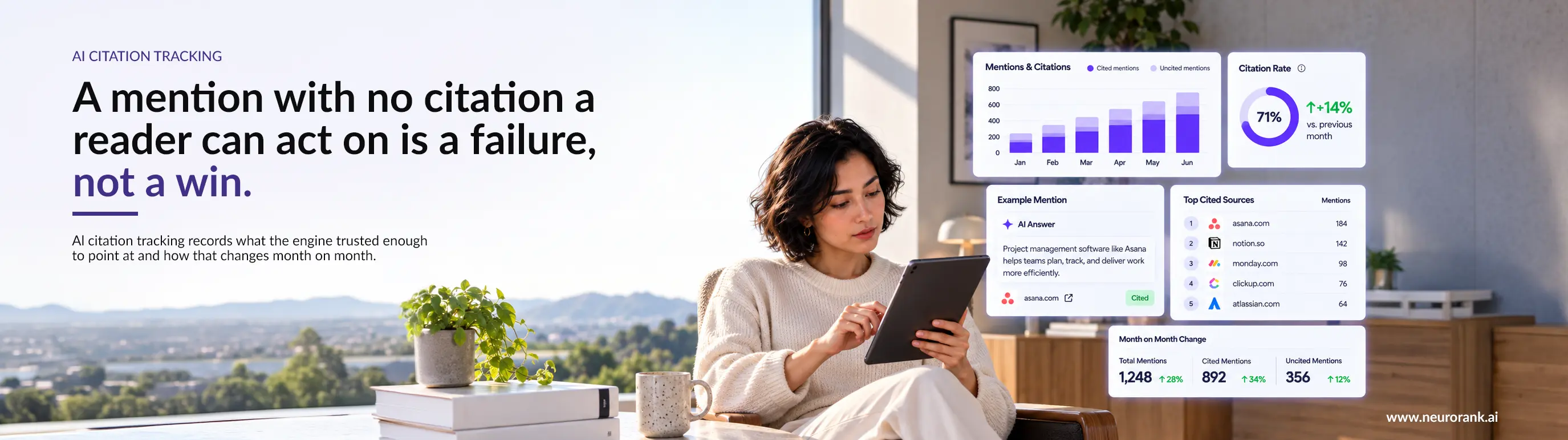
It records what the engine trusted enough to point at. AI citation tracking follows which sources the four engines credit when they answer prompts about a brand, and how that set shifts over time. Earning a citation and tracking one are separate jobs: the first is publishing and placement work, covered in the guide to getting cited, and this page covers the measurement that tells you whether it worked.
Those two move in opposite directions more often than teams expect. A brand can gain mentions while its citations stay concentrated on one thin source, which reads as growth and is fragile.
A mention with no citation a reader can act on is a distinct failure state. NeuroRank classifies it as Zero Leads, one of the four gap types in the ORHL taxonomy alongside Omitted, Replaced, and Hallucinated.
AI citation tracking records which URLs a model credits when it answers prompts about a brand, and how that set changes over time. It is a narrower question than visibility: a brand can gain mentions while its citations stay concentrated on one thin source, which reads as growth and is fragile.
A raw count tells a communications team nothing. Ten citations that are all the brand’s own pages describe a company talking to itself. Three from independent publishers Perplexity already reads describe a company it will vouch for.
Composition is the readable part. NeuroRank splits every cited URL into branded, competitor, neutral third-party, and social, which shows whether authority is being borrowed or built.
Brands’ own domains dominated. In the four full audits that logged their citations, 96 links in total, the single most cited source for a brand was its own website, and the top brand domain alone carried 17 percent of all citations recorded.
The rest went to trade press, financial media, and comparison sites. Wikipedia was nearly absent, which is worth noting for any team treating an encyclopedia entry as the foundation of its entity signal.
That citation sample is small and NeuroRank reports it as such: four brands, 96 links. It is directional, and the direction is that owned domains carry more citation weight than most teams expect while independent corroboration carries the credibility.
Results vary by brand, category, and starting baseline.
In the four full audits that logged citations, 96 links in total, a brand’s own website was consistently the most cited source, with the top domain carrying 17 percent of all citations. Trade press and comparison sites followed, and Wikipedia was nearly absent.
Source. NeuroRank AI visibility research, "Main door to online discovery: winning AI search recommendations in the agentic age". 122 brands, 8,647 end-result prompt ratings, audits run March to May 2026.
The Citation Tracker records it. Every web page each model used for the brand’s prompts is sorted into branded, competitor, neutral third-party, and social, which is what shows the publishers and communities that carried a rival into the answer.
Five fields per entry. The exact URL, the model, the region, the parent prompt, and the date. A citation with no parent prompt cannot be retested next cycle, and one with no engine attached hides whether ChatGPT or Claude produced it.
AI citation optimization works from that record. Where Gemini credits a thin or outdated source, the correction is a better-sourced alternative published where it already looks.
Citation Tracker. Which brand the models cite most, and which kind of source each brand wins on: branded, competitor, review, editorial, community, marketplace, or video.
The Citation Tracker records every cited URL with its model, region, parent prompt, and date, sorted by source type. That sorting shows which publishers carried a competitor into the answer, which a mention count cannot.
Competitor citations inside a brand’s own prompts are the signal most teams miss. They mean the model reached for a rival’s material to answer a question about you, which is a positioning problem before it is a content problem.
A citation count is not readable on its own. Splitting cited URLs into branded, competitor, neutral third-party, and social shows whether authority is being borrowed or built, and competitor citations inside a brand’s own prompts signal a positioning problem before a content one.
The URL, the model, the prompt, the date. Anything less cannot be acted on. A citation with no parent prompt cannot be retested next cycle, and one with no engine attached hides whether ChatGPT or Claude produced it.
The exact URL cited, not the domain.
Which of the four models returned it, and in which region.
The prompt that produced it, so the finding is retestable.
The source type, so the footprint can be read by composition.
The date, so movement is measurable against a baseline.
Most AI visibility platforms monitor. NeuroRank diagnoses, prescribes, conditions, and tracks.
An AI citation tool needs the exact URL, the model, the region, the parent prompt, the source type, and the date. A citation with no parent prompt cannot be retested next cycle, and one with no model attached hides which engine is behaving differently from the others.
By giving retrieval something better. Where Gemini cites a thin or outdated source, the correction is an accurate, well-sourced alternative published where the engine already looks.
Order matters here, and reversing it is expensive. Correct anything the engines state inaccurately first, because a wrong fact compounds as they corroborate each other. Then restructure what is already retrieved. Then earn corroboration on the third-party surfaces those engines trust.
Reverse the first and last steps and the error amplifies across all four engines at once.
Citation optimization works by publishing an accurate, well-sourced alternative where the model already looks, so the retrieval layer has something better to reach for. Correct inaccuracy before earning corroboration, because a wrong fact compounds as the engines cite each other.
Rank tracking, mention monitoring, and citation tracking get discussed as one practice. They answer different questions, and a team reporting one as a proxy for another will misread its own position.
| Dimension | Rank tracking | Mention monitoring | AI citation tracking |
|---|---|---|---|
| Question answered | Where does the page sit | Was the brand named | What did the model trust |
| Unit | Keyword | Mention | Cited URL, per prompt, per model |
| Failure it detects | Ranking below a rival | Absence | Zero Leads, and borrowed authority |
| Source visibility | None | Publication only | Exact URL, split by source type |
| Actionable output | A position | A count | A named source to change or corroborate |
Rank tracking asks where a page sits, mention monitoring asks whether a brand was named, and citation tracking asks what the model trusted enough to point at. Only the third returns a named source a team can change or corroborate.
With one category cluster. NeuroRank is an AI visibility intelligence platform, and a Live Forensic Audit catalogues every cited source with its URL across all four engines, returning a 10-section intelligence report in 12 to 20 minutes that gives a team its first readable footprint.
The Citation Tracker then follows that footprint month on month against the first-cycle baseline. That is what lets a team command how AI perceives, interprets, and recommends your brand, across Asia, Europe, the Middle East, the USA, and North America. The method has been stress-tested across 350+ brands in 65 industries.
Stop paying for clicks that do not convert. Benchmark your AI visibility today with the world's most advanced seo ai tools.
Book a Strategic NeuroRank Briefing