BlogSeptember 15, 2026
Generative engine optimization

Ambika SharmaFounder at Pulp Strategy Communications and NeuroRank.
Ambika Sharma
Ambika Sharma is the Founder & Chief Strategist of Pulp Strategy, a multi-award-winning business transformation and digital agency, and Prod... Read more
Subscribe for Newsletters
Updated September 2026 Ambika Sharma, Founder, Chief Strategist at Pulp Strategy Communications and Product Architect of NeuroRank
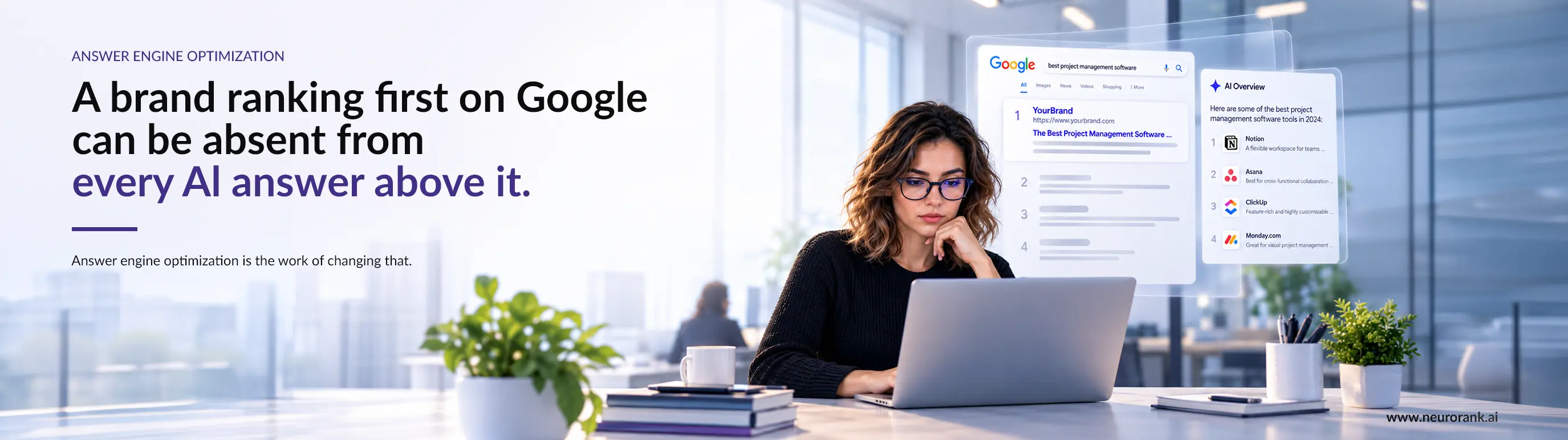
Ask ChatGPT, Gemini, Claude, and Perplexity which platforms solve a category problem, and each returns a short list. A brand ranking first on Google for that same question is frequently absent from every one of those lists. Answer engine optimization is the work of changing what an answer engine says about a brand: whether it appears in the synthesized answer, how it is described, and which source earns the citation. Position is not the unit. Presence is. NeuroRank diagnoses that gap against live evidence, prescribes the fix, conditions the retrieval layer, and tracks whether the answer moved.
| Patent-pending · ISO/IEC 27001 · 4 LLMs + Combined synthesis · Fresh-token methodology · 5,500+ prompt runs per cluster |
Answer engine optimization changes what an engine says. The practice covers how an AI answer engine represents a brand inside the answer it generates. Three outcomes carry it: inclusion in the answer, accuracy of the description, and attribution to a source the reader can open. Rank position in a list of ten blue links is a separate measurement with a separate fix.
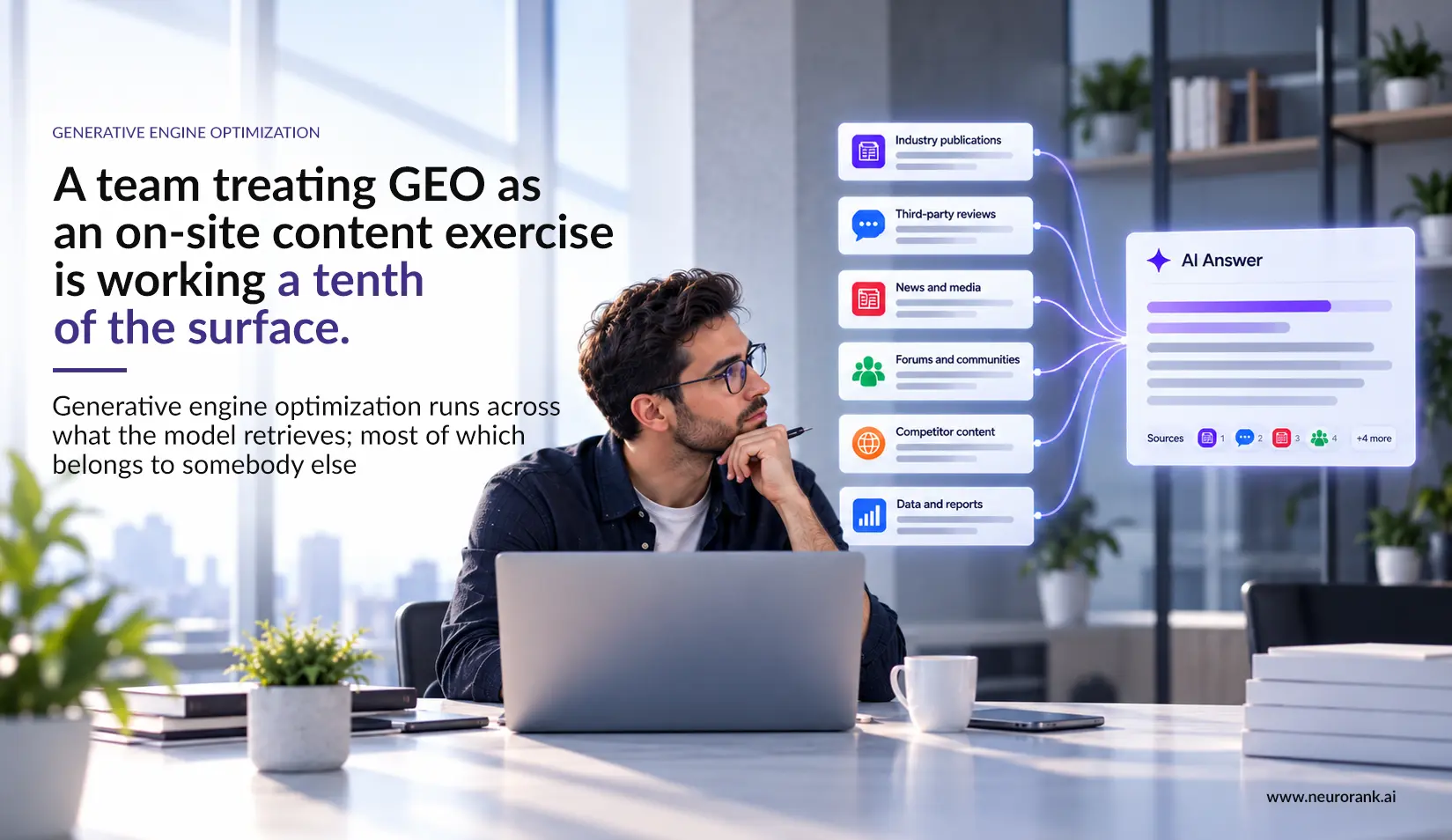
The mechanism differs from search. An answer engine does not order documents against a query. It retrieves passages, weighs how credible each one looks, and composes a single response. That retrieval step never consults the Google rankings.
Perplexity credits its sources inline, while Google AI Overviews compresses several of them into a single paragraph. ChatGPT and Gemini both shift by how the question is phrased. Four engines, four retrieval behaviors, and one brand described four different ways.
Answer engine optimization changes inclusion, accuracy, and citation inside a generated answer. The retrieval step that decides all three does not read the search rankings, which is why a first-position page and an absent brand sit together more often than most teams expect.
Because the two run on different inputs. A search engine returns ten results and hands the choice to the reader. An answer engine returns one response and has already made the choice. Ranking rewards a whole document, and retrieval rewards a passage that is easy to lift and corroborated somewhere the model already trusts.
The failure is rarely total, which is why it survives for months. Most brands appear under their own name and vanish under the category question that decides a shortlist. Marketing checks the branded prompt, finds the description accurate, and concludes the work is finished.
The category question is where a shortlist forms.
Two runs of the same prompt can also return different source sets, so one check measures a single draw from a variable distribution. A team acting on that has acted on noise.
A ranking is judged on document position against a query, and inclusion is judged on whether a model retrieves, trusts, and quotes a passage while composing. Branded prompts flatter a brand by naming it first. The category prompt decides the shortlist, and it is the one most teams never test.
Four, and each needs a different correction. The ORHL failure taxonomy splits them: Omitted, Replaced, Hallucinated, and Zero Leads. The taxonomy itself, and how each class is scored, is set out in full in the ORHL guide. Omitted is absence where the brand belongs, and Replaced is a competitor holding the slot instead. Hallucinated covers the wrong price, the wrong capability, or the wrong category. Zero Leads is a mention carrying no citation a reader can act on.
An Omitted brand has a retrieval problem and needs sources the engine can find. A Replaced brand has an authority problem and needs corroboration a competitor lacks. A Hallucinated brand needs an accurate, well-sourced alternative that is easier to trust than whatever is circulating. A Zero Leads brand needs a citable destination the reader can actually open.
Name the page, the change, and the reason. Most platforms in this category return a composite score and a mention count, which describes a symptom and hands the diagnosis back to the buyer. An answer engine optimization tool that stops at observation cannot tell a team which URL to change on Monday.
Live Prompt Intelligence captures the answers themselves. Every response is stored with the sources it cited, the model that produced it, and its ORHL type. A finding points at a page instead of a feeling.
Then the fix. The Recommendation Engine turns each gap into an action on a named URL, across editorial, website, video, forums, and marketplaces, and writes the brief afterwards. Actions first, briefs second.
Live Prompt Intelligence. Responses captured this month, gaps found, and every gap sorted as Omitted, Replaced, Hallucinated, or Zero Leads.
Recommendation Engine. For one prompt: the potential, the competitor holding the slot, the gap, and the fix, with the signals that are working and the ones that are missing.
An answer engine optimization tool earns its place when it captures the answer, names the source URL behind each gap, and converts that gap into an action on a named page. Live Prompt Intelligence holds the evidence and the Recommendation Engine holds the fix.
Averaging those four into one visibility score prescribes nothing. It is the reason a composite number reads well in a board pack and cannot be worked from on a Monday morning.
Every brand carried them. Across 83 full audits, NeuroRank found an average of 47 unaddressed visibility gaps per brand, and 81 of those 83 carried ten or more rated critical, meaning the brand was absent where it should have appeared (n=3,916 gaps).
The severity split is the part worth sitting with. An average of 18 critical gaps per audit is not a tuning problem. It is a brand missing from the answers that decide its category, repeatedly, across four engines.
Sector changes the number but not the pattern. Combined High inclusion runs from 26 percent in professional services and pharma to 45 percent in consumer durables, a 24-point spread, while average gaps per audit stay between 40 and 49 in every sector measured (n=122 brands).
Results vary by brand, category, and starting baseline.
Across 83 full audits NeuroRank found an average of 47 unaddressed gaps per brand, 18 of them critical, with 81 of 83 brands carrying ten or more critical gaps. Sector shifts the inclusion rate by up to 24 points; it does not change the gap count.
Source. NeuroRank AI visibility research, "Main door to online discovery: winning AI search recommendations in the agentic age". 122 brands, 8,647 end-result prompt ratings, audits run March to May 2026.
ORHL splits answer failure into Omitted, Replaced, Hallucinated, and Zero Leads. Retrieval, authority, accuracy, and attribution are four separate problems with four separate fixes, and a single composite visibility score collapses them into one figure nobody can action.
At cluster scale, in cold sessions. Every run issues on a new authentication token, so memory from a prior query cannot contaminate the result and each answer arrives as a cold start. A logged-in ChatGPT or Gemini account returns an inflated reading, because the model has already learned the tester and is answering the tester.
NeuroRank runs 5,500+ fresh-token prompt runs per prompt cluster, per region. A cluster is the set of related questions a buyer actually asks, grouped across Brand, Product, Category, and Purchase-Intent. Volume at that scale turns a variable answer into a measurable pattern.
Coverage spans all four engines plus a Combined synthesis that reads them together and is reported as the NeuroRank Benchmark. Contradictions between the engines surface in that combined view instead of hiding in separate tabs. A brand described one way by ChatGPT and another way by Perplexity has an accuracy problem, and accuracy and absence never share a prescription.
Region is set at the start. The engines weight regional sources differently across Asia, Europe, the Middle East, the USA, and North America, and an aggregate figure hides a market where the brand is missing.
Diagnosis runs 5,500+ fresh-token prompt runs per prompt cluster, per region, across all four engines plus Combined synthesis. Every run is a cold start with no session history. Output is a 10-section intelligence report with every gap classified under ORHL, and not a single score.
Name the page, the change, and the reason. Most platforms in this category report that a mention happened and stop there, which leaves the interpretation to whoever happens to open the dashboard that week. A finding that cannot be traced to a URL cannot be shipped, approved, or tested next cycle.
Four capabilities separate a report from a working practice. Classification, so the failure type is known. Source cataloguing, so a fix points at a real URL. A ranked prescription tied to the exact prompt that produced the gap. And an approval trail, so every completed change carries a name against it.
Most AI visibility platforms monitor. NeuroRank diagnoses, prescribes, conditions, and tracks.
An answer engine optimization tool earns its place when it names the URL, the change, and the reason, ties each one to the prompt that produced it, and records who approved the work. Monitoring reports that a mention happened. A prescription names a page, ships, and gets tested against the same prompt next cycle.
The client team implements, on its own systems. NeuroRank is an AI visibility intelligence platform, so it issues the prescription and governs the trail, while content writing, publishing, and technical work stay with the brand or its agency. Advisory hours sit inside every Model Preference Engineering subscription to support that team.
Approval runs on two roles. A Maker submits completed work with a live link in Maker: Implementation Tracker. A Checker verifies it in Checker: Approver Panel against a documented benchmark, and an automated GEO Effectiveness Check scores the submission High, Medium, or Low against 13 checks before that review.
Nobody approves their own work.
Most teams discover they need that record late. Once AI visibility reaches a board pack, the question is what changed and on whose authority, and an unattributed list of edits does not survive it.
A Maker implements and submits with a live link, a Checker verifies against a documented benchmark, and the automated GEO Effectiveness Check scores the submission first. Every completed change carries a named approver and the criteria used, which is what makes an AI visibility number defensible.
With one category cluster, measured. That baseline comes from a Live Forensic Audit, which returns a 10-section intelligence report in 12 to 20 minutes across the four engines plus Combined synthesis, with every gap classified and a ranked fix list attached to named sources. The point of the exercise is to command how AI perceives, interprets, and recommends your brand, and a baseline is where that starts.
Five inputs start it: brand name, legal company name, website URL, YouTube URL where a branded channel exists, and target region. The method behind it has been stress-tested across 350+ brands in 65 industries and validated through feedback from over 150 leadership teams, spanning Asia, Europe, the Middle East, the USA, and North America. That is the whole list. The platform queries the engines from outside, the same way a customer does, which usually removes the longest step in a security review.
Model Preference Engineering is the continuous practice, scaling from one model and one prompt cluster to all four engines plus Combined synthesis. Clusters accumulate, so month three runs three and month twelve runs twelve. Configurations and pricing sit on the pricing page.
Start GEO growth with NeuroRank
Stop paying for clicks that do not convert. Benchmark your AI visibility today with the world's most advanced seo ai tools.
Book a Strategic NeuroRank Briefing