ComparisonJuly 29, 2026
AI visibility tools compared: which platform measures, fixes, and approves

Ambika SharmaFounder at Pulp Strategy Communications and NeuroRank.

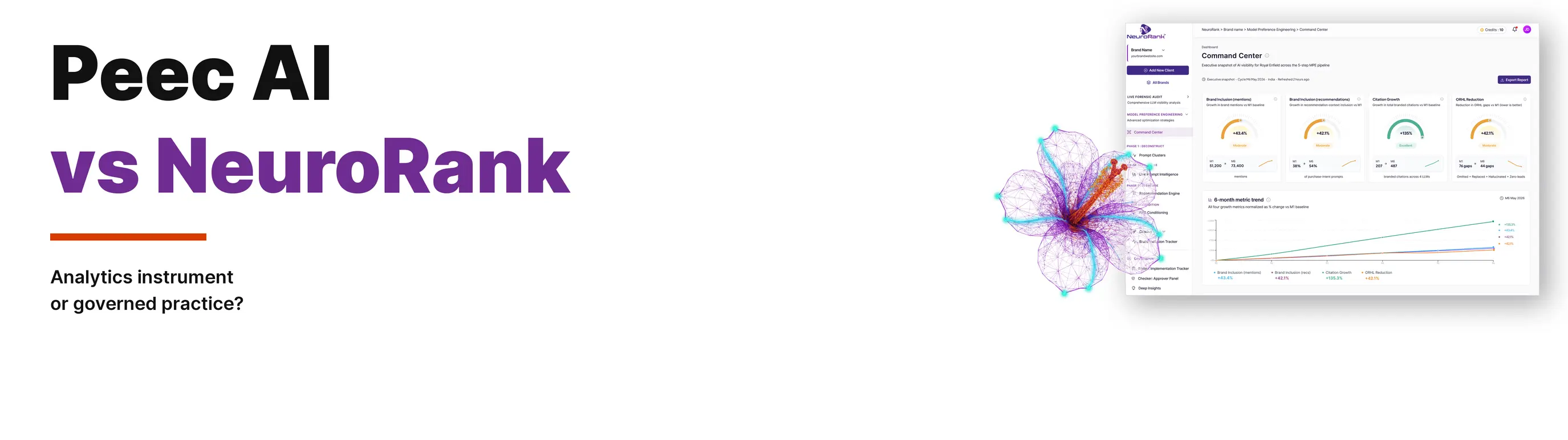
Founder at Pulp Strategy Communications and NeuroRank.
Subscribe for Newsletters
Updated July 2026 · Ambika Sharma, Founder, Chief Strategist at Pulp Strategy Communications and Product Architect of NeuroRank®
Peec AI focuses on AI search visibility measurement. NeuroRank diagnoses visibility gaps, prescribes prioritized actions, conditions models, and tracks the resulting changes.
Peec AI and NeuroRank® meet at the same starting line, measurement, and NeuroRank's measurement runs 5,500+ fresh-token runs per prompt cluster per region before the governed work begins. They differ on the finish line: clean analytics your team interprets, or a full cycle the platform carries through approved fixes and tracked lift. This comparison covers both platforms' published capabilities as of July 2026; it does not evaluate unreleased roadmaps.
The comparison matters because Peec has earned its reputation the right way: focused scope, clean data, and a published price. The question this page answers is what happens after the dashboard, and who owns it.
Peec AI is an AI search analytics platform for marketing teams and SEO agencies. Per its published site and pricing as of July 2026, it tracks prompt-level visibility, position, and sentiment with daily updates, benchmarks competitors, analyzes citation sources, and ships unlimited seats on every plan, with brand plans and agency plans on a published self-serve ladder, agency credit allocation across clients, pitch workspaces, Looker Studio integration, and API access on higher tiers. Core engines are covered on base plans, with further models available as paid add-ons.
NeuroRank is a patent-pending AI visibility intelligence platform, a brand of Pulp Strategy Communications Pvt. Ltd., and Model Preference Engineering is its continuous monthly practice: it deconstructs how the models see the brand, diagnoses every gap with live evidence, prescribes ranked fixes, conditions the models, and tracks the lift, with a named approver on every change.
These are not the same purchase. One is the instrument panel; the other is the full practice.
Unlike Peec AI, NeuroRank does not stop at analytics: every finding becomes a prescribed fix, approved by a named reviewer against a 38-point checklist, conditioned into the models, and measured against baseline.
Peec AI and NeuroRank are both disciplined platforms; the discipline points at different jobs. Peec is the analytics specialist: prompt-level visibility, position, and sentiment, tracked daily, benchmarked against competitors, with unlimited seats, agency credit allocation, pitch workspaces, and a published self-serve ladder, per its published documentation. NeuroRank, a patent-pending AI visibility intelligence platform from Pulp Strategy Communications, is the practice: 5,500+ fresh-token runs per prompt cluster per region across ChatGPT, Gemini (includes AI Overviews), Claude, and Perplexity, every gap classified, ranked fixes, a named approver against a 38-point checklist, model conditioning, and tracked lift. Enterprise customers implement an average of 38 recommendations per cluster per month; teams have averaged a 39.6% AI visibility lift over approximately 80 days, and results vary by brand, category, and starting baseline. Clean analytics tell you where you stand; the governed cycle changes where you stand.
Peec AI is the analytics specialist: prompt-level metrics, daily tracking, unlimited seats, and a published price
Peec's base plans cover core engines, with further models as paid add-ons, per its published plans
NeuroRank fixes the depth: 5,500+ fresh-token runs per prompt cluster per region, at every price tier
Peec reports and benchmarks; NeuroRank prescribes, approves through a named reviewer, conditions, and tracks
Both platforms are agency-friendly; NeuroRank adds embedded advisory hours and a governed, exportable record
NeuroRank is ISO/IEC 27001 certified, GDPR compliant, and needs no access to internal systems
| Peec AI | NeuroRank | |
| What it is | AI search analytics platform | Patent-pending AI visibility intelligence platform running Model Preference Engineering |
| Primary audience | Marketing teams and SEO agencies | CMOs, media and performance teams, SEO and digital leads, agencies |
| Measurement method | Prompt-level tracking with daily updates | 5,500+ fresh-token runs per prompt cluster, per region, monthly |
| Engines covered | Core engines on base plans; further models as paid add-ons, per its published plans | ChatGPT, Gemini (includes AI Overviews), Claude, Perplexity, plus Combined synthesis |
| Gap classification | Visibility, position, and sentiment metrics | ORHL: Omitted, Replaced, Hallucinated, Zero Leads |
| Prescriptions | Analytics and benchmarking; strategy stays with the buyer | Source-linked fixes ranked by impact, tied to the exact prompt |
| Approval workflow | None published | Maker-Checker: named approver, 38-point checklist, auditable trail |
| Model conditioning | Not a published capability | Model Conditioning Loop at prompt-cluster level |
| Improvement tracking | Metric trends per prompt set | Brand Inclusion Score and citation footprint, month on month, against baseline |
| Executive reporting | Dashboards, Looker Studio, CSV, and API on higher tiers | Command Center with formulas shown, plus Deep Insights copilot |
| Compliance | Published documentation; verify per procurement needs | ISO/IEC 27001 certified, GDPR compliant, no internal-system access |
| Pricing model | Published self-serve ladder; brand and agency plans, unlimited seats | Fixed and published: from USD 225/month; USD 350/month full; Enterprise custom |
Source: NeuroRank analysis of both platforms' published documentation, July 2026.
Both platforms measure at the prompt level; they buy different amounts of certainty per prompt.
Pros:
Prompt-level visibility, position, and sentiment update daily, with competitor benchmarking built in, per its published documentation
Unlimited seats on every plan remove the per-user tax on collaboration
Citation source analysis shows which domains feed the answers
Cons:
Depth is shaped by prompt quotas, projects, and engine add-ons per its published plans, so the configured picture is a budgeting decision
The published scope is analytics; what the metrics mean for action stays with the buyer
Pros:
5,500+ fresh-token runs per prompt cluster per region across ChatGPT, Gemini (includes AI Overviews), Claude, and Perplexity, each a brand-new session with no history, the way a first-time buyer sees the model
Every gap classified as Omitted, Replaced, Hallucinated, or Zero Leads (ORHL): skipped, replaced by a competitor, described incorrectly, or simply invisible, and each class routes to a different fix
One new cluster is added each month and every prior cluster re-runs, so month twelve tracks twelve clusters against a continuous baseline
Cons:
The cadence is monthly by design, tuned to how model answers actually shift, rather than daily
Peec reads tracked prompts daily and reads them cleanly. NeuroRank reads each cluster at fixed depth, 5,500+ fresh-token runs per region, and classifies every gap so the next step is named. One optimizes for signal freshness; the other for evidence you can act on and defend.
Peec's focus is a feature, not a gap: it is deliberately an analytics platform, and its published positioning keeps strategy and execution with the buyer.
Pros:
Dashboards, Looker Studio integration, CSV export, and API access on higher tiers put the data wherever teams work, per its published documentation
Agency plans allocate credits across clients, and pitch workspaces support new-business work
The learning curve is short, which is exactly what a focused instrument should offer
Cons:
No prescriptive fix ranking, approval workflow, conditioning, or lift attribution is published; interpretation and execution are the buyer's own system
Configured cost moves with prompts, projects, and engine add-ons
Pros:
The Recommendation Engine converts every classified gap into prescriptive, source-linked fixes, priority-ranked and tied to the exact prompt
Every fix passes a two-step control borrowed from banking: one team member (the Maker) implements it, and a second (the Checker) reviews and approves it against a 38-point checklist before it goes live
The Model Conditioning Loop then places corrected, consistent brand information across your own site, earned coverage, and third-party sources, and the following cycle measures the movement
Cons:
NeuroRank does not write or publish content for you; it prescribes, and your team implements, keeping the approval record honest
Peec hands your team a clean reading and trusts you with the rest. NeuroRank carries the rest: ranked prescriptions, named approval against a 38-point checklist, conditioning, and month-on-month lift against a baseline. The honest question is whether your team wants an instrument or a practice.
Peec's published metrics read visibility, position, and sentiment per prompt, a clean three-axis view of standing. NeuroRank reads perception as its own layer: Market Perception applies aided and unaided recall research to the models, the Brand Battle Card asks the models about your category without naming you and scores the answers across six proprietary dimensions, and ORHL classification, Omitted, Replaced, Hallucinated, or Zero Leads, separates being absent from being misdescribed, which are different problems with different fixes. A brand can be present, accurate, and still unchosen; it can be prominent and wrong. Three different problems need three different fixes, and NeuroRank tells you which problem you have, per model, per region.
Peec's design center is the marketing team or agency that wants clean, fast, prompt-level AI search analytics without platform sprawl: unlimited seats, daily data, agency credit allocation, pitch workspaces, and a published price. It is a deliberately focused instrument, and teams that want exactly that are well served by it.
NeuroRank's design center is the working practice, refined through an eight-month stress test across 350+ brands in 65 industries before opening globally. It is built for the team whose real constraint is focus. Not every brand needs a GEO (Generative Engine Optimization) writing program, but a large number of teams need to concentrate their energies on specific actions. NeuroRank exists to name those actions, govern them, and prove their effect. Each team gets a different advantage from it.
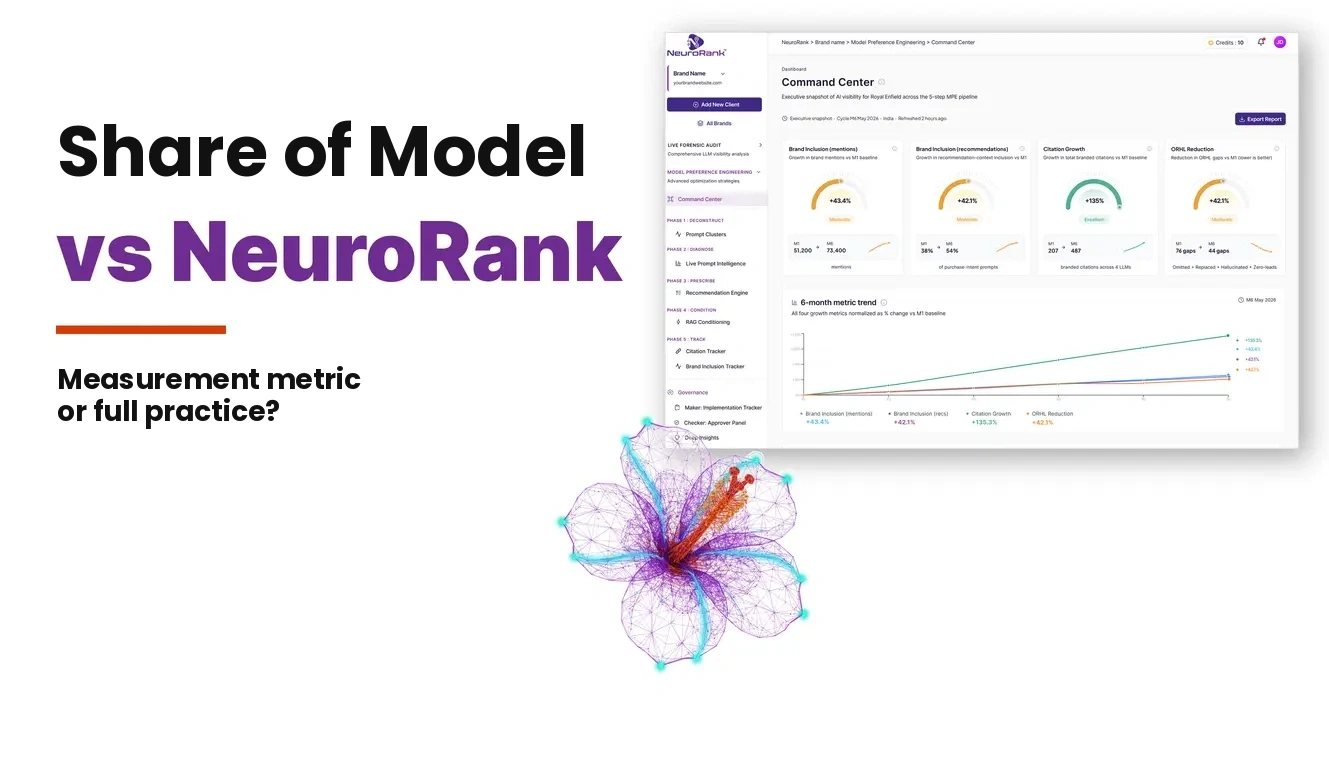
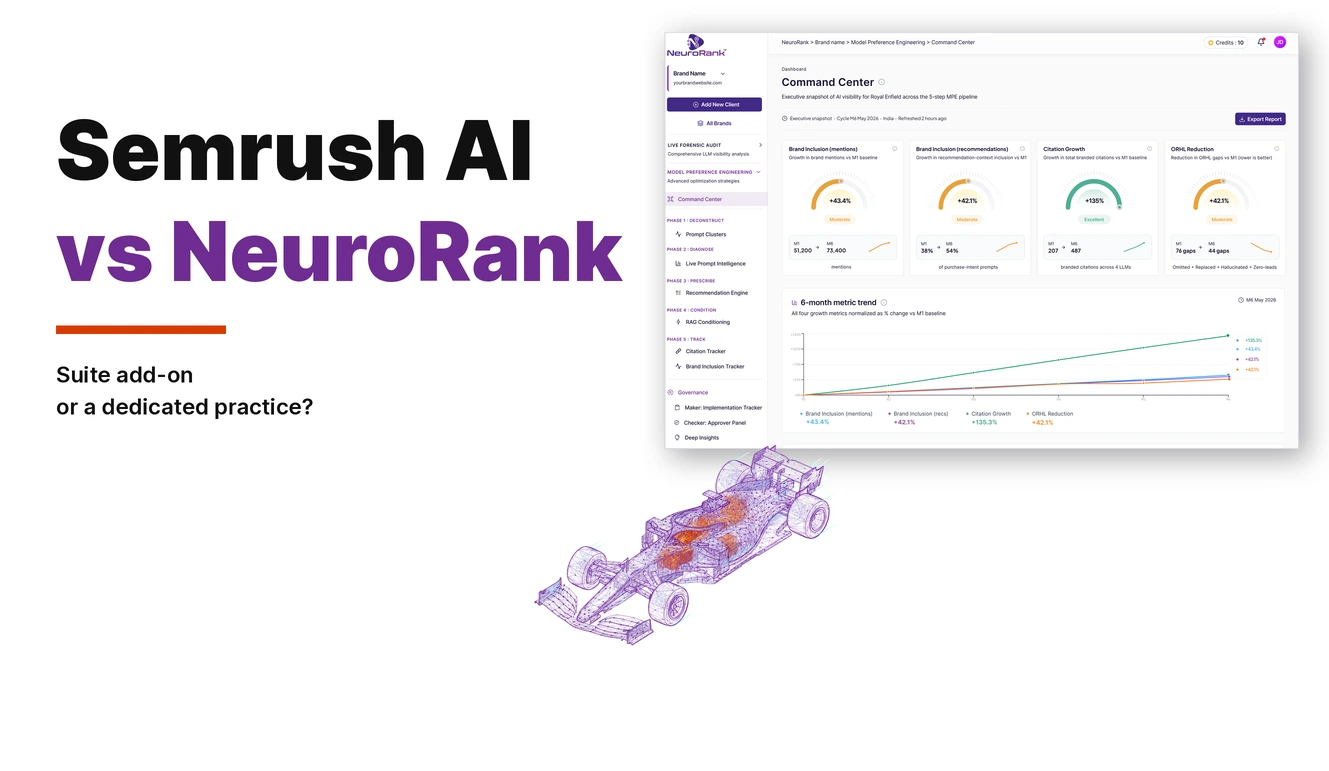
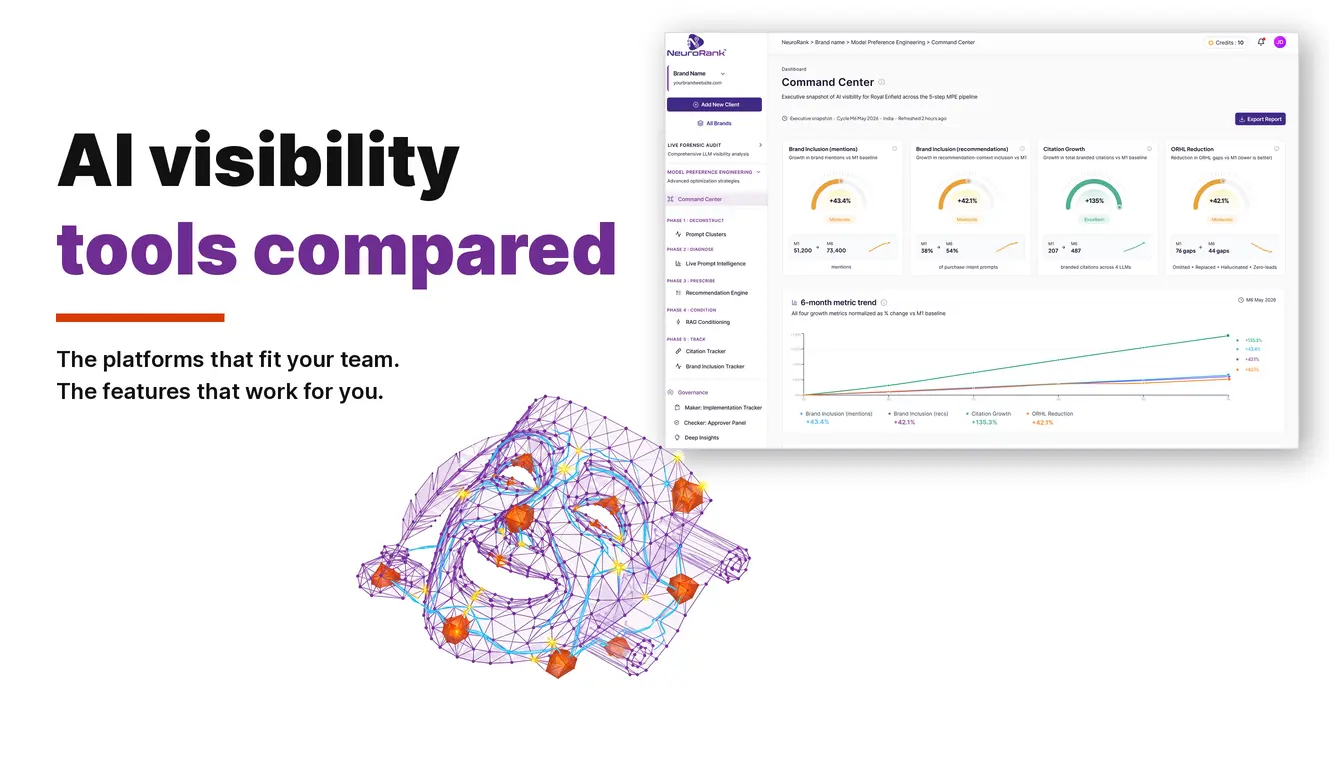
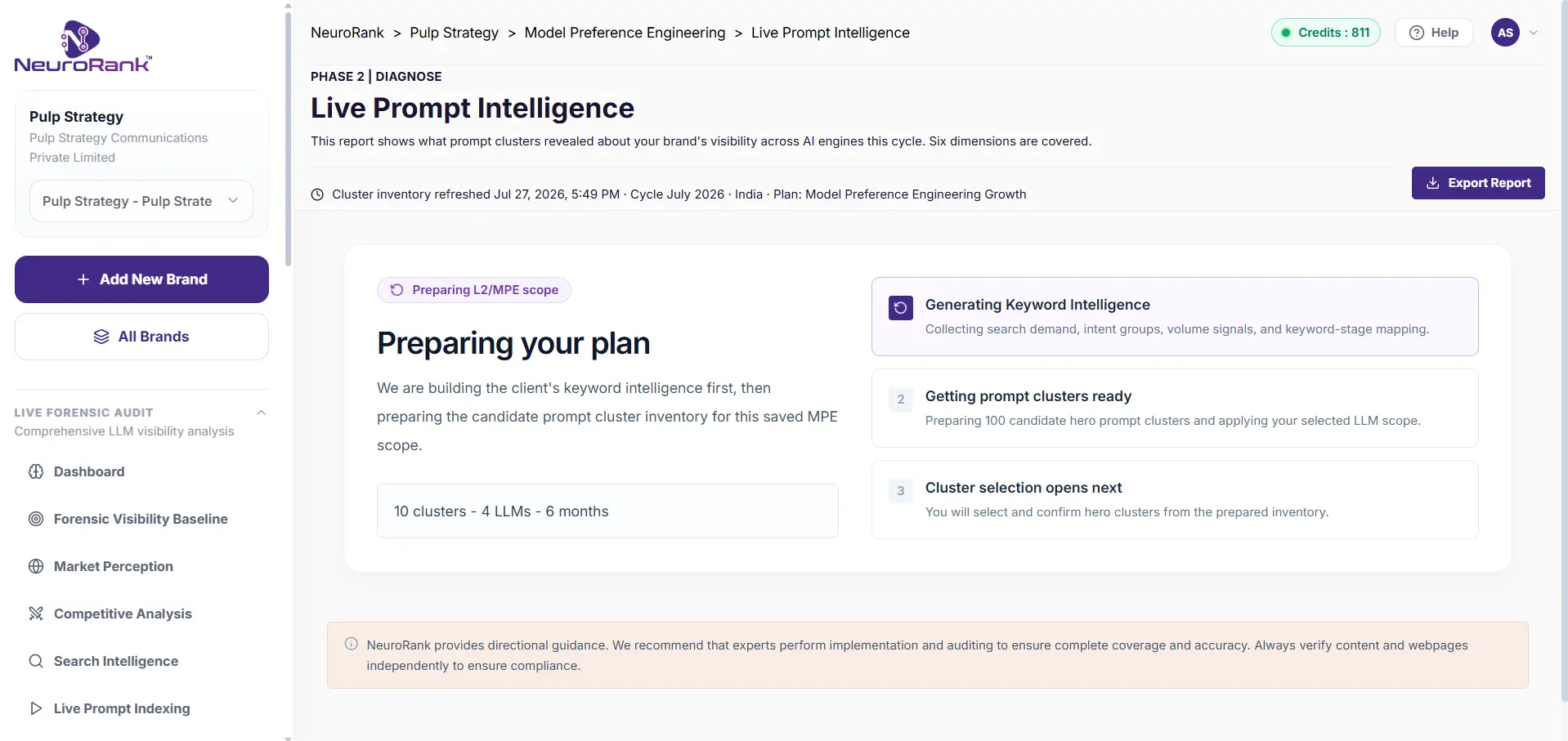
For the CMO, the Command Center is the executive layer: four headline metrics tracked against the first month's baseline, each card showing the formula behind its number, a heatmap of how much of the brand's possible AI surface is actively governed, and a one-click report export. Because every implemented change carries an approval record, the CMO can present the improvement to the board with the evidence behind it.
For media and performance teams, two instruments connect AI visibility to the plans they already run. Keyword Intelligence maps top Google keywords and volumes by region into eight customer-intent journeys, roughly 180 keywords per workspace with difficulty and opportunity scoring, so search demand and AI presence read as one picture. The Citation Tracker classifies every source the models cite as branded, competitor, industry, social, or negative, which tells earned media and PR exactly where placement effort will move the models.
For SEO and digital leads, the diagnostic depth above is the daily surface: live evidence, classified gaps, ranked prescriptions, and month-on-month tracking.
For agencies, NeuroRank runs multi-client, client-shareable reports are expressly permitted under its acceptable use policy, and no access to a client's CRM, analytics, or internal systems is ever required, because the platform probes the models from the outside, the way a customer would. That shortens both the pitch and the security review. Several agencies already use NeuroRank to win new business and strengthen GEO offerings, and structured advisory hours come embedded in every subscription, which matters in a discipline most teams are building for the first time.
Peec fits the team that wants the best version of the instrument panel and will run the practice itself. NeuroRank fits the CMO, the media team, the SEO lead, and the agency that want the practice run for them, governed and proven. Many teams start with the first and graduate to the second; both are good decisions, in order.
Mid-market teams usually make this decision without a procurement process, which means the two questions are practical: can we read it, and can we act on it. This section answers the second one.
Pros:
Looker Studio integration, CSV export, and API access on higher tiers fit existing reporting stacks, per its published documentation
Unlimited seats and agency workspaces keep sharing simple
Cons:
No approval or audit layer is published, so reporting shows movement, not governed change
An executive roll-up of governed work is outside the published scope
Pros:
Both platforms report clearly. The difference in this section is what sits behind the number: NeuroRank shows the formula on each metric card, tracks against the first month, and keeps an exportable record of every change and who approved it.
Deep Insights, a conversational copilot scoped to your own audit data, answers questions across every section of the report and keeps the chat history
Every platform action is attributed in a usage ledger, to a person, a role, a timestamp, and a category, and reviews carry service-level indicators, so an enterprise sees not just what changed but how the team is running
Onboarding reads your existing footprint: the Brand Discovery Panel ingests your sitemap, LinkedIn presence, and llms.txt, and Makers work with CSV import and export
NeuroRank is ISO/IEC 27001 certified and GDPR compliant, and the practice runs without access to your internal systems, which shortens security review
Cons:
The dashboards are purpose-built for the practice rather than a general BI layer; no Looker Studio connector is published
Leadership gets numbers it can read and defend: baseline-tracked metrics with the calculation shown behind every number, and an approval record behind every change. Procurement gets an ISO/IEC 27001 certified, GDPR compliant platform that needs no access to any internal system. Both halves of the enterprise decision are answered on every plan.
The measured pattern behind the practice: an average of 38 approved recommendations implemented per prompt cluster per month, with teams averaging a 39.6% AI visibility lift, a 7% branded citation lift, and a 12% recommendation lift over approximately 80 days. Results vary by brand, category, and starting baseline.
The public record adds an agency proof point. Per NeuroRank's May 2026 launch announcement, several agencies use the platform to win new business and strengthen GEO offerings, and one agency onboarded three enterprise clients across the automobile and BFSI sectors. Client references in NeuroRank's external materials stay at sector level by policy: claims carry their evidence, and evidence carries its limits.
Peec AI vs NeuroRank: pricing and predictability
Peec AI publishes a self-serve ladder with separate brand and agency plans, unlimited users on every plan, agency credit allocation across clients, and further engines as paid add-ons, per its published pricing as of July 2026. The transparency is genuine; the working variables are prompt volume, projects, and engine add-ons, so compare configured totals rather than headline tiers. Verify current figures on Peec's pricing page before budgeting.
NeuroRank's pricing is fixed and published. Model Preference Engineering starts at USD 225/month. The full configuration is USD 350/month for 4 LLMs plus Combined synthesis, 1 prompt cluster. Enterprise is custom. The architecture compounds in the buyer's favor: one new prompt cluster is added each month and every prior cluster re-runs, so month twelve tracks twelve clusters against a continuous baseline at the same fixed price structure, and the dataset becomes an asset that switching away would abandon. And because the price stays fixed while the cluster count grows, the effective cost per active cluster falls month by month.
Lists of Peec AI competitors mix monitoring platforms with full-cycle platforms. Five questions separate them. Is the measurement depth fixed, or shaped by prompt quotas and engine add-ons? Does the platform prescribe fixes or only report and suggest? Who approves work before it goes live, and is the record exportable? Can it see perception, including factual errors about your brand? Can you verify the methodology on your own brand first? NeuroRank answers all five in writing, on every plan.
One fact frames the whole decision: the models keep answering buyer questions every day with whatever they currently believe about your brand, so the choice between the two platforms is really a choice about how quickly those answers get corrected.
NeuroRank's stress test across 350+ brands in 65 industries found the gaps concentrated in prompts outside any tracked set: the brand skipped, swapped, misdescribed, or absent. A dashboard reports the drift it can see; the drift continues either way.
The managed response is a fixed rhythm: an average of 38 implemented recommendations per prompt cluster per month, with teams averaging a 39.6% AI visibility lift, a 7% branded citation lift, and a 12% recommendation lift over approximately 80 days. Results vary by brand, category, and starting baseline. Reading the metrics is necessary; changing them is a separate discipline, and it is the one with the measured return.
Peec AI is the right choice for teams and agencies that want clean, fast, prompt-level AI search analytics with unlimited seats and a published price, and that will run interpretation and execution themselves.
If your team needs the question after measurement answered, what do we fix, in what order, approved by whom, with what proof it worked, that is the cycle NeuroRank was built to run. It runs all of it on every plan: live evidence at fixed depth, prescriptions linked to source pages, a named approver on every change, model conditioning, month-on-month lift against a baseline, and an executive layer the CMO can read in one screen, from USD 225/month.
"I built NeuroRank to address GEO comprehensively, putting control in the hands of the user." Ambika Sharma, Founder, Chief Strategist at Pulp Strategy Communications and Product Architect of NeuroRank |
Keep the instrument if it serves you, and put the practice on your own brand. Model Preference Engineering starts at USD 225/month, and the first cycle produces the baseline: live evidence across four models, classified gaps, and a ranked fix list your team implements under named approval. Enterprises and agencies can talk to the team about a custom configuration.
Stop paying for clicks that do not convert. Benchmark your AI visibility today with the world's most advanced seo ai tools.
Book a Strategic NeuroRank BriefingPeec publishes AI search analytics, citation information, agency features, and action workflows. NeuroRank may fit a team that needs its defined ORHL conditions and a reviewed, client-implemented source-correction record. Peec may fit a team prioritizing its analytics and agency setup. Compare the live workflow and plan scope. Peec product documentation was checked in October 2026: https://peec.ai/.
Peec AI publishes prompt-level AI search analytics, citation and competitor views, and agency workflows. Its current plans describe daily tracking and reporting integrations. Confirm the supported AI platforms and entitlements before comparing contracts. Source, checked September 2026: https://peec.ai/for-agencies
Compare Peec AI’s current offer for brand, prompt, agency, and source-data scope with the NeuroRank plan details at https://neurorank.ai/pricing (Vendor source checked October 2026: https://peec.ai/).
Peec AI publishes its supported AI surfaces in its current product materials. NeuroRank’s platform list depends on the selected plan; check https://neurorank.ai/pricing. Compare feature scope as well as platform names. Google AI Overviews is a Search feature, separate from the Gemini app (Vendor source checked October 2026: https://peec.ai/).
Peec publishes agency features, including multi-client workflows. NeuroRank can also be evaluated for agency work based on the chosen plan’s brand and seat scope and its optional Maker-Checker review. Confirm client sharing, data handling, and entitlements in current terms. Plan coverage varies (Vendor source checked October 2026: https://peec.ai/).
Peec provides analytics and source information that teams can act on. NeuroRank also provides source-linked recommendations, optional Maker-Checker review, and later measurement. Compare current action features and workflow depth directly; an absence of a feature in a short summary is not proof it does not exist (Vendor source checked October 2026: https://peec.ai/).
Compare Peec alternatives on model coverage, prompt scope, citation evidence, agency controls, and source-correction workflows. NeuroRank offers measurement, recommendations, and optional review within the chosen plan; visit https://neurorank.ai/pricing for current details (Vendor source checked October 2026: https://peec.ai/).
NeuroRank can be evaluated as an alternative to Peec AI for a team’s specific measurement and correction workflow. It may also complement existing Peec analytics. Compare current prompts, source evidence, plan limits, and review features. A visibility gain depends on later observed answers (Vendor source checked October 2026: https://peec.ai/).