ArticleJune 30, 2026
How to Build a High-Revenue Generative Engine Optimization Practice: The Agency Playbook
Read the article
Ambika SharmaFounder at Pulp Strategy Communications and NeuroRank.

Ambika Sharma
Ambika Sharma is the Founder & Chief Strategist of Pulp Strategy, a multi-award-winning business transformation and digital agency, and Prod... Read more
Subscribe for Newsletters
By Ambika Sharma, Founder, Chief Strategist at Pulp Strategy Communications and Product Architect of NeuroRank®.
AI search just told a Fortune 500 procurement team that an Indian cloud provider offers free servers indefinitely. The provider does not. AI search just described one of India's largest IT services firms as a vehicle manufacturer. It is not. AI search just confused an Indian AI services company with a 1998 DreamWorks animated movie. The movie is not in the RFP.
These are not edge cases. They are this week's audit data from sixteen brands across five sub-industries of Indian B2B technology.
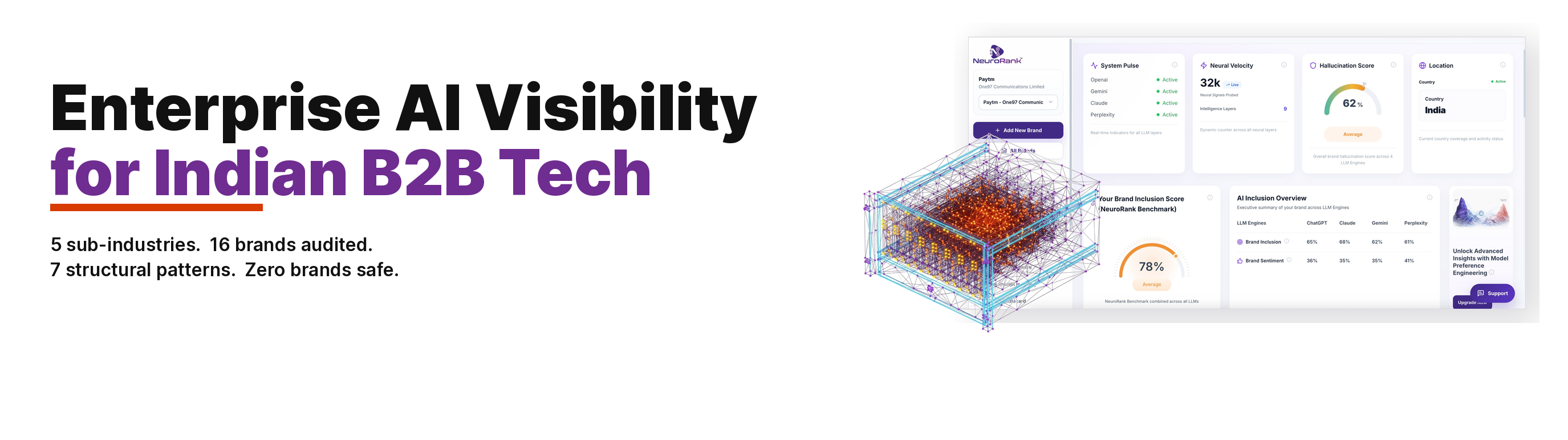
NeuroRank® audited sixteen Indian B2B technology brands across ChatGPT, Gemini, Claude, and Perplexity, plus the Combined synthesis NeuroRank Benchmark, between February and April 2026. Five sub-industries. Tier-1 IT services. Mid-tier IT services. Specialty BPM and SMB services. Indian SaaS and product companies. Cybersecurity and cloud infrastructure. Every category surfaced specific, repeatable, structural failures.
The failures are not brand-specific. They are category-specific. That is the bigger problem.
Enterprise AI visibility is the discipline of measuring and governing how generative AI systems, including ChatGPT, Gemini, Claude, and Perplexity, surface a brand in their answers. It applies to IT services, SaaS, technology services, and B2B platforms whose buyers now research, shortlist, and validate vendors through AI before any sales conversation. The discipline is also called generative engine optimization, or GEO.
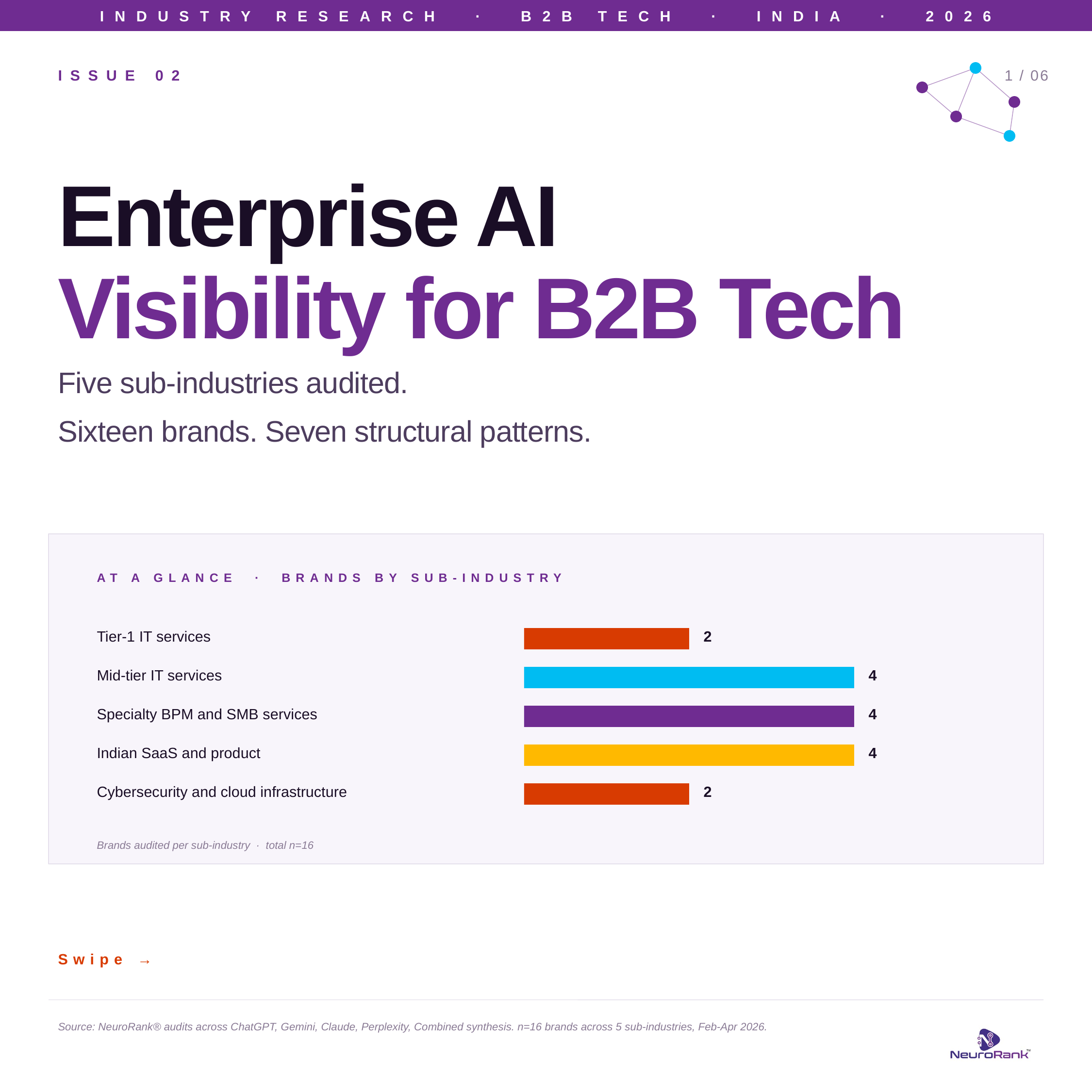
The audit sample is named here in full. Every finding traces back to the public NeuroRank® audit record. The body references brands by name where the audit logged a specific documented LLM output, and by archetype where the structural argument is the point.
The five sub-industries and the sixteen brands are: Tier-1 IT services (HCL Tech, Tech Mahindra); Mid-tier IT services (Happiest Minds, Xebia, Neosoft, PureSoftware); Specialty BPM and SMB services (One Point One Solutions, Compusoft Advisors, Zaj Systems, IT By Design); Indian SaaS and product companies (Zycus, SmartQ, Antz, The Math Company); and Cybersecurity and cloud infrastructure (Zscaler, ESDS).
A note on naming. Every brand-specific reference in this article describes documented output from large language models during NeuroRank® audits, February to April 2026. The findings describe what the models said about the brands at the time of analysis. They do not describe the brands themselves. Each named company is, to NeuroRank's knowledge, a legitimate, regulated, and reputable participant in the Indian B2B technology industry. Right of reply at neurorank.ai/contact-sales.
Sixteen Indian B2B tech brands audited across four LLMs plus Combined synthesis. All five sub-industries showed structural visibility failures. None were isolated brand defects.
Twelve of sixteen brands miscategorized as product-led when they are services-led, or as services-led when they are SaaS. AI defaults to product-vendor framing for almost every Indian B2B firm.
Twelve of sixteen brands tier-flattened against the TCS-Infosys-Wipro-Accenture quartet. The Indian IT services mid-tier is structurally invisible inside AI search.
Eight of sixteen brands suffered parent-conglomerate confusion. Tech Mahindra was described as part of the Mahindra Group's automotive division. AI did not distinguish the IT services operating unit from the vehicle manufacturer.
Four of sixteen brands suffered identity collision. Antz returned 1998 DreamWorks animated movie plot summaries instead of AI services information. One Point One Solutions and SmartQ were confused with unrelated tech firms.
ESDS was hallucinated as offering free servers indefinitely. ESDS was hallucinated as guaranteeing zero percent downtime forever. ESDS was described as US-headquartered when it is Indian. Zscaler was labeled a traditional firewall vendor when it is a cloud-native Zero Trust Exchange.
AI search is not failing these brands at the marketing layer. It is failing them at the entity layer, the schema layer, and the source-authority layer. That is a board-level governance issue.
B2B technology buyers do not research the way consumers do. A retail shopper might run one or two AI prompts before clicking through to a website. A CIO evaluating an IT services partner runs eight to twelve. Positioning. Capabilities. References. Pricing. Regulatory exposure. Leadership credibility. Competitive comparison. Each prompt is a new chance for AI to misrepresent the brand.
Onely's 2026 research found eighty percent of B2B buyers in technology and software now use AI tools as much or more than search engines. Conductor's 2026 benchmark places the IT industry at the highest AI referral traffic share of any vertical.
India's B2B tech sector is uniquely exposed.
India's IT services industry exports more than two hundred billion US dollars annually. Indian SaaS is on track to cross fifty billion in annual revenue by 2030. Yet the AI representation layer for Indian B2B brands is structurally weaker than for American or European peers. Training data underrepresents Indian-headquartered firms. Schema implementation is patchier. Analyst coverage in IDC, Gartner, Forrester, and ISG forms a smaller share of the citation pool.
The result is a category that is commercially significant and AI-search invisible at the same time.
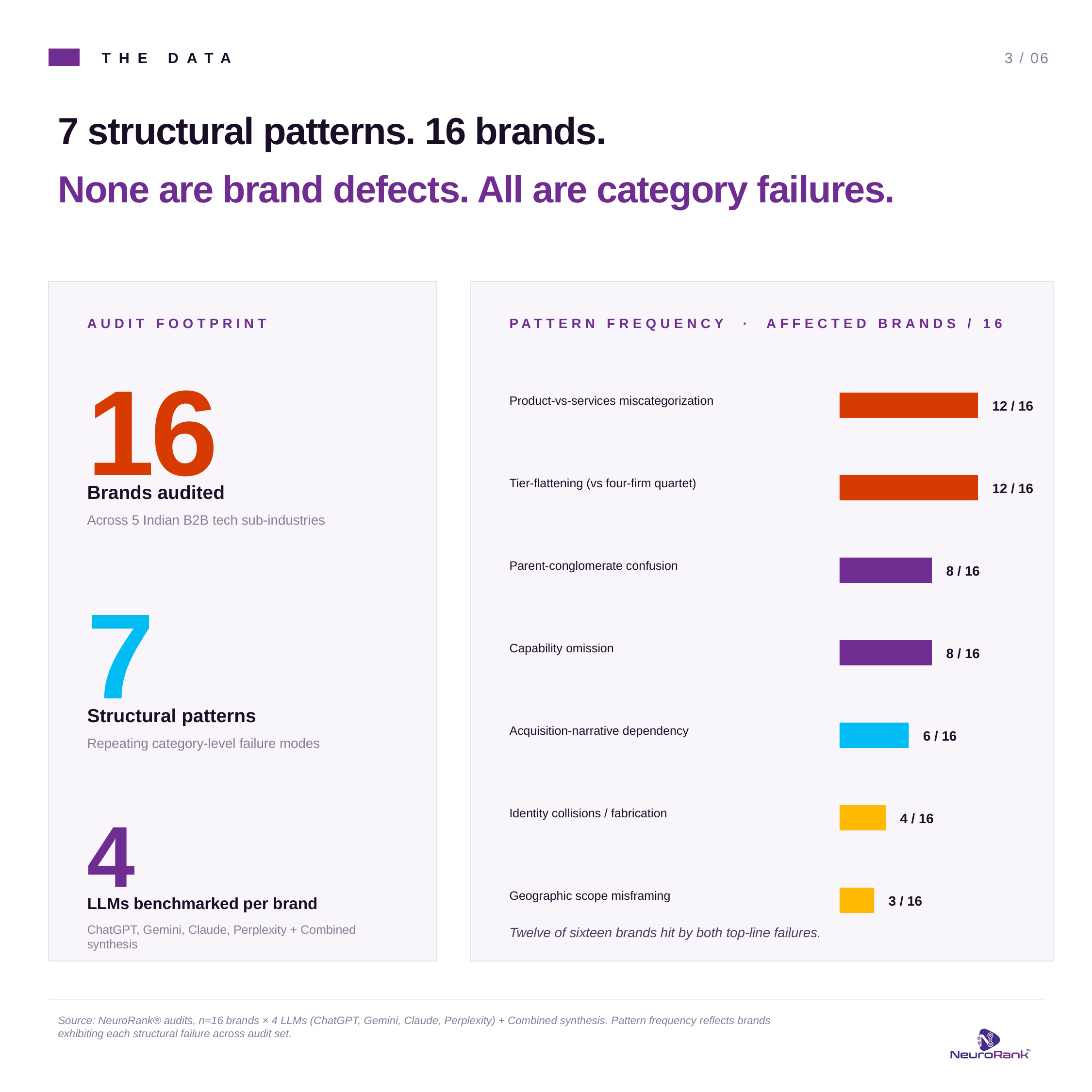
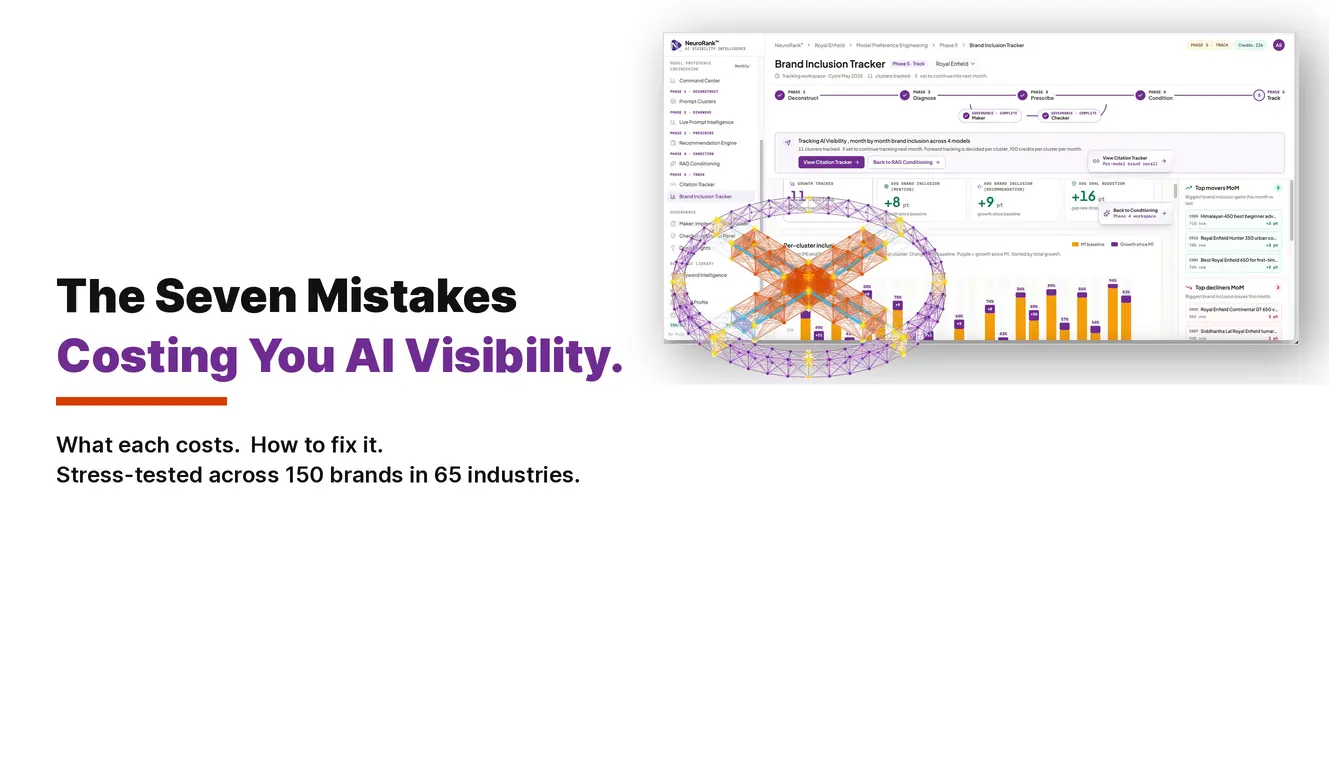
Reading sixteen audits side by side surfaces seven structural failure patterns that repeat across the sample. Each is a category-level failure, not a brand-level one. CMOs and CIOs whose brand sits in any of the five sub-industries should expect to find at least three of these seven patterns inside their own AI visibility profile.
AI defaults to product-vendor framing for almost every services-led Indian B2B firm. Consulting practices get labeled software vendors. Services firms get described as product platforms. Procurement specialists get framed as general software companies.
AI training data has a systematic bias toward product companies. Richer product-page schema. SKU-level structured data. Clearer commercial transaction signals. Services firms that publish thought-content but lack JSON-LD on their service-catalog pages are systematically underrepresented in machine-readable form. Inference fills the gap with the closest product analogue.
Mid-tier and specialty IT services firms get attributed-by-default to the four-firm Indian IT services quartet even when their actual capabilities are equivalent or superior in a niche.
AI search has compressed the Indian IT services market into a winner-takes-all dynamic. The mid-tier is structurally invisible. The specialty layer is invisible.
It is a citation-density problem. The four-firm quartet has accumulated more press, more analyst coverage, more case studies, and more third-party content density than any mid-tier challenger can match in the short term. AI synthesizes the path of least resistance.
AI flattens IT services brands into their corporate parent's identity. The audited brand and the parent group are treated as a single entity unless schema explicitly disambiguates them.
The audit logged AI describing one of India's largest IT services firms as a vehicle manufacturer. The brand operates in IT services. The parent group operates separately in automotive, financial services, and consumer divisions. AI did not parse them as separate operating units. A second audited brand was confused with its parent technology group's product portfolio and leadership across multiple LLM runs.
The fix is missing entity-level schema and parent-subsidiary disambiguation in the JSON-LD layer. Until brand and parent are tagged as distinct Organization entities with explicit relationship metadata, AI synthesizes them as one.
Specific capabilities are simply absent from AI outputs. ISO certifications denied when they exist. Microsoft Gold Partner Asia Pacific status omitted from every category answer in which it should appear. A leading Indian procurement-suite firm with multinational customers was described as a general software vendor in category prompts, with its specialty in supplier risk and procure-to-pay missing entirely. An Indian BPM provider was claimed to lack ISO certifications it verifiably holds.
The structural cause is that capability claims live in PDF brochures, press releases, or non-schema-marked HTML pages that AI retrieval systems cannot reliably parse. Capability becomes invisible by default.
Brands that have been acquired or have parent-company linkages lose their standalone identity in AI outputs. An Indian food-tech SaaS platform's identity was subsumed entirely under its global services-group acquirer in category prompts, with key offerings surfacing only as a unit of the parent. A specialty software firm's narrative was treated across multiple LLMs as merely an extension of its publicly listed parent's earnings story rather than a standalone capability.
AI training data lags M&A activity by twelve to eighteen months. Even after the lag closes, the parent-company narrative often becomes the default answer. Standalone identity has to be actively engineered post-acquisition.
Tier-1 firms with global operations get narrowed to India-only by AI search, ignoring substantial North America, Europe, and Asia-Pacific business. A tier-1 Indian IT services brand operating across more than sixty countries was described as primarily India-focused in AI's investor-context answers, materially understating its global revenue concentration. In the opposite direction, an Indian SMB services firm that exclusively serves the Indian market was described as operating across the United States and Europe.
AI lacks the entity-level signals to distinguish global versus domestic operations reliably. Geographic context drifts in both directions. The structural cause is that location data lives in About-page text, not in schema-marked address blocks tied to operating-unit metadata.
For brands without dominant entity authority, AI defaults to the highest-recall meaning of the brand-name string.
The audit found one Indian AI services brand returning 1998 DreamWorks animated movie plot summaries instead of company information. A specialty BPM provider was confused with a similarly-named Indian IT firm, with confident attribution of one brand's certifications and contracts to the other. An Indian food-tech SaaS platform was confused with multiple unrelated tech companies.
In the cybersecurity and cloud infrastructure sub-industry, the audit logged outright factual fabrication. A cloud-hosting provider was hallucinated as offering free servers indefinitely. The same provider was hallucinated as guaranteeing zero percent downtime forever. The same provider was described as US-headquartered when it is Indian.
None of this was true. All of it was being served to procurement teams as fact.
The structural cause is sparse ground-truth data combined with high-confidence AI assertion. When the engine has nothing authoritative to retrieve, it confabulates. The brand inherits commercial expectations it cannot meet.
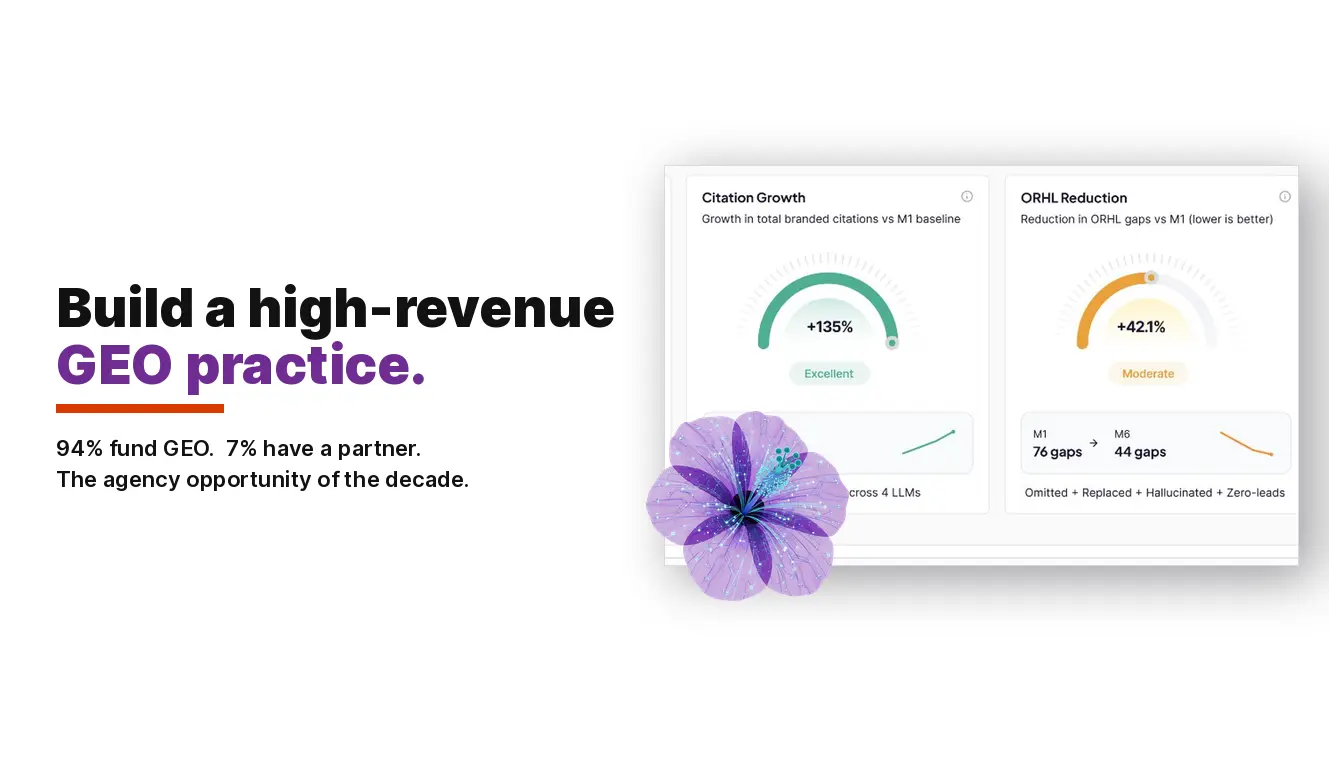
NeuroRank uses a four-class taxonomy to classify how AI search fails a brand. ORHL stands for Omitted, Replaced, Hallucinated, and Zero Leads. Every failure across the sixteen-brand audit set classified into one of these four categories. Examples below are drawn from the audit set, with brands referenced by archetype.
| Class | Tag | What it means in B2B tech |
|---|---|---|
| Omitted | O | Brand absent from category answers it should lead. Specialty BPM leader missing from BPM provider answers. Indian SaaS analytics firm absent from analytics consulting answers. |
| Replaced | R | Competitor named in your place. Mid-tier services firm replaced by Accenture in digital transformation answers. Cybersecurity Zero Trust leader replaced by traditional firewall vendor in network security answers. |
| Hallucinated | H | Confident, articulate misinformation. Cloud hosting provider claimed to offer free servers indefinitely. Same provider claimed to guarantee zero percent downtime. Indian SaaS brand claimed to operate outside India when it serves only India. AI services brand confused with a 1998 animated movie. |
| Zero Leads | Z | Brand mentioned without commercial value. Named on a generic IT services list with no specialty depth, no buyer-intent context, no commercial trigger, no investor narrative. |
Deconstruct: dismantle the LLM's internal representation of your brand. Diagnose: classify visibility gaps across ChatGPT, Claude, Gemini, and Perplexity. Prescribe: issue the specific content, CMS, and other actions required to fix them. Condition: run the Model Conditioning Loop across owned, earned, and third-party surfaces. Track: measure month-on-month lift as the models recalibrate.
The two audited brands in this archetype are HCL Tech and Tech Mahindra, India's largest export-oriented IT services firms. Together they employ more than four hundred thousand people, operate across sixty-plus countries, and serve Fortune 500 clients in financial services, manufacturing, telecom, healthcare, and aerospace.
AI engines did not parse any of that as differentiating. Both were flattened into the broader corporate parent's identity.
HCL Tech was confused across multiple LLMs with parent group HCL Technologies' product portfolio and leadership. AI attributed parent-group software products to the IT services operating unit and named parent-group leadership as the IT services CEO. Tech Mahindra was confused with parent group Mahindra & Mahindra's automotive and financial services divisions, with the audit logging AI describing the IT services brand as a vehicle manufacturer.
AI described one of India's three largest IT services firms as a vehicle manufacturer.
The archetype-specific gap is product-portfolio attribution. Both audited brands have B2B services as primary revenue, yet AI describes their offerings as consumer-facing SaaS products. Compounded by parent-subsidiary disambiguation failures and tier-flattening against the four-firm quartet, both brands are routinely underrepresented in services-comparison answers despite scale and capability that match the quartet head-to-head.
AI also narrowed geographic scope to India-only despite substantial global revenue, and labeled both as digital transformation generalists rather than naming their differentiated practices: telecom network modernization for Tech Mahindra, engineering and R&D services for HCL Tech.
Atomic answer: in the tier-1 archetype, the category leader is hallucinated as an extension of its corporate parent, omitted from comparative tier-1 answers despite scale, and replaced by the four-firm quartet in services-comparison queries. The structural cause is missing parent-subsidiary schema, missing operating-unit disambiguation, and weak operating-unit-level entity signals.
The four audited brands in this archetype are Happiest Minds, Xebia, Neosoft, and PureSoftware. Together they cover digital transformation, generative AI implementation, cloud-native architecture, banking platforms, DevOps and Agile coaching, and managed services for global enterprises. Three are publicly listed in India. One is privately held with a clear acquirer-dependency narrative.
Their capabilities range from comparable to tier-1 in specific niches to category-leading in narrow specialties. AI engines treat all four as undifferentiated mid-tier, invisible behind the four-firm quartet.
Capability is not the gap. Citation density is the gap.
The hallucination pattern is consistent across all four brands. Geographic positioning drifts. Specific specializations are absent from category answers. Independent product capabilities are conflated with the parent or acquirer's portfolio. One audited brand has its standalone narrative entirely subsumed under its acquirer's earnings narrative. Another has financial performance attributed across LLMs with conflicting revenue figures and outdated employee counts. A third has its specialty in cloud-native architecture and DevOps consistently flattened into a generic services-firm description.
Each of these four brands ranks in the top fifty Indian IT services firms by revenue or specialization. None has the press-and-analyst citation depth to break the quartet's gravitational pull. Three of the four publish executive thought-content primarily on internal blogs and LinkedIn rather than third-party analyst venues. The source surfaces AI synthesizes from are narrow.
Atomic answer: in the mid-tier archetype, the audited brands are omitted from tier-1 comparison queries, replaced by the four-firm quartet in capability-shortlist queries, and hallucinated as undifferentiated generalists when their actual capabilities are specialty-led. The structural cause is citation-density gap and absent specialty-tagged schema.
The four audited brands in this archetype are One Point One Solutions, Compusoft Advisors, Zaj Systems, and IT By Design. Two operate in business process management. One is a Microsoft Gold Partner Asia Pacific specializing in Indian SMB digital transformation. One is a US-headquartered IT services firm with strong SMB and channel-partner depth. Their differentiation is real: ISO certifications, Gold Microsoft Partner status, channel-partner specialization, deep BPM expertise.
AI engines miss most of it.
Two of the four suffer name-collision damage. One Point One Solutions is confused across multiple LLMs with similarly-named Indian IT firms, with one brand's certifications and contracts attributed to the other. Zaj Systems is consistently confused with unrelated technology companies, producing scrambled positioning data.
AI denied ISO certifications Compusoft Advisors verifiably holds. AI omitted its Microsoft Gold Partner Asia Pacific status from every category answer.
Geographic context drifts in this archetype too. One audited brand is described as operating outside India when it serves only the Indian market; another is described as domestic-only when it has US operations. The deeper structural issue is entity-collision risk: specialty firms with brand names overlapping common nouns, abbreviations, or other companies have insufficient entity authority to displace the wrong default answer.
Atomic answer: in the specialty BPM and SMB archetype, the audited brands are replaced by similarly-named firms in identity-collision queries, omitted from category-leader answers despite real specialty depth, and hallucinated as lacking certifications or partner statuses they verifiably hold. The structural cause is weak entity authority compounded by name-collision risk.
The four audited brands in this archetype are Zycus, SmartQ, Antz, and The Math Company. Zycus is a global procurement-suite leader headquartered in Mumbai. SmartQ is a food technology platform serving large-enterprise corporate dining. Antz is an AI services and automation firm with platform components. The Math Company is a data science consulting firm with productized analytics.
AI describes them as something else entirely.
Zycus is described as a general software brand. SmartQ is described as product-led when it is services-led, with key offerings absent from food-tech category summaries. Antz has its identity collide with a 1998 animated movie of the same name, with AI returning film plot summaries instead of company information. The Math Company is described as a software vendor instead of a services provider.
When asked about Antz, AI returned the plot summary of an animated film about ants.
Geographic and acquisition signals further distort two of the four. Zycus is associated with global Western markets rather than its Indian roots. SmartQ's post-acquisition standalone identity is heavily diminished, with AI subsuming it into its acquirer's narrative.
The structural cause across all four is the absence of category-defining schema. None has a comprehensive Service or Software Application schema implementation that machine-tags primary category, sub-category, target customer, and competitive set in a way AI retrieval systems can parse without ambiguity.
Atomic answer: in the Indian SaaS and product archetype, the audited brands are hallucinated as the wrong category entirely, replaced by Western competitors in their own specialty queries, and in one case omitted because of identity collision with an unrelated movie. The structural cause is missing category-defining schema and weak entity authority for India-headquartered product brands.
The two audited brands in this archetype are Zscaler and ESDS. Zscaler is a cloud-native cybersecurity platform with global Zero Trust deployments and substantial Indian-market presence. ESDS is an Indian cloud-hosting and data center provider serving banking, government, and enterprise customers.
AI describes them with a level of factual error that would be unacceptable in any other category.
The cybersecurity brand is repeatedly described as a traditional firewall vendor. It is a cloud-native Zero Trust Exchange. AI compares it against endpoint protection platforms instead of secure web gateways. AI suggests its service is unsuitable for large enterprises. It is a Fortune 500 standard.
The cloud-hosting brand is hallucinated as offering free servers indefinitely. Hallucinated as guaranteeing zero percent downtime forever. Described as headquartered in the United States when it is Indian. Given a wrong founding date. Assigned features it does not offer.
ESDS does not offer free servers indefinitely. ESDS does not guarantee zero percent downtime. ESDS is not headquartered in the United States. AI search said all three.
These are not minor errors. They destroy commercial outcomes. A CIO running a Zero Trust evaluation through AI search would screen out Zscaler on the false belief that it is a legacy firewall. A procurement team running a hosting RFP would either dismiss ESDS on false US-headquarter assumptions or pursue it on false free-server expectations.
The structural cause for both brands is sparse machine-readable architectural metadata. Neither has Service schema, ProductCategory tagging, or capability-graph data that lets AI distinguish a cloud-native platform from a legacy firewall, or a paid commercial offering from a marketing-trial signal.
Atomic answer: in the cybersecurity and cloud infrastructure archetype, the audited brands are hallucinated with confidently fabricated facts, replaced by competing architecture categories, and described with technical errors that would screen them out of real RFPs. The structural cause is sparse machine-readable architectural metadata combined with high-confidence AI assertion of fabricated facts where ground truth is thin.
If your brand sits in any of the five sub-industries above, this is what is already happening to you. Not might. Is.
Your largest customer's procurement team has already run an AI prompt about your category. Your buy-side analyst has already run an AI prompt about your operating unit. Your most senior engineering candidate has already run an AI prompt about your employer brand. None of those prompts ran through your sales team. None of them ran through your marketing team. All of them shaped the next conversation.
You are not in the room when the answer is being formed.
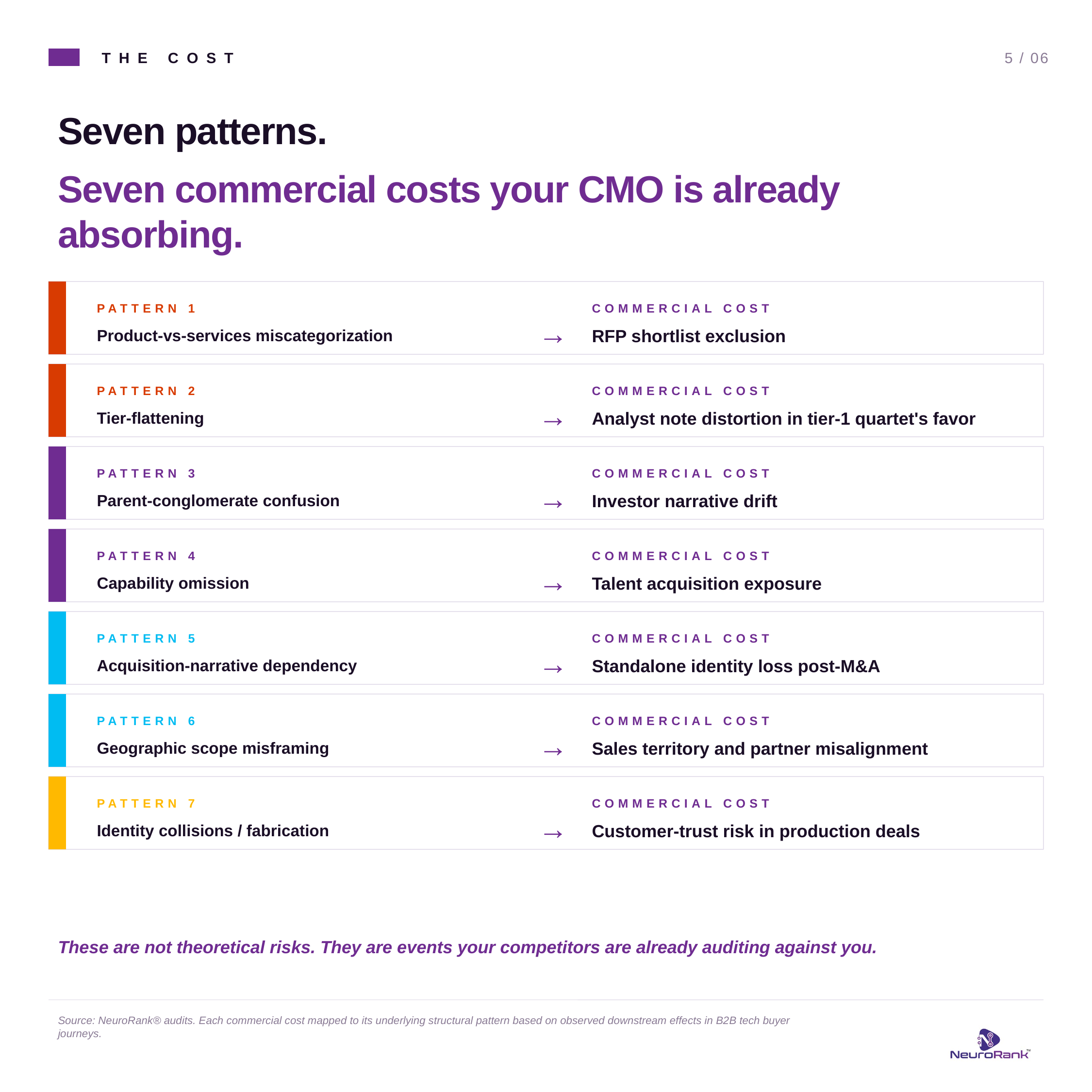
Seven commercial costs trace directly to the seven structural patterns. Your CMO, CIO, CFO, and CHRO are absorbing each of them right now, whether they have measured it or not.
Your RFP shortlist is being filtered before you see it. Buyers ask AI for the category and screen out brands AI miscategorizes. Pattern 1 cost.
Your analyst note is being pre-written. IDC, Gartner, Forrester, and ISG analysts now run AI-assisted research. If AI tier-flattens your brand into the four-firm quartet, your narrative position is decided before the formal analyst conversation begins. Pattern 2 cost.
Your investor narrative is drifting. AI describes your operating unit as your parent group. Capital-markets coverage anchors on the parent. Your segment-level reporting becomes harder to defend. Pattern 3 cost.
Your senior engineering hires are reading the wrong story about you. AI omits your real capabilities. Top candidates accept offers from competitors AI describes more accurately. Pattern 4 cost.
Your acquisition is rewriting your identity. Customer references, partner programs, and category-leader positioning are drifting toward your acquirer in AI outputs. Standalone identity is decaying month over month. Pattern 5 cost.
Your geographic positioning is wrong in both directions. AI narrows your global firm to India-only or claims your Indian-only firm operates abroad. Sales territories and partner-recruitment strategies misalign with prospect expectations. Pattern 6 cost.
Your brand is inheriting commercial expectations you never set. AI is asserting fabricated guarantees, fabricated features, and fabricated partnerships. Customer-trust risk compounds in production deals. Pattern 7 cost.
These are not theoretical risks. They are events your competitors are already auditing against you.
Many AI visibility tools monitor. NeuroRank diagnoses, prescribes, conditions, and tracks. From $7.
The distinction matters in a B2B tech context because monitoring alone tells a CMO or CIO that a problem exists. It does not classify the problem under a structural framework. It does not prescribe a fix tied to specific schema or content actions. It does not run a conditioning loop across owned, earned, and third-party surfaces. It does not track inclusion growth as the models recalibrate.
Profound, Semrush AI Visibility, AthenaHQ, and Peec AI each monitor brand mentions across LLM outputs. Per their published documentation as of April 2026, none publishes a structural failure taxonomy comparable to ORHL. None runs the cross-brand pattern analysis that surfaces category-level governance issues like the seven patterns documented above. None operates the patent-pending Model Conditioning Loop across owned, earned, and third-party surfaces.
Monitoring shows the symptom. Governance closes the loop.
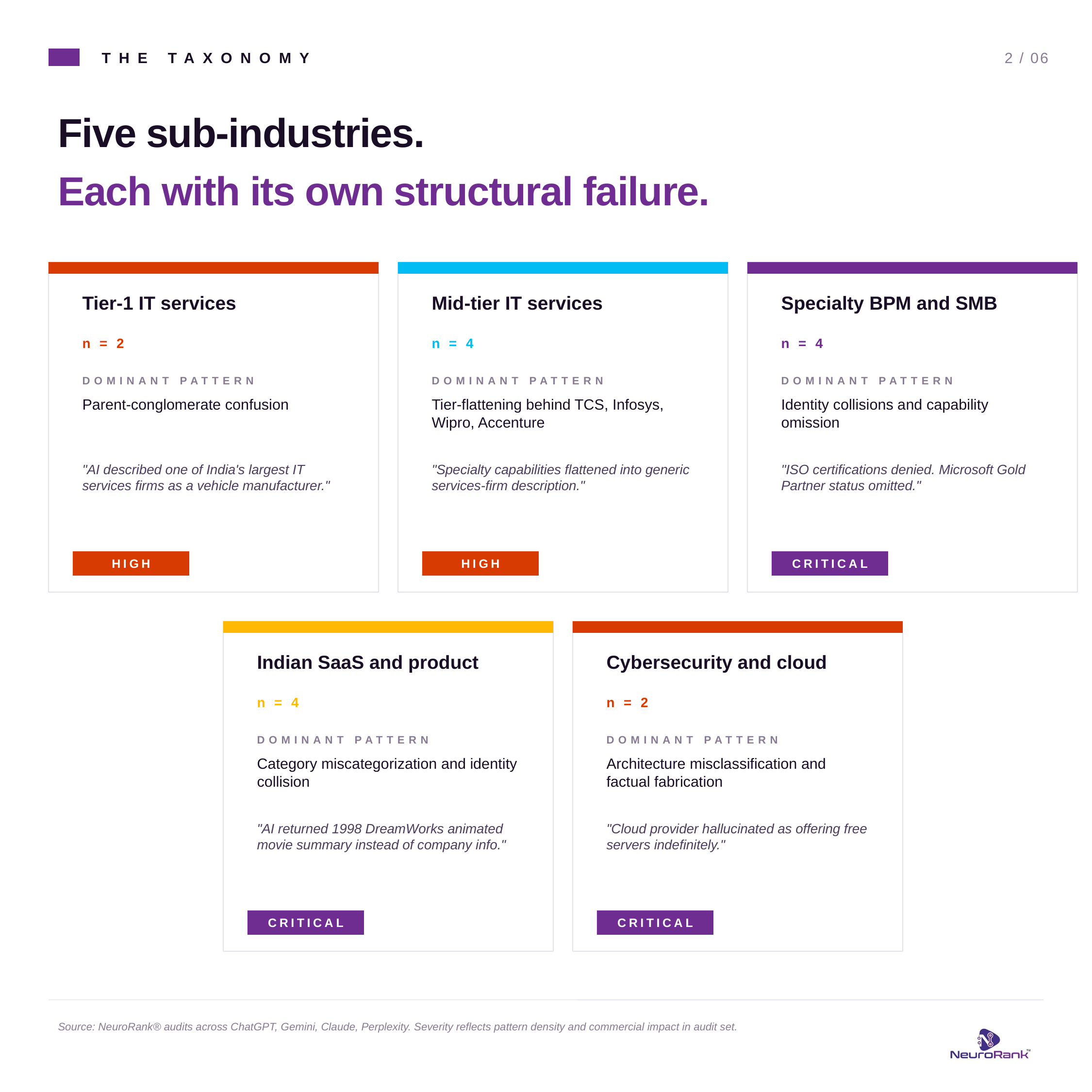
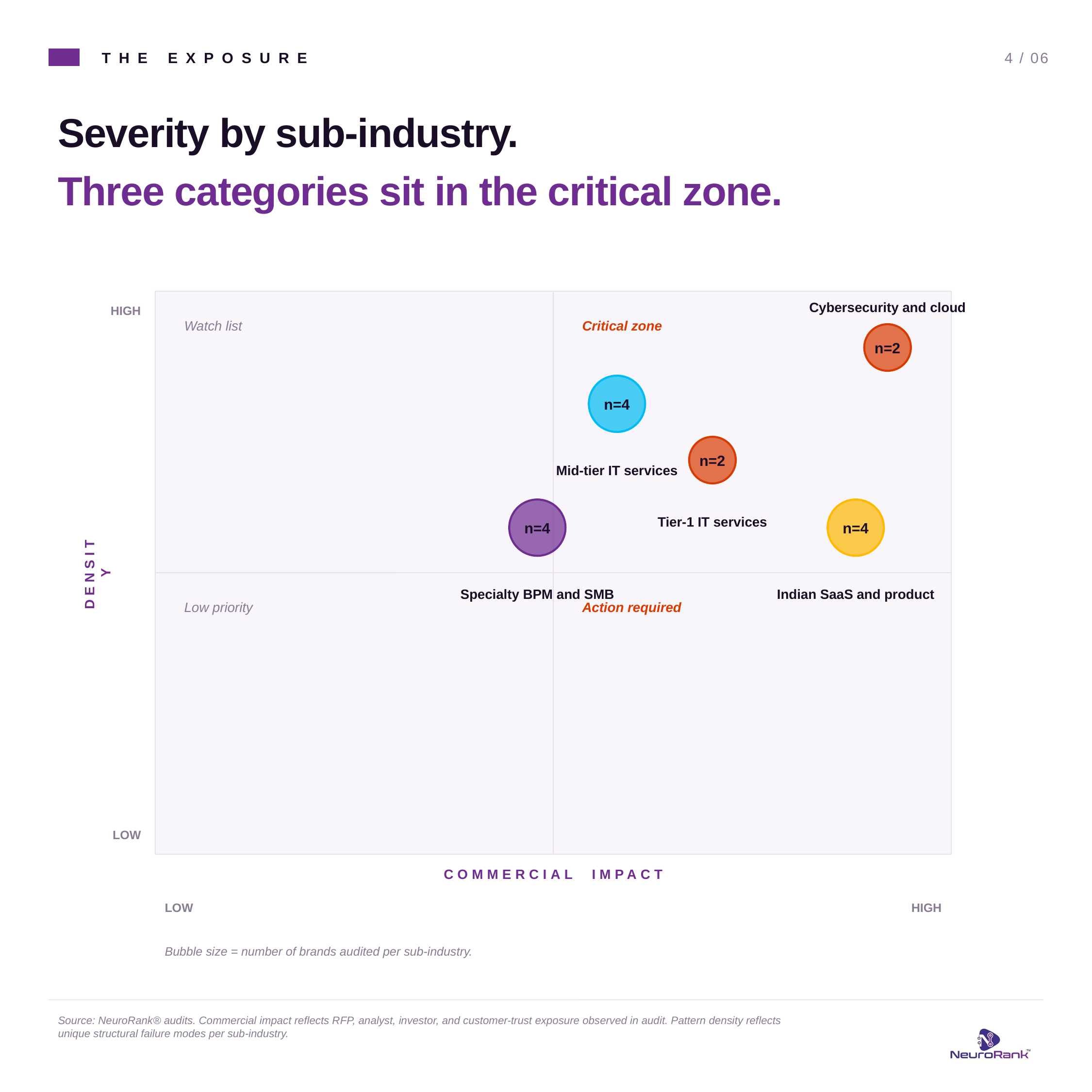
| Sub-industry | Brands | Dominant patterns | Severity |
|---|---|---|---|
| Tier-1 IT services | 2 | Parent-conglomerate confusion, tier-flattening, geographic misframing | High |
| Mid-tier IT services | 4 | Tier-flattening, capability omission, acquisition-narrative dependency, product-vs-services miscategorization | High |
| Specialty BPM and SMB services | 4 | Identity collisions, capability omission, parent-conglomerate confusion, tier-flattening | Critical |
| Indian SaaS and product | 4 | Product-vs-services miscategorization, identity collisions, geographic misframing, capability omission | Critical |
| Cybersecurity and cloud infrastructure | 2 | Architecture misclassification, factual fabrication, geographic misframing | Critical |
Source: NeuroRank® audits across ChatGPT, Gemini, Claude, Perplexity, and the Combined synthesis / NeuroRank Benchmark. The hallucination patterns described are observations of LLM outputs at the time of analysis. Model behavior shifts as retrieval and training data refresh. See full disclaimer at the end of this article.
Within the audit set, the cleanest performers are not necessarily the largest. They are the brands with the strongest entity-level schema, the highest density of third-party citations, and the clearest single-category positioning. Brands with global Western parents and consistent multi-platform brand content perform measurably better than India-headquartered brands of comparable scale. Their citation density across analyst reports, peer reviews, and industry press is higher.
The four-firm Indian IT services quartet (Tata Consultancy Services, Infosys, Wipro, Accenture's India operations) dominates AI inclusion in tier-1 comparison queries against every audited brand in our sample.
This is not a capability gap. It is a content-density gap and a citation-velocity gap. Closing it requires structural action, not creative campaigns.
Three Indian-market specifics shape AI visibility for B2B tech that do not apply in the same form to Western markets.
The first is NASSCOM membership and the affiliated industry-body citation pool. NASSCOM, IT-ITES SSC, and CII publish industry data, member listings, and capability matrices that AI engines synthesize. Brands that have not refreshed their NASSCOM, CII, or industry-body profiles in the past twelve months show measurably weaker AI visibility than peers that maintain current entries.
The second is the global capability center, or GCC, layer. India hosts more than seventeen hundred GCCs operated by Fortune 1000 multinationals. AI search routinely fails to distinguish between Indian-headquartered IT services firms and the captive GCCs of Western corporations. This is a structural disambiguation issue with direct consequences for the operating-unit narrative.
The third is Hindi-English query drift in B2B contexts. Most B2B procurement queries run in English. Customer-service and SMB-vendor searches increasingly run in Hindi-English hybrids that current AI retrieval handles inconsistently.
This article describes observed AI model behavior across sixteen audited brands in five sub-industries of Indian B2B tech. It does not describe the underlying brands themselves. The analysis applies to ChatGPT, Gemini, Claude, and Perplexity outputs as observed in audits between February and April 2026. Model behavior shifts as retrieval mechanisms, training data, prompt phrasing, and engine versions change. Findings reported here may not be reproducible at later dates. The article does not cover Indian consumer technology brands, edtech, fintech-as-a-category beyond the brands in the audit set, telecom infrastructure beyond the audit scope, or hardware brands. Each of those categories warrants its own audit cycle.
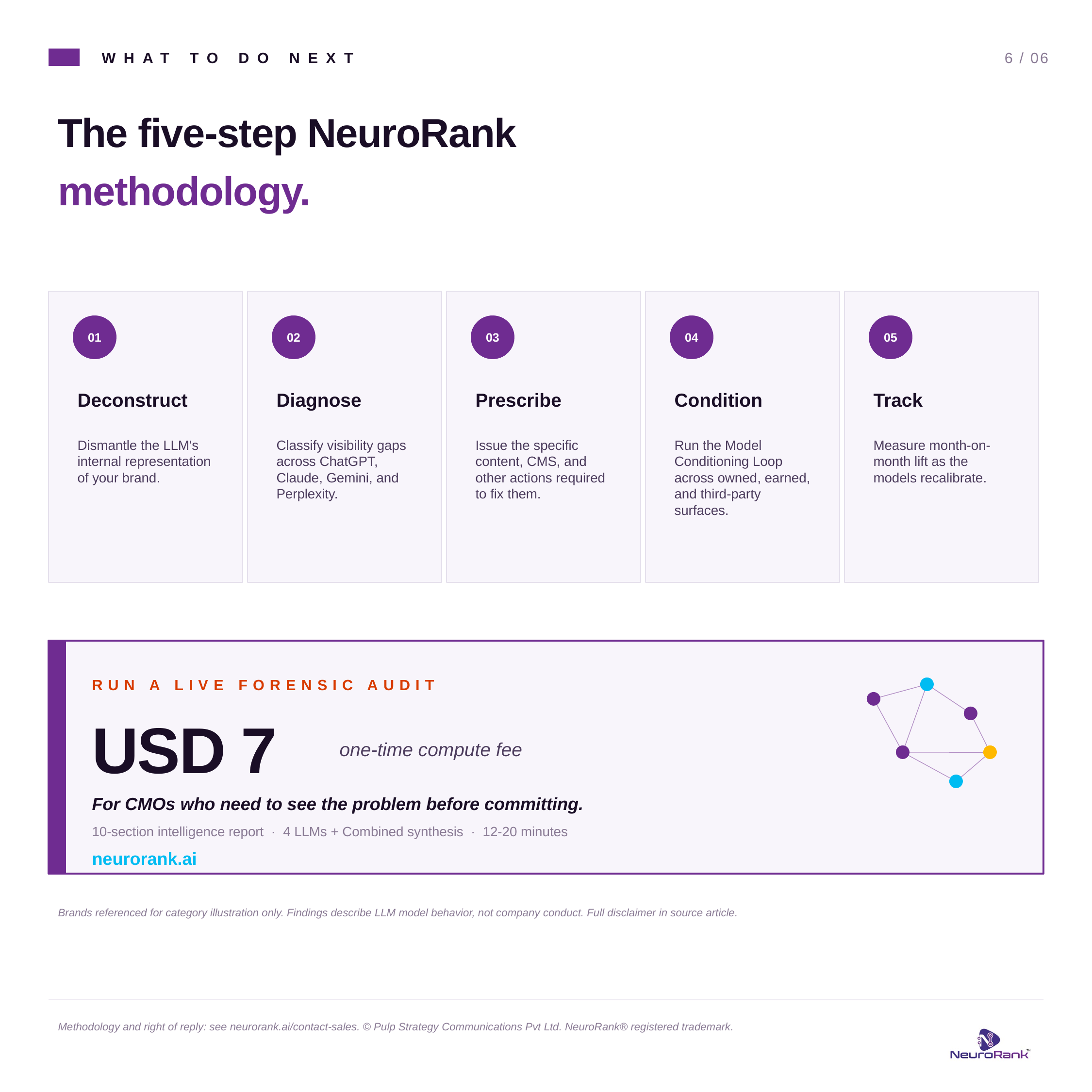
If your brand is in any of the five sub-industries above, the next step is direct. Run a Live Forensic Audit on your brand and the two competitors AI engines are most likely to surface in your place. Read every hallucination as if it had been written by your CFO, your largest customer's procurement head, and a tier-1 analyst together.
The cost of finding out is USD 7. The cost of not knowing is paid downstream, in RFP exclusion, analyst narrative drift, talent-acquisition exposure, and customer-trust risk in production deals.
When AI tells your story to your buyer, your CFO, and your largest customer's procurement head, is it telling the truth?
Stop paying for clicks that do not convert. Benchmark your AI visibility today with the world's most advanced seo ai tools.
Book a Strategic NeuroRank Briefing