BlogSeptember 16, 2026
AI search engine optimization

Ambika SharmaFounder at Pulp Strategy Communications and NeuroRank.
Founder at Pulp Strategy Communications and NeuroRank.
Subscribe for Newsletters
The answer has split. Comscore’s Q2 2026 AI Intelligence Report means brands now have to read AI visibility model by model, because one assistant no longer speaks for the market. NeuroRank’s own research, published separately, shows what that split costs. Across 63 brands measured on ChatGPT, Gemini, Claude, and Perplexity in NeuroRank’s AI Visibility Index 2026 , the median gap between a brand’s best and worst model was 33.3 percentage points.
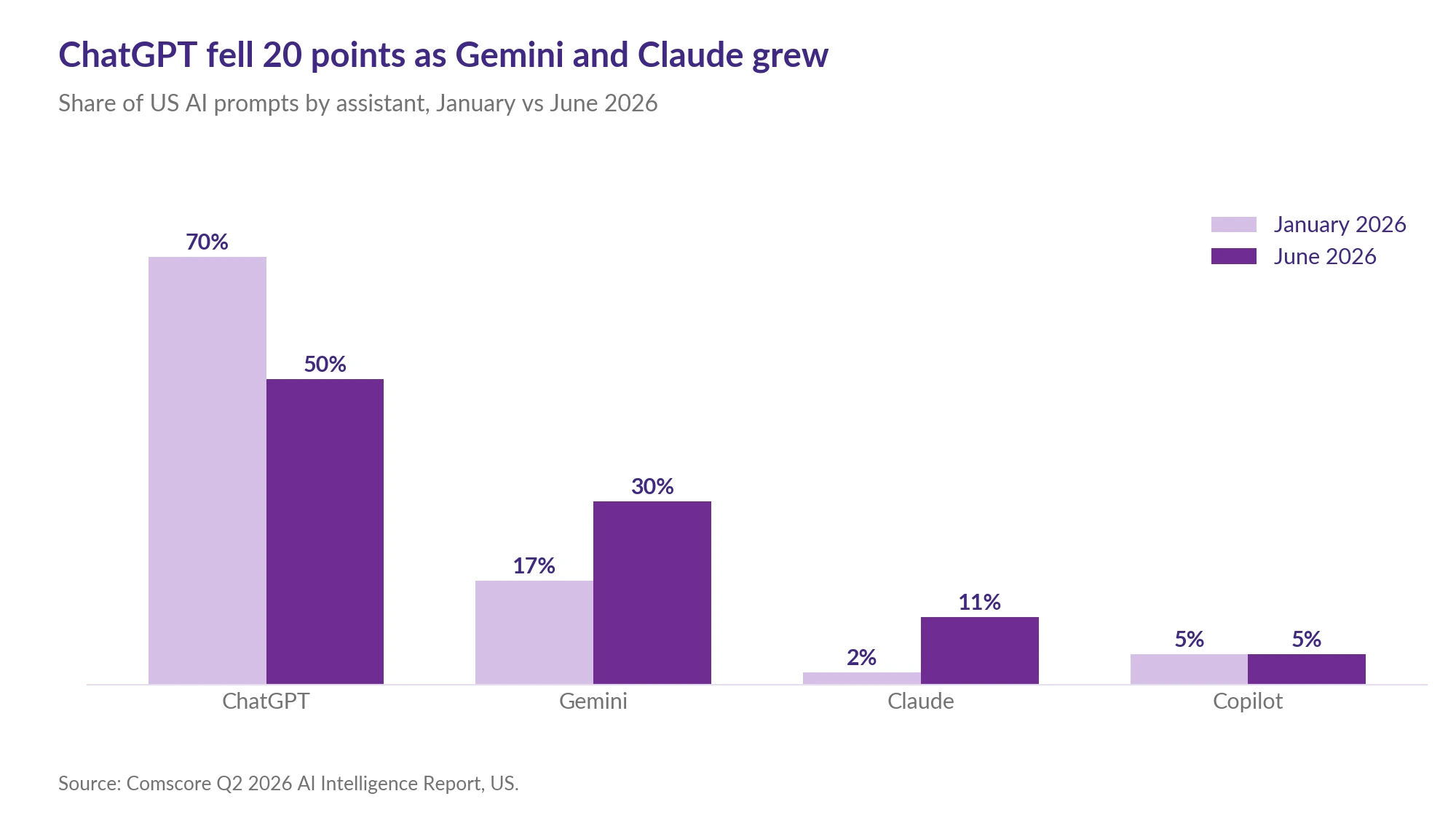
Comscore measures usage through its US panels. Between January and June 2026, ChatGPT’s share of US AI prompt volume fell from 70 percent to 50 percent. Gemini, 17 percent to 30 percent. Claude, 2 percent to 11 percent. ChatGPT still leads the category, and its share shrank because the others grew faster.
I read the report as the end of the single-model check. A brand that measures its AI visibility on ChatGPT alone now reads half the prompts, and the half it skips includes the model that gained the most share.
This article draws on two separate studies, with different publishers, methods, markets, and time windows. Comscore’s report records where US users take their questions, the links they are shown, and the ads placed beside the answer. NeuroRank’s AI Visibility Index 2026, called the Index below, records what four models said about 122 brands across 7,580 unique prompts, captured through fresh-token runs between March and May 2026. Their figures are reported side by side and never combined, and the reading that connects them is NeuroRank’s.
Highlights
|
It means brands must read each AI model separately, because the major models describe the same brand differently. ChatGPT carried 50 percent of US AI prompts in June 2026 in Comscore’s panel. In NeuroRank’s AI Visibility Index 2026, 41 of 63 brands measured on all four models swung by at least 30 points between their best and worst model. |
A single reading assumed the models agreed. They do not.
In the Index , 57 of the same 63 brands swung by at least 20 points, and 21 by at least 40. The prompt panels behind each model were not matched, so the levels read as directional and the dispersion reads as the finding.
The combined view helps, within limits. Combined Synthesis, the Index’s aggregate across the four models, beat a brand’s best single model for 48 of 81 comparable brands and trailed it for 28. An average smooths the swing, so the per-model reading still has to sit underneath it.
Brands are hardest to find on Gemini, the model that gained the most AI prompt share in Comscore’s data. Gemini’s share of US AI prompts rose from 17 percent to 30 percent in six months. In NeuroRank’s Index, Gemini returned High inclusion on 9.3 percent of rows where the prompt named no brand. |
Four models, four different doors. On prompts that named no brand, High inclusion ran 17.7 percent on ChatGPT, 9.3 percent on Gemini, 19.6 percent on Claude, and 26.3 percent on Perplexity. Perplexity, the easiest of the four in the Index [CONFIRM: Index URL], held the smallest prompt share of the four in Comscore’s count.
The two studies measure different things, and each stands on its own. Taken separately, Comscore shows US users moving toward Gemini, and the Index shows Gemini as the model least likely to put a brand forward unasked. I would act on that direction now, before a second quarter of data confirms it.
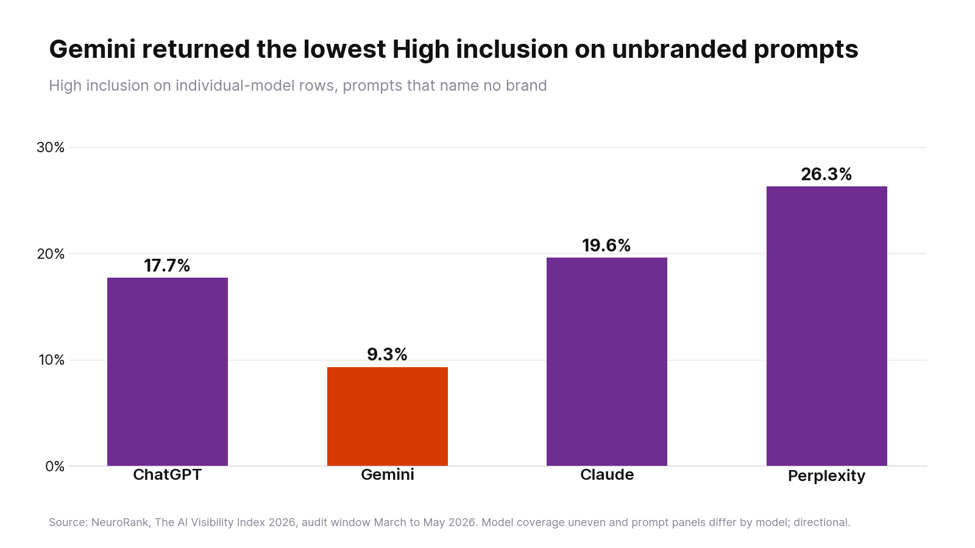
Model coverage in the Index was uneven and the prompt panels differed by model, so the ranking is directional. The distance between 9.3 percent and 26.3 percent is still too wide to treat a brand’s Gemini result as a copy of its ChatGPT result.
The weakness concentrates in one kind of question. Shortlist and recommendation prompts made up 38.6 percent of the Index’s unique prompts. Only 5.9 percent of them named the audited brand, and High inclusion on those rows was 20.0 percent. It is the largest low-performing intent class in the Index. This is the prompt a buyer types before any brand is in the conversation, and the model answers it from the category alone.
Definition: Unaided recall Unaided recall in AI answers is whether a model names a brand when the prompt names no brand. NeuroRank submits category-level and problem-type prompts without brand identification and records whether and how the brand entity appears organically. It is the discovery half of AI visibility, and the harder half to win. |
Look at the report on your own desk. If it shows one visibility number, taken on one model, from prompts that already name your brand, it describes the easiest test on a model that now carries half of US AI prompts.
“Across 63 brands measured on ChatGPT, Gemini, Claude, and Perplexity in NeuroRank’s AI Visibility Index 2026, the median gap between a brand’s best and worst model was 33.3 percentage points.” – NeuroRank, The AI Visibility Index 2026 |
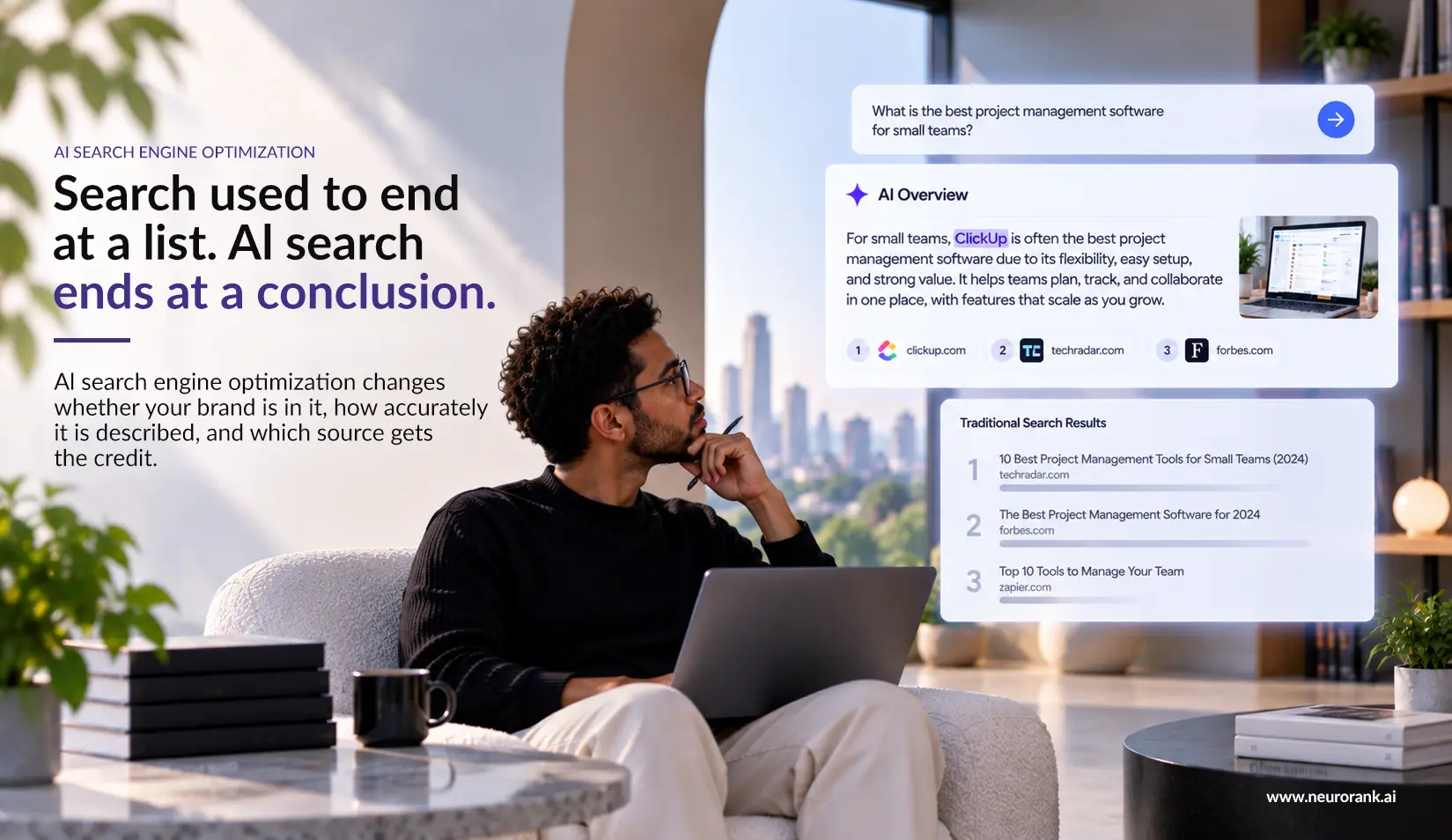
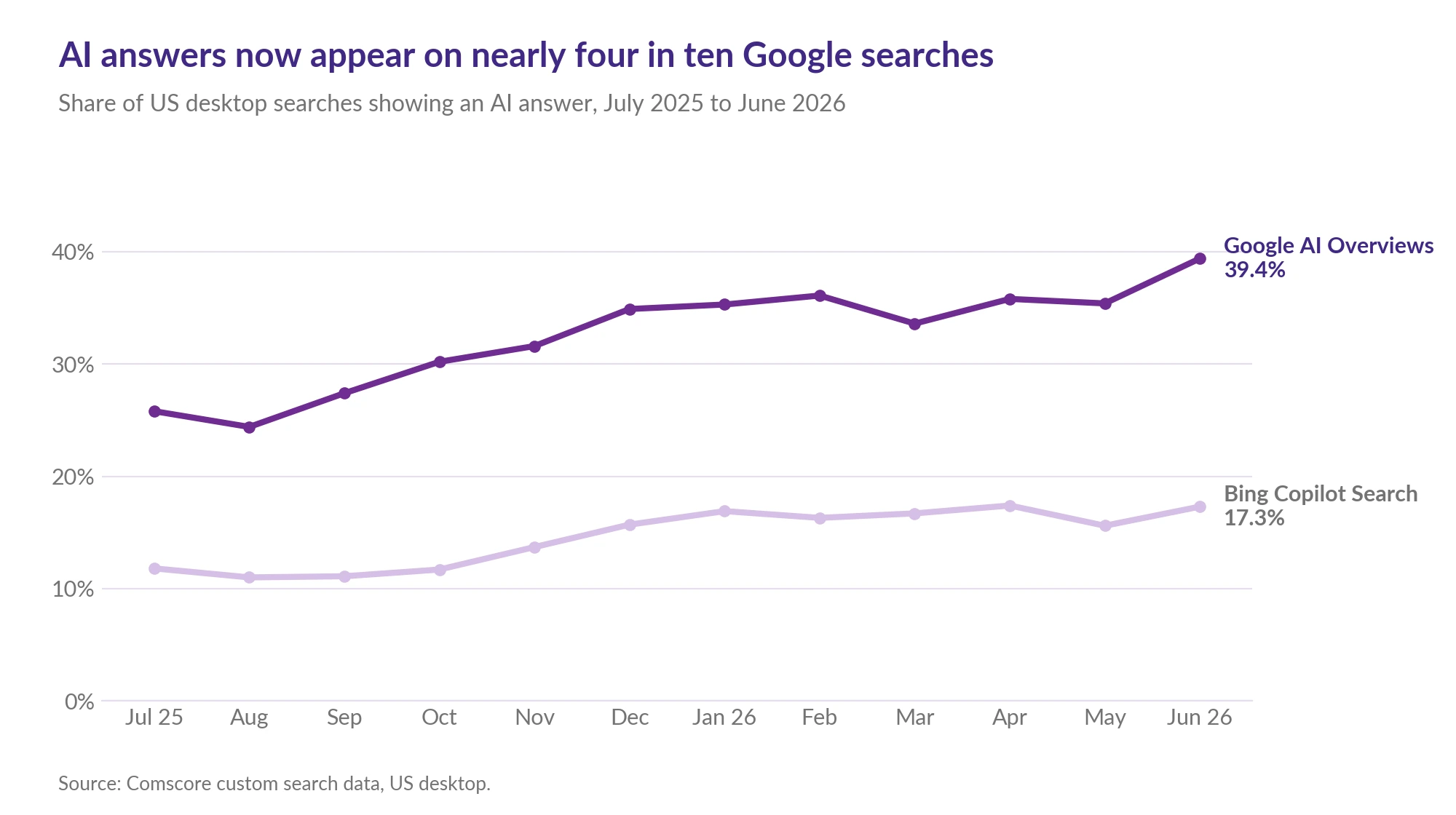
A top organic ranking stops guaranteeing visibility once an AI Overview answers first. Comscore recorded a Google AI Overview on 39.4 percent of US desktop searches in June 2026, up from 25.8 percent in July 2025, while Bing showed Copilot Search on 17.3 percent. A buyer can read the overview and act without reaching the links. |
Search optimization still does its job: it keeps a brand crawlable, relevant, and eligible for retrieval, the ground an AI Overview draws from. GEO adds the answer layer that rank reports leave unmeasured: whether the answer names the brand, recommends it, and cites it.
NeuroRank’s AI Visibility Index 2026, a separate study, recorded a similar false comfort inside AI answers. Of 82 brands, 22 reached at least 50 percent High inclusion when the prompt named them and fell below 20 percent when it did not. A brand-named score records recognition. A category search tests discovery.
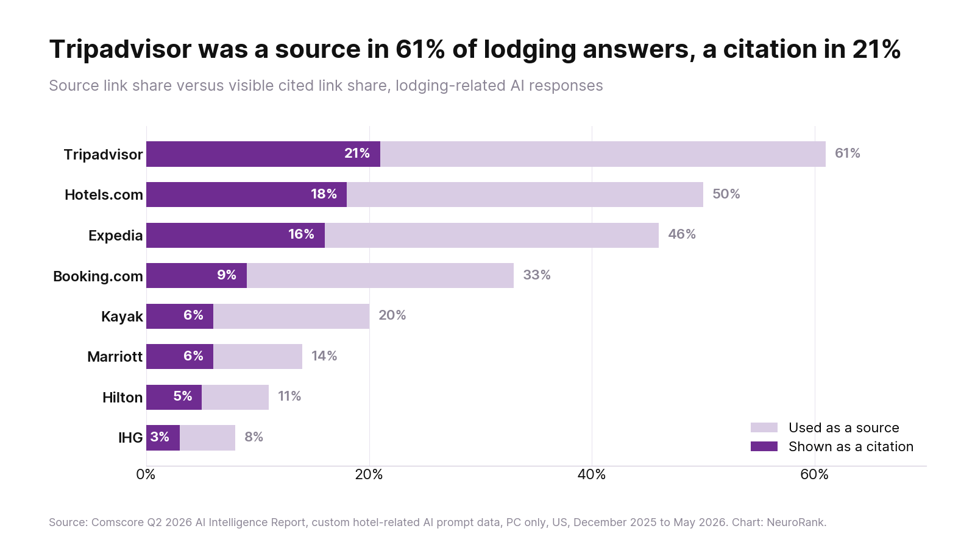
Models read far more sources than they show. In Comscore’s lodging-related AI responses from December 2025 to May 2026, Tripadvisor appeared as a source link in 61 percent and as a visible citation in 21 percent. Marriott’s own domain fell from 14 percent as a source to 6 percent as a citation. |
Financial services shows who carries the answer. In June 2026, YouTube was the domain Comscore found most cited in Google and Bing AI Overviews for financial services searches, at 9 percent. NerdWallet, Reddit, and Bankrate followed at 7 percent each, Forbes at 6 percent, and Chase and Fidelity at 5 percent.
NeuroRank’s AI Visibility Index 2026 [CONFIRM: Index URL] recorded a related pattern in a separate and much smaller sample: four USA BFSI audits. Of 96 logged citations, 64.6 percent pointed to third-party sources and 35.4 percent to the audited brand’s own domain. The same audits held 61 error notes, and 27 of them concerned price, fees, rates, or other quantitative detail.
Four audits cannot support a market-wide claim. They do show which facts broke: the ones a buyer uses to decide. Each study, on its own measure, found most cited pages outside the brand’s own site: third parties held the top five places in Comscore’s financial services list, and most logged citations in the four audits.
AI answers now sit inside the buying session. In Q2 2026, 35 percent of US desktop Home and Living purchasers in Comscore’s panel visited an AI assistant in the 30 days before buying. In the same session as the purchase, 26 percent visited one, and 14 percent held an on-topic Home and Living conversation. |
Comscore reports this as reach: the data places AI at the point of decision, and it stops short of showing that the answer caused the sale.
Brands are being named more often as well. Between January and March 2026, fashion brand mentions in AI responses grew 123 percent, and health and beauty brand mentions grew 150 percent, across the peer sets Comscore tracked.
NeuroRank’s AI Visibility Index 2026 [CONFIRM: Index URL] measured a different thing in a different window: how often brands appear when the prompt names no brand. Retail and lifestyle brands recorded 13.8 percent High inclusion there, and FMCG and personal care brands 11.9 percent. The two studies cannot be joined into one trend. I read them as one question for consumer brands: if the category is discussed near purchase, is your brand in that discussion?
What does the sponsored layer in ChatGPT change?
Sponsored ads now sit inside some ChatGPT answers. Comscore found sponsored ads in 3 percent of US desktop ChatGPT conversations about video games and consoles in March 2026 and 47 percent in June. In hotel-related prompts with source links, the share rose from 6 percent in March to 24 percent in May. |
Other retail categories moved between March and June 2026 as well. Toys and hobbies, 5 percent to 24 percent. Books, music, and video, 9 percent to 22 percent.
An ad buys a placement beside the answer. The model still writes the description of the brand: its category, its price, its capabilities. Where that description is wrong, the ad pays to stand next to the error. I read the ad data as a reason to defend organic inclusion first.
NeuroRank’s Index measured organic inclusion only, and how sponsored placements interact with it is an open question. It needs its own measurement before anyone prices it.
Why do multi-turn conversations defeat one-off visibility checks?
Buyers refine a question across several prompts, and a brand has to hold its place on each one. Comscore measured an average of 5.4 prompts per conversation on ChatGPT in June 2026, 6.2 on Gemini, 9.1 on Claude, and 6.9 on Microsoft Copilot. A prompt typed once by hand captures one turn. |
Follow-ups narrow the question: a budget, a use case, a city. Each narrowing moves the prompt further from the brand’s name and closer to the category.
In NeuroRank’s AI Visibility Index 2026, High inclusion was 56.2 percent when the prompt named the brand and 17.8 percent when it did not.
Follow-up turns that add constraints without naming a brand sit in the second state. Visibility is better measured across clusters of related prompts, run at scale on fresh sessions, than through one question typed into one chat window.
Brand teams should read every major model separately, split branded from unbranded prompts, and trace the sources behind each answer. Comscore’s Q2 2026 data shows demand spreading across assistants and AI Overviews. NeuroRank’s separate Index shows representation varying by model and by prompt state. Six changes follow, in NeuroRank’s reading of each study. |
Read each model on its own. Measure ChatGPT, Gemini, Claude, and Perplexity side by side, and give Gemini its own baseline, since its share gained the most.
Split named and unnamed prompts. Report recognition and discovery as two numbers. A blended score hides the harder one.
Put AI inclusion beside search rankings. With AI Overviews on 39.4 percent of US desktop Google searches, a ranking report alone misses the answer above it.
Map the sources behind the answer. Find the publishers, review sites, and communities the models cite in your category, and where your brand is absent from them.
Watch the sponsored layer. Where ads are entering answers in your category, defend organic inclusion on the questions that decide a purchase.
Retest like for like. Re-run the same prompt classes, on the same models, in the same markets, before reading any movement as progress.
Across four models, several markets, and dozens of prompt clusters, this is a monthly operation. The requirement is a per-model, per-prompt-state reading, with every cited source traced and every gap classified. NeuroRank, the patent-pending AI visibility intelligence platform, runs that reading as a five-step cycle: Deconstruct, Diagnose, Prescribe, Condition, and Track. It classifies each gap by ORHL: Omitted, Replaced, Hallucinated, and Zero Leads.
Unlike a single blended visibility score, NeuroRank reports aided and unaided recall separately for each of the four models, showing where a brand is recognized and where it is discovered.
Two separate studies: what each measures, and what it leaves out
Dataset | Publisher | What it counts | Window | Market | Models | Leaves out |
|---|---|---|---|---|---|---|
Q2 2026 AI Intelligence Report | Comscore | Visits, prompts, citations, sponsored ads | January 2025 to June 2026 | USA panels | ChatGPT, Gemini, Claude, Copilot, others | How models describe a given brand |
The AI Visibility Index 2026 | NeuroRank | High inclusion by prompt state, model, sector | March to May 2026 | India, USA, other | ChatGPT, Gemini, Claude, Perplexity | Sales, traffic, sponsored placements |
Both datasets stop before revenue. Comscore’s figures describe reach, prompts, citations, and ads measured through US panels. NeuroRank’s Index describes how four models represented 122 brands between March and May 2026, with prompt panels that differed by model. Each shows direction on its own terms, and each brand still has to test that direction in its own market. |
The windows differ: Comscore’s charts run from January 2025 to June 2026, and the Index covers one quarter. The Index did not measure AI Overviews, Copilot, or sponsored placements. The Q2 report’s charts are sourced to US panels, so a brand selling in Asia, Europe, the Middle East, the USA, and North America needs a reading in each market.
The questions have moved. When a buyer asks Gemini what to buy in your category, and names no brand, does the answer include you?
Next steps
Start with the two readings this report makes necessary: how each of the four models represents your brand, and whether each one names you when the prompt does not. Take both readings in every market you sell in, and repeat them on the same prompts each month, so movement means something. Start GEO growth with NeuroRank.
Stop paying for clicks that do not convert. Benchmark your AI visibility today with the world's most advanced seo ai tools.
Book a Strategic NeuroRank Briefing