BlogOctober 19, 2026
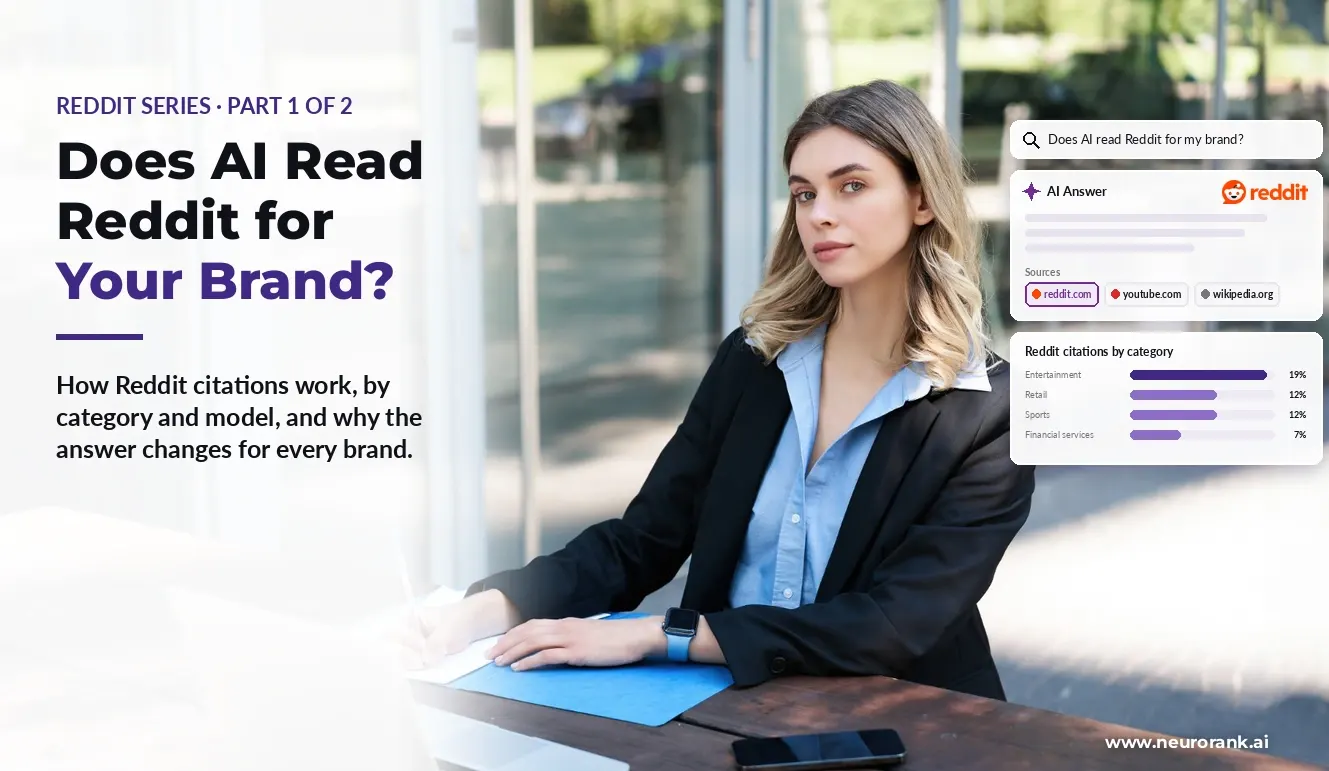
Does AI Read Reddit for Your Brand? Category and Model Decide

Ambika SharmaFounder at Pulp Strategy Communications and NeuroRank.
Founder at Pulp Strategy Communications and NeuroRank.
Subscribe for Newsletters
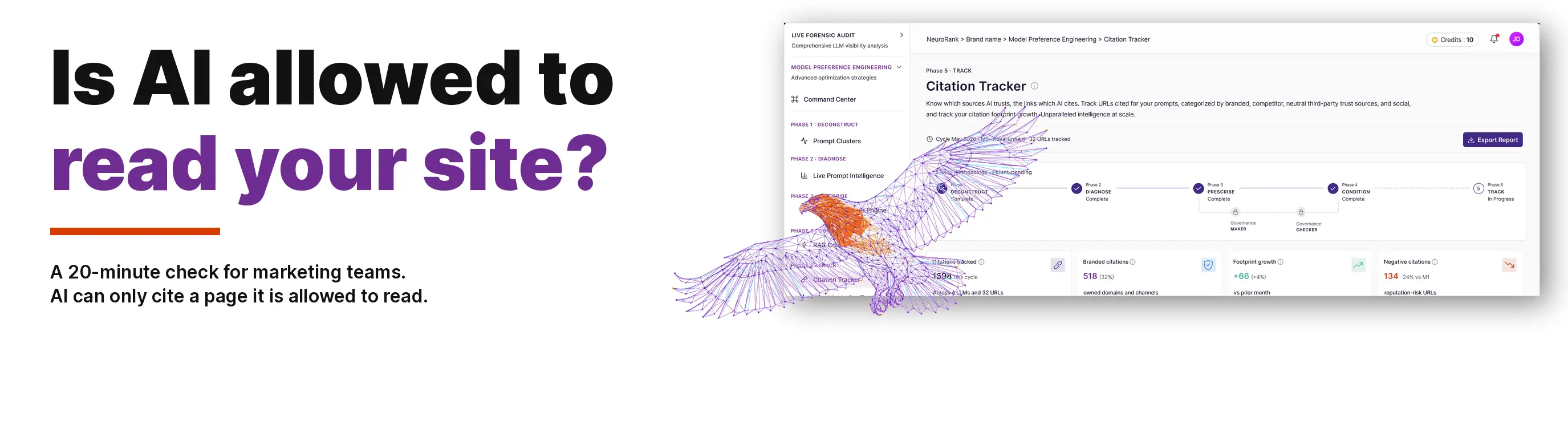
AI crawler access has to be checked provider by provider, because AI systems rely on different crawlers and search agents. A site indexed perfectly by Google can still be unavailable to ChatGPT Search, Claude Search, or Perplexity if their search agents are blocked. Google is different: Googlebot supplies Google Search crawling, including the Search infrastructure used by AI Overviews and AI Mode, while Google-Extended is a robots.txt product token instead of a separate crawler. This is a 20-minute access check any marketing team can run; some fixes still require engineering.
Update, October 2026: for current data on how AI assistants recommend brands, see The State of AI Visibility 2026.
Providers use different agents for model development, search, and user-requested fetching. OpenAI uses GPTBot for potential training, OAI-SearchBot for ChatGPT search discovery, and ChatGPT-User for user-requested visits. Anthropic uses ClaudeBot for model development, Claude-SearchBot for search, and Claude-User for user-directed retrieval. Perplexity uses Perplexity Bot for search and Perplexity-User for user-requested fetches. Google is different: Googlebot handles Google Search crawling, including Search features such as AI Overviews and AI Mode. Google-Extended is not a separate HTTP crawler; it is a robots.txt product token that controls certain Gemini training and grounding uses of content Google has already crawled.
Blocking GPTBot does not by itself block OAI-SearchBot. Review search discovery and user-requested fetches separately under each provider’s documented rules. A blocked search crawler can limit access or eligibility, but the effect of a user fetcher and the resulting citation behavior varies by product.
Open your-domain.com/robots.txt and inspect the rules for OAI-SearchBot, GPTBot, Claude-SearchBot, ClaudeBot, PerplexityBot, Googlebot, and user-requested fetchers where relevant. A block on a search crawler can reduce eligibility for that provider’s search experience. A block on a training crawler controls model-development use, not search indexing. Google-Extended should be reviewed as a product-control token, not as a crawler. Also check CDN and WAF rules, because robots.txt can allow a bot while the edge still returns a 403 response.
A clean robots.txt is not enough if your CDN is blocking bots above it. Cloudflare and similar services ship a one-click control that blocks AI bots. It is easy to enable by accident, and it silently overrides your file. Confirm no firewall or bot-management rule is treating the search agents as scrapers. This is where a marketing team usually needs a quick word with whoever owns the CDN.
Access is not the same as legibility. If your key content loads through JavaScript that the fetchers do not run, the page can be reachable and still effectively empty to a model. Confirm your important facts are present in the served HTML, not painted in after load. View the page source, not the rendered page, and search for the fact you need a model to find.
Filter server logs for the published agents, then verify the traffic using that provider’s current IP ranges or documented verification method. Do not rely on the user-agent string alone or assume reverse DNS is the correct method for every provider. A successful fetch demonstrates access; it does not establish indexing or influence on an AI answer.
Read Schema markup for AI ingestion. Read How to get cited in AI search. Read AI content optimization and RAG conditioning. Read the guide to answer engine optimization. |
Stop paying for clicks that do not convert. Benchmark your AI visibility today with the world's most advanced seo ai tools.
Book a Strategic NeuroRank Briefing