Adgully: Why AI Visibility, Not SEO, Will Define Marketing

Summarize with AI
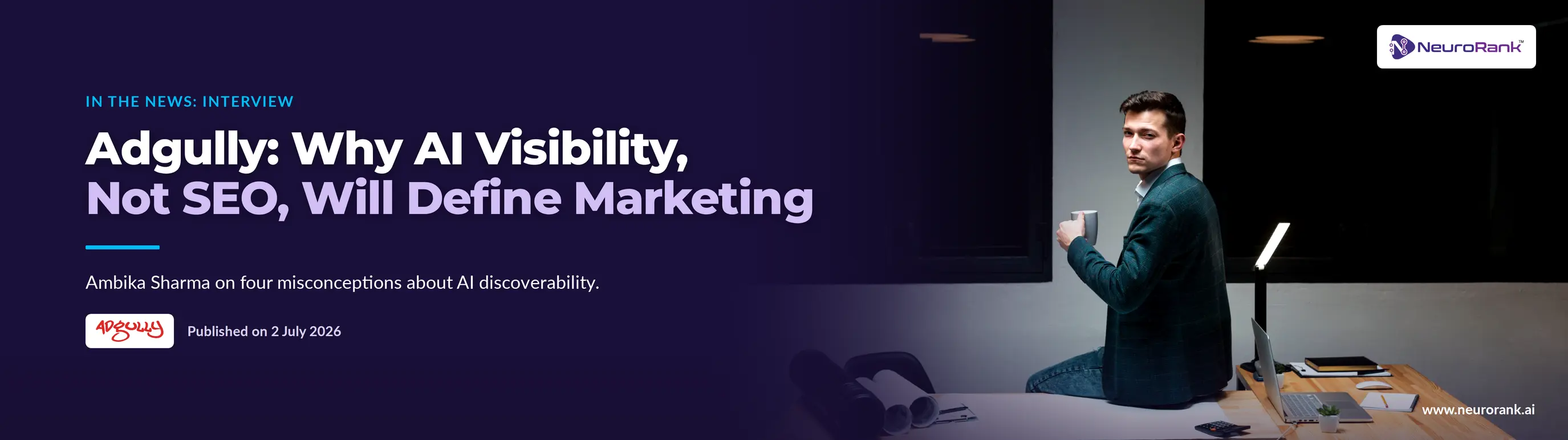
Adgully interviewed Ambika Sharma on 2 July 2026 about Large Language Model Optimization (LLMO) and why AI visibility will matter more than SEO over the next decade. She covers the gap NeuroRank was built to fill, four misconceptions about AI discoverability, what testing the platform taught the team, and the move from AI search to AI agents.
Consumer engagement has moved upstream
Ambika Sharma frames the change as a question of control. For about two decades brands owned the campaign, the channel, and the message. Search took part of that control, and social media took more. AI now shapes a consumer’s expectations before they reach a website, so the brand becomes the subject of a model’s summary. Most marketing teams still optimize the experience after that moment.
By mid-2024, she says, ChatGPT was already misrepresenting brands. It invented facts, recommended competitors, and left out companies that should have been named. Brands could see their Google rankings and had no view of the AI answer. NeuroRank was built for that gap, and it covers the full cycle: it deconstructs how models see a brand, diagnoses the errors, prescribes corrections, improves the sources AI relies on, and tracks progress monthly.
Four misconceptions carry a cost
Ambika Sharma lists four beliefs she sees among marketers.
A strong Google ranking guarantees AI visibility. She notes that only a small share of the links AI cites overlap with Google’s top results.
AI describes every brand accurately. On unbranded questions especially, a model can omit a brand, give its strengths to a competitor, or repeat outdated facts.
A favorable answer in your own account reflects what customers see. Personal history and context shape that answer.
AI optimization is a one-time project. Models retrain and sources change, so visibility drifts once management stops.
She calls the fourth the most expensive.
Creative work is now judged by AI first
Ambika Sharma treats creativity and measurement as partners. Work starts with a business objective a CFO would defend, then the creative route most likely to meet it. Awards follow effective work. She adds a new test: the most measurable creative output today is the content AI cites when a consumer asks about a category, and a model reads it before the audience does.
Testing showed governance belongs above marketing
Stress-testing NeuroRank across more than 350 brands in 65 industries, with more than 150 marketing teams, produced three lessons. Models trust different sources by industry, by geography, and even by prompt. One brand was repeatedly described by AI as having poor customer service while its own customer satisfaction scores exceeded 90 percent. Its website could not fix that, because the models were reading third-party sources, and the case led the team to rebuild the Recommendation Engine around source-level governance.
The second lesson concerns ownership. AI answers cover investor information, customer support, ESG communication, employer branding, and product facts, and each belongs to a different function. Sharma argues that accountability for the AI description sits with the CEO and the board, shared across the CMO, CFO, CHRO, CSO, and CPO.
The third came from BFSI enterprises, which would deploy AI-driven content recommendations only with an approval workflow. NeuroRank added Maker-Checker governance in response, so each recommendation is drafted, reviewed, and approved before it goes live.
AI agents come next
LLMO governs how models describe a brand when a person asks. Ambika Sharma expects the next shift to be AI agents that compare options, shortlist providers, and complete transactions for a person. The organizations building trusted authority, structured data, and continuous governance now are the ones she expects those agents to choose.
Brands that treat visibility as a one-off project risk being invisible twice.
Asked for her biggest takeaway from testing, Ambika Sharma said:
this category rewards governance rather than speed.”
Governance sounds slow to a marketing team. In a regulated business it is what makes action possible at all, because legal and compliance can approve a fix they have seen. Every board should be able to name the person who signs off on what AI says about the company. Where that name is missing, the work starts there, before a single page is rewritten.
Ambika Sharma, Founder, NeuroRank in Adgully, 2 July 2026
Related coverage
View all news
Indiantelevision Profile: Your Brand Has an AI Reputation
Indiantelevision: The Next Marketing Challenge Is Being Chosen by AI