Indiantelevision Profile: Your Brand Has an AI Reputation

Summarize with AI
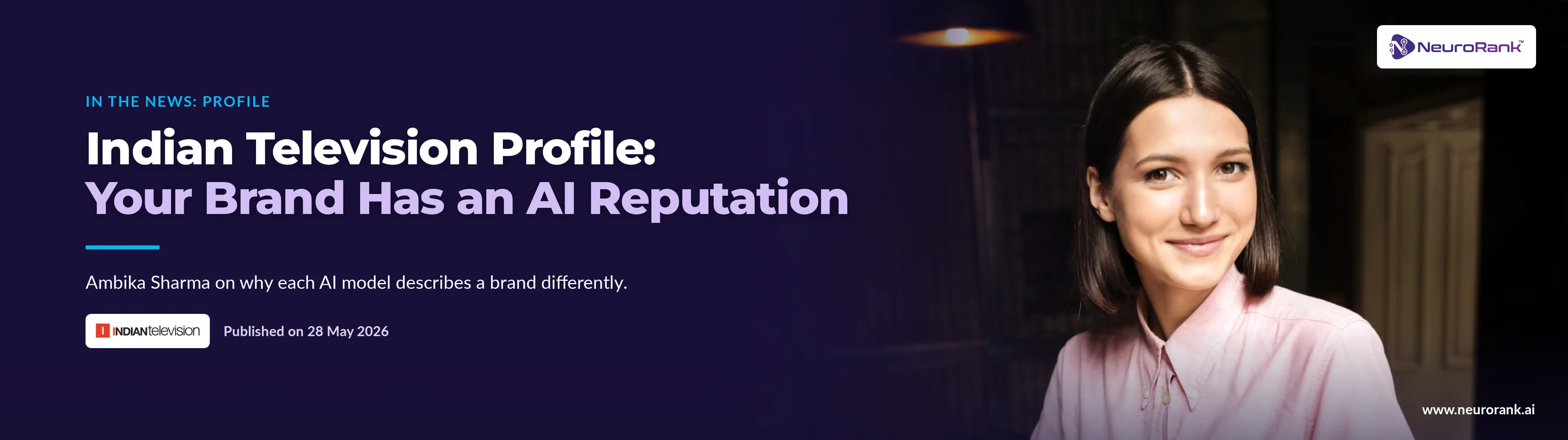
Indiantelevision.com profiled Ambika Sharma on 28 May 2026, opening on a sentence a machine is writing about every brand that the brand has rarely read. Written by Subodh Sharma, the profile covers why LLMO is its own discipline, the mistakes brands make when they check AI answers, why the four major models disagree, and three principles for staying visible.
Every brand has a description it has never read
The profile starts with the question that ran marketing for two decades: where does the brand rank on Google? Ambika Sharma expects that question to fade. A buyer now asks a model and acts on its answer, and the website becomes one source the model may or may not cite.
NeuroRank is introduced as a patent-pending AI visibility intelligence platform that monitors what ChatGPT, Gemini, Claude, and Perplexity say about brands today.
LLMO is its own discipline
Ambika Sharma calls the work LLMO, Large Language Model Optimization, also known as GEO. The profile describes it as a separate discipline from SEO. It asks whether a model recommends a brand, ignores it, or describes it wrongly to a customer with no reason to doubt the answer.
She expects it to move from specialism to the center of marketing within five years, because the answer is where the decision now happens.
Two mistakes keep brands blind
The first is misplaced confidence. Marketing teams type their brand name into ChatGPT from their own accounts and like what they see. Ambika Sharma calls this logged-in bias: the platform knows the user and answers kindly, while customers get a different account of the brand.
The second is paralysis. Few marketers track whether AI models cite them at all. In an AI answer there is no second page, and a brand outside the short list is absent from the decision. Ambika Sharma notes that a handful of manual queries cannot show the real picture, and that the first shock for most CMOs in a NeuroRank diagnostic is simply reading what the model says.
The four models disagree with each other
Across more than 700 brands studied, NeuroRank found a consistent pattern: the four models describe the same brand differently, because each draws on different sources and weighs them differently. One model may cite owned content, another may lean on third-party reviews, and a third may name a competitor alongside the brand. A brand can be visible in one model and missing from another without knowing it.
Ambika Sharma held 150 CMO meetings presenting NeuroRank results before the 2025 launch because of that variation. In her account, monitoring one model is hard, monitoring all of them at scale is harder, and governing all of them is the part that changes the result.
Content has to earn a model’s trust
Her advice on content is direct. Write with the structure a model needs to trust and cite a passage: clear, factual, and well sourced. Vague brand copy loses. The website becomes a source of truth for machines as well as a brochure for people.
She frames the shift as control. Traditional digital marketing optimized surfaces the brand owned: its site, ads, pages, and influencers. AI marketing influences a surface the brand does not own, and the citation goes to the brand the model has the most reason to trust. She adds a cost for brands that wait: query fan-out in paid search, where AI expands one search into several related queries, spends budget on ads that do not convert when the models do not yet trust the brand.
Smaller brands have the clearest opening
The profile’s most counterintuitive point is that startups may gain more than large enterprises. On Google, a startup competes against years of domain authority and large link budgets. A model cites the clearest, most accurate, most relevant source, and spend does not buy clarity. Ambika Sharma points to G2 research showing B2B buyers purchasing from vendors they first met through an AI answer.
Visibility is a position to hold
Ambika Sharma treats AI visibility as a position held over time. Models retrain, sources shift, and competitors work on their own presence, so a brand cited well this quarter can disappear next quarter without any dashboard it owns showing the change. Early absence also compounds. NeuroRank is built around Model Preference Engineering, a continuous governance practice, for that reason.
The profile cites a 90-day financial services engagement in which sustained conditioning lifted the brand’s AI visibility by 30 percent and its citation frequency by 12 percent across all four major models.
The profile closes on three principles, none of them budget: see early and act quickly, put substance ahead of spin, and treat AI visibility as a discipline that runs continuously.
Ambika Sharma’s case starts with how buying has changed:
“The buyer no longer scrolls a page of links. They ask a machine and take its answer.”
The logged-in check is an honest mistake. A marketer asks ChatGPT about their own brand from their own account and gets a warm answer shaped by their own history. A first-time customer gets a colder one. Run the same question from a clean session before deciding how visible the brand is. It is the cheapest correction in AI visibility, and the most often skipped
Ambika Sharma, Founder, NeuroRank in Indiantelevision.com, 28 May 2026
Related coverage
View all news
Indiantelevision: The Next Marketing Challenge Is Being Chosen by AI
Adgully: Why AI Visibility, Not SEO, Will Define Marketing