NeuroRank

Competitive Analysis AI: How Rivals Take Your AI Recommendations

Ambika Sharma
Ambika Sharma
Read time6 min read
July 21, 2026
Competitive Analysis

Updated July 2026. By Ambika Sharma, Founder, Chief Strategist at Pulp Strategy Communications and Product Architect of NeuroRank®.

Competitive displacement is when an AI model recommends a rival brand in the slot your brand should hold. NeuroRank® measures it as the Replaced class of AI visibility gaps, and it is the most expensive failure in AI search, because a competitor is being recommended to your buyer inside the answer where the decision is made. About 60 percent of searches now end without a click (this data includes traditional + AI Search - Bain, 2025), so the recommendation the model gives is increasingly the whole encounter. This article covers how to detect, reverse, and prevent competitive displacement across ChatGPT, Gemini, Claude, and Perplexity. It does not cover being left out entirely, which is the Omitted gap, or being described wrongly, which is the Hallucinated gap.

Executive Overview

Competitive analysis in AI search is the work of finding which questions return a competitor instead of your brand, then closing the gap that lets it happen. NeuroRank runs this analysis across ChatGPT, Gemini, Claude, and Perplexity, classifies each loss as a Replaced gap under the ORHL framework (Omitted, Replaced, Hallucinated, Zero Leads), and links it to the exact source the model cited to justify the rival. The mechanism is corroboration, not promotion: brand mentions across the web predict AI citation at 0.66 while backlinks predict at 0.10 (Ahrefs, 75,000 brands, 2026), so a competitor better represented in the sources a model trusts wins the slot even when your search ranking is stronger. The consequence is direct. When the buyer decides inside the answer and the answer names your rival, you are out of the consideration set before you knew there was a contest.

Highlights

  • Displacement is the Replaced gap: a rival is named in the slot your brand should hold.

  • Only about 11 percent of domains are cited by both ChatGPT and Perplexity, so displacement is per model.

  • Brand mentions predict AI citation at 0.66; backlinks predict at 0.10 (Ahrefs, 2026).

  • A brand’s own site is only 5 to 10 percent of what a model reads (McKinsey, 2025).

  • Brands with eight or more structured attributes are cited over four times more (Erlin, 2026).

  • Reversal starts at the cited source, not the homepage.

  • NeuroRank tracks competitor co-mention per prompt, per model, and per region.

Definition. Competitive displacement is when an AI model names a competitor in place of your brand for a question your brand should win. NeuroRank records it as Replaced, one of four AI visibility gap types in the ORHL framework. Unlike simple absence, the model already has a shortlist, and a rival is on it.

Why competitive analysis in AI is different now

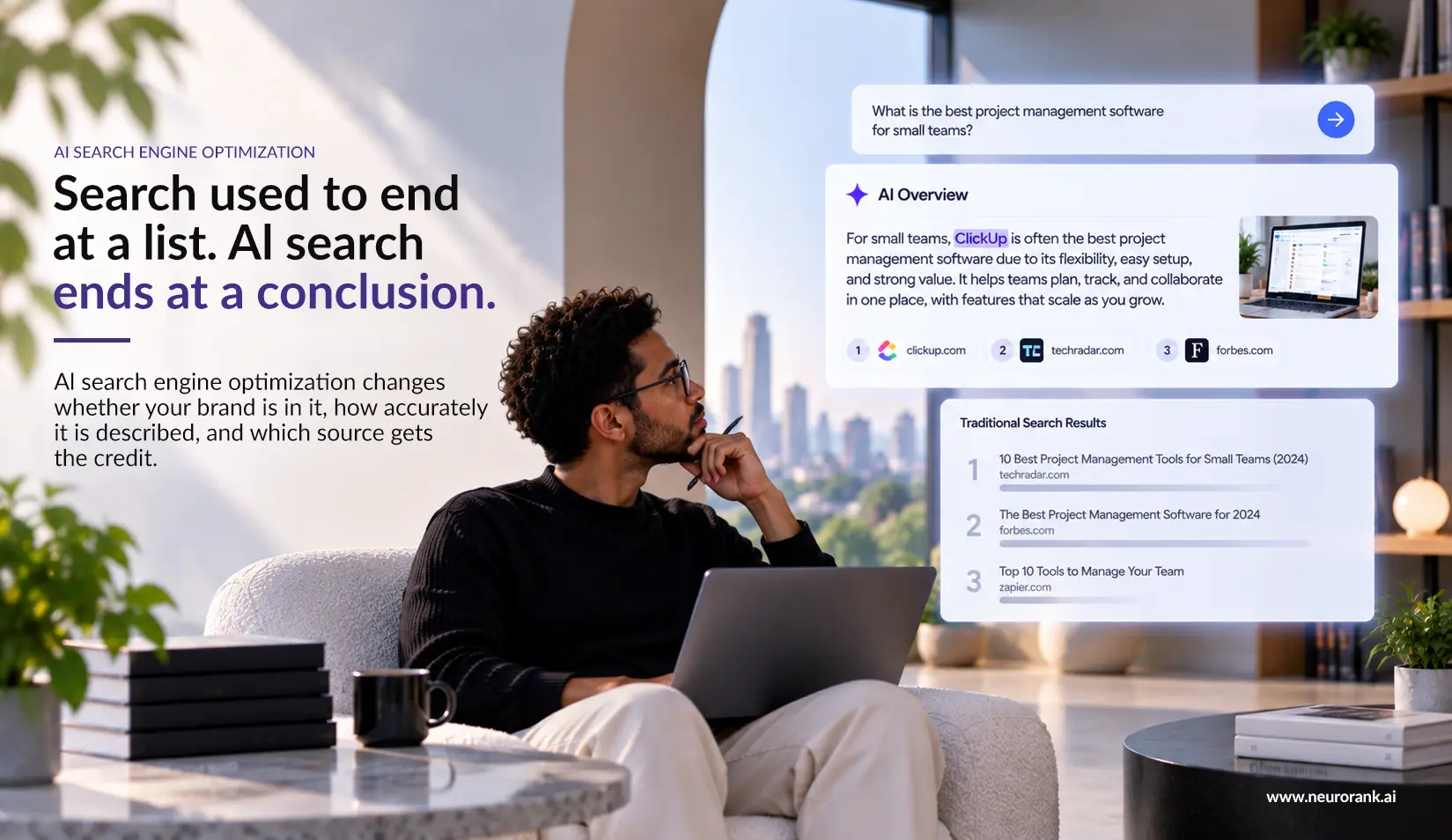
Competitive analysis used to mean tracking where rivals ranked on a results page. That measure is losing its meaning, because the results page is being replaced by a single generated answer. When an AI summary appears, people click a traditional result only 8 percent of the time (Pew Research Center, 2025), and Gartner expects traditional search volume to fall 25 percent by 2026.

The competitive question has moved with the buyer. It is no longer “where do we rank against this rival,” it is “when a buyer asks, whom does the model name, and why them.” Most analysts tracking the shift agree the answer is now the battleground: Bain, McKinsey, and Gartner all describe discovery moving from the link to the generated response. That agreement is the reason competitive displacement, not ranking, is the metric to watch.

Displacement in AI is a marker of one thing: a competitor is better corroborated than you in the specific sources a model reads for a specific question. That is a solvable problem, but only if you can see it per model and per prompt.

What is failing when a competitor takes your slot

The failure is not visibility in general, it is corroboration on a specific question. When your brand is Replaced, the model understands the category, has a shortlist, and has more trustworthy material about your rival than about you for that prompt. Diagnosing this as a ranking problem sends teams to fix the wrong thing.

A rankings dashboard cannot show it. Displacement happens inside the generated answer, which is assembled mostly from third-party sources, and a brand’s own website is only 5 to 10 percent of what the model reads (McKinsey, 2025). The other 90 percent, reviews, forums, encyclopedic entries, news, and listings, is where the rival is winning and where a rank tracker never looks.

It also hides inside a single blended score. Because only about 11 percent of domains are cited by both ChatGPT and Perplexity, a brand can hold its slot in one model and lose it in another. Report one average and the model where you are being Replaced disappears into the mean.

People also ask: Can competitor analysis tools show me AI displacement? Traditional competitor tools track rankings, backlinks, and share of search on the results page. They do not read the generated answer, so they cannot show which model named a rival instead of you, or which source justified it. That requires querying the models directly.

How do you detect competitive displacement across the four models?

Detect displacement by asking the questions your buyers actually ask, across every model, at cold start, and recording who gets named when your brand does not. Displacement is not uniform, so a single check misses most of it.

Run the prompt set through ChatGPT, Gemini, Claude, and Perplexity separately, because the models read different source pools and name different brands. Run each prompt enough times to separate a real pattern from the normal run-to-run variation in AI answers, which is wide: identical prompts under identical conditions produce cited sources that overlap only 34 to 42 percent from one day to the next (arXiv, 2026). Run cold, with no login or history, so the result reflects what a new buyer sees rather than your own account.

For every prompt, record two things: whether your brand appears, and which competitor is named when it does not. That competitor co-mention pattern, tracked per prompt and per model, is the raw material of AI competitive analysis. The platform captures it on every run, across regions, so displacement shows up as a specific list of prompts and rivals rather than a vague sense of losing ground.

Atomic answer: Competitive displacement is detected by running your buyers’ prompts across ChatGPT, Gemini, Claude, and Perplexity at cold start, many times each, and recording which rival is named when your brand is not. NeuroRank logs competitor co-mention per prompt, per model, and per region.

Why does AI recommend a competitor with weaker SEO than yours?

AI recommends the better-corroborated brand, not the better-ranked one, because citation runs on agreement across sources rather than on your link profile. This is why a rival with a thinner SEO footprint can still take your slot.

The evidence is direct. Across 75,000 brands, brand mentions predicted AI citation at 0.66 while backlink volume predicted it at 0.10 (Ahrefs, 2026). The models are reading how consistently the web describes a brand, not how many links point at it. A competitor mentioned accurately and consistently across the sources a model trusts gives that model more to work with than a brand with strong rankings and a thin presence in those same sources.

Structured, extractable facts compound the effect. Brands carrying eight or more structured attributes were cited over four times more often than brands with fewer than three (Erlin, 2026). The rival that has published clean, specific, liftable facts in the places a model reads is easier to name than the brand that has kept its detail locked inside marketing copy on its own site.

Atomic answer: AI recommends the better-corroborated brand, not the better-ranked one. Brand mentions predict citation at 0.66 against 0.10 for backlinks (Ahrefs, 2026), so a rival with consistent, extractable presence in trusted sources can take the slot from a higher-ranking brand.

How do you reverse displacement once you find it?

Reverse displacement at the source the model cited, not on your own page. For each prompt where a rival holds your slot, the platform identifies the exact source the model used to justify the recommendation, which tells you precisely where the corroboration gap sits.

From there the work is specific. If the model leaned on a review platform where your competitor is answered and you are absent, the gap is on that platform. If it cited a third-party listing carrying your rival’s attributes and not yours, the gap is in that listing. Close the specific gap by publishing clean, verifiable facts a model can lift, and by earning accurate, consistent presence in that source, rather than by adding more to a homepage the model barely reads.

This is conditioning the source layer, and it is the move traditional SEO does not make. The platform routes each fix through a Maker-Checker workflow and a 13-point effectiveness check, then re-measures, so a recommendation is not counted as done until the slot actually moves.

Atomic answer: Displacement is reversed by fixing the specific source a model cited to justify the rival, not the homepage. NeuroRank names that source per prompt, prescribes the fix, and re-measures after Maker-Checker review, so the slot is confirmed recovered rather than assumed.

How do you keep a competitor from taking the slot back?

Prevent recurrence by re-running the same prompts every month and watching the shape of the change, because the models and their sources keep moving. A slot won once is not held automatically.

Two forces erode it. Providers update their models without notice, and the sources rotate: content cited 82 percent of the time at 30 days can fall to 37 percent by 180 days on some engines. Monthly re-measurement against a fixed baseline catches both. The tell is in the pattern. If your brand moves on a prompt and comparable brands measured the same way do not, that is your work holding or slipping. If every brand moves at once, the model changed, and it should be recorded as drift rather than a competitive loss.

Tracking competitor co-mention on this cadence turns displacement from a recurring surprise into a monitored metric with an owner.

Atomic answer: Displacement is prevented by re-running the same prompts monthly against a fixed baseline and watching competitor co-mention. A brand-specific move signals your own gain or loss; a move across all brands signals model drift. NeuroRank re-runs every cluster each month.

Value.

Recovering a displaced slot puts your brand back into the answer where the decision is made. The mechanism is corroboration: close the source gap the model cited, and the model has grounds to name you instead of the rival. Across NeuroRank’s enterprise base, recommendation rose 12 percent over about 80 days.

What competitive displacement costs while you wait

Left alone, displacement compounds, because the sources that let a competitor win keep earning the model’s trust while your gap stays open. Every month the rival is named, the model sees its choice reinforced and the buyer sees your rival, not you.

The exposure is the size of the shift to AI answers. About 80 percent of consumers now rely on AI answers at least 40 percent of the time (Bain, 2025), and McKinsey projects 750 billion dollars of US revenue moving through AI search by 2028. A displaced slot is not a ranking position lost, it is a share of that decision volume handed to a named competitor. Unlike a ranking dip, it is invisible to the tools most teams already run, so it can persist for quarters before anyone attributes the lost pipeline to it.

Comparative statement. Unlike rank-tracking and competitor SEO tools, which measure positions on a results page, NeuroRank measures which model names a rival instead of you, why, and from which source, then conditions that source and tracks the recovery.

Rank tracking versus AI competitive analysis

DimensionRank-tracking / Competitor SEO ToolAI Competitive Analysis (NeuroRank)
Unit measuredPosition on a search engine results page (SERP)Named brand inside a generated AI answer
Where the contest happensSearch resultsChatGPT, Gemini, Claude, Perplexity
Signal of a lossCompetitor ranks above youCompetitor named in your slot (Replaced)
Root cause shownLinks, on-page factorsExact source the AI model cited
Per-model viewNot applicableYes, scored separately for each AI model
Action it points toImprove your page and backlinksCondition the cited source so the model references your brand
VerificationRe-check search rankingsRe-measure the AI answer after implementing the fix
What a rank-tracking tool measures versus what AI competitive analysis measures. NeuroRank analysis, July 2026.
Source: NeuroRank analysis, July 2026.


Named proof

The pattern is consistent across NeuroRank’s validation. In a 10-month stress test spanning 150 brands across 65 industries, in Asia, Europe, the Middle East, the USA, and North America, every brand was carrying an AI-visibility signal it had not seen, and competitor displacement was among the most common.

A representative case, anonymized to sector per NeuroRank’s client-confidentiality standard: an enterprise brand in financial services was being Replaced on a set of high-intent comparison prompts across two of the four models, while holding a strong classic search position for the same terms. The rankings dashboard showed nothing wrong. The AI analysis showed a competitor named in the slot on those prompts, justified by a third-party comparison source that carried the rival’s attributes in a clean, extractable form and omitted the brand’s. The fix was made at that source, not on the brand’s own site. The correction was verified on the following monthly re-run, when the brand re-entered the slot on the affected prompts.

Across the enterprise base, the loop that produced these recoveries shows an average 39.6 percent lift in AI visibility, a 7 percent lift in branded citations, and a 12 percent lift in recommendation over about 80 days. Results vary by brand, category, and starting baseline, and how quickly a displaced slot returns depends on the competition in the category, the brand’s scale, and where it starts.

Displacement in Asia and India

Displacement patterns differ by region, because the models weigh regional sources differently. For India-based prompts, ChatGPT-priority behavior is common, and Indian review platforms, regional publications, and local listings carry more weight than they do for other markets. A brand can hold its slot globally and be Replaced for Indian buyers, or the reverse, which is why the platform measures by geography in the order Asia, Europe, the Middle East, the USA, and North America rather than assuming one global result. For Indian brands specifically, the corroboration gap that drives displacement often sits in local sources a global-first strategy has not addressed.

Next Steps

Start with the prompts where a lost slot costs you the most: your highest-intent comparison and category questions. Run a Live Forensic Audit for USD 7.00 to see, across ChatGPT, Gemini, Claude, and Perplexity, which of those prompts return a competitor instead of your brand, and which source justified it. The audit returns the per-model picture and the ORHL classification for each gap, so the first fixes are aimed at the sources actually costing you the recommendation.

Is your brand invisible in the AI synthesis?

Stop paying for clicks that do not convert. Benchmark your AI visibility today with the world's most advanced seo ai tools.

Book a Strategic NeuroRank Briefing

More Articles

Analyze the Damage.
Establish Governance.