BlogSeptember 16, 2026
AI search engine optimization

Ambika SharmaFounder at Pulp Strategy Communications and NeuroRank.
Ambika Sharma
Ambika Sharma is the Founder & Chief Strategist of Pulp Strategy, a multi-award-winning business transformation and digital agency, and Prod... Read more
Subscribe for Newsletters
Updated July 2026. By Ambika Sharma, Founder, Chief Strategist at Pulp Strategy Communications and Product Architect of NeuroRank®.
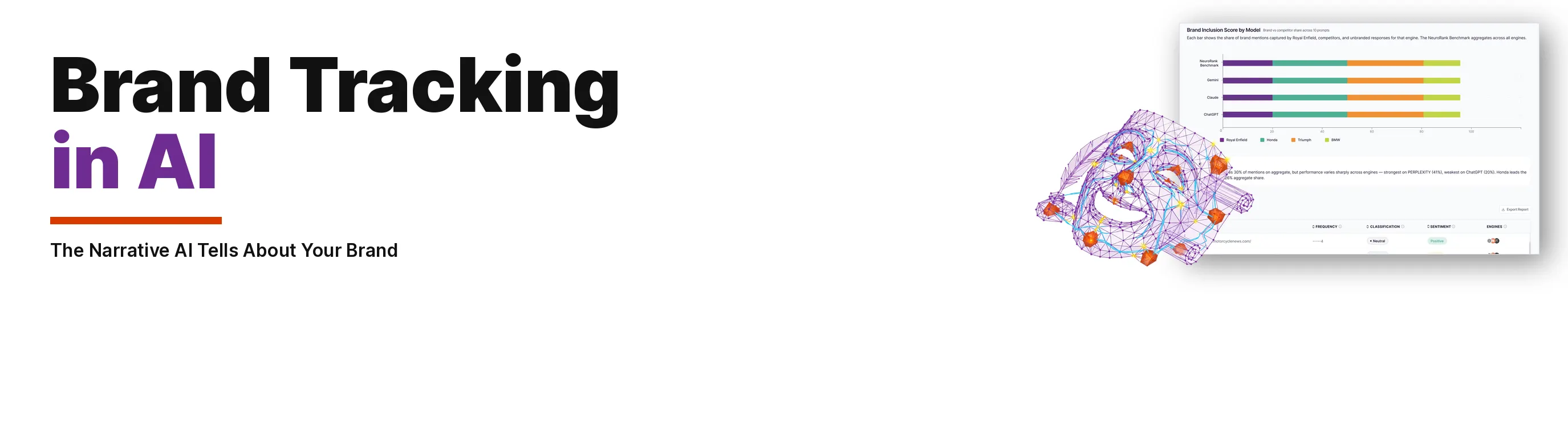
Brand tracking in AI is the practice of monitoring the narrative AI models tell about your brand, the way they summarize who you are, what you offer, and whether to recommend you. NeuroRank® tracks that narrative across ChatGPT, Gemini, Claude, and Perplexity, because each model assembles its own version from fragmented third-party sources, and the version buyers hear is the model’s, not yours. This article covers how AI constructs a brand narrative, why it can drift from reality, and how to see and correct it. It does not cover social listening or traditional brand tracking surveys, which measure human sentiment rather than model output.
Brand tracking in AI is monitoring the narrative AI models tell about a brand and measuring how it changes. It matters because the models assemble that narrative from fragmented sources, and a brand’s own site is only 5 to 10 percent of what they read (McKinsey, 2025), so the story a buyer hears is stitched mostly from material the brand does not control. NeuroRank tracks the narrative across ChatGPT, Gemini, Claude, and Perplexity, measures it as inclusion, recommendation, citation, ORHL reduction (Omitted, Replaced, Hallucinated, Zero Leads), and sentiment, and names the sources driving it. The narrative differs by model, since ChatGPT and Perplexity share only about 11 percent of cited domains, so one story is never the whole picture. The consequence is that a brand can be described accurately by one model and wrongly by another, and only tracking each shows it.
Brand tracking in AI monitors the narrative models tell about you, per model.
Models assemble the narrative from fragmented third-party sources, not your marketing.
A brand’s own site is only 5 to 10 percent of what these systems read (McKinsey, 2025).
The narrative differs by model, since ChatGPT and Perplexity share about 11 percent of domains.
A wrong narrative is usually a corroboration or freshness problem in the sources.
Correction follows the source, then is confirmed by re-tracking the narrative.
NeuroRank tracks the narrative across the four models and names the sources behind it.
Definition. Brand tracking in AI is the practice of monitoring how AI models describe and recommend a brand, the narrative they assemble from the sources they read, and measuring how that narrative changes over time across models and regions. It differs from social listening, which tracks human conversation rather than model output.
The narrative a buyer hears is now assembled by a model, not read from your website. A buyer asks, and the model composes a description from the sources it trusts, which is mostly not you: a brand’s own site is only 5 to 10 percent of what these systems read (McKinsey, 2025). The story is stitched from listings, reviews, articles, and references, and it updates as those sources change.
That makes it a tracking problem, not a one-time check. The narrative differs by model and shifts as sources rotate, so a single reading is a snapshot of something moving. Because ChatGPT and Perplexity share only about 11 percent of cited domains, checking one model tells you little about the others, which is why brand tracking in AI means watching each model over time.
A wrong narrative is usually a corroboration or freshness failure in the sources, not a model malfunction. The model faithfully summarizes what it reads, so when the sources are thin, inconsistent, or stale, the summary is thin, inconsistent, or stale, and it is delivered with confidence.
Your own analytics cannot see it, because the narrative forms inside the answer from third-party material a brand-tracking survey never touches. The corroboration threshold matters here: across 73 million brand profiles, below a certain level of agreement across sources, models hedge and say a brand “claims to be” something, and above it they state it as fact. Weak corroboration does not just risk error, it changes how confidently, and how favorably, you are described.
| People also ask: Is the AI brand narrative the same across all models? No. Each model reads a different source pool and assembles its own version, and ChatGPT and Perplexity share only about 11 percent of cited domains. A brand can be described accurately by one model and wrongly by another, so the narrative has to be tracked per model. |
AI constructs the narrative by retrieving the sources it trusts for a question and summarizing their consensus into a description of your brand. It is composition from corroboration, not a reading of your official messaging.
The models weight agreement across sources: brand mentions predict citation at 0.66 while backlinks predict at 0.10 (Ahrefs, 2026), so consistent descriptions across trusted sources shape the narrative more than your link profile does. Where sources agree, the model states the narrative confidently; where they conflict or are thin, it hedges or omits. NeuroRank captures the narrative each model gives and the sources behind it, so the construction is visible rather than guessed.
| Atomic answer: AI constructs your brand narrative by retrieving trusted sources and summarizing their consensus, weighting agreement across them, since mentions predict citation at 0.66 versus 0.10 for backlinks (Ahrefs, 2026). NeuroRank captures the narrative each model gives and the sources behind it. |
It is often wrong because it is only as good as the sources, and the sources are frequently thin, inconsistent, or stale. The model does not verify, it summarizes, so errors in the source layer become confident errors in the narrative.
Three causes recur: thin corroboration, where too few trusted sources describe you, so the model hedges or omits; inconsistency, where sources disagree, so the narrative is muddled; and staleness, where content cited 82 percent of the time at 30 days can fall to 37 percent by 180 days, so old descriptions persist. Because your own site is a small share of what the model reads, fixing your homepage rarely corrects the narrative on its own.
| Atomic answer: The AI narrative is often wrong because the model summarizes sources without verifying them, so thin, inconsistent, or stale sources produce a wrong but confident narrative. NeuroRank identifies which sources are driving the error so the correction targets the real cause. |
Discover it by asking the models the questions your buyers ask, at cold start, across all four, and recording the narrative each gives and the sources behind it. Checking while logged in reflects your own history, not a buyer’s experience.
Run cold and repeatedly, since identical prompts can overlap only 34 to 42 percent in cited sources day to day (arXiv, 2026), so one reading is not the narrative. Capture what each model says about who you are, what you offer, and whether it recommends you, plus the sources it cites. A NeuroRank Live Forensic Audit does this across ChatGPT, Gemini, Claude, and Perplexity for USD 7.00, returning the per-model narrative and the sources driving it.
| Atomic answer: You discover your AI narrative by asking the models your buyers’ questions at cold start across all four, many times, and recording what each says and the sources behind it. A NeuroRank Live Forensic Audit returns the per-model narrative and its sources for USD 7.00. |
Correct it at the source, then confirm by re-tracking. Find the material driving the wrong narrative, fix the facts there, and add clean, consistent corroboration, then re-run the prompts to check the narrative changed across the models.
This is conditioning the source layer, and it works: in one enterprise engagement, an outdated figure the models were citing was corrected inside AI answers within 40 days once the source was addressed. Control is ongoing, because sources rotate and freshness decays, so tracking continues after the correction. NeuroRank routes each fix through a Maker-Checker workflow and re-measures, so a correction counts only when the narrative moves and holds. Results vary by brand, category, and starting baseline.
| Atomic answer: You correct the AI narrative by fixing the specific sources driving it and adding clean, consistent corroboration, then re-tracking to confirm the change landed across all four models. NeuroRank conditions the source, re-measures through Maker-Checker review, and keeps tracking afterwards, since sources rotate and freshness decays. |
Value. Tracking and correcting the narrative protects how a buyer understands your brand at the moment of decision. The mechanism is the source layer: fix what the models read, and the narrative they tell improves across answers. Across NeuroRank’s enterprise base, branded citations rose an average of 7 percent over about 80 days.
Left untracked, a wrong narrative is repeated to every buyer who asks, with the model’s confidence, for as long as the sources driving it stay unaddressed. Because it forms inside the answer, nothing in your dashboards flags it.
The exposure is the reach of AI answers. With about 80 percent of consumers relying on AI answers at least 40 percent of the time (Bain, 2025) and McKinsey projecting 750 billion dollars of US revenue moving through AI search by 2028, a wrong or thin narrative is applied to a growing share of decisions. It can persist for quarters, misread as weak demand rather than a narrative problem, because the story lives where classic brand tracking does not look.
Comparative statement. Unlike a brand-tracking survey, which measures human sentiment, NeuroRank tracks the narrative AI models tell about your brand and names the sources shaping it.
| Dimension | Traditional Brand Tracking | Brand Tracking in AI |
|---|---|---|
| What is measured | Human awareness, perception, and sentiment | The narrative AI models generate about your brand |
| Source | Surveys, market research, and social listening | The sources AI models retrieve, read, and cite |
| Where it forms | In people's minds through experiences and marketing | Inside AI-generated answers produced by large language models |
| Varies by | Audience segment, demographics, and market | AI model, since source overlap across models is only about 11% |
| Main lever | Campaigns, advertising, PR, and messaging | Conditioning the sources AI models read and retrieve |
| How you confirm | Periodic survey waves and brand studies | Re-tracking the generated narrative across multiple AI models |
| Why measuring human sentiment does not tell you what AI says about your brand. NeuroRank analysis, July 2026. Source: NeuroRank analysis, July 2026. |
The pattern is consistent across NeuroRank’s validation. In a 10-month stress test spanning 150 brands across 65 industries, in Asia, Europe, the Middle East, the USA, and North America, every brand carried a narrative in AI it had not seen, and many were inaccurate.
One consumer brand in the motorcycle category, in the United Kingdom, carried 47 reviews at a 1.3-star rating with no claimed account, and the models had generalized the unanswered complaints into a cautionary narrative delivered to buyers before they reached the brand. The brand’s own tracking showed nothing, because the narrative formed inside AI answers it had never measured. Surfacing the driving source was the first step to correcting it. Across the enterprise base, the tracking-and-correction loop supports an average 39.6 percent lift in AI visibility, a 7 percent lift in branded citations, and a 12 percent lift in recommendation over about 80 days. Results vary by brand, category, and starting baseline.
For Indian buyers, the AI narrative is shaped by regional sources, local review platforms, regional publications, and community forums, which the models weight for India-based questions, and ChatGPT-priority behavior is common. A brand can carry an accurate global narrative and a weaker Indian one, or the reverse, if its local sources are thin, which is why NeuroRank tracks the narrative by geography in the order Asia, Europe, the Middle East, the USA, and North America.
Start with the questions where a wrong narrative costs you most: your category and comparison prompts. Run a NeuroRank Live Forensic Audit for USD 7.00 to see the narrative each of ChatGPT, Gemini, Claude, and Perplexity tells about your brand and which sources are driving it. The output gives you the per-model narrative, its sentiment, and the sources to address, so correction targets the material actually shaping the story.
Stop paying for clicks that do not convert. Benchmark your AI visibility today with the world's most advanced seo ai tools.
Book a Strategic NeuroRank Briefing