BlogSeptember 30, 2026
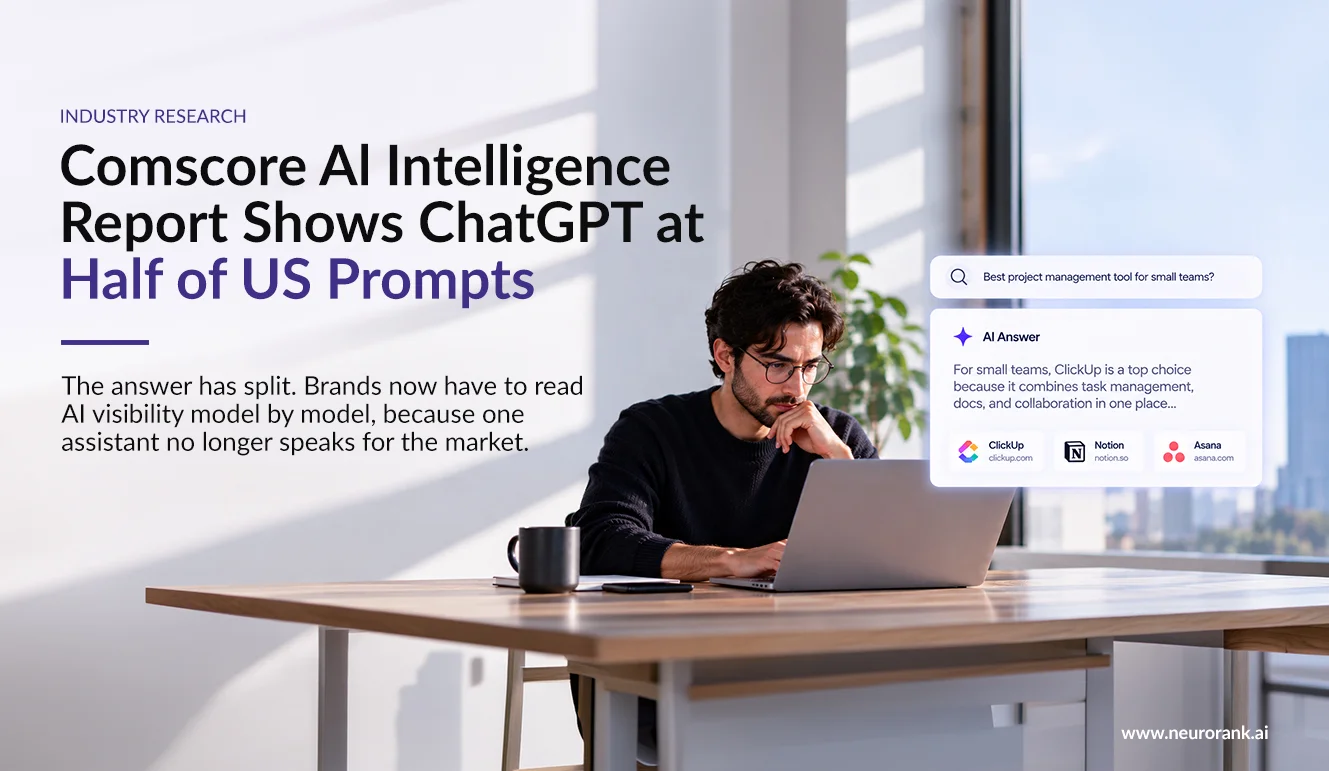
Comscore AI Intelligence Report Shows ChatGPT at Half of US Prompts

Ambika SharmaFounder at Pulp Strategy Communications and NeuroRank.
Founder at Pulp Strategy Communications and NeuroRank.
Subscribe for Newsletters
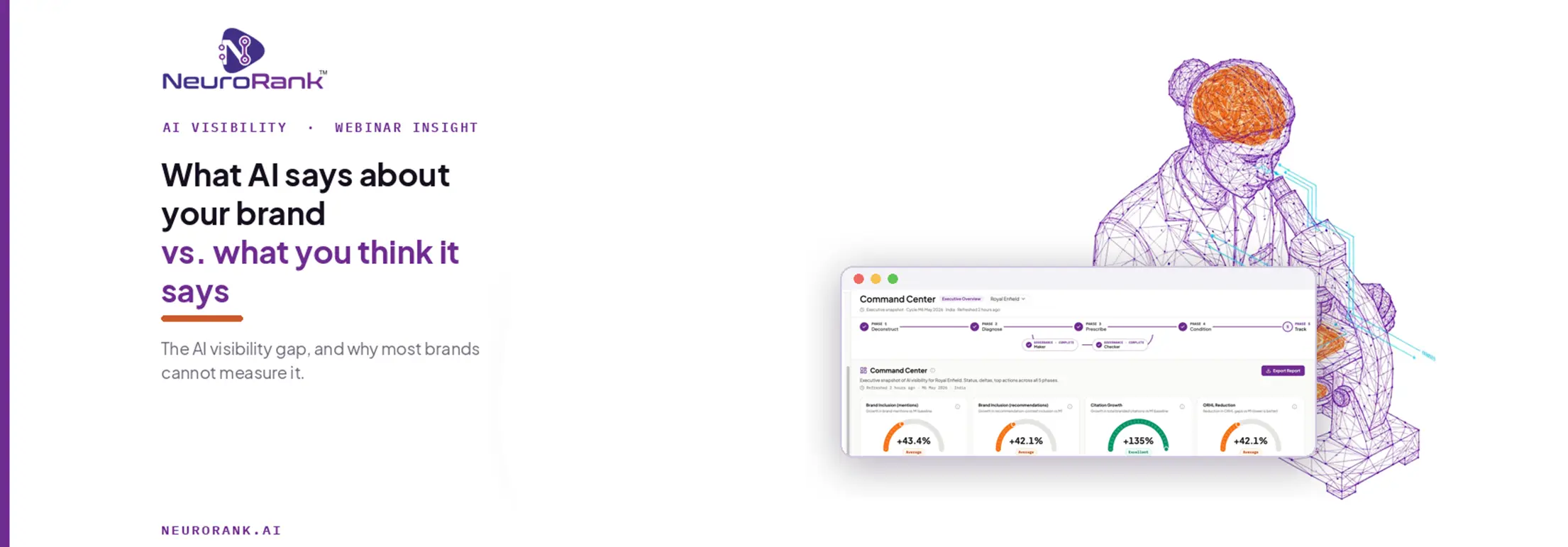
The AI visibility gap, and why most brands cannot measure.
Watch the latest on GEO optimisation, the questions CMO's are asking and a live demo of the best way to achieve GEO governance success.
The AI visibility gap is the distance between knowing AI now shapes buying decisions and being able to measure and act on that risk. NeuroRank®, a patent-pending AI visibility intelligence platform, was built to close it. In a recent live poll of marketing leaders, 54 percent could not estimate what AI steering buyers to a competitor costs them in a year. Awareness is no longer the blocker. Measurement is. The buyers have already moved, and the brands that cannot put a number on the risk are the ones that stall. This article explains what the AI visibility gap is, why it persists, and the exact sequence brands use to close it.
The AI visibility gap is the difference between recognizing that AI answers now drive buyer decisions and being able to quantify, price, and fix your exposure. Buyers have already shifted: 51 percent of B2B software buyers now begin research with an AI assistant rather than Google, according to G2's 2026 research. Yet most brands cannot say how much that shift costs them, so budgets stall while competitors compound their lead. NeuroRank closes the gap by measuring brand presence, accuracy, and recommendation across ChatGPT, Gemini, Claude, and Perplexity, classifying each failure under the patent-pending ORHL taxonomy, prescribing the fix, conditioning the models, and tracking the monthly lift. The consequence of waiting is measurable, because models learn from what they already say, so a brand that is invisible this quarter becomes harder to surface next quarter. The first move is a baseline, not a strategy document.
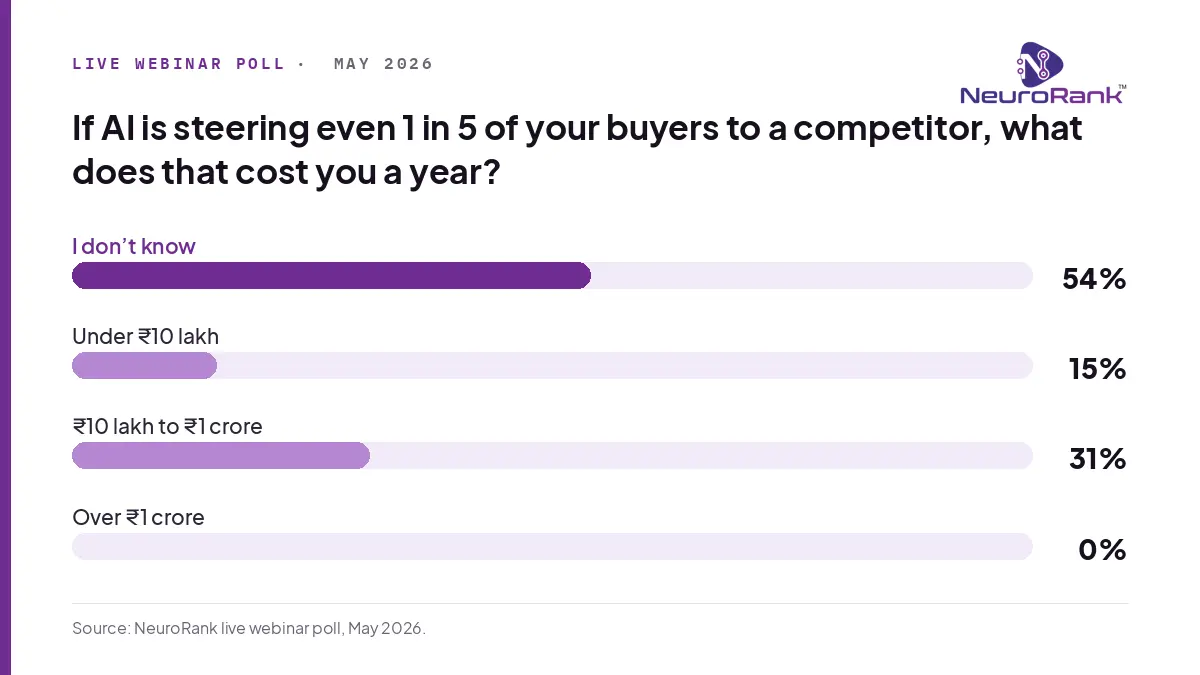
54 percent of polled marketing leaders cannot estimate the annual cost of AI steering buyers to a competitor.
51 percent of B2B software buyers now start research with an AI assistant, not Google (G2, 2026).
Only 17 percent of polled leaders are actively investing in AI visibility, while 57 percent are still exploring.
Only 1 in 6 sources cited in AI answers also ranks in the organic top ten.
NeuroRank groups every gap under ORHL: Omitted, Replaced, Hallucinated, Zero Leads.
Two BFSI engagements lifted AI visibility by more than 30 percent in the first 90 days.
Definition. The AI visibility gap is the gap between knowing AI now shapes buyer decisions and being able to measure, price, and improve how AI represents your brand. It is a measurement gap first, not an awareness gap, which is why most brands stall before they act.
AI search crossed from novelty to default in under two years. About 25 percent of search volume has already moved to AI answer engines, and Gartner forecasts that traditional search volume will fall 25 percent by 2026 as the shift continues. The four engines that dominate AI search, ChatGPT, Gemini, Claude, and Perplexity, now account for almost all of that activity.
The buyers moving first are the high-value ones. According to G2's 2026 research, based on a March 2026 survey of 1,076 B2B software buyers, 51 percent now begin research with an AI assistant more often than with Google, up from 29 percent a year earlier, and 71 percent rely on AI assistants during research. One in three bought from a vendor they had never heard of before AI surfaced it.
Coverage is widening fast. BrightEdge data reported via Search Engine Journal shows AI answer coverage grew 58 percent in the twelve months to February 2026. G2, Gartner, and BrightEdge agree the shift is structural, not seasonal.
The exposure is not spread evenly. The share of category searches that now return an AI answer before a single link varies sharply by industry:
Healthcare: 88 percent of searches return an AI answer.
Education: 83 percent.
B2B technology: 82 percent.
Restaurants: 78 percent.
Insurance: 63 percent.
Entertainment: 37 percent, a category that barely registered a year ago.
Against that backdrop, the market is aware but frozen. In a live poll during our recent webinar, only 17 percent of marketing leaders said they were actively investing in AI visibility. The majority, 57 percent, were exploring internally, while 13 percent were discussing it with no action and 13 percent were hearing about it for the first time.
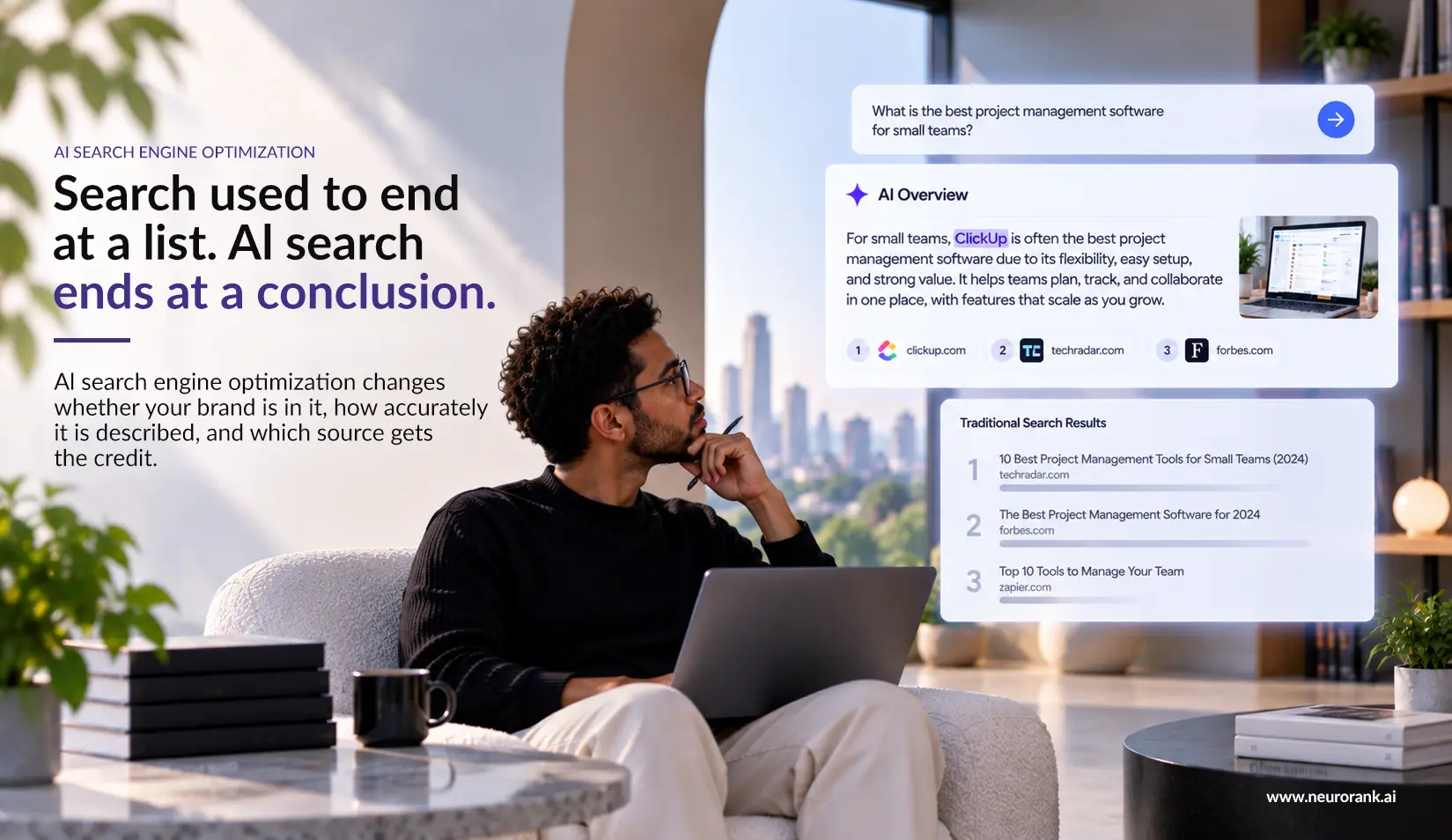
How is AI visibility different from SEO? SEO competes for a ranked link, while AI visibility competes to be named inside the answer itself, where only about 1 in 6 cited sources is a page-one result.
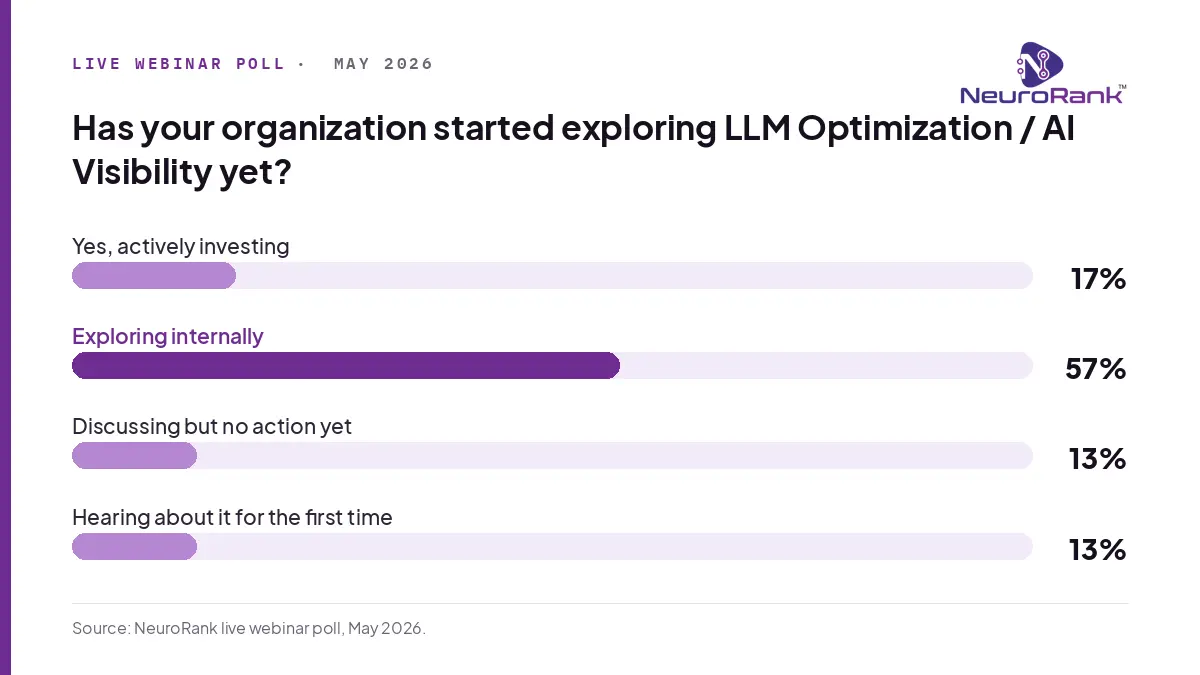
Key takeaway. AI visibility matters now because a quarter of search has already moved to AI answers, high-value B2B buyers migrated first, and coverage grew 58 percent in a year. Yet only 17 percent of brands are acting, which is why early movers can still win the answer cheaply.
The real blocker is that brands cannot price the risk. We asked leaders a deliberately concrete question: if AI is steering even 1 in 5 of your buyers to a competitor, what does that cost you in a year? More than half, 54 percent, answered "I do not know." Of those who answered, 31 percent put the figure between Rs 10 lakh and Rs 1 crore, 15 percent under Rs 10 lakh, and none above Rs 1 crore.
That "I do not know" majority is why the action line stays low. You cannot build a business case, secure budget, or set a target for a risk you cannot quantify. Exploration without a number stays exploration.
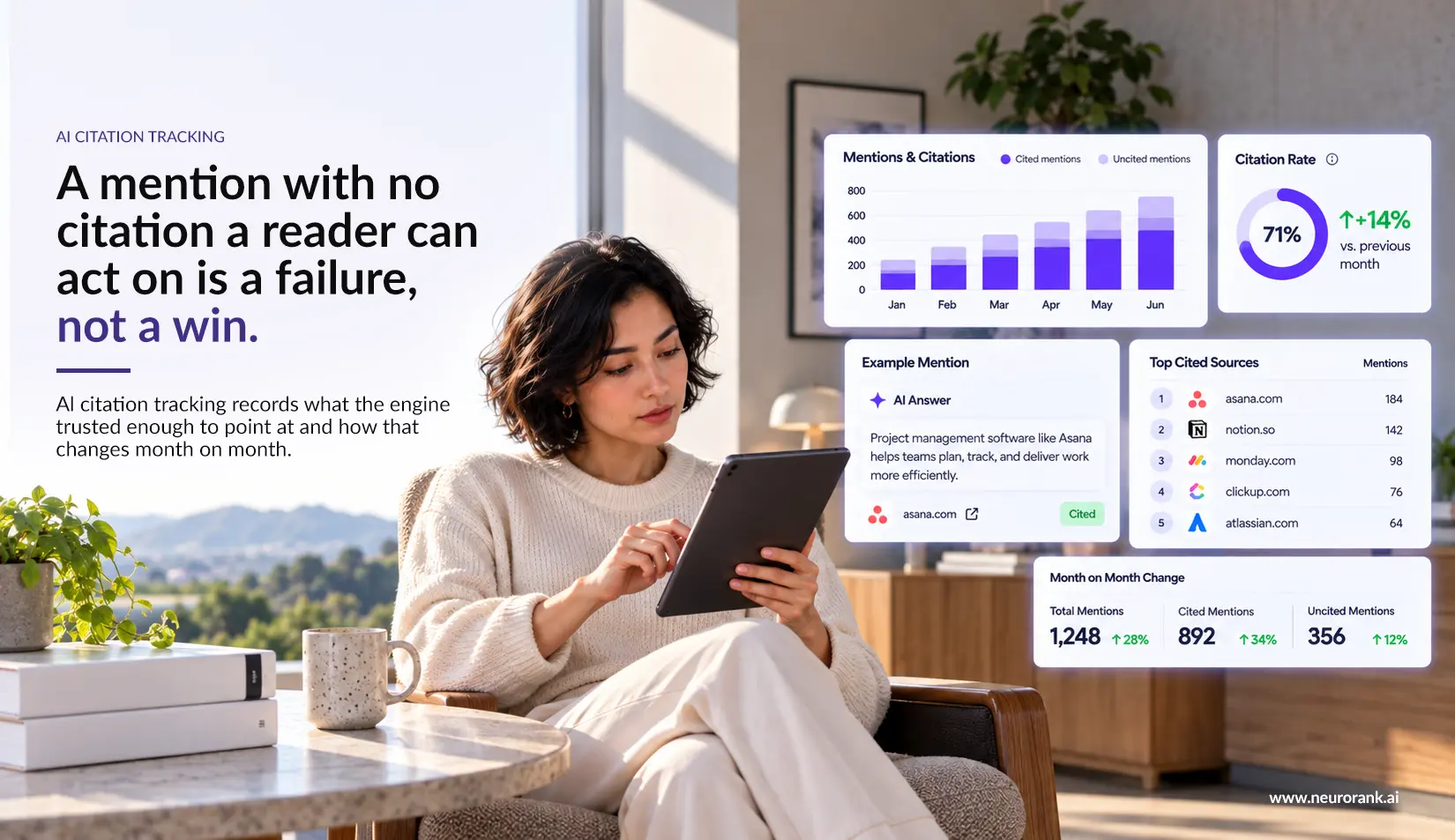
What is brand inclusion in AI? It is whether an AI engine names your brand in its answer to a category question, and it is the first metric to track, ahead of citations or rankings.
The risk itself is concrete. NeuroRank classifies every gap into four failure types under the patent-pending ORHL taxonomy, expanded on first use as Omitted, Replaced, Hallucinated, and Zero Leads:
Omitted: the model never surfaces your brand, so you are absent from the consideration set.
Replaced: a competitor takes your slot on a category question, even when the recommendation is wrong.
Hallucinated: AI states false facts about your brand with full confidence, and buyers believe it.
Zero Leads: your brand is mentioned but unreachable, with no link or citation that brings the buyer back.
Hallucination is not theoretical. During the webinar, an AI assistant recommended one vendor and warned against another, claiming the second used automated submissions. Both vendors clearly described manual submissions on their own sites. The model had invented a disqualifying fact about a real brand, and a buyer acting on that answer would never have known.
"AI does not rank anyone. The game is getting into the answer."
Ambika Sharma, Founder and Product Architect of NeuroRank
Key takeaway.The core problem is measurement. Most brands cannot price what AI invisibility costs them, so they stall. Every absence is one of four failures under ORHL, Omitted, Replaced, Hallucinated, or Zero Leads, and each carries a different cost that only a cross-model audit can quantify.
Measure it from three inputs: the share of your category's buying journeys that now begin in AI, the share of AI answers in which your brand is absent or replaced, and the value of a won customer. Multiply them for an annual exposure figure.
How to put a number on it. Estimate the share of category journeys that start in AI, run a cross-model audit to find your true absence rate, then multiply both by the value of a won customer. The result is a defensible annual exposure figure, and the business case leadership has been waiting for.
The first input is large and rising. The third you already know. The hard input is the middle one, your real absence rate, which teams almost always underestimate. A cross-model audit measures it directly rather than by assumption.
In one live audit, the largest brand in its category, holding more than half the market by share, was absent from 52 percent of the category's AI answers, with the weakest presence on Claude and Perplexity. A market leader can still be missing from half the conversations that build the shortlist.
Does AI rely on my website or on outside sources? Both. The model runs a live search and also draws on what it already remembers, which is why conditioning the model's memory matters as much as fixing your own pages.
Key takeaway. To measure the cost of AI invisibility, multiply the share of buying journeys that start in AI by your audited absence or replacement rate and the value of a won customer. The audited absence rate is the input most teams get wrong, and it is the one a cross-model baseline fixes.
It varies by category, region, and query, so the safe answer is to measure all four major engines together rather than betting on one. Perceived influence is not the same as where your risk sits.
In a live poll, leaders ranked ChatGPT highest at 41 percent, then Google Gemini at 29 percent, Claude at 24 percent, and Perplexity at 5 percent. Yet in the audit above, the brand's worst absences were on Claude and Perplexity, the two platforms the audience rated least influential. A team optimizing only for ChatGPT would have declared victory while staying invisible elsewhere.
Two technical realities compound this. The engines draw on different sources and refresh their memory at different speeds, and in NeuroRank engagements Claude is typically the slowest to update, often nine to twelve months, which makes an absence there the stickiest.
Is ranking first on Google enough to appear in AI answers? No. Only about 1 in 6 sources cited in AI answers also ranks in the organic top ten, so a number-one position does not guarantee a place in the paragraph the buyer reads.
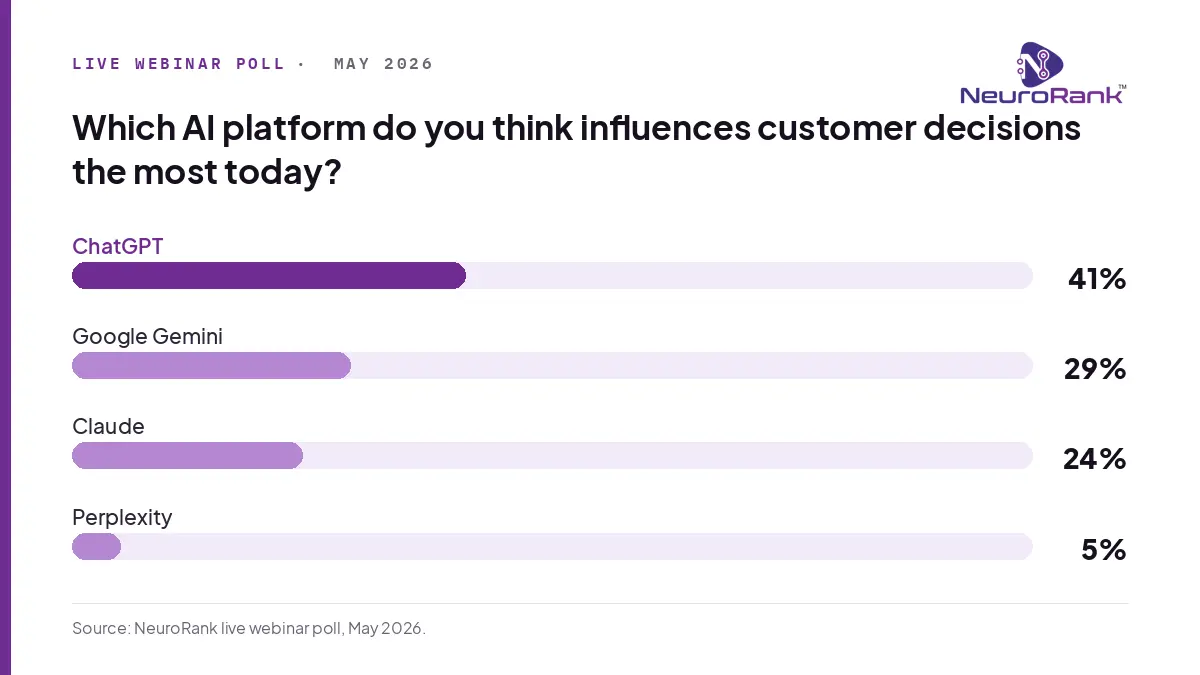
Key takeaway. No single AI platform should be optimized in isolation. ChatGPT is rated most influential, but brands are frequently weakest on Claude and Perplexity, and Claude refreshes slowest. Measuring ChatGPT, Gemini, Claude, and Perplexity together is the only way to see where your real exposure sits.
Start with a baseline, not a strategy document. Most teams stall because they cannot quantify the risk, not because they lack interest, and a baseline converts an open-ended debate into a specific number and a prioritized list of fixes.
The poll makes the stall visible: 57 percent exploring, only 17 percent investing. The fastest way out of exploration is a measurement that the team and the budget holder can both see. From there, NeuroRank runs one five-step method every cycle, in a fixed order:
Deconstruct the model's representation of your brand, granularly, against competitors.
Diagnose the gaps across ChatGPT, Gemini, Claude, and Perplexity, by region.
Prescribe the specific content and technical fixes, with the source URLs the models cite.
Condition the models through the Model Conditioning Loop so the corrected signals enter memory.
Track the month-on-month lift as the models recalibrate.
A NeuroRank Live Forensic Audit runs in 12 to 20 minutes across all four engines for USD 7.00 and returns a 10-section, presentation-ready baseline. It does not fix everything, and it is not meant to. It replaces "I do not know" with a starting line.
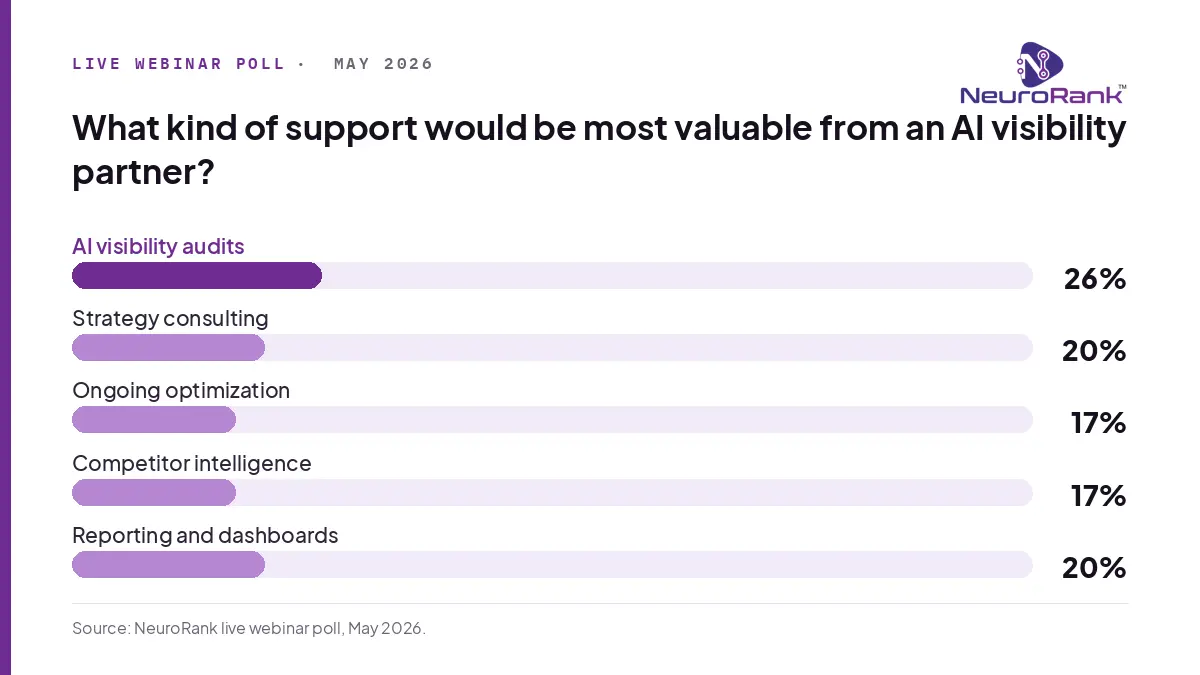
Key takeaway. Brands want diagnosis and direction over another monitoring number. In polling, audits and strategy outranked reporting, and audience questions centered on execution and revenue attribution. The need is to know what is wrong, what to fix first, and how to tie the result to pipeline.
The cost of inaction
Doing nothing is not a neutral choice, because absence compounds. Models learn from what they already say, so a brand that is invisible this quarter becomes harder to surface next quarter, while a competitor that shows up early gets reinforced in the model's memory.
The exposure is already quantifiable. With 51 percent of B2B buyers starting in AI and one in three buying from a vendor they discovered there, every category answer you are missing from is a shortlist you never entered. On a slow-refreshing model such as Claude, where updates can take nine to twelve months, a late start carries the longest tail.
AI visibility is also the fastest-growing discipline in marketing, and the distance between early movers and the rest is widening each quarter. Early invisibility hardens into entrenched invisibility, because a model that has learned to leave you out will keep leaving you out until the underlying signals change. The longer the wait, the more correction it takes.
The pattern mirrors every prior platform shift. Brands that learned search early won search, and the same window is open now. It will not stay open, because the answer layer hardens around whoever is cited first.
Key takeaway. The cost of inaction grows over time. Absence compounds as models reinforce what they already say, slow-refreshing engines extend the recovery window, and competitors that appear first get entrenched. Every quarter of "I do not know" raises both the exposure and the cost of catching up.
Unlike monitoring platforms that stop at a visibility score, NeuroRank diagnoses each gap with ORHL, traces the sources the models cite, prescribes the exact fix, conditions the models, and tracks the monthly lift.
| Approach | Diagnoses gaps (ORHL) | Traces cited sources | Prescribes fixes | Conditions models | Tracks monthly lift | Maker-Checker governance |
|---|---|---|---|---|---|---|
| Typical monitoring platform | No | Partial | No | No | Score only | No |
| NeuroRank | Yes | Yes | Yes | Yes | Yes | Yes |
Source: NeuroRank analysis, May 2026.
The method is tested, not theoretical. Across two BFSI engagements, sustained conditioning lifted AI visibility by more than 30 percent in the first 90 days and citation frequency by more than 12 percent in the first 30 days, across all four engines. Hallucinations, the most damaging gap, tend to correct fastest, which makes them the earliest win.
The webinar demonstrated the audit on two named brands, Royal Enfield for the UK market and Mahindra Susten for India. The Mahindra Susten audit showed strong information sourced from third parties such as PV Magazine India, the Economic Times, and Mercom India rather than from the brand's own properties, a classic Zero Leads pattern where the brand is visible but not the source.
Every result is produced with fresh-token methodology, a new authentication token on each run, with more than 5,500 runs per prompt cluster, per region, so the data reflects what a first-time user sees rather than a logged-in, personalized view.
NeuroRank's method has been stress-tested across 150 plus brands in 65 industries and validated through individual feedback from over 150 leadership teams across Asia, Europe, the Middle East, the USA, and North America. Benchmarking and platform data are verified against independent sources including G2 and SourceForge, as of March 2026. NeuroRank was featured on Product Hunt in May 2026.
Key takeaway. These results are measured, not claimed. Two BFSI engagements delivered more than 30 percent visibility lift in 90 days and more than 12 percent citation growth in 30 days across four engines, and the method is stress-tested across 150 plus brands, 65 industries, and 150 plus leadership teams.
India is among the fastest-adopting AI-search markets, which sharpens the urgency for brands here. Smartphone penetration is near universal, voice search is common, and AI engines now return spoken answers, so the shift reaches buyers earlier than in many markets. India is also one of the two markets, alongside the United States, where NeuroRank ran its stress test.
The same four engines, ChatGPT, Gemini, Claude, and Perplexity, dominate AI search in India, accounting for almost all of it. Homegrown Indian models are emerging but are not yet positioned for this use case at scale. For source coverage, the platforms that carry weight for AI crawling are the brand website, YouTube, LinkedIn, Reddit, and Quora, with SlideShare and GitHub adding weight for technical and software brands. Meta properties such as Instagram and Facebook are not read by the models for memory or recommendation.
Trust signals also vary by industry and region, so a software brand leans on sources such as G2 and SourceForge, while other categories rely on different authorities that NeuroRank surfaces per market. Pricing decisions follow the same logic, with separate visibility tracking per brand and per region.
Key takeaway. In India, AI-search adoption is fast and reaches premium buyers early, and the same four engines dominate. Brands should prioritize their website, YouTube, LinkedIn, Reddit, and Quora for AI source coverage, because Meta properties are not read by the models for recommendation.
If your organization is in the 57 percent still exploring, the fastest way out is a number. Run a NeuroRank Live Forensic Audit, which delivers a 10-section baseline in 12 to 20 minutes across ChatGPT, Gemini, Claude, and Perplexity for USD 7.00. Use it to replace "I do not know" with a measured starting line you can take to your leadership team, then decide what to fix first.
Stop paying for clicks that do not convert. Benchmark your AI visibility today with the world's most advanced seo ai tools.
Book a Strategic NeuroRank Briefing