BlogSeptember 16, 2026
AI search engine optimization

Ambika SharmaFounder at Pulp Strategy Communications and NeuroRank.
Ambika Sharma
Ambika Sharma is the Founder & Chief Strategist of Pulp Strategy, a multi-award-winning business transformation and digital agency, and Prod... Read more
Subscribe for Newsletters
By Ambika Sharma, Founder, Chief Strategist at Pulp Strategy Communications and Product Architect of NeuroRank®.
Google’s I/O 2026 announcements made AI Mode the default search experience. The brands already stranded don’t know it yet.
The verdict
Google’s I/O 2026 made AI Mode the default search experience. The click contract that funded twenty years of SEO is broken. GEO strategy is what replaces it.
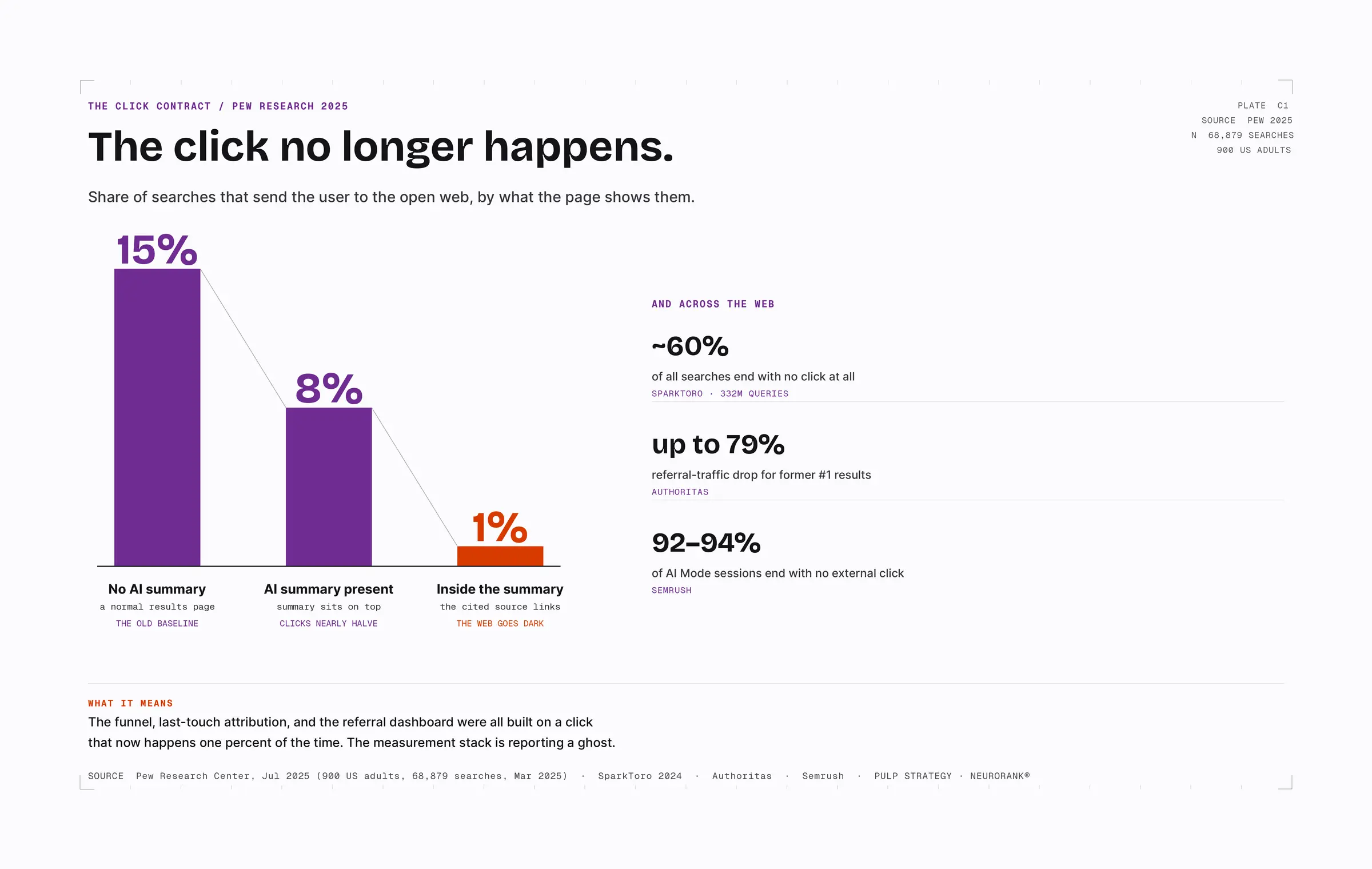
Pew Research reports that only one percent of users click the source links inside an AI summary. NeuroRank’s own audits, captured fresh-token across ChatGPT, Gemini, Claude, and Perplexity, show that more than two-thirds of audited brands fail to appear at all for one or more core commercial prompts in their own category. The buyers have moved into the answer. The brand the model picks executes the transaction. Most CMOs have never read the sentence the machine writes about their company.
That is not a marketing problem. That is a valuation problem.
Scope of this article This article covers the strategic implications of Google’s I/O 2026 AI Mode rollout for brand visibility, the failure of the click contract that funded twenty years of SEO, and the rise of GEO strategy as the discipline that replaces it. It does not cover paid-media bidding mechanics, technical schema implementation detail, industry-specific regulatory frameworks, or the day-to-day operational mechanics of the NeuroRank platform. Those are addressed in companion articles in the Related Reading block. |
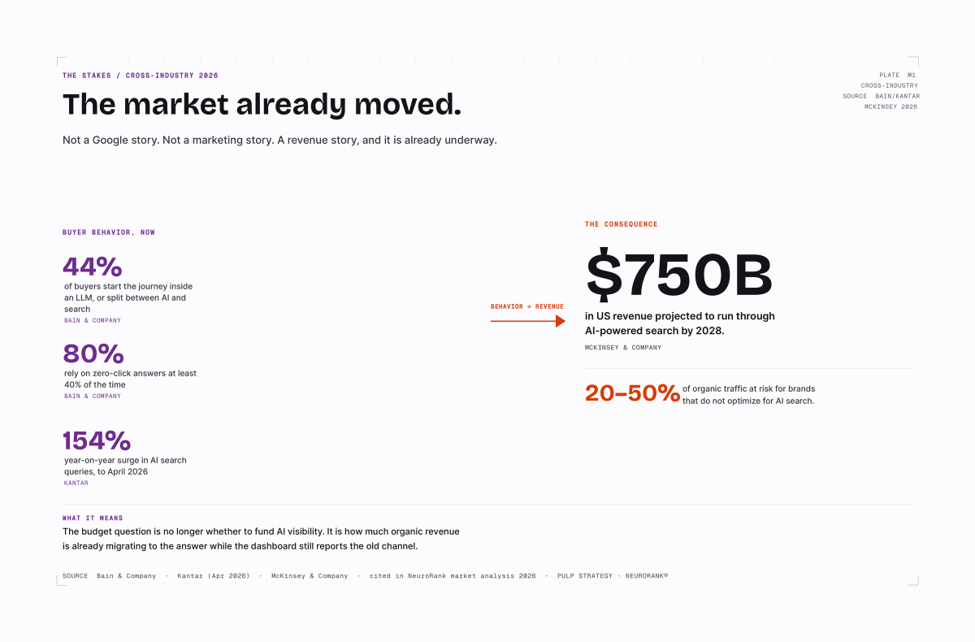
GEO strategy, or generative engine optimization, is the discipline of governing how large language models perceive, interpret, and recommend a brand inside AI-generated answers. After Google’s I/O 2026 announcements, in which AI Mode crossed one billion monthly users, queries doubled every quarter, and the Search box was rebuilt to absorb conversational, multimodal, and agentic input, GEO is no longer optional. NeuroRank® audits across 350-plus cross-industry brands found 68 percent absent from AI-generated shortlists, 52 percent encountering hallucinations, and 88 percent affected by cross-lingual confusion. With one percent of users clicking through from AI summaries (Pew Research), AI traffic to US retail sites up 4,700 percent year-on-year (Adobe), and 80 percent of consumers now relying on zero-click AI results at least 40 percent of the time (Bain and Company), brands that fail to govern model preference are invisible inside the surface that now drives the transaction. The consequence is valuation, not visibility, and the window to act narrows every quarter as the models train further into the brands they already trust.
Google’s AI Mode crossed one billion monthly users twelve months after launch, with queries doubling every quarter.
Pew Research reports a one percent click-through rate to source links inside AI summaries on Google.
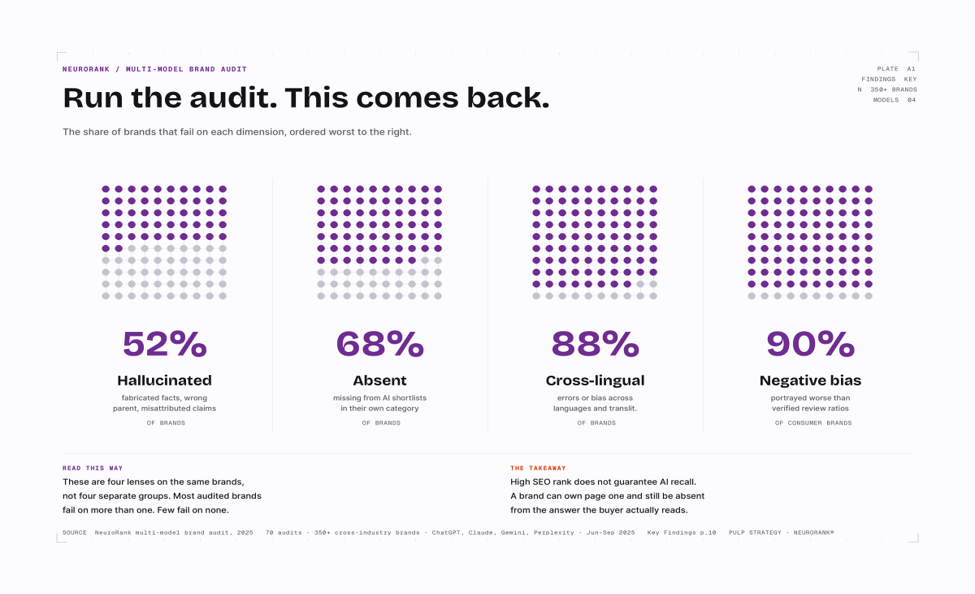
Sixty-eight percent of audited brands are absent from AI-generated shortlists for their own category (NeuroRank).
Adobe reports AI-driven traffic to US retail sites grew 4,700 percent year-on-year, with 84 percent higher revenue per visit.
Information agents, agentic booking, and generative UI now intercept the transaction before the buyer reaches a brand site.
Cross-lingual confusion affects 88 percent of audited brands, with the cost concentrated in multi-region operations.
Generative engine optimization, also referred to as generative AI optimization, is the discipline of diagnosing, prescribing, and conditioning how large language models perceive, interpret, and recommend a brand inside AI-generated answers across engines like ChatGPT, Gemini, Claude, and Perplexity. It governs the model’s description of the brand, not the brand’s ranking on a results page.
On May 19, 2026, Liz Reid, Vice President of Search at Google, announced what she called the biggest upgrade to Google Search in twenty-five years. Five moves shipped at once, any one of which would have been a category event.
Gemini 3.5 Flash became the new default model inside AI Mode, globally, with no subscription gate. AI Mode crossed one billion monthly users twelve months after launch and queries are doubling every quarter. The queries themselves are running two to three times longer than legacy keyword searches because users are speaking to Search, not querying it.
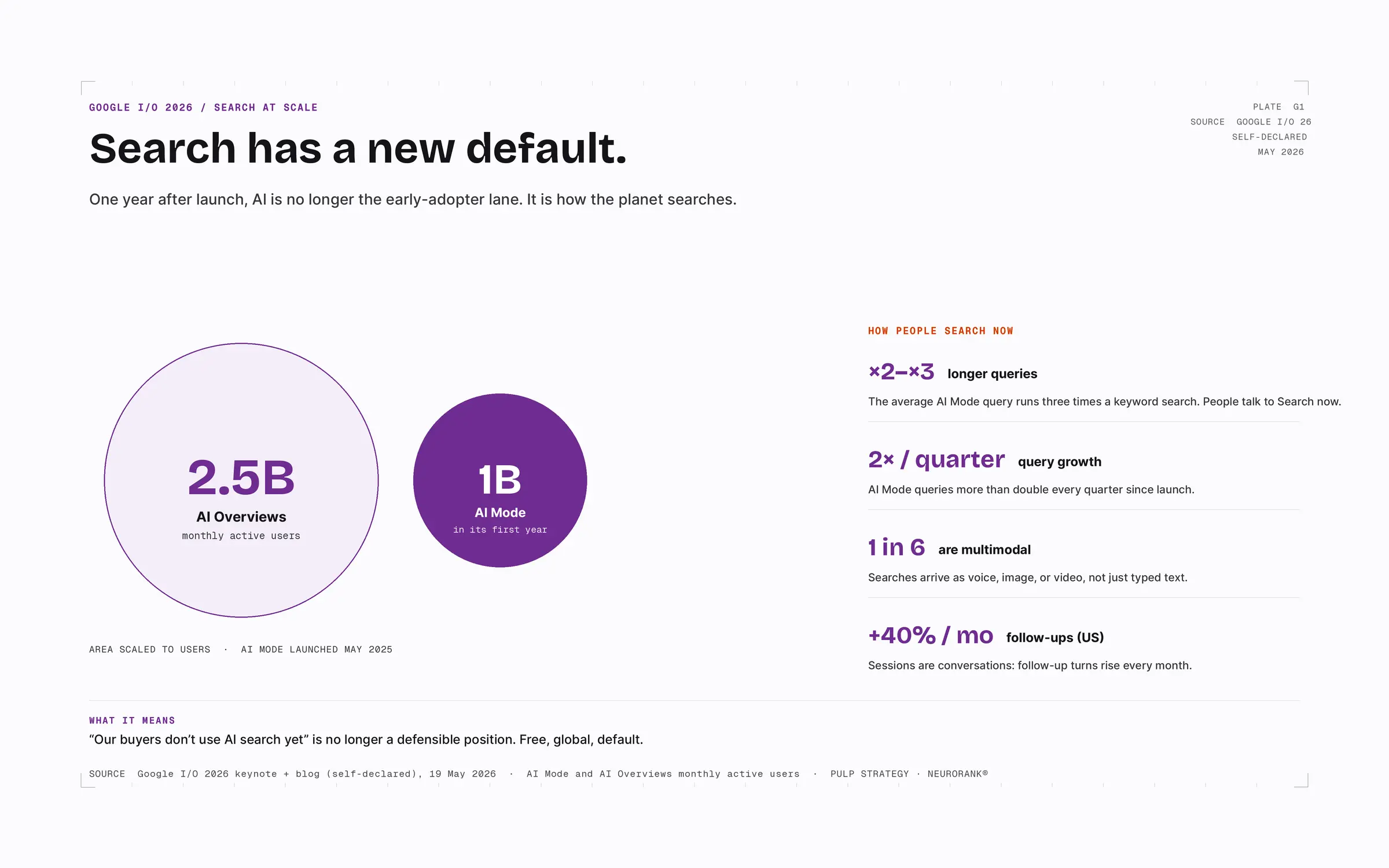
The Search box was rebuilt to ingest text, images, files, videos, and Chrome tabs. Information agents now run 24/7 on the buyer’s behalf, monitoring the web and Google’s real-time finance, shopping, and sports data, pushing synthesized updates with one-click action. Agentic booking and calling went live in the US for home repair, beauty, and pet care, with Google phoning businesses on the buyer’s behalf. Through Google Antigravity, Search now generates its own user interface on the fly, assembling custom dashboards, simulations, and mini-apps from whichever brands and sources the model trusts most. Personal Intelligence connects Gmail, Google Photos, and soon Calendar, personalizing the answer to each individual buyer across nearly 200 countries and 98 languages.
The external research lines up. Adobe reports AI-driven traffic to US retail sites is up 4,700 percent year-on-year, with those visitors spending ten percent longer on-site, viewing 32 percent more pages, and producing 84 percent higher revenue per visit. SparkToro’s analysis of 332 million US and EU searches finds an estimated 60 percent zero-click rate. Pew Research observes that only eight percent of users click result links when an AI summary appears, compared with 15 percent when none does, and only one percent click the source links inside the summary itself.
The trend is widening, not stabilizing. Zero click searches are no longer a fringe pattern. Bain and Company finds 80 percent of consumers now rely on zero-click AI results at least 40 percent of the time. Kantar reports AI adoption queries surged 154 percent year-over-year by April 2026, with 74 percent of AI assistant users regularly seeking AI-driven brand recommendations. McKinsey and Company projects USD 750 billion in US revenue will funnel through AI-powered search by 2028 and estimates 20 to 50 percent organic traffic risk for brands that fail to optimize for AI search. The pace of behavior change has now overtaken the pace of marketing planning calendars. AI search optimization, the broader umbrella discipline that GEO strategy operationalizes, is therefore no longer a quarterly initiative. It is a continuous governance function.
| Atomic answer Google’s I/O 2026 rollout made AI Mode the default surface for one billion users, with longer, agentic, multimodal queries that close inside the answer. External data from Pew, SparkToro, and Adobe confirms the shift to a zero-click economy where AI inclusion governs revenue. |
For two decades, Google sent buyers to brand websites in exchange for content, schema, and authority signals. That contract is broken. The buyer now finishes the journey inside the answer. The brand the model picks executes the transaction. The brand the model omits never enters the conversation.
NeuroRank audits classify the failure modes through the ORHL taxonomy. Omitted: the brand does not appear at all. Replaced: a competitor appears in place of the brand. Hallucinated: AI returns wrong or outdated information about the brand. Zero Leads: the brand is mentioned in passing, with no decision-stage context. Across 70 full-spectrum audits covering 350-plus cross-industry brands, hallucination references appeared more than 200 times, structured-data absences appeared more than 600 times, and negative sentiment bias appeared more than 500 times. Sixty-eight percent of brands were absent from AI-generated shortlists in their own categories. Eighty-eight percent showed cross-lingual errors or biases.
The measurement stack assumes a click that no longer happens. Referrer headers go blank. Last-touch attribution returns zero. CRM source fields read “direct.” The dashboards keep producing numbers, the numbers keep getting smaller, and the room keeps debating channel mix as if the channel still exists. Meanwhile, AI is repeating a sentence about each brand to thousands of buyers per hour, in 98 languages, in nearly 200 countries. That sentence is the marketing surface that now matters. Most CMOs have not read it.
| Atomic answer The problem is not declining traffic. The problem is the brand description has been transferred from the brand to the model, and the measurement stack cannot see it. ORHL classifies four failure modes: omitted, replaced, hallucinated, and zero-leads. Across 350-plus brands NeuroRank has audited, 68 percent are absent from their own category answers. |
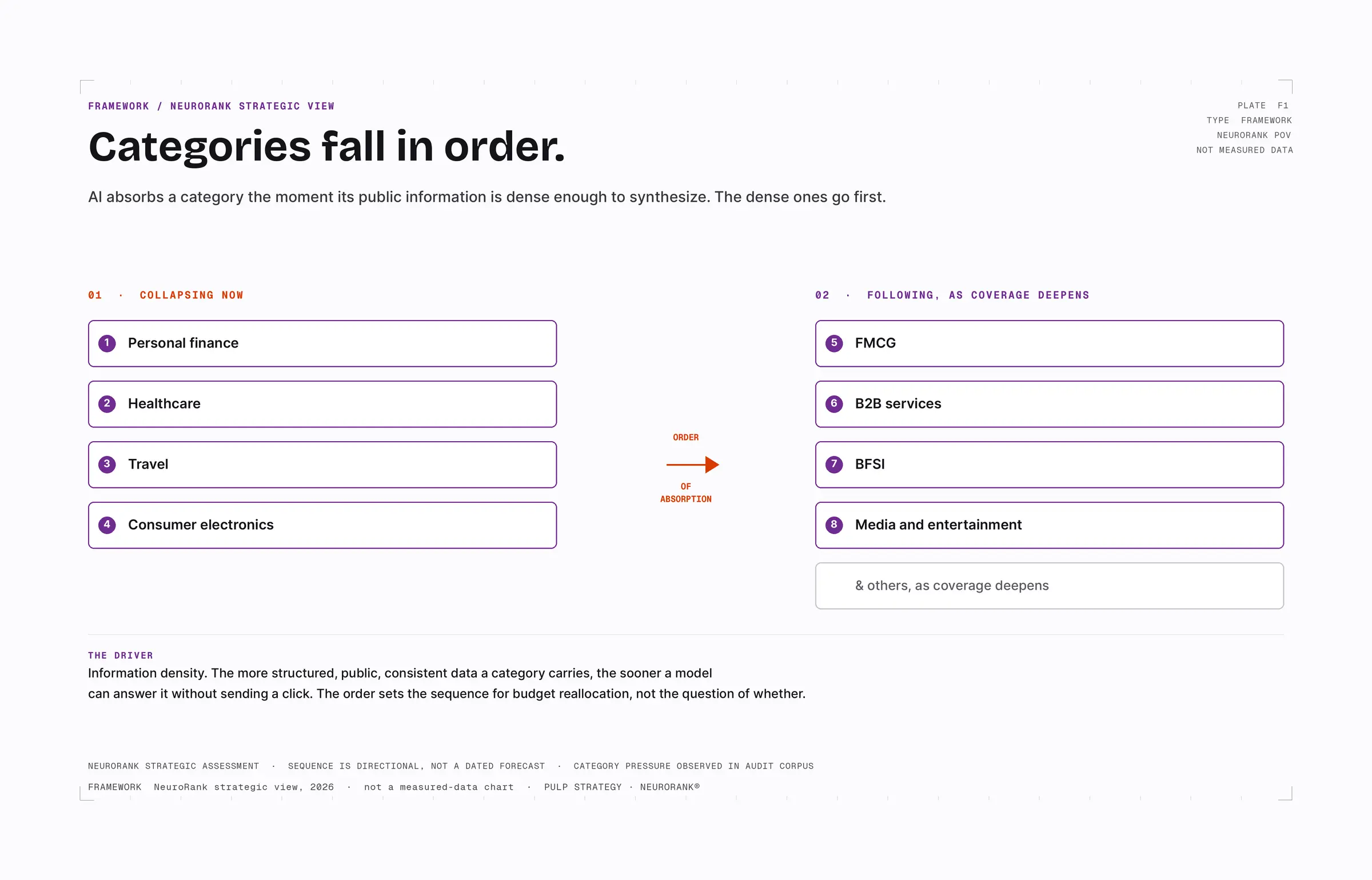
The fifteen shifts inside I/O 2026 group into four motions. Each one moves a different lever in the marketing stack. Walk through them in order. The lever each one breaks is the lever the next discipline replaces.
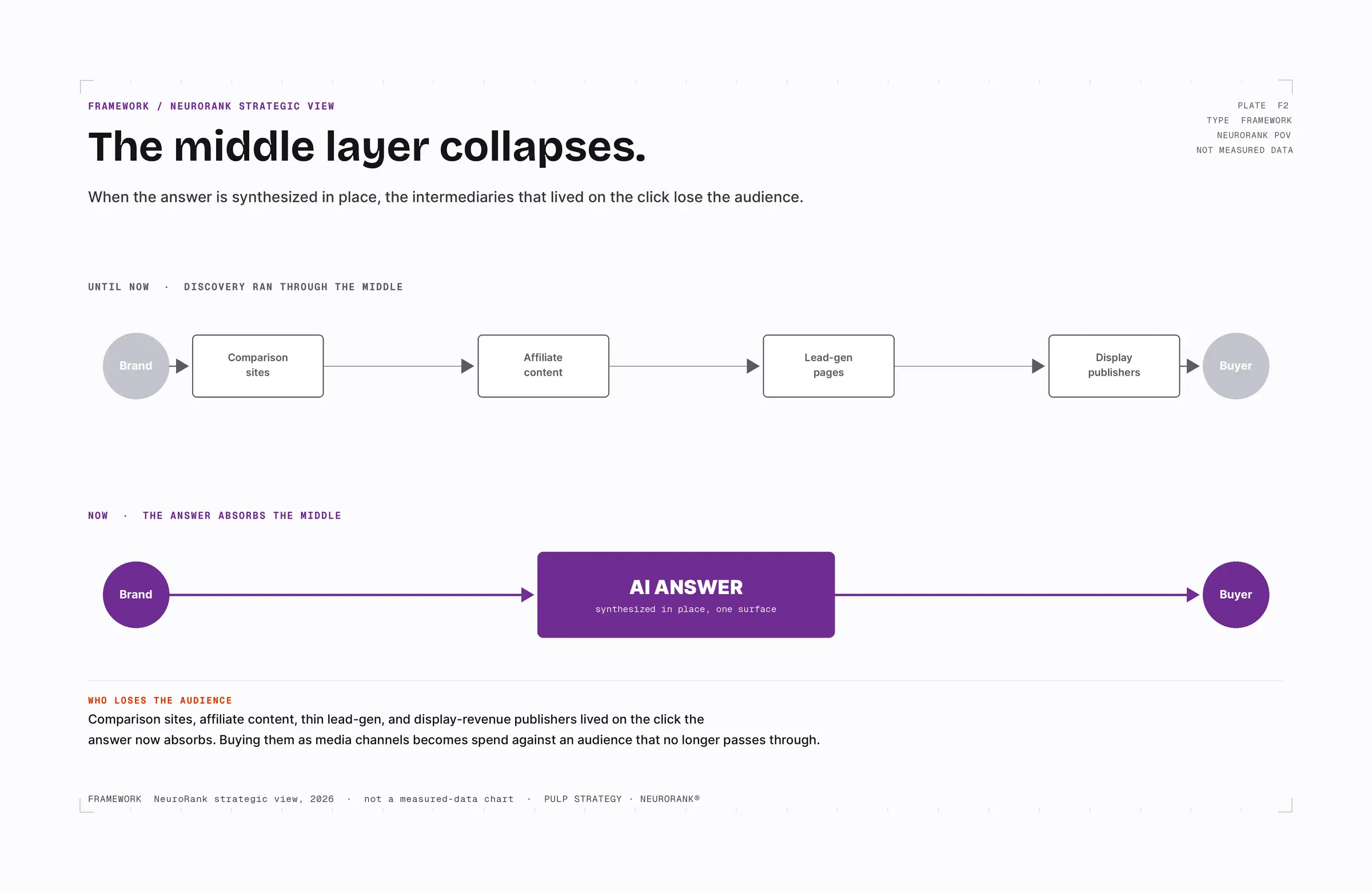
By moving the answer inside the search box itself and removing the buyer’s reason to click anywhere else. Five product moves did the work.
The new Search box absorbs full conversational questions and accepts text, images, files, videos, and Chrome tabs as a single input. Information agents work 24/7 in the background. Agentic booking and calling complete the transaction without a brand handoff. Generative UI assembles the answer surface on the fly. Personal Intelligence personalizes the answer per buyer across 200 countries and 98 languages.
AI Mode now serves one billion monthly users, with queries doubling every quarter and running two to three times longer than legacy keyword searches. Adobe reports AI-driven traffic to US retail is up 4,700 percent year-on-year, but Pew’s one-percent click-through inside summaries means that traffic concentrates in brands the model already trusts. The asymmetry is the story.
| People also ask Is SEO dead because of AI Mode? No. SEO is now a feed for the model, not a destination for the buyer. The website still matters, but it is now read by crawlers training the model, not by humans completing a journey. Generative engine optimization governs what the model says after it reads the site. |
| Atomic answer Google’s AI Mode rollout broke the click contract by collapsing five functions (search, agent, booking, calling, UI assembly) into a single surface that one billion users now treat as default. Click-through to source links inside the summary is one percent. The transaction closes inside the answer. |
SEO optimizes for ranking on a page so the user clicks. GEO strategy optimizes for inclusion, accurate description, and recommendation inside the AI-generated answer itself. SEO was a flow of traffic. GEO is a stock of model authority that compounds inside model weights and the retrieval layer over time.
SEO’s measurement is sessions, bounce, conversion. GEO’s measurement is prompt inclusion, citation health, and recommendation rate inside ChatGPT, Gemini, Claude, and Perplexity. SEO’s asset is the page. GEO’s asset is the schema, the named entities, the structured data, and the third-party authority signals the model can read when it assembles the answer.
Generative UI removes the landing page from the equation. Through Antigravity, Google’s Search now builds the answer surface itself. Years of CRO investment lose their force, because there is no longer a single page the buyer is being routed to. The brand the model trusts to feed the surface is the brand that wins the surface.
| People also ask Can a brand do SEO and GEO at the same time? Yes, and most enterprise programs will run both for the next 24 months. SEO continues to feed the open web. GEO governs what the model says about the brand once it ingests that web. Treat SEO as the input layer and GEO as the output layer. |
| Atomic answer Generative engine optimization replaces search engine optimization at the layer where the buyer now completes the journey. SEO ranks the page; GEO governs the answer. SEO measures clicks; GEO measures inclusion, citation, and recommendation. SEO is a flow; GEO is a stock of model authority that compounds inside the weights. |
Through a five-step methodology that runs as a continuous loop, not a periodic audit. NeuroRank® structures the discipline as Deconstruct, Diagnose, Prescribe, Condition, Track.
Deconstruct dismantles the LLM’s internal representation of the brand. Diagnose classifies visibility gaps across ChatGPT, Claude, Gemini, and Perplexity using the ORHL taxonomy. Prescribe issues the specific content, CMS, and other actions required to fix them. Condition runs the Model Conditioning Loop across owned, earned, and third-party surfaces so the model trains on the corrected story. Track measures month-on-month lift as the models recalibrate.
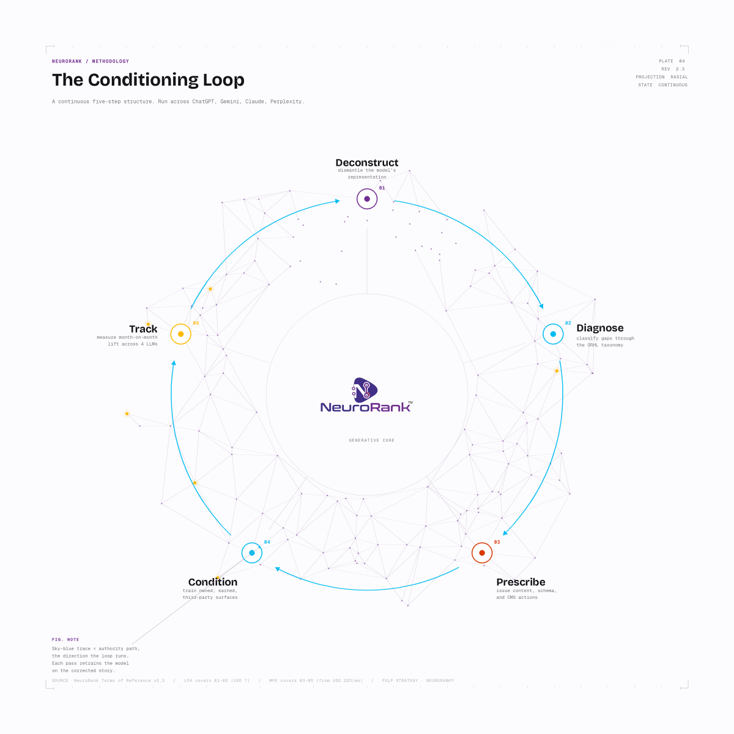
The Live Forensic Audit runs Deconstruct and Diagnose in twelve to twenty minutes across ChatGPT, Gemini, Claude, and Perplexity plus the Combined synthesis view, for USD 7. The audit was priced below the smallest measurable downstream consequence of getting the answer wrong: one missed referral, one mispriced product mention, one quote handed to a competitor by a model that does not yet know the brand.
| Atomic answer Brands govern AI description through a five-step continuous loop. Deconstruct, Diagnose, Prescribe, Condition, Track. The loop runs across ChatGPT, Gemini, Claude, and Perplexity. The Live Forensic Audit covers the first two steps in twelve to twenty minutes for USD 7. Model Preference Engineering subscriptions condition and track from USD 225 per month. |
Five steps. Each one is small enough to assign and large enough to matter. Execute them in order.
| Process snippet next 90 days Step 1: Run a Live Forensic Audit across ChatGPT, Gemini, Claude, and Perplexity to read the current AI description of the brand. Step 2: Classify gaps using the ORHL taxonomy. Step 3: Issue the content and schema prescriptions. Step 4: Activate Model Preference Engineering. Step 5: Track month-on-month lift. |
Days 1 to 15: read the sentence. Run a Live Forensic Audit and circulate the verdict to CEO, CFO, CMO, and Head of Investor Relations. The audit becomes the room’s shared baseline.
Days 16 to 45: fix the schema layer. Implement the schema, entity, and structured data prescriptions the audit returns. Most brands close 30 to 40 percent of their hallucination surface in this window alone.
Days 46 to 75: condition the model. Activate Model Preference Engineering to run the Model Conditioning Loop across owned, earned, and third-party surfaces. The loop is continuous because the models retrain continuously.
Days 76 to 90: install the dashboard. Set up monthly tracking on prompt inclusion, citation health, and recommendation rate. For GEO enterprise programs running across multiple brands or regions, instrument the dashboard at brand-line and region level so the CFO can see exposure by cluster. Report up the same way you report investor metrics, because the consequence is the same.
The model can describe your brand wrong, hand your strength to a competitor, or omit you entirely. Most brands have never read the sentence the machine writes about them. There is no support ticket to file. Ambika Sharma, Founder, Chief Strategist at Pulp Strategy Communications and Product Architect of NeuroRank® |
| People also ask How long until generative engine optimization shows results? NeuroRank audits show a typical 30 to 40 percent reduction in hallucination surface within 30 days of the schema and entity prescriptions being implemented. Inclusion and recommendation rates compound over a 90 to 180 day window as the Model Conditioning Loop runs. |
| Atomic answer A CMO can execute generative engine optimization in 90 days by sequencing five steps: read the AI description through a Live Forensic Audit, classify gaps with ORHL, fix the schema and entity layer, activate Model Preference Engineering, and install monthly tracking on inclusion, citation, and recommendation rate |
Pick the brand’s category. Open ChatGPT. Open Gemini. Open Claude. Open Perplexity. Ask each one to recommend the best brand in the category, without naming the company. Read the sentences they return. Note whether the company is in any of them, which competitor is mentioned, and what the model specifically says.
That is the sentence the buyer is hearing. Right now. In 98 languages. Across nearly 200 countries and territories. From an agent that may not click to the brand site. To a buyer whose next step may be a booking the model itself completes. Inside a generative UI surface the model has just assembled. With Personal Intelligence priming the answer with what the model already knows about the buyer’s preferences from their own Gmail and Photos.
You are not falling behind in rank. You are absent from the answer about your own market.
| Value snippet what GEO protects Generative engine optimization protects brand equity, pipeline conversion, and investor narrative by ensuring the brand is included, accurately described, and preferentially recommended inside the AI answers where one billion buyers now complete their journey. It runs as a continuous Model Conditioning Loop, not a periodic audit. |
Every quarter that passes, the model trains further into the brands it already trusts. Authority compounds. Omission compounds. Hallucination compounds. PwC observes that 74 percent of AI’s total economic value is already captured by just 20 percent of AI-leader organizations, an asymmetry that hardens with each model retraining cycle. The asymmetry between brands that are actively conditioning the model and brands that are not is no longer a marketing gap. It is a valuation gap that shows up six quarters later in pipeline, conversion, and unit economics, and the CFO will not connect the line back to a missed I/O 2026 reading. The Social Samosa expert panel of 3 June 2026 captures the consensus across India’s leading marketing voices: the click contract is breaking, the website becomes a source of truth for crawlers, and the brand the model picks executes the transaction.
Comparative statement Unlike traditional SEO, which optimizes for page rank in a results list the buyer is invited to click, generative engine optimization governs the sentence the model writes about the brand inside an AI answer the buyer never leaves. Comparison: traditional search engine optimization and generative engine optimization across five dimensions. |
Dimension | Search engine optimization (SEO) | Generative engine optimization (GEO) | Primary metric | Owner |
What it optimizes | Ranking on a search engine results page | Inclusion and description inside the AI-generated answer | Position vs. prompt inclusion rate | CMO vs. CFO |
Where the buyer ends up | On the brand’s website | Inside the AI answer, agent, or generative UI surface | Sessions vs. recommendation rate | Marketing vs. brand and IR |
What the asset is | The page, content, backlinks, page speed | Schema, named entities, structured data, third-party authority | Domain authority vs. model authority | SEO team vs. GEO governance |
How it is measured | Clicks, sessions, bounce rate, conversion | Prompt inclusion, citation health, recommendation rate, ORHL gap | GA4 dashboards vs. NeuroRank reports | Performance team vs. brand intelligence team |
What the failure mode looks like | Lower rank, lower traffic, lower conversion | Omitted, replaced, hallucinated, or zero-leads in the AI answer (ORHL) | Traffic loss vs. valuation drift | Marketing alert vs. board-level escalation |
Source: NeuroRank field methodology, applied across 350-plus cross-industry brands.
Hallucination, replacement, and omission are not theoretical. NeuroRank field audits, captured fresh-token across ChatGPT, Gemini, Claude, and Perplexity, return specific artefacts. The framings below describe captured AI outputs, not assertions about the brands themselves. Each named brand has been documented through audit. The brand’s factual position is stated alongside the captured output.
In one cohort audit captured across major Indian building materials and interiors brands, the JK Cement entity was described by multiple LLMs as the parent of JK Maxx Paints. JK Cement publicly denies this attribution. JK Maxx Paints was separately confused by several models with TK Maxx, the unrelated international off-price fashion retailer. The Greenply entity was described in one captured output as having Greenpanel as a competitor. Greenpanel is a demerged sister entity of the Greenply group (demerged 2019), not a competitor. The pattern is corporate-architecture identity collapse, and it appears repeatedly across category leaders that have not implemented machine-readable corporate structure schema.
In financial services audits, captured LLM outputs include misclassification of category-leader Indian non-bank financial brands. In one captured pattern, models described certain regulated financial entities as offering cryptocurrency trading services, which they do not. In another, a Core Investment Company regulated under the RBI’s CIC Direction 2016 was described as a generic NBFC, conflating it with a separate group subsidiary that holds the NBFC license. The cost in regulated categories is not reputational. It is compliance-adjacent. A hallucinated claim about licensing or a misstatement of regulatory status can trigger reputational damage or regulatory attention before any human correction is possible. NeuroRank treats financial services as a class where the disclaimer block, the captured-not-claimed framing, and the right-of-reply are mandatory.
| Atomic answer Captured LLM outputs across NeuroRank field audits show consistent corporate-architecture collapse, cross-language confusion, and regulatory misclassification. Each captured artefact is described as the AI’s output, with the brand’s factual position stated alongside. The pattern is structural and the cost concentrates in regulated and conglomerate categories. |
Indian-headquartered brands carry an additional load. Eighty-eight percent of NeuroRank-audited brands show cross-lingual errors or biases. Indian brands operating under multiple language footprints, with transliteration between Hindi and English, are frequently commingled with foreign competitors or with common-noun homonyms in the model’s training data.
The legal floor is moving in parallel. On the search advertising side, the Delhi High Court ruled against Google last month in the Hindware trademark dispute, restricting competitor keyword bidding on registered trademarks. The judgment specifically concerns trademark law, but it also marks the first Indian-jurisdiction signal that the courts will police how third-party brand names are commercialized inside search experiences. Generative engine optimization brings a parallel question to the board: who is accountable when an AI engine uses one brand’s name to describe a competitor, or attributes a competitor’s product to your brand?
For India-domiciled brands, the priority sequence is: implement Hindi-English entity disambiguation in schema, run captured-output audits across ChatGPT, Gemini, Claude, and Perplexity in both languages, and escalate cross-lingual hallucination findings through the right-of-reply channel where the model output describes a regulated category. NeuroRank field audits cover five canonical regions (Asia, Europe, the Middle East, the USA, and North America) so the cross-lingual exposure can be sized before remediation is scoped.
| Atomic answer Indian brands face concentrated cross-lingual exposure (88 percent of NeuroRank-audited brands show cross-lingual errors). The Delhi High Court’s Hindware ruling signals that the legal floor on third-party use of brand names inside search experiences is being raised. Brands should sequence Hindi-English entity disambiguation, dual-language captured-output audits, and right-of-reply escalation in regulated categories. |
Read the sentence the machine writes about the brand. Run a Live Forensic Audit across ChatGPT, Gemini, Claude, and Perplexity at USD 7 to capture the current AI description. Circulate the verdict to CEO, CFO, CMO, and Head of Investor Relations. Activate Model Preference Engineering from USD 225 per month to run the Model Conditioning Loop continuously. Track prompt inclusion, citation health, and recommendation rate monthly. Treat the report the way you treat investor metrics, because the consequence is the same.
Stop paying for clicks that do not convert. Benchmark your AI visibility today with the world's most advanced seo ai tools.
Book a Strategic NeuroRank Briefing