NeuroRank

AI Search Revenue Attribution: How to Measure What AI Search Moves

Ambika Sharma
Ambika Sharma
Read time8 min read
โ€ขJuly 22, 2026
ai search revenue attribution

Updated July 2026  ยท Ambika Sharma, Founder, Chief Strategist at Pulp Strategy Communications and Product Architect of NeuroRank.

AI search revenue attribution fails for most brands before it begins, because AI search moves revenue through twelve distinct avenues and only three of them produce a click. That single fact explains why most measurement of this channel fails before it begins. Assistant referrals arrive in analytics labeled Direct, with the source string stripped, and 2026 industry analyses put roughly 70 percent of AI sessions in that bucket. NeuroRank classifies the gaps behind those avenues using ORHL, which stands for Omitted, Replaced, Hallucinated, and Zero Leads. The stake is not traffic. In categories including healthcare, education, and B2B technology, where more than eight in ten searches now return an AI answer, the shortlist forms before a buyer reaches your site at all.

Executive Overview

No accepted method calculates AI search revenue directly, and any platform claiming a single true number is selling that number rather than measuring it. What experienced teams run instead is a triangulation discipline: four independent lenses, with every figure labeled either observed or inferred. The first lens counts what survived the referrer. The second recovers what buyers report themselves. The third infers influence from branded search and citation movement. The fourth, a holdout test, is the only one that supports a causal claim to a finance team. Research published by Seer Interactive on one B2B client between October 2024 and April 2025 found assistant referrals converting at multiples of Google organic. The consequence is direct: a brand that measures this channel on referral traffic alone will understate it badly enough to lose the budget that would have defended it.

Highlights

  • Only three of the twelve revenue avenues in AI search produce a measurable click.

  • Roughly 70 percent of assistant sessions land in the Direct channel in GA4, per 2026 analyses.

  • Google shipped generative AI performance reports in Search Console on 3 June 2026, with impressions but no clicks.

  • Analysis of over 500 million crawler fetches found no evidence of JavaScript execution by AI crawlers.

  • ORHL separates four distinct failure types, and Replaced at decision stage is the most expensive.

  • Only a holdout test, treating one cluster set and holding a matched set, supports a causal revenue claim.

  • Forrester found B2B buyers complete 70 to 80 percent of research before contacting sales.

What AI search revenue attribution means

AI search revenue attribution is the practice of connecting a brand's presence inside AI-generated answers to pipeline and revenue in its own systems. Because most AI influence produces no click, AI attribution relies on triangulating several independent signals rather than on a single tracked path. It is a discipline of evidence, not of tracking codes.

Why AI search revenue is real and largely uncounted

Buyer behavior moved before measurement did. G2 research published in 2026 found that 51 percent of B2B software buyers now begin product research with AI rather than Google, and that one in three purchased from a vendor they had never previously heard of, surfaced to them by an assistant. That second figure matters more than the first. It is evidence of genuinely new demand rather than demand redistributed from an existing channel.

The surface itself is no longer emerging. BrightEdge data reported through Search Engine Journal across February 2025 to February 2026 put the share of searches returning an AI answer at 88 percent in healthcare, 83 percent in education, and 82 percent in B2B technology. Adobe Digital Insights recorded AI-driven traffic to retail sites growing 693 percent year over year across the 2025 holiday season, with travel up 539 percent and financial services up 266 percent.

Against that, most marketing organizations still report AI search as a small referral line. The gap between those two pictures is not a measurement inconvenience. It is the reason budgets are being set against a channel nobody can see.

Atomic answer. AI search is already the surface where shortlists form, with more than eight in ten searches returning an AI answer in healthcare, education, and B2B technology, yet most organizations still measure it as a minor referral line.

The twelve avenues AI search moves revenue

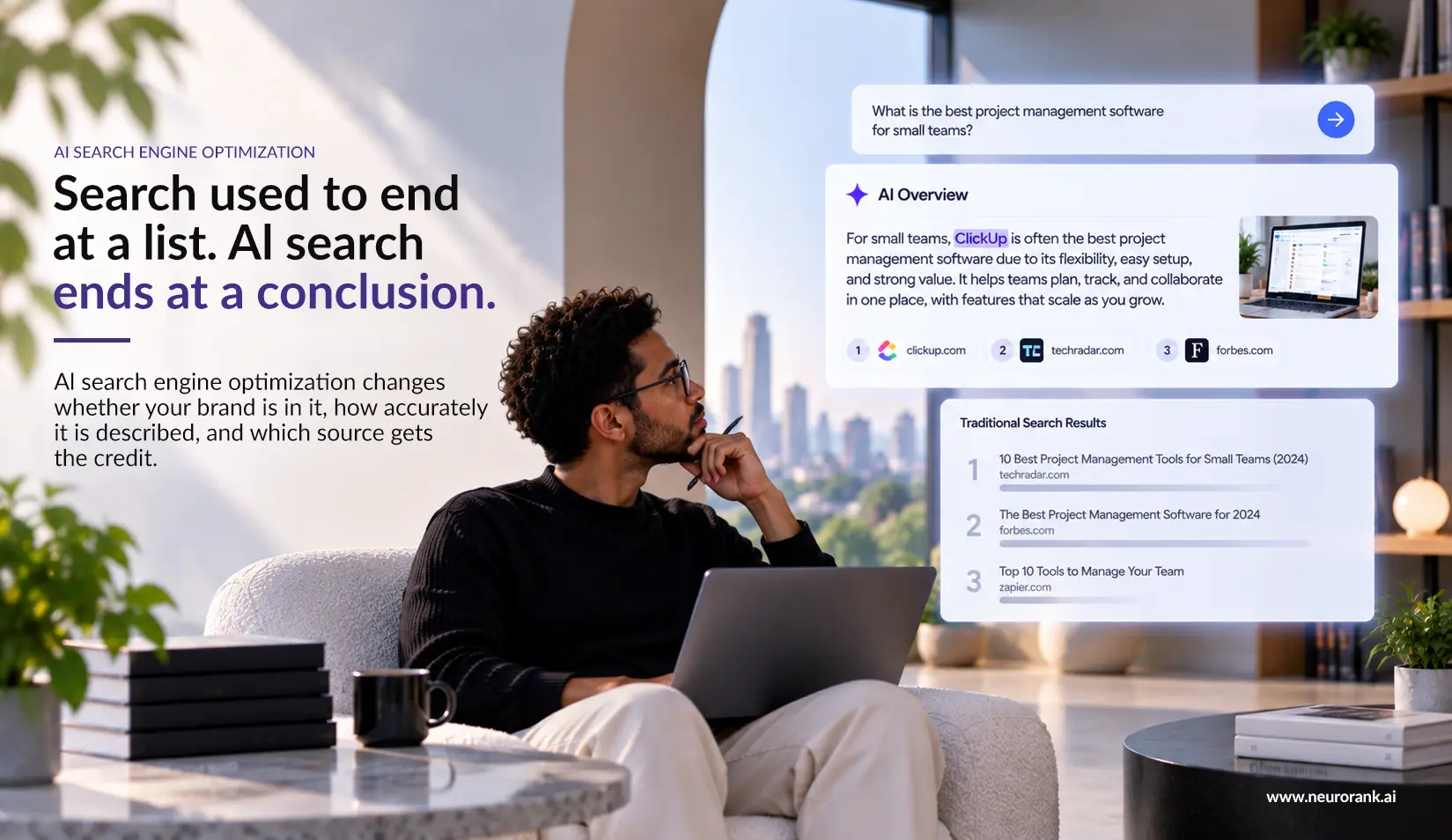
The common error is treating AI search as a traffic channel. It is a consideration channel, and this is where AI search optimization diverges most sharply from the search discipline that preceded it. Measuring it on sessions is a category error, and it hides most of the value. NeuroRank groups the avenues by the outcome a marketing leader is accountable for.

Group

Avenues

Produces a click

Win more

Shortlist inclusion, displacement defense, new vendor discovery

Rarely

Convert better

Accuracy that qualifies, decision-stage context, late-funnel arrival

Sometimes

Spend less

Branded search lift, lower paid dependency, content and PR efficiency

Indirectly

Protect

Positioning and margin, compounding citation moat, risk containment

No


Read that final column again. Nine of the twelve avenues leave no click to attribute. A brand that reports only referral sessions is reporting a quarter of its own results.

The avenues also map to distinct failure types. Omitted means the brand does not appear at all. Replaced means a named competitor is recommended in its place. Hallucinated means the model states something wrong or outdated. Zero Leads means the brand is mentioned without the decision-stage context that converts. Replaced on a high-intent cluster is the most expensive of the four, because a rival is being handed the recommendation at the moment of choice.

Atomic answer. AI search moves revenue through twelve avenues across winning, converting, saving, and protecting, and nine of them produce no click, which is why referral reporting understates the channel by design.

Why AI search revenue does not appear in your analytics

It does appear. It appears in the wrong place. Assistants strip or omit referrer headers, and mobile assistant applications commonly drop attribution entirely, so the sessions arrive beside bookmarks and typed URLs in the Direct channel.

Three configuration steps recover the visible portion. First, build a custom channel group in GA4 covering the assistant hostnames, including chat.openai.com, gemini.google.com, claude.ai, perplexity.ai, and copilot.microsoft.com. Second, audit the referrer exclusion list, because AI hostnames sitting in that list are discarded before they are ever counted. Third, apply UTM parameters on assets you control that assistants are likely to surface.

Two platform reports now supplement this. Google shipped dedicated generative AI performance reports in Search Console on 3 June 2026, covering AI Overviews and AI Mode, rolling out to a subset of properties. They currently carry impressions only, without clicks, click-through rate, or queries, so they show visibility rather than its traffic value. Microsoft opened an AI performance report in Bing Webmaster Tools in February 2026, tracking citations.

The journey itself compounds the problem. An AI and search behavior study published in 2026 by Eight Oh Two found that 37 percent of consumers now begin searches with an assistant rather than Google, while 85 percent still cross-reference through traditional search before converting. One journey, two channels, and conventional attribution captures only the second. This is also why last-click must go: a multi-touch or data-driven model that credits an assistant appearing anywhere in a 30-day path will read the channel far more accurately than one crediting the final session.

What remains invisible is the honest part. AI Overviews clicks resolve to Google organic and do not separate cleanly. Assistant application traffic often carries no attribution at all. Most importantly, a buyer can be fully persuaded inside an answer and never click anything. No configuration recovers that.

Atomic answer. Assistant traffic is already in analytics, misfiled as Direct, and three GA4 fixes plus the new Search Console and Bing reports recover the visible portion, which is a defensible floor rather than the total.

Is there a method to calculate AI search revenue

No single accepted method exists. The practice that has emerged instead is triangulation across four independent lenses, each with a different rigor and a different failure mode.

Lens

What it does

Strength

Limitation

Observed

GA4 AI channel, UTM parameters, and CRM source fields

Defensible today

Counts only what survived the referrer

Self-reported

Free-text how did you hear about us, classified and re-attributed

Strongest single recovery method

Recall bias and inconsistent naming

Inferred proxy

Branded search lift, Direct lift on commercial pages, citation share

Fills the zero-click gap

Correlational, not causal

Causal

Holdout test on matched cluster or geography sets

Survives finance scrutiny

Requires patience and discipline


Ask the second question. When a buyer selects an assistant as their discovery source, prompt them for the actual wording they used. That single extra field converts a channel label into a prompt list, which tells you exactly which questions are producing revenue and which to prioritize next. Place it where it fits the motion: at signup for self-serve, during the demo call or onboarding for sales-led.

The discipline that makes triangulation credible is labeling. Every figure in the report is marked observed or inferred. Report only what you observed and you understate the channel badly enough to lose the budget. Report only what you inferred and you will eventually be caught overclaiming. Last-click attribution is the wrong model in either case, because it credits the return visit rather than the recommendation that started the journey.

One further caution applies to prompt-level demand. Panel-based estimates of how often a question is asked inside an assistant now exist commercially, licensed from consented consumer panels. They are modeled rather than census data. Profound research conducted across March and April 2026 also found that ChatGPT rewrote user wording into largely different retrieval queries, while Perplexity stayed close to the original phrasing. A keyword list is therefore not a prompt set, and clusters should be tracked rather than exact strings.

Atomic answer. No accepted method calculates AI search revenue directly, so serious teams triangulate four lenses, observed, self-reported, inferred, and causal, and label every published figure as observed or inferred.

Which metrics actually matter, and in what order

Four measures carry the weight, and most teams track only the first. Read them in sequence, because each one answers a question the previous one cannot.

Visibility answers whether the brand appears at all, expressed as the share of relevant AI responses that include it. Split that score by funnel stage and by branded versus non-branded prompts. A brand that appears whenever its own name is typed, and vanishes on non-branded category questions, has an awareness problem disguised as a visibility score.

Position answers how prominently. Being named tenth in a list is a fraction of the exposure of being named first or second, and the difference is commercial rather than cosmetic. Track position across many prompts and aggregate weekly, because daily results move too much to read.

Sentiment answers what the model says once the brand is in the room. This is the most undervalued measure in AI search and often the fastest to fix. Evaluation-stage questions such as whether a product is easy to use or well supported are purchase decisions resolved by whatever the model says next. Unlike training data, which shifts slowly, the third-party sources shaping sentiment can frequently be corrected within weeks.

Source share answers why. Identify which third-party domains the models cite when answering your category questions, then find the ones citing competitors where they do not cite you. That list is a public relations brief with commercial value attached, and where a source carries inaccurate or manipulated content, correction is a legitimate and often rapid remedy.

Atomic answer. Track four measures in order: visibility split by funnel stage and branded versus non-branded prompts, position aggregated weekly, sentiment on evaluation-stage questions, and the third-party sources citing competitors where they do not cite you.

How to measure reliably when models answer differently every time

Large language models are non-deterministic. The same prompt returns different answers, which makes any single observation close to meaningless and makes disciplined sampling the whole game.

The randomness is predictable rather than chaotic, because responses are drawn from a probability distribution. Practitioners running comparison prompts report that roughly ten responses per prompt give a workable estimate of both appearance rate and rank distribution. Run each priority prompt multiple times, then record the percentage of runs in which the brand appears and where it lands.

Track categories rather than individual strings. Grouping prompts by topic, funnel stage, and customer segment turns noisy individual results into readable patterns, and it survives the fact that engines rewrite user wording before retrieving anything.

Account for session state. Responses from an application programming interface, a logged-out session, and a logged-in account can differ materially. Most tracking platforms read logged-out sessions or APIs, so treat their output as directional and validate periodically against a logged-in account. NeuroRank runs fresh-token sessions to remove personalization bias from the baseline.

Atomic answer. Because models are non-deterministic, sample each priority prompt roughly ten times, aggregate by category rather than by string, and treat logged-out and API tracking as directional, validating against logged-in sessions.

How to prove AI search caused the change

Because assistant answers leave no reliable click trail, causation comes from experimental design rather than attribution modeling. The sequence has two halves, and skipping the first invalidates the second.

Set the baseline once, properly. Run the prompt set in a single pass and record responses verbatim across ChatGPT, Gemini, Claude, and Perplexity. Capture 28 days of Search Console impressions, clicks, and average position for the target URLs. Capture 28 days of sessions and conversions by source, read through the new AI channel group. Then document the date, the method, and the exact prompts. An undocumented baseline is an opinion.

Then hold a control group. Treat your priority clusters and hold a matched set untouched. Vanity URLs and offer codes make the treated set readable. Read the leading indicators before the lagging ones, because inclusion, citation, and gap closure all move before pipeline does. On the lagging side, watch more than volume: demo requests, sales cycle length, and win rate in the treated clusters often move before closed revenue does, and a shortening cycle is frequently the first commercial evidence that buyers are arriving better informed. The gap between the treated set and the held set is the only figure that supports a causal claim.

Governance is what makes the comparison honest. When every fix carries a live URL and a date, a movement in the answer can be traced to a specific intervention rather than to a guess.

Atomic answer. Prove causation by design rather than attribution: document a 28-day baseline, treat one cluster set while holding a matched set untouched, and read the gap between them across three monthly cycles.

What stops a model from reading you at all

This layer sits beneath every other measure and silently caps all of them. Analysis by Vercel and MERJ of over 500 million crawler fetches found no evidence of JavaScript execution, a pattern confirmed independently through 2026. Only Google's Gemini renders JavaScript, through Googlebot infrastructure.

The consequence is concrete. Pricing tables, product specifications, comparison data, and FAQ answers that exist only after client-side rendering are effectively blank to every major AI crawler except one. A site built on client-side rendering can rank respectably in Google while returning almost nothing to an assistant.

Server logs are the only complete record of this. Analytics filters bots out, and Search Console covers Googlebot alone. Logs show which agents reached the site, which pages they took, and what status codes they received. Every 404, 429, or stale cache response returned to a retrieval agent is a citation that did not happen. A page crawled frequently but never cited is a content-structure problem rather than a discovery problem: the model arrived and found nothing worth quoting.

Atomic answer. AI crawlers do not execute JavaScript, so client-side rendered pricing and comparison content is invisible to them, and server logs are the only complete record of which agents reached the site and what they received.

The cost of waiting another quarter

Models learn from what they already say. A brand cited today becomes marginally more likely to be cited tomorrow, and a competitor that establishes the reference position in a cluster becomes progressively harder to displace. That compounding is the reason delay carries a price that a traffic report will never show.

Forrester's 2025 B2B buying study found that buyers complete 70 to 80 percent of their research before contacting sales. In a category where the assistant answers most of that research, the shortlist is decided in a conversation the brand never sees. Every month spent without a baseline is a month in which the recovery period extends and the correction gets more expensive.

There is also a direct risk dimension. A hallucinated regulatory claim or an incorrect product fact reaching buyers is not a visibility problem. In financial services, insurance, and pharmaceuticals it is a compliance exposure with revenue consequences attached.

Atomic answer. Delay compounds, because models reinforce the positions they already hold, and Forrester found buyers complete 70 to 80 percent of research before contacting sales, which places the decision inside an answer the brand never observes.

Where NeuroRank fits

Unlike AI visibility monitoring platforms, NeuroRank diagnoses, prescribes, conditions, and tracks.

The distinction matters for measurement specifically. Monitoring reports what a model said. It does not tell a team which gap to close first, whether the fix shipped, or whether the movement that followed was caused by the work. NeuroRank classifies every gap by ORHL, prescribes a source-linked correction tied to the exact prompt cluster, governs the fix through a maker and checker workflow so each change carries a live URL and a date, and tracks inclusion, recommendation share, and citation footprint across ChatGPT, Gemini, Claude, and Perplexity month over month.

What the published evidence shows

The argument for this channel rests on conversion quality rather than traffic volume. Seer Interactive, analyzing one B2B client between October 2024 and April 2025, reported ChatGPT referral traffic converting at 15.9 percent and Perplexity referral traffic at 10.5 percent, against 1.76 percent for Google organic. Those figures come from a single client and should be treated as direction rather than as a benchmark, because category, funnel shape, and price point all move them.

Previsible's State of AI Discovery Report, analyzing over 1.96 million assistant-driven sessions, found AI traffic concentrating on industry, tools, and pricing pages at several times the site-wide rate. That page distribution is the more durable finding. It says assistant visitors arrive late in the decision rather than at the top of the funnel.

Research published by Kyle Poyar in 2026 places AI search at roughly 10 to 15 percent of B2B pipeline, with very little of it visible in standard attribution. Taken together, the three findings describe a channel that is small in sessions, late in the funnel, and materially larger in pipeline than any referral report will show.

Atomic answer. Published analyses agree the value is conversion quality: assistant traffic concentrates on pricing and comparison pages, converts well above organic in one measured B2B client, and represents roughly 10 to 15 percent of B2B pipeline.

Regional notes

Model behavior is not uniform across markets, so measurement should be set per region rather than blended. The share of answers each model serves, the third-party sources it prefers, and the local competitors it names all vary by geography. A brand operating across Asia, Europe, the Middle East, the USA, and North America should baseline each region separately and compare movement within a region, never across regions.

Regulatory exposure varies as well. In markets with strict financial promotion rules, a hallucinated product or guarantee claim reaching buyers through an assistant carries a compliance cost independent of any revenue effect, which raises the priority of the Hallucinated class relative to the other three.

Next steps

Begin with instrumentation, because a baseline captured on misconfigured analytics cannot support any claim made later. Build the assistant channel group, clear the exclusion list, and record 28 days of Search Console and analytics data alongside one verbatim prompt pass across the four models. Then choose a single priority cluster set, hold a matched set untreated, and read the difference across three monthly cycles. A Live Forensic Diagnostic from NeuroRank, at USD 7.00, produces the prompt-level baseline for one brand in a single pass.

Is your brand invisible in the AI synthesis?

Stop paying for clicks that do not convert. Benchmark your AI visibility today with the world's most advanced seo ai tools.

Book a Strategic NeuroRank Briefing

More Articles

Analyze the Damage.
Establish Governance.