Social Samosa: Consumer Brands and Negative AI Sentiment
Summarize with AI
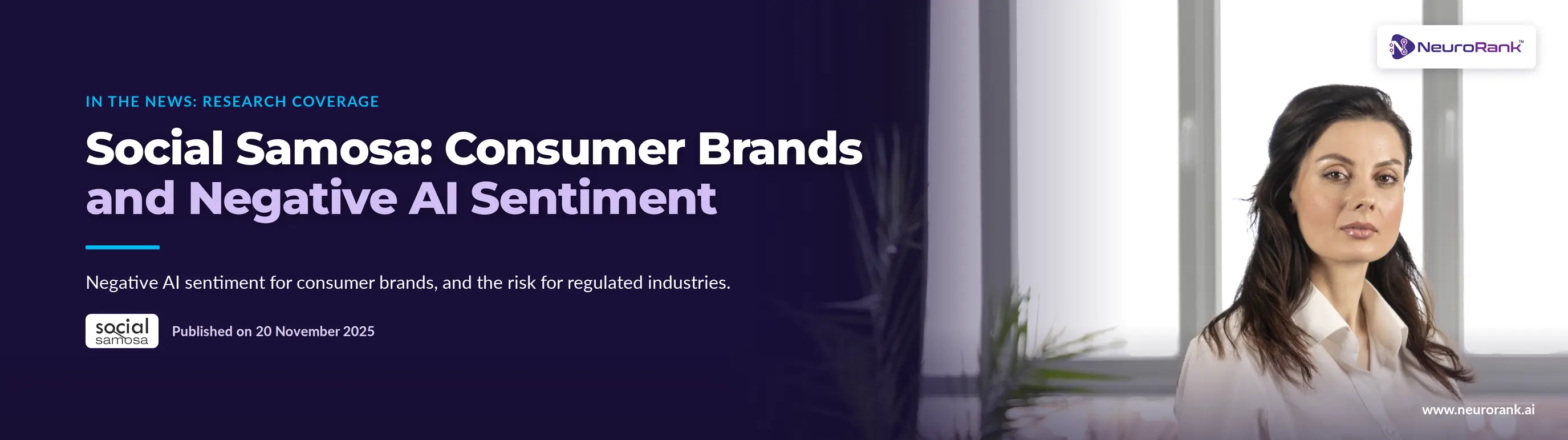
Social Samosa reported on 20 November 2025 on Pulp Strategy’s GEO Benchmark Index 2025, powered by NeuroRank, into how ChatGPT, Gemini, Claude, and Perplexity decide which brands customers discover and trust. Its headline finding concerns consumer brands, which the study found are summarized with a negative sentiment skew.
Consumer brands meet a negative skew
Social Samosa led with sentiment. The research found that AI summaries of consumer brands lean negative, alongside wider problems: brands missing from category lists, factual errors, and inconsistent naming across the four models. The study tied those weaknesses to how brands publish: PDFs and other formats a model parses poorly, pages without structure, and thin trust signals in the knowledge graphs AI draws on.
The figures behind the headline start with sentiment: 90 percent of consumer brands showed a negative skew. Beyond that, 68 percent of brands were absent from AI-generated lists in their own categories, 52 percent faced factual errors or misstatements, and 88 percent had inconsistent naming and recognition across models.
Regulated industries face specific risks
The report names the risks for regulated sectors: ESG credentials misinterpreted, compliance exposure, and impaired visibility in procurement. It also warns that AI search now shapes procurement shortlists, investor narratives, and high-intent consumer discovery, and that competitors can appear ahead of category leaders.
The method spanned audits, prompts, and interviews
The study drew on 70 enterprise audits, more than 350 brands, 408,000 prompt simulations, and interviews with more than 60 chief marketing officers and senior marketing executives.
Pulp Strategy described a method combining anonymized GEO audits, real-world prompt runs across the four models, interviews with CMOs and other senior marketers, and external validation of selected findings. The study recommended a 30 to 90 day roadmap.
For current findings, see the AI Visibility Index 2026.
Sentiment is measured on its own
NeuroRank’s Brand Sentiment Score is the share of brand-naming responses classified as positive, with every response sorted into positive, neutral, or negative. It is judged independently of recommendation. A model can recommend a consumer brand and still describe it in negative terms, and the two readings point to different fixes.
Ambika Sharma’s verdict on the research, as quoted by Social Samosa:
“most brands will not like what they find”
Negative sentiment in an AI answer rarely starts with a brand’s own content. It usually comes from the loudest third-party pages: an old complaint thread, a review site that ranks well, a news story from years ago. A model summarizes what it finds. A consumer brand should know which sources carry its sentiment before it writes another campaign line.
Ambika Sharma, Founder, NeuroRank in Social Samosa, 20 November 2025
Related coverage
View all news
Moneycontrol: AI Visibility Is Not the Same as Recommendation
BestMediaInfo: AI Assistants and Consumer Brand Discovery