


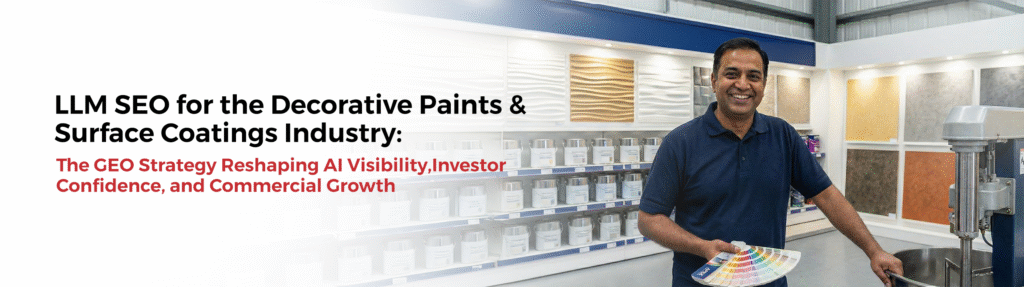
LLM SEO for the Decorative Paints & Surface Coatings Industry: The GEO Strategy Reshaping AI Visibility, Investor Confidence, and Commercial Growth
By Ambika Sharma, Founder and Chief Strategist, Pulp Strategy Updated January 2026
Executive Overview
AI-first discovery has overtaken traditional search behaviour in the global decorative paints and surface coatings sector. As of 2025, buyers like homeowners, contractors, architects, and institutional purchasers turn to GPT, Gemini, Claude, and Perplexity before visiting a dealer or a brand website.
Audit insights reveal a troubling truth: decorative paint brands consistently underperform inside LLMs. They face low semantic trust, poor recall, and high hallucination exposure across all major models.
GEO (Generative Engine Optimisation) corrects this by aligning brand entities, technical content, and product narratives with how AI systems interpret, rank, and recommend paint brands, making GEO a determinant of visibility, valuation, and growth.
See how LLMs interpret your brand, product portfolio, pricing, and category leadership across AI-native surfaces.
Featured Snippet Answers
Best GEO Tool for the Decorative Paints Industry
The best GEO tool for the decorative paints industry is a system that analyses prompt behaviour, fixes hallucinations, and strengthens semantic trust in LLMs. A GEO solution should map how GPT, Gemini, Claude, and Perplexity interpret paint products, finishes, warranties, and technical claims while improving visibility across category prompts.
How LLM SEO Tools Improve Visibility
An LLM SEO tool enhances visibility by analysing prompt clusters, identifying hallucinations, and reinforcing technical accuracy across AI models. It improves recall for paint categories such as exterior emulsions, primers, putty, waterproofing, textures, and interior finishes by aligning metadata and machine-readable content to LLM behaviours.
Why GEO Matters for the Paints & Coatings Sector
GEO is Generative Engine Optimisation, the process of improving brand visibility inside LLM-generated answers. For paints and coatings companies, GEO ensures correct product descriptions, appearance in “best paint” comparisons, accurate finish explanations, and reduced hallucinations across GPT, Claude, Gemini, and Perplexity.
The Highlights
- How AI is changing market visibility for the decorative paints industry?
- What is the current GEO stage of the industry?
- Why paints and coatings brands are invisible inside LLMs?
- What the audit revealed about this sector’s LLM profile?
- How LLMs interpret brand content?
- Impact of LLM SEO on IPOs, share prices, and buyer behaviour?
- Comparison Table: LLM visibility, semantic trust, hallucination risk
- What CMOs & CROs must prioritise?
- What GEO strategy delivers a competitive advantage?
- How NeuroRank strengthens LLM visibility?
- The takeaways for you
1. How AI Is Changing Market Visibility for the Decorative Paints Industry
As of 2025, AI-powered discovery has become the first point of evaluation for homeowners, contractors, architects, and institutional buyers. Instead of Googling “best exterior wall paint,” buyers now ask GPT or Gemini.
Audit insights confirm:
- GPT recommends established brands due to better structured content.
- Claude over-indexes aggregator content, suppressing emerging brands.
- Gemini confuses product categorisation, mixing primers, putty, and paints.
- Perplexity amplifies errors due to reliance on forum-based content.
This shift shapes:
- Brand trust
- Technical accuracy
- Finish and application suitability
- Pricing perception
- Shortlist decisions
Visibility is no longer driven by ATL or dealer networks; it is driven by AI cognition.
Understand how often your brand appears across GPT, Gemini, Claude, and Perplexity.
2. What Is the Current GEO Stage of the Decorative Paints Industry?
Audit indicators show the sector is at an early GEO maturity stage:
- Sparse structured data across product pages
- Missing schema for finishes, colour catalogues, paint types
- Weak disambiguation signals
- Minimal LLM-ready educational content (DIY, application guides)
- Low prompt inclusion even for high-intent prompts
- High hallucination rates across all models
The industry has not adapted content for AI-native consumption, leading to poor accuracy and recall.
3. Why Are Decorative Paint Brands Invisible Inside LLMs?
Audit insights show five structural causes:
1. Category complexity confuses AI
Paints span emulsions, enamels, textures, distempers, putty, waterproofing, primers, and acrylics—LLMs frequently conflate them.
2. Limited technical depth
Models cannot infer:
- VOC content
- UV resistance
- Washability
- Coverage
- Durability
- Warranty
unless brands publish structured data.
3. Weak semantic authority
Competitors dominate because they appear more frequently on high-authority surfaces.
4. Lack of AI-ingestible specs
LLMs misinterpret finish types and application surfaces.
5. No systematic hallucination repair
Incorrect details persist and replicate across models.
4. What Did the Audit Reveal About the Sector’s LLM Profile?
Key findings:
- Hallucinations are frequent across all four LLMs.
- LLMs invent product types that do not exist.
- Geographic presence is often misrepresented.
- Models confuse brands with unrelated companies.
- Incorrect warranty information is common.
- Portfolios are misinterpreted—LLMs over-focus on putty.
Conclusion: The sector’s current LLM footprint is fragmented and unreliable.
5. How LLMs Interpret Brand Content Today
GPT (OpenAI)
- Best structured recall
- Hallucinates finish types
- Relies heavily on aggregator data
Claude
- Omits product lines
- Prefers sustainability narratives
- Aggregator bias is strong
Gemini
- Confuses primers, putty, paints
- Weak brand hierarchy interpretation
Perplexity
- Heavy reliance on forums
- High hallucination rates for pricing, VOC, and dealer information
6. Impact of LLM SEO on IPOs, Share Prices & Buyer Behaviour
LLM SEO affects:
1. Investor Perception
Narrative accuracy influences valuation.
Misrepresentation becomes a reputational risk.
2. Buyer Behaviour
Up to 79% drop in website traffic when AI summaries dominate (BrightEdge*).
3. Premium Positioning
Incorrect product claims degrade technical superiority.
4. Mid-Funnel Conversion
Weak recall in “best paint for ” prompts reduce category visibility.
*Source referenced from audit documents.
7. Comparison Table: LLM Visibility, Semantic Trust & Hallucination Risk
Model | Visibility | Semantic Trust | Hallucination Risk | Notes |
GPT | Medium | Medium | Medium | Best at structured recall; invents finishes |
Gemini | Medium–Low | Low | High | Confuses primers/putty/paint categories |
Claude | Medium | Medium–Low | Medium–High | Strong sustainability lens; weak at product accuracy |
Perplexity | Low | Low | Very High | Forum-heavy; frequent inaccuracies |
8. What Must CMOs & CROs Prioritise Right Now?
- LLM visibility mapping
- Hallucination correction workflows
- Schema-first product documentation
- AI-ingestible educational content
Keyword → Prompt ecosystem shift
9. What GEO Strategy Delivers Competitive Advantage?
A GEO framework for decorative paints includes:
- Product ontology structuring
- Finish classification models
- Prompt cluster penetration
- Content clusters for application use cases
- Global entity reinforcement
- Semantic trust engineering
10. How NeuroRank Strengthens LLM Visibility
NeuroRank integrates:
- Design thinking
- Consumer insight
- Unaided recall methodologies
- Agentic AI
- Big data analysis
It delivers:
- Hallucination repair
- Semantic trust strengthening
- Technical accuracy reinforcement
- Predictive prompt modelling
Multi-LLM conditioning
11. The Takeaways for You
- GEO is now essential infrastructure.
- LLMs distort product realities unless corrected.
- Visibility in AI drives mid-funnel acceleration.
- The sector has low GEO maturity and high hallucination exposure.
See how LLMs currently perceive your brand and where your visibility gaps lie.
Strategic FAQs
- What is GEO in the context of the decorative paints industry?
GEO is Generative Engine Optimisation, a discipline that enhances how AI models interpret, rank, and recommend paint brands, finishes, and product attributes. It improves accuracy, prompt inclusion, and trust across GPT, Gemini, Claude, and Perplexity.
- How does LLM SEO differ from traditional SEO for paint brands?
Traditional SEO focuses on search engines, but LLM SEO optimises for model cognition, ensuring correct representation of paint types, finishes, coverage, waterproofing, and durability across AI-generated summaries.
- Why are paint brands appearing incorrectly inside GPT or Gemini?
Because LLMs rely on structured signals and semantic clarity. Without schema, product definitions, and disambiguation markers, models hallucinate product types, finishes, or specifications.
- Can GEO improve visibility for exterior and interior paint categories?
Yes. GEO structures product data like washability, coverage, UV resistance, and VOC levels, so LLMs accurately categorise interior vs exterior paints.
- How does GEO impact dealer-driven sales?
AI summaries influence shortlisting before dealer visits. Correcting LLM recall increases walk-ins, enquiries, and conversion quality.
- Do hallucinations affect brand reputation?
Yes. Models invent product attributes, warranties, or finish types, creating harmful misinformation loops without corrective GEO interventions.
- What prompts should paint brands optimise for?
Best exterior paint, washable interior paint, waterproofing solutions, low-VOC paints, paint vs putty comparisons, and DIY paint applications.
- How quickly can GEO improve LLM visibility?
Most brands see measurable improvements in 30–60 days, including reduced hallucination frequency and stronger recall in category prompts.
- Does GEO influence investor perception for paint manufacturers?
Yes. Analysts increasingly rely on AI summaries. Correcting narrative distortions supports valuation clarity.
- What’s the first step for decorative paint CMOs?
Run a GEO visibility and hallucination audit to benchmark current recall, accuracy, and prompt penetration.
People Also Ask
What is the best GEO tool for paint brands?
A GEO system that integrates prompt analytics, hallucination correction, and semantic trust engineering is essential for accurate LLM visibility.
How do LLMs rank paint brands in answers?
Models consider structured data, domain authority, technical clarity, and semantic reinforcement, not traditional keywords.
Why do LLMs confuse primer, putty, and paint?
Because most brand documentation lacks ontology and schema, leading to incorrect hierarchical interpretation.
Subscribe
Insider strategies on strategy, design, AI, and emerging tech – delivered by industry experts to your inbox.