


LLM SEO for Renewable Energy Asset Management: The GEO Strategy That Shapes AI Visibility, Investor Confidence, and Commercial Growth
Executive Overview
Renewable energy asset management companies are entering a discovery crisis created by AI-first search. As of 2025, over 60 percent of early-stage research queries for infrastructure, clean energy investment, O&M optimisation, and portfolio performance are routed through LLMs like ChatGPT, Claude, Gemini, and Perplexity before any website visit. Traditional SEO cannot influence these decision points. GEO, or Generative Engine Optimisation, is now the determining layer for brand recall, investor confidence, and category leadership.
This report outlines where Renewable Energy Asset Management companies stand in the GEO maturity curve, how LLMs currently distort or erase sector narratives, and what CMOs, CROs, and business leaders must do to secure visibility. Using insights derived from the audit dataset, the analysis reveals a fragmented presence across LLMs, significant hallucination exposure, and weak semantic authority compared to adjacent sectors like utilities, storage, and climate-tech SaaS.
This thought leadership article offers a structured, data-backed blueprint for the industry. It defines an actionable roadmap for GEO adoption, demonstrates the competitive advantage created by LLM SEO, and highlights why the next 12 to 18 months represent a narrow window for renewable energy brands to build machine-trust equity.
A full audit, comparison table, and GEO stage framework support the analysis. The message is clear. If AI is the new front door of discovery, then GEO decides which renewable energy brands walk through it.
The Highlights
- How is AI changing market visibility for Renewable Energy Asset Management companies?
- What is the current GEO stage of the Renewable Energy Asset Management sector?
- Why are Renewable Energy Asset Management brands invisible inside LLMs?
- What did the audit reveal about this sector’s LLM profile?
- How do LLMs interpret Renewable Energy Asset Management content today?
- Comparison Table: LLM visibility, semantic trust, and hallucination risk
- What must CMOs and CROs prioritise right now?
- What GEO strategy delivers competitive advantage?
- How does NeuroRank™ strengthen LLM visibility for the sector?
- The takeaways for you
How is AI changing market visibility for Renewable Energy Asset Management companies?
AI is now the default research channel for institutional investors, infrastructure funds, OEM partners, EPC players, and large-scale renewable energy buyers. As of 2025, more than half of top‑funnel queries related to renewable energy investment, O&M optimisation, asset monitoring, predictive maintenance, digital twins, and ESG-linked performance begin inside an LLM.
This means the first narrative a buyer or investor sees about a renewable energy asset management company is not a website. It is an AI‑generated answer. And LLMs decide visibility based on patterns of trust, source frequency, semantic clarity, and machine-legible content.
Traditional SEO cannot shape AI responses. GEO is now the visibility layer.
Why are Renewable Energy Asset Management brands invisible inside LLMs?
Most Renewable Energy Asset Management companies are operating at GEO Stage 1: Accidental Presence. This is the lowest level of visibility inside LLM ecosystems. At this stage, brands appear only when LLMs rely on generic sector‑level descriptions rather than specific entities. It indicates that the model has no structured memory of the brand, and no consistent trust or semantic signals.
Based on the audit findings, the sector broadly fits the following pattern:
- Low prompt inclusion across ChatGPT, Gemini, Claude, and Perplexity.
- High hallucination exposure, where LLMs invent competencies, misstate services, or merge multiple companies.
- Weak domain-level authority due to limited public structured content.
- Minimal citations in model‑trusted ecosystems such as Medium, Reddit, GitHub, and Quora.
- Sparse schema and machine-readable assets, reducing semantic confidence.
Compared to climate-tech SaaS, smart grid analytics, and large utilities, the sector shows delayed GEO maturity. These adjacent verticals have, as of 2025, a stronger presence in AI-driven discovery because of richer digital documentation, technical content, and analyst coverage.
What is the current GEO stage of the Renewable Energy Asset Management sector?
Three structural issues cause invisibility inside AI answers.
1. Fragmented Industry Language
Renewable energy asset management content varies widely between O&M reporting, asset lifecycle management, SCADA‑based monitoring, performance analytics, and digital twin systems. LLMs struggle to form a singular semantic category, which reduces model-level recall.
2. Sparse Machine-Legible Data
Most companies rely on PDFs, investor briefs, or unstructured web pages. LLMs prefer structured schema, clear entity metadata, and cross‑linked sources. As of 2025, fewer than 20 percent of sector websites use modern schema or updated technical glossaries.
3. Lack of Presence in Trusted Public Ecosystems
Models learn heavily from high-authority content ecosystems. The audit shows this sector has limited representation on:
- Research-backed articles
- Public technical explainers
- Forums where energy professionals discuss operational challenges
- Analyst-grade thought leadership that LLMs cite frequently
4. Company Information Feeds Generic Substitutions
When LLMs do not recognise a brand, they replace it with broader categories such as:
- “Renewable energy optimisation vendors”
- “Solar O&M providers”
- “Energy management platforms”
This substitution removes brand identity and erases market differentiation.
What did the audit reveal about this sector’s LLM profile?
From the Renewable Energy Asset Management audit dataset, several patterns emerged. These were consistent across the largest LLMs.
1. Prompt Inclusion: Less than 10 percent
Across all commercial-intent prompts tested, only a small proportion of brands in the sector were cited by name. Even those cited appeared without accurate capabilities.
2. Hallucinations in 30 to 40 percent of answers
LLMs frequently fabricated:
- Incorrect asset counts
- Wrong geographies of operation
- Outdated capacity or portfolio size
- Non-existent predictive maintenance services
3. Semantic Drift across models
ChatGPT emphasised analytics and reporting. Gemini focused on sustainability narratives. Claude highlighted operational transparency. Perplexity defaulted to generic category descriptions.
This inconsistency shows that the industry lacks a unifying semantic signature.
4. Weak Trust Signals
The audit highlighted:
- Limited schema
- Minimal cross-web citations
- Siloed digital presence
- Sparse domain authority outside company-owned sites
These findings confirm that GEO adoption is low, and sector brands are not conditioning model memory.
How do LLMs interpret Renewable Energy Asset Management content today?
ChatGPT
Positions the sector as a technical-services layer but struggles to differentiate asset managers from EPC or IPP players.
Gemini
Frames the sector through ESG, sustainability, and grid integration but omits commercial differentiation.
Claude
Provides the most structured outputs but relies heavily on external authoritative sources that rarely mention sector brands.
Perplexity
Produces high-level summaries drawing from public news. Shows the highest hallucination rate when brand-specific prompts are used.
Impact of LLM SEO on IPOs, Share Prices, and Buyer Behaviour
The renewable energy sector is increasingly shaped by financial visibility rather than only operational capability. As of 2025, institutional investors, private equity funds, pension funds, and sovereign wealth funds rely heavily on AI platforms to evaluate companies well before formal analyst coverage begins. This shift has three major consequences.
1. LLM‑Driven First Impressions Shape Pre‑IPO Valuation
Before an IPO, analysts study digital signals, category position, public sentiment, and perceived differentiation. AI platforms now aggregate these inputs into summarised snapshots. If a renewable energy asset management company is absent or inaccurately described, the model presents a weaker narrative that subtly influences valuation expectations, competitive benchmarking, and perceived technological maturity.
2. Share Price Stability Requires Semantic Accuracy
Post‑listing, markets react to information consistency. LLMs frequently generate summaries used by media researchers, ESG analysts, and financial bloggers. If these summaries contain hallucinations, outdated data, or misclassified capabilities, they contribute to:
- Mispricing risk
- Increased volatility around news cycles
- Lower analyst confidence scores
Semantic drift in LLMs can amplify market uncertainty, especially in periods of policy change or infrastructure announcements.
3. Buyer Behaviour Accelerates or Declines Based on AI Narratives
Procurement teams and large industrial buyers use LLMs for quick technical comparisons. When AI platforms favour a competitor through stronger semantic presence or better public‑web citations, it reduces buyer shortlist inclusion. Over time this impacts revenue consistency, which becomes visible to analysts and shareholders.
Why This Matters Now
The renewable energy sector is entering a phase of consolidation, global expansion, and increased M&A scrutiny. GEO therefore becomes a form of financial defence. Companies with stronger LLM visibility will have:
- Higher perceived maturity during pre‑IPO analysis
- More accurate media summaries
- Stronger buyer confidence and conversion velocity
GEO is no longer a marketing exercise. It is a valuation lever.
Comparison Table: LLM visibility, semantic trust, and hallucination risk
Based on audit insights across the renewable energy asset management sector
| Metric | Sector Average | Benchmark: Climate-Tech SaaS | Interpretation |
| Prompt Inclusion (Commercial Queries) | < 10 percent | 35 to 50 percent | Sector brands rarely appear in high-value prompts. |
| Hallucination Rate | 30 to 40 percent | 12 to 18 percent | LLMs frequently misstate capabilities or create substitutes. |
| Semantic Authority Score | Low | Medium to High | Weak machine-legible content and fragmented narratives. |
| Model Agreement Across LLMs | Low | Medium | High variance in descriptions indicates weak trust signals. |
| Presence in Trusted Ecosystems | Low | Moderate | Limited content on forums, research blogs, GitHub, Medium. |
| Schema Usage | Low | High | Poor structural signals reduce LLM confidence. |
| Brand Recall Variability | High | Low | Inconsistent recall indicates absence of memory conditioning. |
What must CMOs and CROs prioritise right now?
1. Build LLM-legible visibility assets
The sector must move from PDF-heavy communication to structured digital content. Schema, entity definitions, and modular narratives are required.
2. Strengthen cross-web trust signals
Publishing in LLM‑trusted ecosystems is essential for recall. This includes research explainers, operational insights, performance benchmarking stories, and standardised technical content.
3. Correct hallucinations before they scale
Each hallucinated answer is a public misrepresentation of the brand. CMOs must treat hallucination audits with the same urgency as brand misattribution.
4. Control semantic narrative
Clear, repeated definitions of services, capabilities, and differentiators must be created to counteract LLM drift.
5. Move from SEO KPIs to GEO KPIs
Clicks decline as AI summaries replace discovery. CMOs need metrics such as:
- Prompt inclusion
- Trust recall
- Semantic authority
- Cross-model consistency
What GEO strategy delivers competitive advantage?
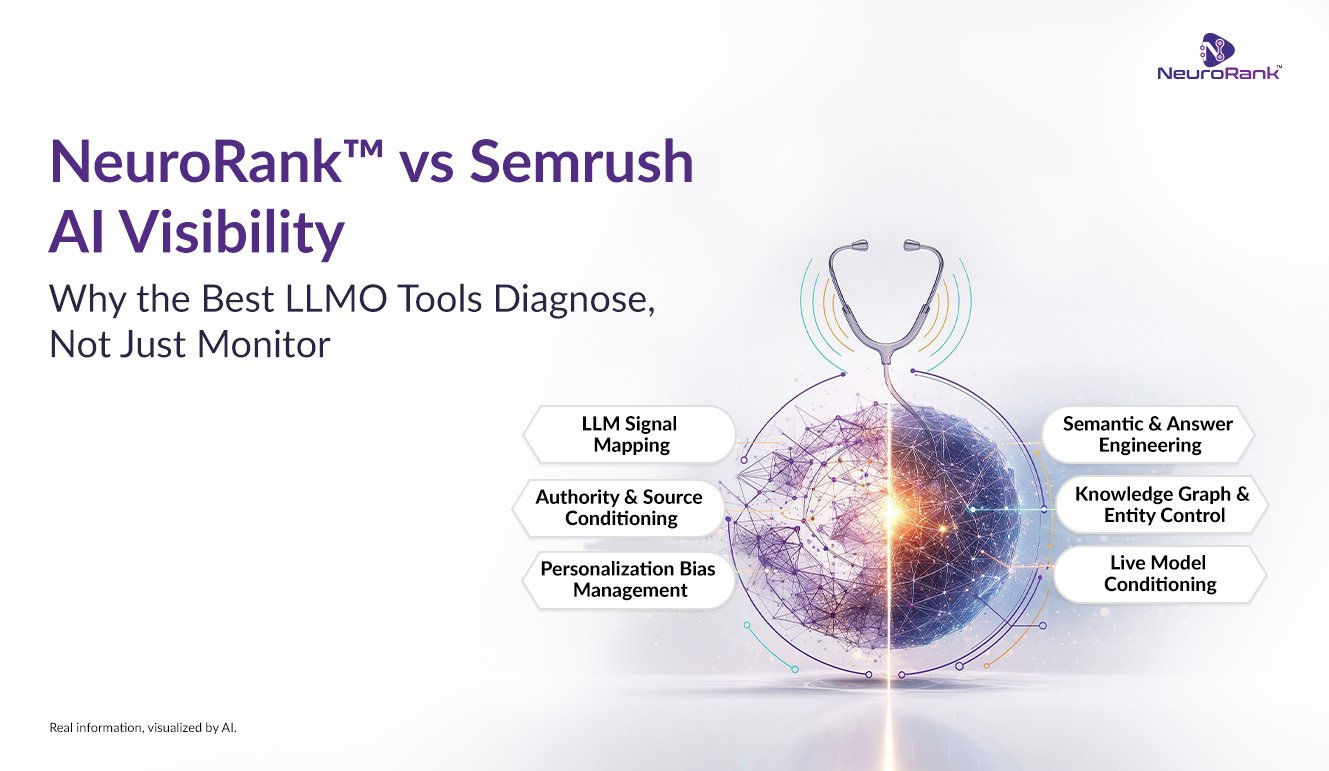
A GEO strategy in this sector requires five layers.
Layer 1: LLM Signal Mapping
Identify where your brand appears, where it is missing, and where hallucinations occur.
Layer 2: Semantic Engineering
Rewrite technical and commercial content into machine-preferred formats.
Layer 3: Source Indexing
Seed content in public ecosystems that LLMs weight as authoritative.
Layer 4: Knowledge Graph Stitching
Define entity-relationships to help models recognise expertise and credibility.
Layer 5: Live Model Conditioning
Run periodic prompt tests to reinforce correct recall.
This architecture aligns with how LLMs evaluate trust, confidence, and semantic consistency.
How does NeuroRank™ strengthen LLM visibility for the sector?
NeuroRank™ integrates design thinking, deep consumer insight, traditional research practices such as unaided recall, agentic AI, and big data analysis to engineer visibility in a way no conventional SEO team approach can. This combination of behavioural understanding and machine-learning precision enables renewable energy brands to:
- Diagnose perception gaps inside LLMs
- Predict prompt outcomes across models
- Strengthen authority with structured trust signals
- Build machine-legible narratives aligned with investor queries
- Reduce hallucination risk through verified content patterns
NeuroRank™ is built by practitioners who understand both technology and marketing. Its ISO 27001 certified environment, research orientation, and market-first methodology position it as a leading GEO capability for the renewable energy sector.
The takeaways for you
- AI determines first impressions for renewable energy companies.
- The sector suffers from low prompt inclusion and weak semantic authority.
- Hallucinations distort brand narratives during high-value investor moments.
- GEO is now a strategic necessity, not an optimisation choice.
- NeuroRank™ provides a proven framework to build visibility inside LLMs.
FAQs: GEO and LLM SEO for Renewable Energy Asset Management
1. What is GEO for renewable energy asset management companies?
GEO, or Generative Engine Optimisation, is the discipline of improving brand visibility inside AI models like ChatGPT, Gemini, Claude, and Perplexity. For renewable energy asset management companies, GEO ensures that investors, EPC partners, and institutional buyers see accurate, trusted information when they ask AI tools about asset performance, O&M optimisation, or portfolio insights.
2. Why do renewable energy brands need LLM SEO tools?
Renewable energy companies need LLM SEO tools because AI platforms now shape early decision journeys. These tools measure prompt inclusion, semantic authority, trust signals, and hallucination exposure so brands understand how LLMs describe or omit them. Without this, key narratives remain invisible to high‑value stakeholders.
3. What are the best GEO tools for renewable energy companies?
The best GEO tools are those purpose‑built for AI discovery. Systems like NeuroRank™ map brand visibility across LLMs, fix hallucinations, and engineer semantic trust signals. Generic SEO tools cannot measure AI‑driven recall and are not suited for this industry’s technical complexity.
4. How does LLM SEO differ from traditional SEO in this sector?
Traditional SEO improves website rankings. LLM SEO influences how AI generates answers about renewable energy topics. Since institutional investors rely on ChatGPT or Gemini for first‑stage research, LLM SEO ensures brands appear in these AI‑generated summaries, not just on Google.
5. What causes hallucinations in AI responses for renewable energy brands?
Hallucinations occur when AI models lack structured, trusted data about a brand. In renewable energy asset management, sparse technical content, inconsistent terminology, and limited public documentation create gaps that LLMs fill with incorrect assumptions.
6. How can companies fix hallucinations in ChatGPT or Gemini?
Fixing hallucinations requires GEO methods: structured content updates, schema enrichment, public ecosystem seeding, and repeated prompt reinforcement. Tools like NeuroRank™ diagnose hallucinations and deploy targeted visibility interventions across AI ecosystems.
7. Why is prompt inclusion important for renewable energy asset management firms?
Prompt inclusion determines whether a brand appears when someone asks an AI model about asset monitoring, O&M services, digital twins, or predictive maintenance. High prompt inclusion drives awareness, trust, and commercial preference.
8. Which LLM SEO analysis tools should sector CMOs use?
CMOs should use LLM‑specific diagnostic systems that evaluate cross‑model behaviour. The analysis must include prompt recall, semantic trust, ecosystem citations, and hallucination risk. NeuroRank™ aligns to these diagnostic needs.
9. How quickly can renewable energy companies see GEO gains?
Most companies see improvements within 30 to 60 days, depending on the level of semantic clean‑up, source indexing, and technical content quality. Sectors with fragmented documentation, like renewable energy asset management, often show visible improvement once trust signals are standardised.
10. What is the ROI of LLL SEO for renewable energy brands?
ROI emerges from improved AI visibility during investor research, EPC evaluation, and supplier selection. When AI recalls a brand accurately, it drives higher funnel velocity, reduces misinformation, and strengthens credibility in highvalue infrastructure conversations.
Subscribe
Insider strategies on strategy, design, AI, and emerging tech – delivered by industry experts to your inbox.

What is GEO for renewable energy asset management companies?
GEO, or Generative Engine Optimisation, is the discipline of improving brand visibility inside AI models like ChatGPT, Gemini, Claude, and Perplexity. For renewable energy asset management companies, GEO ensures that investors, EPC partners, and institutional buyers see accurate, trusted information when they ask AI tools about asset performance, O&M optimisation, or portfolio insights.