 Patent-Pending AI Visibility Intelligence
Command how AI perceives, interprets, and recommends your brand.
NeuroRank is the patent-pending AI visibility intelligence platform that deconstructs how ChatGPT, Gemini, Claude, and Perplexity represent your brand, diagnoses where your AI presence is broken, and prescribes exactly what to fix. Influences the RAG layer and accelerates AI memory. Tracks inclusion growth.
One-Time Live Forensic Audit vs.
Continuous Brand Governance
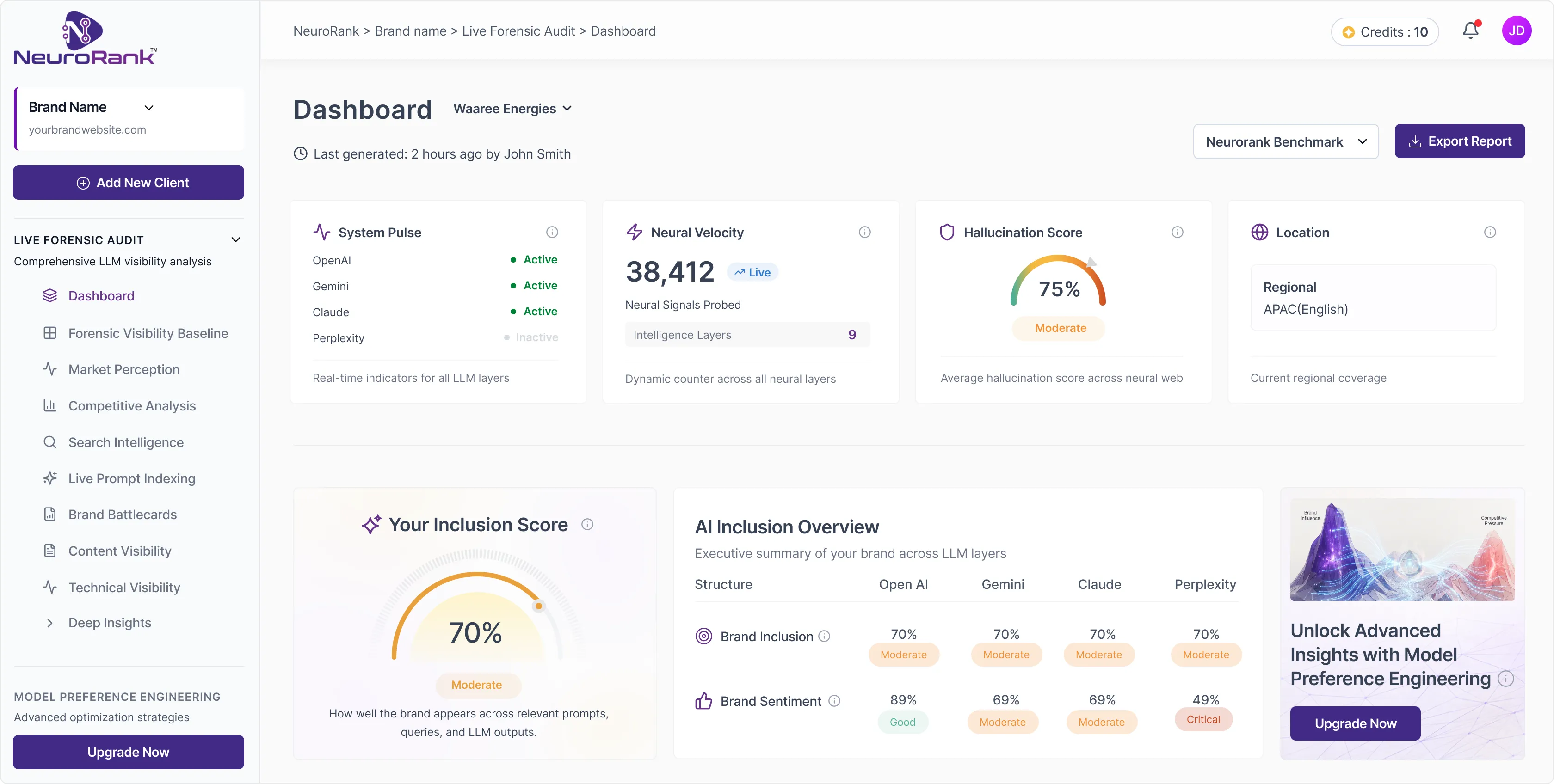
The $7 diagnostic reveals the extent of brand misrepresentation, technical and digital health in AI models. Our comprehensive Model Preference Engineering subscription suite provides the full stack to deconstruct visibility, diagnose technical infrastructure and content narratives required, and prescribe actions required to secure and optimize your brand’s AI presence.
Live Forensic Audit
Identify where AI models are misrepresenting your brand. This is the first step before entering full governance. Uncover misrepresentation through high-volume query simulation across global models. This 20-minute probe uses a fresh-token incognito methodology to eliminate session bias and identify technical failures.

Brand Overview
Perception, sentiment and trust signals

Search Intelligence
Real queries and prompts people ask.

Campaigns
Latest brand campaigns detected in AI Distribution

Live Prompt Indexing
Live AI output for brand prompts. Momentum & intelligence scoring

Technical Visibility
Audit: Brand’s digital technical health

Market Perception
Aided recall research techniques deployed to identify spontaneous awareness

Brand Battle Cards
Deep competitor comparison: based on 6 standard brand health metrics.

Deep Insights
Talk to your audit data.

Competitive Analysis
Unaided recall research and neuromarketing-based parameters

Content Visibility
Audit: Brand’s 14 digital technical health parameters
Brand Overview
Perception, sentiment and trust signals
Search Intelligence
Real queries and prompts people ask.
Campaigns
Latest brand campaigns detected in AI Distribution
Live Prompt Indexing
Live AI output for brand prompts. Momentum & intelligence scoring
Technical Visibility
Audit: Brand’s digital technical health
Market Perception
Aided recall research techniques deployed to identify spontaneous awareness
Brand Battle Cards
Deep competitor comparison: based on 6 standard brand health metrics.
Deep Insights
Talk to your audit data.
Competitive Analysis
Unaided recall research and neuromarketing-based parameters
Content Visibility
Audit: Brand’s 14 digital technical health parameters
Comprehensive AI Visibility Command Suite
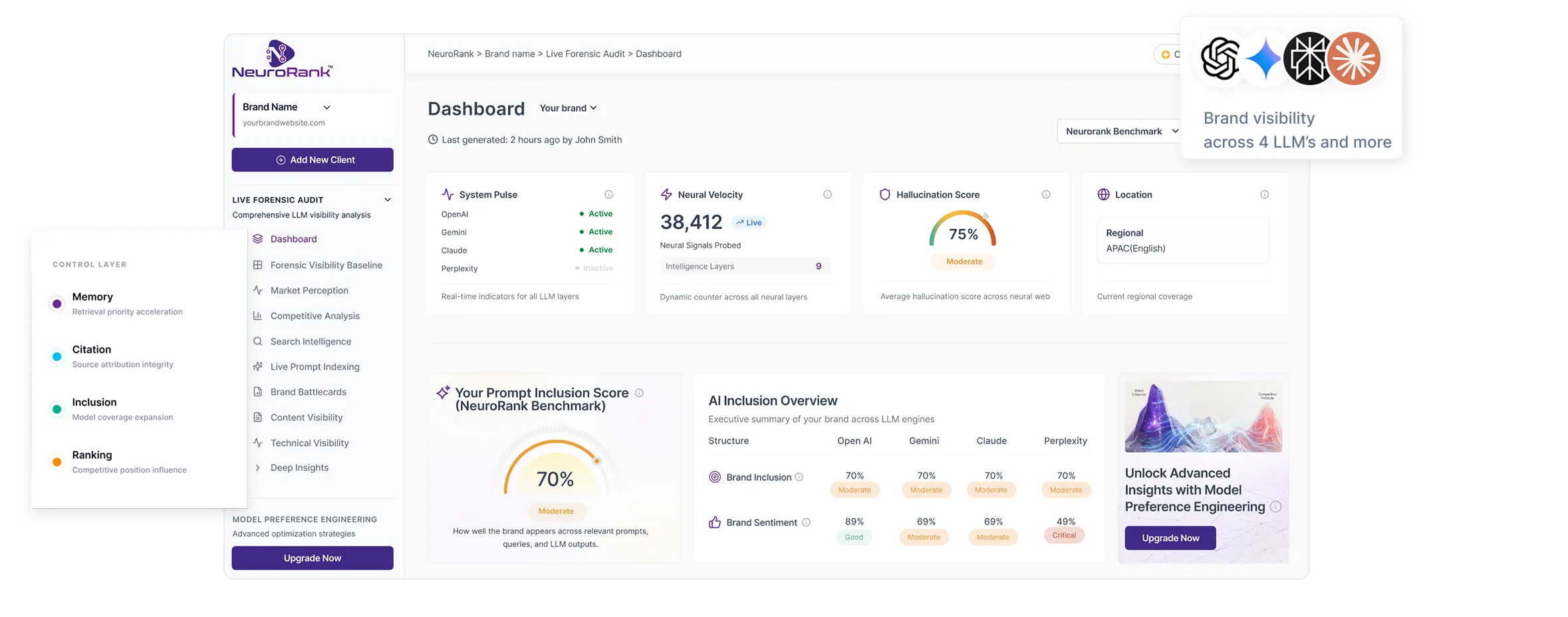
Customizable monthly subscription deconstructs how AI models represent your brand, diagnoses where your AI presence is broken, and prescribes exactly what to fix. Influences the RAG layer and accelerates AI memory. Tracks inclusion growth. Continuous conditioning, RAG layer management, and proactive brand security.
Strategic Visibility Protocol

Model Preference Engineering
Systematic prescriptions to influence how LLMs prioritize your brand weights in recommendation cycles.

Agent Intelligence
Diagnostic reporting for autonomous AI agents that serve as the primary interface for user decision-making.

Model Selection Audits
Continuous benchmarking across specialized models to identify and prescribe fixes for model-specific biases.

RAG Layer Control
Maintain authority over the retrieval layer. We ensure AI models prioritize your verified technical documentation as the primary source of truth.

Memory Acceleration
Minimize the propagation delay between content updates and AI recognition. Synchronize new narratives across LLM memory stores.

Citation Link Audits
Continuous monitoring and prescription of link structures to ensure AI citations provide direct attribution.

Inclusion Management
Drive brand visibility within high-intent AI recommendation cohorts. Monitor and expand your presence in automated decision-making cycles.

Risk Mitigation
24/7 technical oversight. Automated detection and correction protocols for hallucinations and hidden competitive conquesting.

Inclusion Benchmarking
Quarterly analysis of competitive inclusion trends to identify shifting model preferences in your industry sector.

Reporting Dashboards
Enterprise platform for real-time visibility monitoring, narrative health scores, and recommendation tracking.

Progress Reports
Monthly technical diagnostics and summaries tracking the prescription-to-outcome optimization cycle.
Practice Intelligence
Professional GEO
Practice Methodology
NeuroRank provides the foundational infrastructure for your GEO/LLMO practice. We replace the “Black Box” of AI search with a clear, audited methodology that allows teams to manage their AI presence with total visibility and controlled execution. We provide the visibility your team needs to stop operating in an environment they cannot control.
Performance Breakdown
Brands ahead of you
3
Gaps detected
5
Critical Issues
6
Aggregate LLM score vs top competitors
Aided and unaided brand recall methodologies
Deconstruct
We dismantle the LLM’s internal representation of your brand weights at a granular level. What are your users asking, where are they in the decision funnel, where is AI response and sentiment misaligned. Competition benchmarking.
Structured Roadmap
Eliminate the cost of
untrained experimentation.
Structured advisory hours embedded in every subscription to bridge the internal LLMO skills gap.
Stop wasted effort by replacing trial-and-error with a forensic technical roadmap. Establish a controlled governance environment where AI brand signals are verified.
Visibility trend - past 8 weeks (your brand vs Competitor A)
Strategic Authority
Eyes and guide map in an
uncontrolled environment.
Most brands operate in an environment they cannot control because their teams lack the diagnostic tools or an execution roadmap for the reasoning layer.
NeuroRank provides the visibility and governance protocols required to transform wasted effort into a strategic LLMO practice.
GEO practice maturity - brands over time
Enterprise Grade Institutional Authority
Defining the Automated
Standard for Professional Visibility
NeuroRank defines the automated standard for professional visibility. Forgoing a rushed entry into the market, the platform was refined through an exhaustive 8+ month cycle of live use-case testing following our June 2025 soft launch.
NeuroRank’s methodology has been stress-tested across 65 industries by 150+ brands, including large enterprises, mid-market leaders, and growth brands. Spanning Asia, Europe, the Middle East, the USA, and North America, and validated through individual feedback from over 150 leadership teams, NeuroRank stands as the most widely tested and operationally adapted intelligence tool in its category.
Your Brand
Diagnostic Score : 7/10

20+ Years Marketing Expertise
Two decades of consulting with the world’s largest global brands on visibility, narrative control, and market dominance.

Validated Global Scale
Stress-tested through 150+ leadership interviews and refined post-soft launch with 150+ brands across 65 industries.

ISO/IEC 27001 Certified
Adherence to the internationally recognized standard for Information Security Management Systems.

High-Volume Data Fidelity
Operations built on high-volume runs with 5,500+ prompt simulations per cluster using fresh-token methodology.

124+ International Awards
Product design led by a strategic leadership team recognized globally for excellence in brand visibility and marketing strategy.

Regional Market Fidelity
Precise diagnostics capturing regional AI logic variances across Asia, India, US, Gulf, and European markets.

Regional LLM Customization
Ability to customize specific coverage across Claude, Gemini, Perplexity, and OpenAI by geographic region.

Embedded Strategic Advisory
Core deliverable providing expert human oversight and toolkits to upskill internal teams and lead your GEO practice.

Independent Verification
Benchmarking and platform data verified against independent sources including G2 and SourceForge.
Widely Tested and Operationally Adapted Across 150+ Global Brands


Frequently asked questions
1. How does AI represent my brand?
-AI models synthesize answers from training data, indexed content, and retrieval sources. Your brand may be accurately described, partially represented, hallucinated with incorrect information, or omitted entirely. Different AI models often represent the same brand differently. NeuroRank’s Live Forensic Diagnostic probes ChatGPT, Gemini, Claude, and Perplexity simultaneously using fresh-token incognito methodology to surface exactly how AI represents your brand across all four models.
2. What is AI brand intelligence?
+AI brand intelligence is the practice of deconstructing, diagnosing, and governing how AI language models perceive and represent a brand. NeuroRank applies a five-stage methodology to AI brand intelligence: Deconstruct how AI models represent your brand at a granular level, Diagnose where your AI presence is broken, Prescribe exactly what to fix with technical roadmaps, Condition the RAG layer to accelerate AI memory, and Track inclusion growth and narrative health over time.
3. How do I check my brand’s AI presence?
+Initiate a Live Forensic Diagnostic on NeuroRank. Enter your brand name, company, website URL, YouTube channel, and region. NeuroRank’s marketing agent reads your brand, then probes ChatGPT, Gemini, Claude, and Perplexity simultaneously. A 10-section intelligence briefing is delivered in 12 to 20 minutes covering brand perception, competitive positioning, search intelligence, prompt inclusion, content visibility, and technical health. The compute fee is $7. This is the start point, to get a detailed intelligence and governance start the Model Preference Engineering which will enable you to deconstruct in-depth Ai visibility, diagnose deep issues, prescribe corrections, condition the RAG layer, and track improvements.
4. What is an LLMO intelligence platform?
+LLMO (Large Language Model Optimization) is the practice of engineering how AI models perceive, cite, and recommend brands. An LLMO intelligence platform provides the diagnostic and governance layer for this practice. NeuroRank is an LLMO intelligence platform that deconstructs how AI models represent your brand, diagnoses misrepresentation and competitive displacement, prescribes corrections with technical roadmaps, and governs visibility through continuous Model Preference Engineering including RAG layer control, memory acceleration, and citation audits.
5. Is NeuroRank a patent-pending AI visibility platform?
+Yes. NeuroRank is a patent-pending AI visibility intelligence platform built by Pulp Strategy Communications Pvt. Ltd. The company is ISO/IEC 27001 certified. NeuroRank’s methodology has been stress-tested across 65 industries by 150+ brands and validated through feedback from over 150 leadership teams across Asia, Europe, the Middle East, and North America.
6. How is NeuroRank different from AI visibility monitoring tools?
+Unlike monitoring tools that track surface-level AI mentions, NeuroRank deconstructs the structural causes of AI misrepresentation. The platform applies aided and unaided recall research methodologies to the AI reasoning layer, diagnoses competitive displacement by geography, and prescribes technical roadmaps for Knowledge Graph and RAG reclamation. NeuroRank provides governance protocols where AI brand signals are verified through a Maker-Checker framework before any action is taken.